The Real Risk of Chicago Knob and Tube Wiring — and What to Do About It
If your home has Chicago knob and tube wiring, here’s what you need to know right away:
- It’s outdated. Knob and tube was installed from the 1880s through the 1940s — and many Chicago homes still have it.
- It’s ungrounded. No third wire means no protection against electrical faults.
- It may affect your insurance. Many carriers will raise premiums or deny coverage outright.
- It often can’t handle modern loads. Today’s appliances, devices, and circuits demand far more than this old system was designed for.
- Replacement is the safest long-term solution. A licensed Chicago electrician can assess your system and map out a rewiring plan.
Chicago’s older housing stock — the bungalows, two-flats, and greystones built before World War II — is full of character. But behind those plaster walls, many of these homes are still running on electrical systems that were never designed for 2026 living.
Knob and tube wiring was once considered state-of-the-art. Today, it’s a known fire hazard, an insurance liability, and a red flag for home buyers. The cloth insulation becomes brittle with age. There’s no grounding wire. And decades of DIY modifications often made things worse, not better.
This guide is written to help you understand exactly what you’re dealing with — and how to find the right electrician in Chicago to fix it safely.
I’m Michał Napieralski, and through Energy Co., I’ve helped homeowners across the Chicago suburbs identify and replace dangerous Chicago knob and tube wiring with safe, code-compliant modern systems. In the sections below, I’ll walk you through everything you need to know — from spotting the wiring to understanding your replacement options.
Chicago Knob and Tube: What It Is and Why It’s Still Found in Older Homes
To understand chicago knob and tube, we have to take a trip back in time. From the late 1880s through the 1940s, this was the gold standard for residential electrification. While it remained in use in some parts of the world until the 1960s, most Chicago homes built during the Great Depression or earlier were originally wired this way.
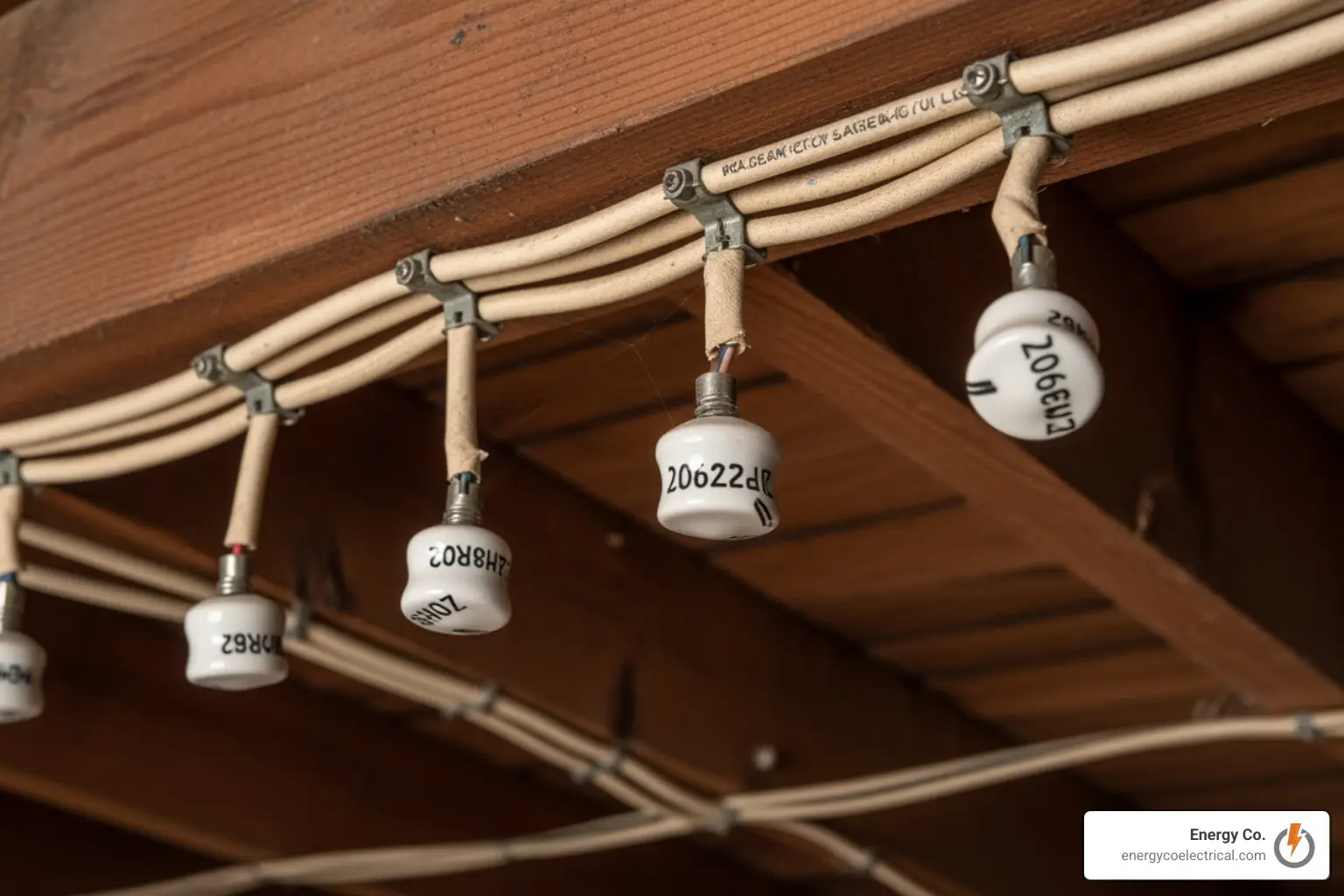
At its core, Knob-and-tube wiring consists of single-insulated copper conductors run within wall or ceiling cavities. It gets its name from the porcelain “knobs” used to support the wire and the porcelain “tubes” used to protect the wire as it passes through wooden joists or studs.
How knob and tube wiring works
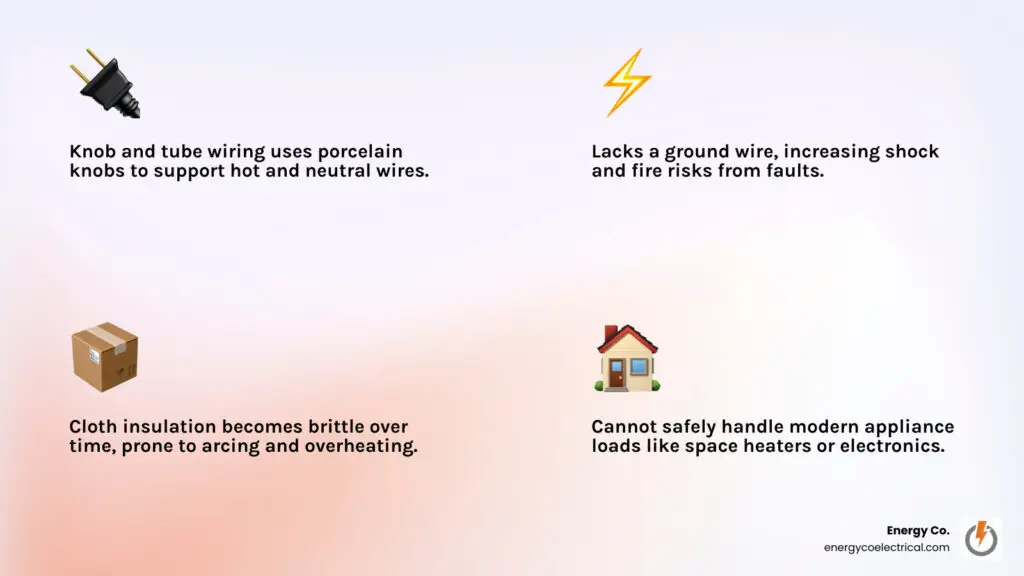
Unlike modern Romex cables, which bundle three wires (hot, neutral, and ground) into one plastic sleeve, knob and tube uses two separate wires: a hot and a neutral. These wires are spaced several inches apart to allow heat to dissipate into the surrounding “open air.”
The system relies on:
- Ceramic Knobs: These act as anchors, keeping the wire under tension and away from the wood.
- Ceramic Tubes: These are inserted into holes drilled through joists to prevent the wire from rubbing against the wood.
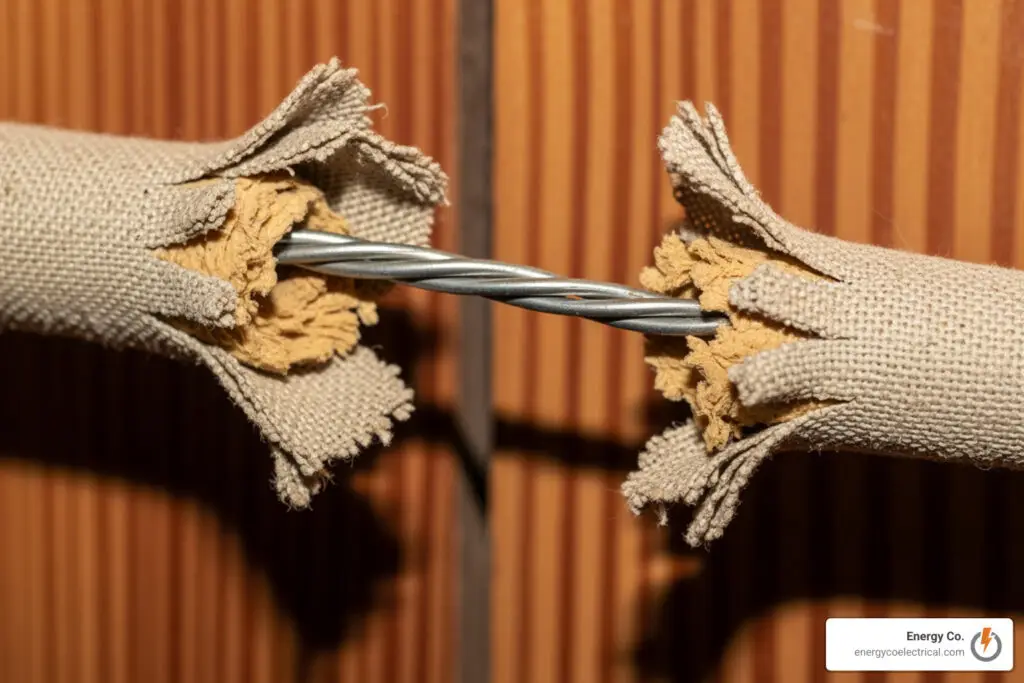
- Cloth Insulation: The copper wire is wrapped in a rubberized cloth or asphalt-soaked cotton.
- No Ground Wire: This is the most critical difference. There is no third wire to provide a safe path for “stray” electricity, which is why these systems use two-prong outlets.
Why Chicago homes commonly used knob and tube
Chicago saw a massive building boom in the early 20th century. Neighborhoods like Cicero, Arlington Heights, and the city’s historic bungalow belts were built during the height of the knob and tube era. At the time, electricity was primarily used for a few light bulbs and perhaps a radio. The “open-air” design was actually quite clever for the low-demand needs of a 1920s household. Because Chicago has such a dense stock of pre-war housing, we see these systems more often than almost any other city in the Midwest.
Why old systems struggle with modern power demands
The problem is that the world has changed, but the wiring hasn’t. In May 2026, the average Chicago household is running high-definition TVs, powerful microwave ovens, space heaters, and high-end gaming computers.
Knob and tube systems are often protected by 15-amp fuses. When homeowners find these fuses blowing constantly, they sometimes make the dangerous mistake of installing a larger fuse. This forces the old, thin wire to carry more current than it was ever designed for, leading to overheating and potential fires. Furthermore, modern electronics often require a ground connection to protect sensitive circuits—a feature chicago knob and tube simply does not have.
Safety Risks Every Homeowner Should Know About chicago knob and tube
Electrical wiring is not a hobby, and it’s certainly not something to ignore when it gets old. The primary danger of chicago knob and tube isn’t just its age; it’s how it interacts with modern home improvements.
The biggest dangers behind chicago knob and tube
- Brittle Insulation: Over 80 to 100 years, the rubberized cloth insulation becomes bone-dry and brittle. If you touch it, it often crumbles away like a dry cracker, leaving bare, energized copper wire exposed inside your walls.
- Lack of Grounding: Without a ground wire, a short circuit has nowhere to go but through your appliances—or through you. This increases the risk of electrical shocks and can destroy expensive electronics.
- The Insulation Trap: Knob and tube wiring must have air space to stay cool. Many Chicago homeowners have added blown-in attic insulation to save on heating bills. When you cover knob and tube with insulation, the heat can’t escape, which can lead to a fire.
- Improper Modifications: Over the decades, “handyman” repairs often spliced modern wire into the old system. These “spiderweb” connections are frequently loose and hidden behind walls, creating major arcing hazards.
Is knob and tube wiring up to current Chicago electrical codes?
Technically, knob and tube wiring is “grandfathered” in, meaning it isn’t illegal to have it in your home if it was installed when it was the standard. However, it does not meet modern Chicago electrical codes for new construction or major renovations.
Any time you pull a permit for a significant remodel in Chicago or suburbs like Hoffman Estates, the building inspector will likely require you to update the wiring in that area to modern standards. Furthermore, the National Electrical Code (NEC) specifically prohibits surrounding active knob and tube with thermal insulation.
Top warning signs it’s time for replacement
If you notice any of the following, your old wiring is likely crying for help:
- Flickering Lights: This often indicates a loose connection or an overloaded circuit.
- Warm Outlets or Switch Plates: A clear sign of overheating behind the wall.
- The “Burning” Smell: An unmistakable ozone or plastic-burning scent.
- Sizzling or Popping Sounds: This is the sound of electricity “arcing” or jumping across a gap.
- Frequent Blown Fuses: Your system is telling you it can’t handle the load.
- Two-Prong Outlets: If you can’t plug in a modern laptop charger without an adapter, you’re likely on an ungrounded system.
How to Identify Knob and Tube Wiring in a Chicago Home
You don’t always need to tear down drywall to see if you have chicago knob and tube. Most of the time, the evidence is hiding in plain sight in the “unfinished” parts of your home.
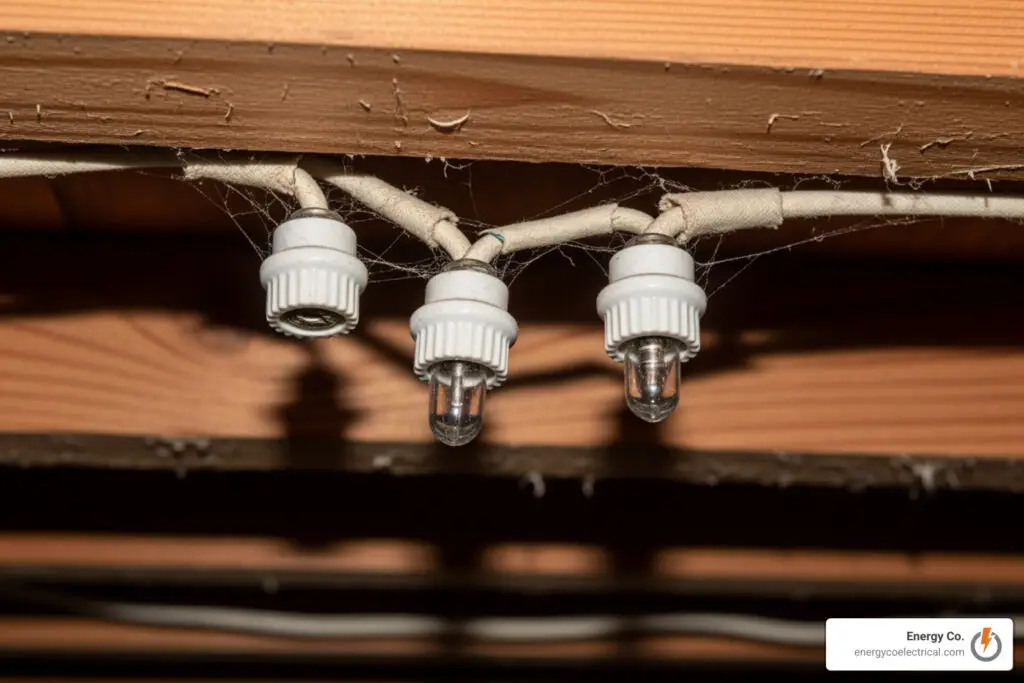
Where chicago knob and tube is usually found
- The Basement: Look up at the ceiling joists. You’ll see white porcelain cylinders (tubes) passing through the wood or white porcelain spools (knobs) with wires wrapped around them.
- The Attic: If you can see the floor joists under the insulation, look for the same porcelain fixtures. Be very careful not to step on or touch the wires!
- The Service Panel: Older homes may still have a fuse box with “screw-in” glass fuses rather than a modern circuit breaker panel. This is a huge indicator that the rest of the house uses legacy wiring.
What homeowners can safely check before calling an electrician
Before you call us for a Residential Electrical Services consultation, you can do a quick walk-through. Check your outlets. Are they all two-prong? If someone has installed three-prong outlets, use a simple $10 outlet tester (available at any hardware store in Palatine or Schaumburg) to see if they are actually grounded. If the tester shows “No Ground,” you likely have knob and tube hiding behind the wall.
When a professional inspection is the smarter move
While DIY identification is a good start, a professional can tell you if the system is “active.” Sometimes, old knobs are left in place but the wires have been cut. We use specialized non-contact voltage testers and thermal imaging to see what’s happening behind your plaster walls. If you’re experiencing recurring issues, it might be time for Circuit Breaker Repair or a full system evaluation.
Replacement Options, Costs, and the Rewiring Process in Chicago
Replacing chicago knob and tube is a significant project, but it’s one of the best investments you can make in your home’s safety and longevity.
How much it costs to replace knob and tube wiring in Chicago
We get asked this constantly. The truth is, there is no “flat fee” because every Chicago home is unique. However, costs are generally influenced by:
- Square Footage: A two-story home in Mount Prospect will cost more than a small bungalow in Rolling Meadows.
- Wall Material: Plaster and lath walls (common in old Chicago homes) are much harder to work with than modern drywall.
- Accessibility: Is there a crawlspace? Is the attic finished?
- Panel Status: Often, a Electrical Panel Upgrade is required to handle the new modern circuits.
On average, a full whole-house rewiring in the Chicago area can range from $8,000 to $20,000+, depending on the complexity. While this sounds high, it is a one-time cost that lasts for 50+ years.
| Feature | Partial Rewiring | Full Rewiring |
|---|---|---|
| Safety Level | Moderate | High (Maximum) |
| Code Compliance | Partial | Full |
| Grounding | Only in new sections | Entire Home |
| Insurance Impact | May still face high premiums | Generally lowers premiums |
| Home Value | Slight Increase | Significant Increase |
What the replacement process looks like step by step
- The Walk-Through: We meet with you to map out every outlet, switch, and fixture.
- Permitting: We handle the paperwork with your local municipality (like Elk Grove Village or Roselle).
- The “Fishing” Phase: Our experts use specialized tools to “fish” new copper wires through your walls with minimal damage to your plaster.
- Device Installation: We install new, grounded three-prong outlets, switches, and GFCI protection in kitchens and baths.
- The Final Connection: We move everything over to a new, modern circuit breaker panel.
- Inspection: A city inspector verifies that everything is up to the 2026 electrical code.
Can knob and tube be modified or partially upgraded?
We generally advise against “patching” knob and tube. While you can technically add a GFCI outlet to an ungrounded circuit to provide some shock protection, it doesn’t solve the issue of brittle insulation or fire risk. Industry experts also note that partial replacements often lead to “mixed” systems that are confusing and potentially dangerous for future owners.
Why hiring a licensed Chicago electrician matters
Chicago has some of the strictest electrical codes in the country (including the famous requirement for metal conduit in many applications). Hiring a specialist from Energy Co. ensures that your home isn’t just “working,” but is legally compliant and safe for your family.
Insurance, Resale Value, and Local Next Steps for Homeowners
Beyond safety, chicago knob and tube is a financial issue.
Does knob and tube wiring affect home insurance in Chicago?
Yes, significantly. In 2026, many insurance carriers view knob and tube as an “unacceptable risk.” If they find out your home has it, they may:
- Refuse to issue a new policy.
- Cancel your existing policy upon renewal.
- Charge a “high-risk” premium that costs thousands more per year.
Most carriers will require a certification from a licensed electrician stating that the knob and tube has been replaced or at least inspected and deemed safe (though few electricians will sign off on the latter).
How outdated wiring impacts buying or selling a home
If you are selling a home in Arlington Heights or Chicago, the buyer’s inspector will find the knob and tube. This often leads to:
- Negotiation Deadlocks: Buyers may demand a $15,000 credit to cover the rewiring.
- Lender Refusal: Some FHA or VA loans will not close until the electrical system is modernized.
- Lower Appraisal: Your home value is directly tied to the integrity of its core systems.
What to do if you suspect a problem today
If you see sparks, smell burning, or are tired of your fuses blowing, don’t wait.
- Stop DIY Repairs: Don’t try to “fix” old cloth wiring with electrical tape.
- Unplug High-Draw Appliances: Move your portable AC or space heater to a newer circuit if possible.
- Schedule an Inspection: Contact us for Emergency Electrical Services if you have active sizzling or smells.
- Get a Quote: Knowledge is power. Knowing the cost of a Electrical Panel Upgrade and rewiring helps you plan for the future.
Frequently Asked Questions About Chicago Knob and Tube
Is it always necessary to remove all knob and tube wiring?
While “abandoning” the wires (cutting them and leaving them dead in the wall) is common, they should never remain active if you want a truly safe home. If you are doing a renovation, that is the perfect time to pull them out entirely.
Are three-prong outlets proof that an old system is grounded?
Absolutely not. This is a common “trick” used by unscrupulous flippers. They replace the two-prong outlet with a three-prong one but don’t actually connect a ground wire. This is incredibly dangerous because it gives a false sense of security. Always test your outlets!
Are there local Chicago regulations or incentives for rewiring?
While there aren’t many direct “rebates” for rewiring, many homeowners find that the savings on their insurance premiums help pay for the project over time. Additionally, upgrading your panel often allows you to take advantage of federal tax credits for energy-efficient upgrades like EV chargers or heat pumps. For more localized advice, contact us directly.
Conclusion
Living in a historic Chicago home is a point of pride, but it comes with the responsibility of maintaining its “bones.” Chicago knob and tube wiring was a marvel of the 19th century, but it has no place in a 2026 household. By upgrading to a modern, grounded system, you protect your family from fire, secure your home’s insurance eligibility, and significantly increase your property value.
At Energy Co., we specialize in navigating the tight spaces and delicate plaster of Chicago’s older buildings. We provide clear communication, licensed expertise, and a satisfaction guarantee that ensures your home’s electrical system will be safe for the next hundred years.
Ready to bring your home into the 21st century? Contact Us today to schedule a comprehensive electrical safety inspection. You can also Learn more about Energy Co. and our commitment to keeping Chicagoland powered safely. From Our Services to our emergency response, we are here to ensure you never have to “blow a fuse” over your wiring again.