
What Chicago Tenants and Landlords Need to Know About Electrical Repairs in 2026
Landlord electrical repairs Chicago rules are clear: under the Chicago Residential Landlord and Tenant Ordinance (RLTO), landlords must maintain safe, functional electrical systems in all covered rental units.
Here’s a quick overview of your key rights and timelines:
| Situation | Required Action | Timeframe |
|---|---|---|
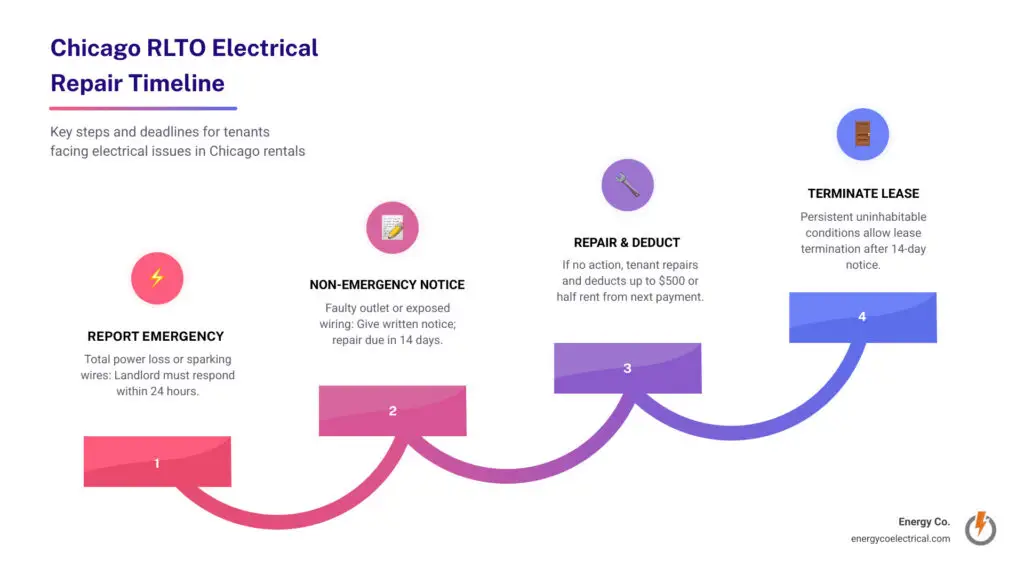
| Total power loss or electrical emergency | Landlord must respond | Within 24-72 hours |
| Non-emergency defect (faulty outlet, exposed wiring) | Landlord must repair after written notice | Within 14 days |
| Landlord fails to act on non-emergency | Tenant may repair and deduct | Up to $500 or half monthly rent (whichever is greater) |
| Landlord fails to restore essential services | Tenant may procure substitute service and deduct cost | After written notice |
| Uninhabitable conditions persist | Tenant may terminate lease | After 14-day written notice |
Electricity is classified as an essential service under the RLTO. That means losing power isn’t just an inconvenience — it’s a legal violation that triggers specific landlord obligations and tenant remedies.
Chicago’s rental housing stock is dominated by older buildings — greystones, two-flats, and vintage six-flats — where aging wiring, outdated panels, and overloaded circuits are common. Knowing your rights before a problem escalates can save you time, money, and stress.
I’m Michał Napieralski, a licensed electrician with years of hands-on experience diagnosing and resolving the exact electrical issues that come up in Chicago rental properties, making me well-versed in the practical side of landlord electrical repairs Chicago compliance. In the sections below, I’ll walk you through everything you need to know — from emergency response rules to the repair-and-deduct process — so you can act with confidence.
Understanding Landlord Electrical Repairs Chicago Requirements Under the RLTO
When you sign a lease in Chicago, you aren’t just paying for four walls and a roof; you are paying for a space that meets the minimum standards of “habitability.” As of April 2026, the Chicago Residential Landlord Tenant Ordinance (RLTO) remains the gold standard for tenant protections in the Midwest. It mandates that landlords keep the property in compliance with the Chicago Municipal Code.
What Are Landlords Legally Required to Maintain?
According to the guide on Are Landlords Legally Required to Make Repairs?, the answer is a resounding yes. In the context of electrical systems, this includes:
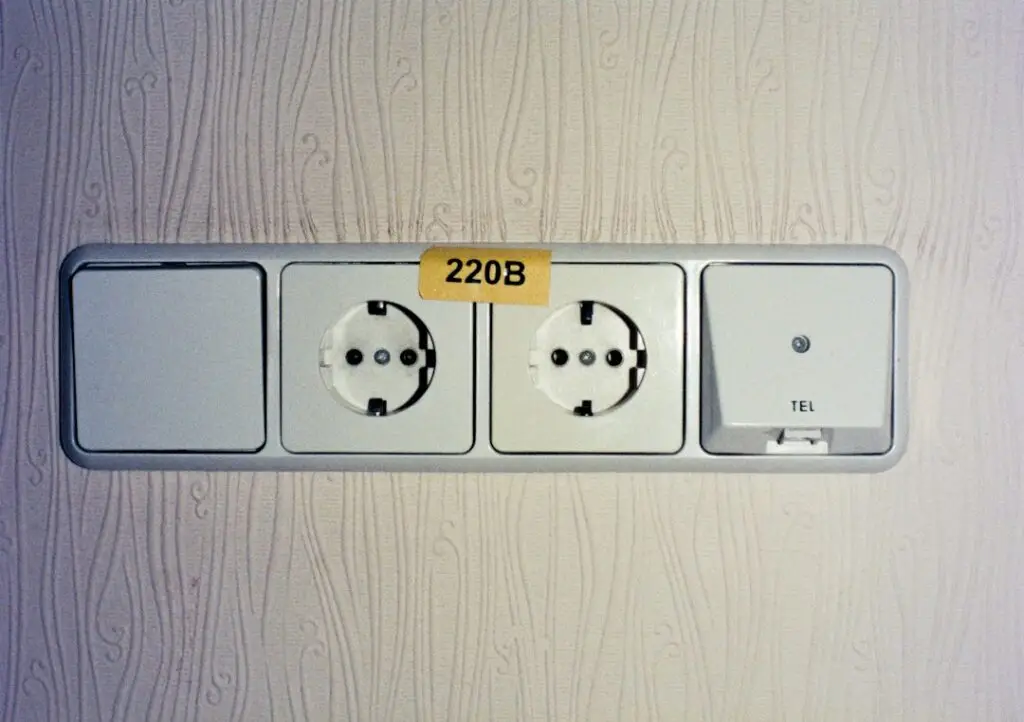
- Safe and Operable Outlets: Every room must have a sufficient number of outlets that are properly grounded and not posing a fire risk.
- Functional Light Fixtures: Permanent fixtures in hallways, bathrooms, and kitchens must work correctly.
- Code Compliance: The wiring must be able to handle the load of modern appliances without constantly tripping breakers.
We often see vintage buildings in neighborhoods like Belmont Cragin or Norwood Park that still utilize “knob and tube” wiring or outdated fuse boxes. While these systems were standard decades ago, they often struggle to meet current safety codes. Our Residential Electrical Services often involve helping property owners bring these older systems up to modern standards to ensure they stay on the right side of the law.
The Six-Unit Rule: Does the RLTO Apply to You?
It is a common misconception that the RLTO applies to every single apartment in the city. There is a major exception: owner-occupied buildings with six or fewer units. If you live in a coach house behind a landlord’s primary residence, or a three-flat where the owner lives on the first floor, you may not be protected by the RLTO’s specific timelines and “repair and deduct” remedies. In those cases, you fall under general Illinois state law, which is significantly less tenant-friendly.
Identifying Electrical Emergencies and Essential Service Failures
Not every flickering bulb is an emergency, but when electricity fails, the clock starts ticking fast. The RLTO classifies electricity as an “essential service.” If your landlord fails to provide it, they are in “material non-compliance” with the lease.
What Qualifies as an Electrical Emergency?
In our experience providing Emergency Electrical Services, an emergency usually involves one of the following:
- Total Power Loss: Not caused by the utility company (ComEd).
- Exposed Wiring: Live wires that pose an immediate shock or fire hazard.
- Sparking or Burning Smells: Clear signs of an impending electrical fire.
- No Heat (Winter Months): Since most furnaces require electricity to run the blower motor, an electrical failure between September 15 and June 1 that results in temperatures dropping below 68°F (daytime) or 66°F (nighttime) is a critical emergency.
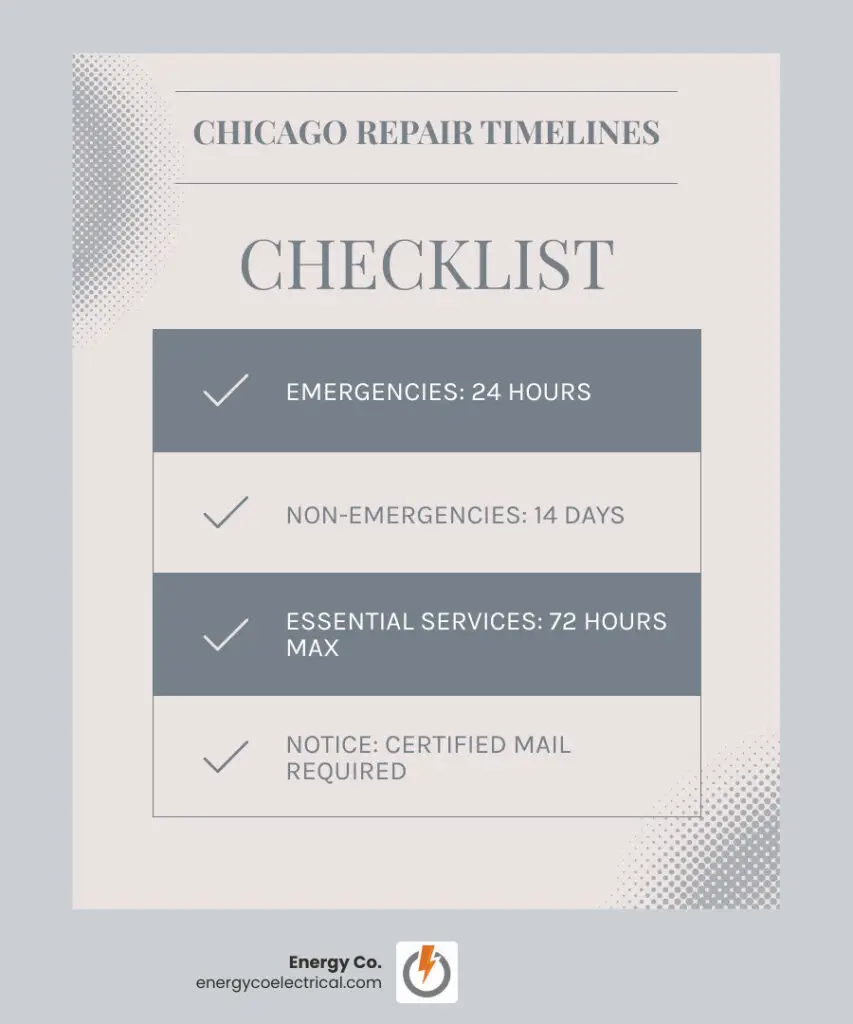
Under the Understanding Essential Services: Electricity Rights for Tenants in Chicago guide, landlords generally have a 24 to 72-hour window to address these issues after receiving written notice. If the issue isn’t fixed within 24 hours, you can begin pursuing “substitute services.”
Immediate Action for Landlord Electrical Repairs Chicago Emergencies
If you are facing a total blackout or a dangerous hazard:
- Notify the Landlord Immediately: While a phone call is great for speed, follow it up immediately with a text or email to create a paper trail.
- Procure Substitute Services: If the landlord fails to act within 24 hours, you can pay for a temporary fix or even a hotel (within reason) and deduct those costs from your rent.
- Call 311: Reporting the issue to the City of Chicago Department of Buildings can trigger an official inspection.
- Request Professional Help: If you see sparks or smell smoke, don’t wait for the landlord to “find a guy.” Contact a pro for Circuit Breaker Repair or emergency troubleshooting.
The “Repair and Deduct” Process for Non-Emergency Issues
For non-emergencies—like a dead outlet in the bedroom or a faulty light switch—the process is a bit slower but very effective. This is known as the “repair and deduct” remedy.
The 14-Day Rule
To legally use the repair and deduct remedy, you must follow these steps precisely:
- Written Notice: You must send a formal letter to your landlord. We highly recommend using Certified Mail with a Return Receipt. This is your “proof of service.”
- The Waiting Period: You must give the landlord 14 days from the date they receive the notice to make the repair.
- Hire a Licensed Pro: If the 14 days pass and the work isn’t done, you can hire your own electrician. The work must be done by a licensed professional (like our team at Energy Co.) in a “workmanlike manner” that complies with the building code.
- Submit the Bill: After the work is finished, give your landlord a copy of the paid invoice and deduct that amount from your next rent check.
Legal Limits on Landlord Electrical Repairs Chicago Deductions
There are strict financial caps on this remedy. According to the Apartment Conditions & Repair resources, the deduction is limited to $500 or half of your monthly rent, whichever is greater.
For example, if your rent is $2,000, you can deduct up to $1,000 for an Electrical Panel Upgrade or complex rewiring. However, you cannot deduct for repairs if the damage was caused by your own negligence (like overloading a circuit with a space heater and melting the outlet).
Tenant Remedies and Legal Protections in Chicago
What if the landlord just refuses to fix a major issue that makes the apartment unlivable? Chicago tenants have some of the strongest protections in the country, but you have to play by the rules to avoid eviction.
Rent Withholding vs. Lease Termination
If the electrical issues are so severe that the unit is “not reasonably fit and habitable,” you have two main paths:
- Rent Withholding: You can withhold a portion of your rent that reflects the “diminished value” of the apartment. Warning: This is risky. If you withhold too much, the landlord may sue for eviction. We always suggest consulting a lawyer or a tenant advocacy group before choosing this path.
- Lease Termination: If a major electrical problem isn’t fixed within 14 days of written notice, you can terminate your lease. You then have 30 days to move out, and the landlord must return your security deposit and any prepaid rent.
The Landlord Retaliation Act
A major fear for many tenants is that the landlord will kick them out for complaining. Fortunately, the RLTO includes a “retaliation” clause. If a landlord tries to evict you, increase your rent, or decrease services within a year of you making a formal repair request, the law presumes they are retaliating. In Chicago, this can lead to the landlord owing you money for damages plus your attorney’s fees.
You can view our full range of Our Services to see what kind of professional documentation we can provide to help substantiate your claims during a dispute.
Frequently Asked Questions about Chicago Rental Repairs
Can my landlord charge me for electrical repairs?
Generally, no—landlords are responsible for the “wear and tear” of the building’s systems. However, under RLTO Section 5-12-040, tenants must “reasonably use” electrical facilities. If you deliberately damage a panel or cause a fire through gross negligence, the landlord can perform the repair and bill you for it. They must provide you with a 14-day notice before entering to fix non-emergency tenant-caused damage.
Does the RLTO apply to all Chicago apartments?
No. As mentioned earlier, it doesn’t apply to owner-occupied buildings with six units or less. It also typically excludes:
- Hotels or motels (unless you’ve stayed more than 32 days).
- Hospital rooms or school dormitories.
- Employee housing (where the unit is part of your compensation).
- Co-ops where the tenant is a shareholder.
What documentation do I need for a repair dispute?
In landlord electrical repairs Chicago disputes, documentation is your best friend. You should keep:
- Dated Photos/Videos: Show the sparks, the dead outlets, or the “no power” state of your appliances.
- Certified Mail Receipts: Proof that the landlord received your 14-day notice.
- Written Communication: Save every text and email.
- Contractor Estimates: Even if you don’t go through with the repair-and-deduct, having an estimate from a licensed pro proves the issue was real.
If you need a professional assessment of your rental’s electrical safety, Contact Us for an inspection.
Conclusion
Navigating landlord electrical repairs Chicago doesn’t have to be a nightmare. Whether you are a tenant dealing with a negligent landlord or a property owner trying to keep your building safe and code-compliant, the RLTO provides a clear (if sometimes strict) roadmap.
At Energy Co., we specialize in the unique challenges of Chicago’s older buildings. From the greystones of Logan Square to the bungalows of Norwood Park, we know how to fix outdated wiring and upgrade panels safely and efficiently. We are licensed, insured, and committed to a satisfaction guarantee.
Don’t let electrical hazards put your safety or your lease at risk. Explore Our Professional Electrical Services today and let our local experts handle the heavy lifting. Whether it’s a 24/7 emergency or a standard 14-day repair-and-deduct job, we’re here to help Chicagoland stay powered up and protected.