Why Commercial Wiring Is the Foundation of Every Safe, High-Performing Business
Commercial wiring is the complete electrical system that distributes power throughout a non-residential building — from the service entrance, through panelboards and feeders, all the way to individual branch circuits powering lights, HVAC, equipment, and data systems.
Here’s a quick overview of what that means in practice:
| What It Covers | Examples |
|---|---|
| Power distribution | Service entrance, panels, feeders, branch circuits |
| Building types | Offices, warehouses, hospitals, retail, manufacturing |
| Wiring methods | EMT conduit, MC cable, busways |
| Key standards | NEC (NFPA 70), OSHA, local building codes |
| Voltage systems | 120/208V or 277/480V three-phase |
Getting it right matters — a lot. Commercial buildings account for roughly 36% of total U.S. electricity consumption, and faulty electrical wiring contributes to more than 20% of commercial structure fires. At the same time, a well-designed and properly maintained system can cut energy costs by 15–30% and prevent the majority of costly electrical failures and downtime.
Whether you’re building from scratch, upgrading an aging system, or troubleshooting a problem in an older Chicago-area space, understanding how commercial wiring works helps you make better decisions — faster.
I’m Michał Napieralski, and through my work at Energy Co. serving businesses across the Chicago suburbs, I’ve designed and installed commercial wiring systems in everything from small retail buildouts to large-scale industrial facilities. This guide pulls from that hands-on experience to give you a practical, complete picture of commercial electrical systems.
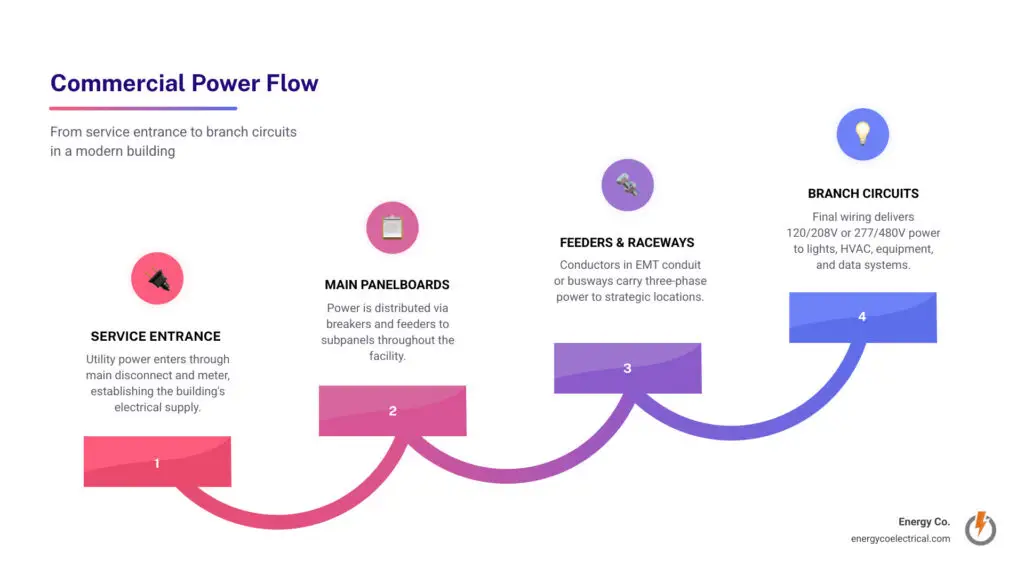
What Commercial Wiring Is and Why It Matters
When we talk about commercial wiring, we aren’t just talking about a few extra outlets. These systems are the “lifeblood” of a business. In May 2026, as businesses in Chicagoland integrate more automation and high-speed data than ever before, the demand on these systems is at an all-time high.
What Is commercial wiring?
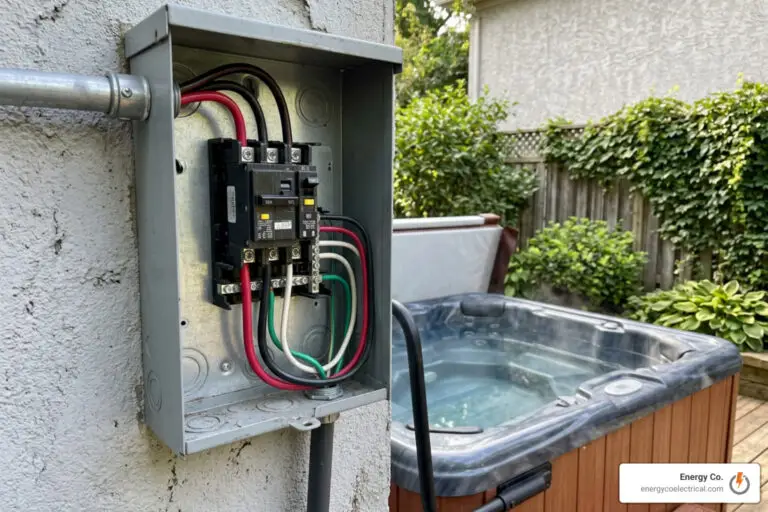
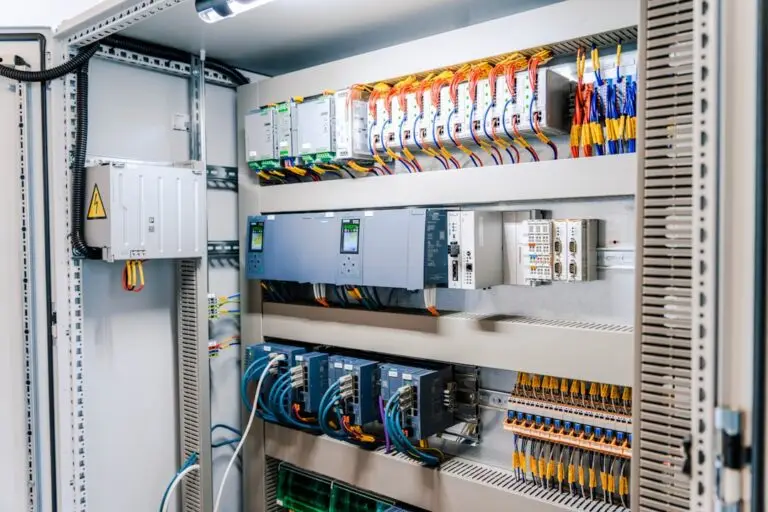
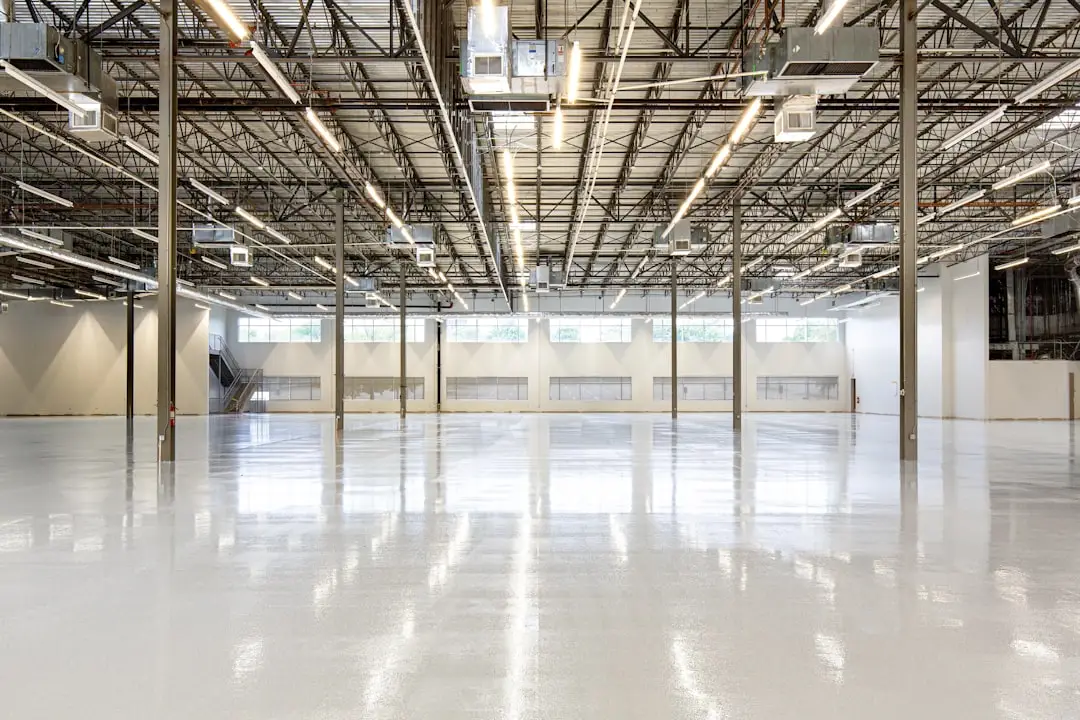
At its core, commercial wiring refers to the complex network of electrical systems used to distribute power in buildings like offices, warehouses, hospitals, and manufacturing plants. Unlike a house, where you might just have one main panel and some plastic-sheathed cable, a commercial system involves heavy-duty conductors, large distribution panels (switchgear), feeders, and specialized branch circuits. It supports everything from standard lighting to massive HVAC units and sensitive server rooms.
Why commercial wiring is critical for safety and performance
Reliability isn’t just a “nice to have”—it’s a requirement. Statistics show that faulty wiring causes over 20% of commercial fires. By ensuring your system is up to code, you aren’t just protecting your inventory; you’re protecting your people.
Beyond safety, a high-quality installation offers:
- Energy Efficiency: Modern systems can reduce energy bills by 15-30% through better load management.
- Scalability: A well-planned system allows you to add new machinery or workstations without gutting the building.
- Uptime: Upgrading outdated panels can prevent up to 70% of system failures that lead to expensive downtime.
Commercial wiring vs. residential wiring
The biggest difference is “The Three-Phase Factor.” Most homes use single-phase 120/240V power. Commercial buildings, however, typically use three-phase power (either 120/208V or 277/480V).
Three-phase systems are up to 40% more efficient at delivering power to high-load equipment. Furthermore, while residential wiring often uses flexible plastic-sheathed (NM) cable hidden in wooden studs, commercial wiring almost always requires metal conduit or armored cable to protect against physical damage and fire in high-traffic environments.
Main Commercial Wiring Methods Used in Buildings
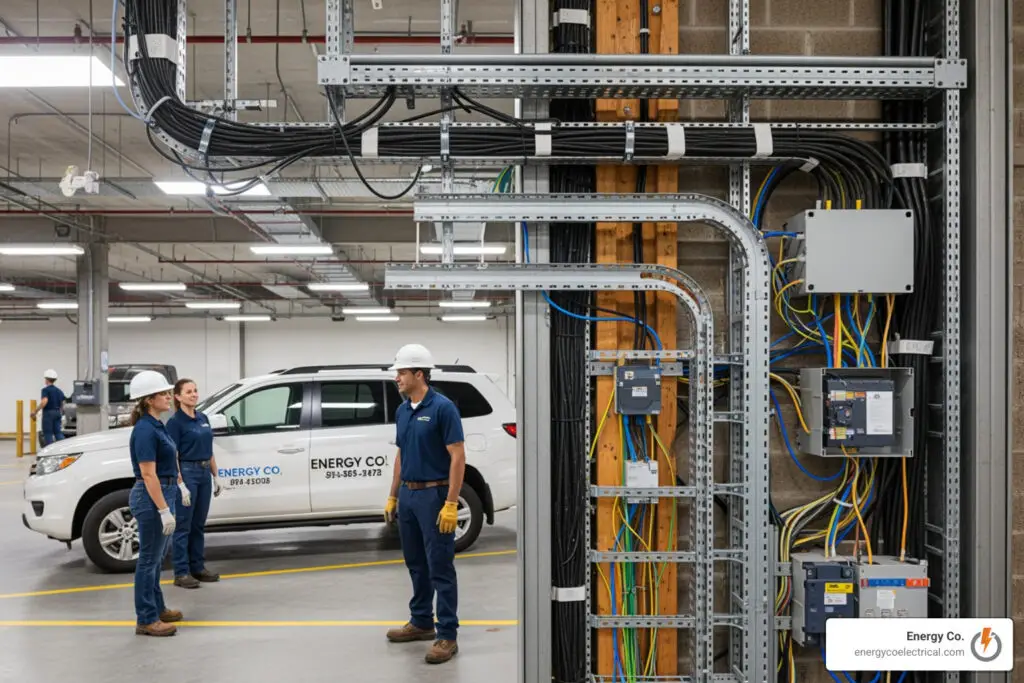
In the commercial world, we don’t just “run wires.” We use specific methods designed for protection, longevity, and ease of modification.
Electrical raceways for commercial wiring
A raceway is essentially a “highway” for your wires. The most common type is EMT (Electrical Metallic Tubing), often called thin-wall conduit. It’s popular because it’s lightweight yet offers great protection. For heavier industrial use, we might use RMC (Rigid Metal Conduit) or IMC (Intermediate Metal Conduit). The beauty of raceways is that we can pull new wires through them later without tearing down walls—perfect for evolving retail or office spaces.
Busways and bus ducts for high-capacity distribution
Think of a busway as a high-capacity “power bar” for an entire building. Instead of bundles of individual wires, a busway uses solid metal bars (copper or aluminum) inside a protective enclosure. These systems can handle anywhere from 60 to 4,000 amps. They are common in data centers and manufacturing plants where you need to “plug in” heavy machinery at various points along a line.
Cable assemblies in commercial buildings
MC (Metal-Clad) cable is a staple in modern commercial construction. It consists of factory-tested insulated wires wrapped in a flexible metal spiral. Because it’s pre-assembled, it allows for much faster installation than traditional conduit, making it a favorite for warehouses and branch circuits in office tenant improvements.
How raceways, busways, and cable assemblies differ
| Feature | Raceways (Conduit) | Busways (Bus Duct) | Cable Assemblies (MC) |
|---|---|---|---|
| Protection | Very High | High | Moderate |
| Install Speed | Slower | Moderate | Fast |
| Flexibility | High (easy to pull new wire) | High (plug-and-play) | Low (must replace cable) |
| Typical Use | Exposed runs, hospitals | Factories, data centers | Concealed walls, retail |
| Cost | Higher labor | Higher material | Lower overall |
Advantages, Limitations, and Best-Fit Applications
No single wiring method is perfect for every scenario. Choosing the right one depends on your specific facility needs.
When conduit systems are the best choice
Conduit is king when you need maximum protection. If your wiring is exposed in a high-traffic area, or if you are in a “code-heavy” space like a hospital, RMC or EMT is usually required. It’s also the best choice for businesses that remodel frequently, as the conductors can be swapped out easily.
When busway is the better solution
If you are running a facility with massive electrical loads—like a data center or a factory—busways are superior. They take up less space than dozens of large conduits and allow you to add “tap-off” boxes quickly when you get a new piece of equipment.
When cable assemblies make sense
When speed and budget are the priorities, MC cable is the go-to. It’s excellent for “concealed” spaces, such as inside metal-stud walls or above drop ceilings. While it doesn’t offer the same physical protection as rigid conduit, it is far more durable than residential plastic wiring.
Choosing the right method for your facility
When we sit down with a client in Schaumburg or Hoffman Estates, we look at several factors:
- Occupancy Type: Is it a quiet office or a damp food-processing plant?
- Future Growth: Do you plan on adding 20 more employees next year?
- Physical Environment: Are there chemicals, moisture, or a risk of forklifts hitting the walls?
- Budget: What is the balance between upfront cost and long-term maintenance?
Codes, Standards, and Safety Rules for Commercial Wiring

Electrical work in Chicagoland isn’t the Wild West. We follow strict rules to keep your building standing and your insurance valid.
NEC requirements every commercial wiring project should follow
The National Electrical Code (NEC), or NFPA 70, is the bible of the industry. Key sections include:
- Article 220 (Load Calculations): Ensuring your system isn’t “starved” for power.
- Article 250 (Grounding and Bonding): The most critical safety step to prevent shocks.
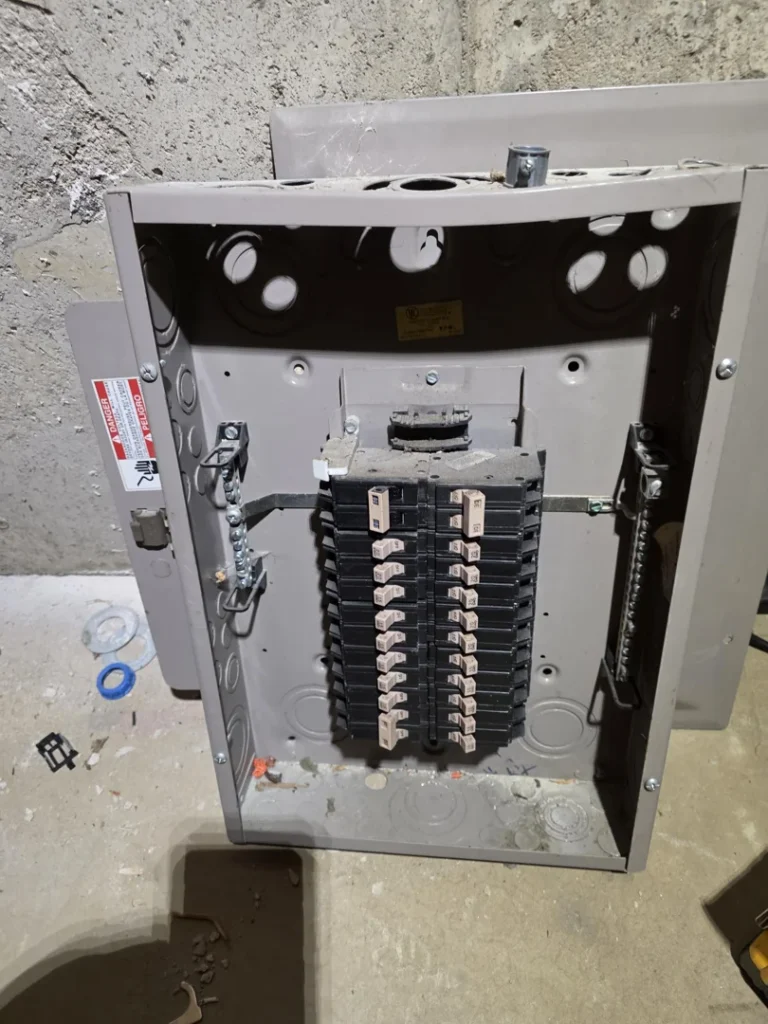
- Article 408 (Panelboards): Rules on how panels must be installed and labeled.
- The 80% Rule: For continuous loads (like office lights that stay on all day), you should never exceed 80% of a circuit breaker’s rated capacity.
Grounding, bonding, and overcurrent protection
Grounding provides a safe path for “stray” electricity to return to the earth, while bonding connects all metal parts of the system to ensure they stay at the same electrical potential. Together, they prevent the metal shell of a machine from becoming “live” and shocking an employee. We also install GFCIs (Ground Fault Circuit Interrupters) near water and AFCIs (Arc Fault Circuit Interrupters) to prevent fires caused by spark gaps.
Fire and workplace safety considerations
Loose connections are a silent killer. They increase resistance, which creates heat, which causes fires. We recommend regular staff training on how to spot warning signs and keeping a detailed maintenance log for OSHA compliance.
When panel upgrades are required
You might need an Electrical Panel Upgrade if you are:
- Converting a retail space into a restaurant (those ovens need serious power!).
- Adding EV charging stations for your employees.
- Operating an older building in Cicero or Chicago where the panels are simply outdated and lack spare capacity.
Planning, Installing, and Maintaining Commercial Wiring Systems
A successful project starts long before a single wire is pulled.
Planning a commercial wiring project from design to permit
We start with a “one-line diagram” that maps out how power flows. We coordinate with HVAC and lighting designers to ensure the Commercial Electrical Services we provide meet every demand. In many parts of Cook County, permit review times can take weeks, so early planning is essential. We always recommend planning for 20-25% spare capacity to avoid expensive retrofits later.
Step-by-step commercial wiring installation process
- Rough-in: Installing the conduit, pull boxes, and raceways.
- Wire Pulling: Routing the conductors through the raceways.
- Termination: Connecting the wires to panels, outlets, and machinery.
- Labeling: Every single breaker must be permanently labeled (no “mystery” switches!).
- Commissioning: Testing voltage, grounding, and continuity before the power is officially turned on.
Inspection and maintenance best practices over time
Don’t wait for a “pop” to call us. Annual inspections are vital. We use thermal imaging to look for “hot spots” in your panels—these are often loose connections that haven’t failed yet but are on their way to causing a fire.
Emergency issues and when to call for immediate service
If you notice a burning smell, flickering lights (especially when heavy equipment kicks on), or breakers that trip repeatedly, you have a serious problem. Our Emergency Electrical Services are available 24/7 because electrical failures don’t wait for business hours.
How to Choose a Commercial Wiring Contractor
Hiring a residential-only electrician for a commercial job is a recipe for disaster. The codes, voltages, and materials are entirely different.
Qualifications to verify before hiring
- Licensing: Ensure they hold a master electrician license that covers commercial work.
- Insurance: They must have comprehensive liability and workers’ compensation.
- Portfolio: Have they worked on buildings similar to yours (e.g., medical, industrial, or retail)?
Questions to ask before signing a proposal
- “Will you pull all necessary permits and handle inspections?”
- “What is the plan for spare capacity in the panels?”
- “Do you provide ‘as-built’ drawings so I know where the wires are after the walls are closed?”
Why local experience matters in older commercial buildings
In the Northwest Suburbs and Chicago, we deal with a lot of “legacy” systems. Knowing how to safely integrate modern commercial wiring with 50-year-old infrastructure requires local expertise. Whether it’s a warehouse in Elk Grove Village or an office in Rolling Meadows, we understand the specific municipal requirements of the area.
Explore our Our Services or learn more about our specific approach to Commercial Wiring to see how we handle these complexities.
Frequently Asked Questions About Commercial Wiring
What is the most common commercial wiring method?
EMT conduit is the most common for exposed areas and branch circuits because it offers a great balance of protection and the ability to change wires later.
How often should commercial electrical systems be inspected?
We recommend a professional inspection at least once a year. For high-demand facilities like data centers or manufacturing plants, twice a year is safer.
What warning signs suggest commercial wiring problems?
- Breaker Trips: If a breaker trips more than once, it’s not a fluke—it’s an overload or a short.
- Warm Outlets: Outlets or switches should never feel hot to the touch.
- Burning Smells: This is an immediate emergency.
- Flickering Lights: This often indicates a “lost phase” or a loose neutral wire.
Conclusion
Your building’s electrical system is too important to leave to chance. From the initial design to the final inspection, proper commercial wiring ensures your business stays safe, efficient, and ready for future growth.
At Energy Co., we specialize in navigating the unique challenges of Chicagoland’s commercial landscape. Whether you need Industrial Electrical Services for a factory in Palatine or a simple office rewire in Arlington Heights, our team of licensed pros is here to help.
Ready to ensure your facility is up to code? About Us and then Contact Us today for a consultation. Let’s build something powerful together.
Industry Standards & Safety Resources:
- For more information on national safety standards, visit the National Fire Protection Association (NFPA).
- Learn more about workplace safety requirements and electrical regulations at OSHA’s Electrical Safety Standards.
- Review the latest updates on the National Electrical Code (NEC).