Why Commercial Electrical Services Are Critical for Every Business
Commercial electrical services keep your business running safely, efficiently, and without costly downtime.
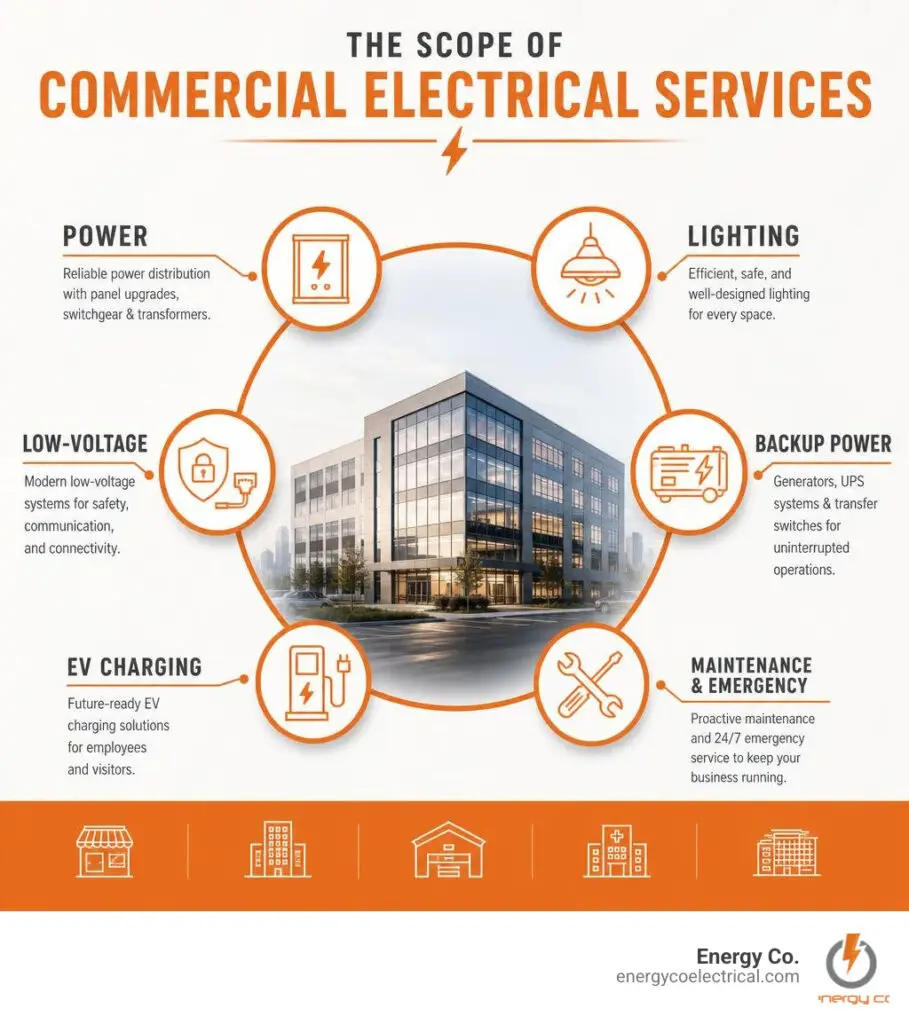
Here’s a quick overview of what they include:
| Service Category | Examples |
|---|---|
| Power Distribution | Panel upgrades, switchgear, transformers |
| Lighting | LED retrofits, emergency lighting, parking lot lighting |
| Low-Voltage Systems | Fire alarms, security, structured cabling, AV |
| Backup Power | Generators, UPS systems, transfer switches |
| New Construction & Tenant Improvements | Wiring, circuit installation, build-outs |
| Maintenance & Emergency | Inspections, 24/7 repairs, preventative maintenance |
| Specialized Systems | EV charging, building automation, data infrastructure |
Every business — from a small retail shop to a large warehouse — depends on a reliable electrical system. When something goes wrong, operations stop, revenue is lost, and safety is at risk. In fact, roughly 30% of commercial building electrical fires are linked to faulty wiring or overloaded circuits. That’s not a small problem.
The U.S. commercial building sector accounts for about 18% of total national energy consumption, and electrical systems are a major driver of that usage. Getting those systems right — and keeping them efficient — has a direct impact on your bottom line.
I’m Michał Napieralski, a licensed electrician and founder of Energy Co., with hands-on experience delivering commercial electrical services across Schaumburg and the greater Chicago area. From heavy-duty panel installations to full commercial wiring projects, I’ve helped dozens of businesses stay safe, compliant, and powered up.
Understanding Commercial Electrical Services
When we talk about commercial electrical services, we are stepping into a completely different world than standard home repairs. Commercial systems are designed to handle massive, continuous electrical loads, run sophisticated machinery, and support thousands of occupants simultaneously.
Whether you are managing a retail storefront in Arlington Heights, retrofitting an office space in Rolling Meadows, or coordinating a massive tenant improvement project in Mount Prospect, you need an electrical system built for durability and scale. To understand how these services keep your business operational, let’s look at how they stack up against residential installations.
| Feature | Residential Electrical Systems | Commercial Electrical Systems |
|---|---|---|
| Primary Voltage | Typically 120V / 240V | 120V, 208V, 240V, 277V, up to 480V |
| Phase Configuration | Single-phase power | Three-phase power |
| Wiring Protection | Non-metallic sheathed cable (Romex) | Heavy-duty metal conduit wiring (EMT/rigid) |
| Load Capacity | Usually 100A to 200A | 400A to 4,000A+ |
| System Accessibility | Concealed behind drywall | Often exposed or routed through drop ceilings/conduits |
| Primary Focus | Comfort, convenience, and basic safety | High-demand distribution, redundancy, and strict code compliance |
If you are planning a facility build-out or looking to understand the core infrastructure behind your commercial space, check out The Complete Guide to Commercial Wiring for a deep dive into how these systems are structured.
Key Differences Between Residential and Commercial Electrical Services
The fundamental difference between residential and commercial electrical work boils down to power demand, safety requirements, and structural materials.
Three-Phase Power vs. Single-Phase Power: Most homes operate on single-phase power, which uses two hot wires and a neutral wire to deliver 240 volts of electricity. This is perfect for running lighting, home appliances, and standard HVAC units. Commercial facilities, however, rely on three-phase power. This system uses three hot wires to deliver a continuous, non-pulsing stream of electricity, usually at 120/208V or 277/480V. Three-phase power is highly efficient for running heavy industrial equipment, large air conditioning systems, and massive computer networks without experiencing voltage drops.
Conduit Wiring and Protection: In a home, wires are typically run through wooden wall studs using flexible plastic-sheathed cables (commonly known as Romex). In commercial buildings, safety codes are much stricter to prevent fire hazards and physical damage. Commercial wiring must be run through protective metal conduits (such as Electrical Metallic Tubing, or EMT). This protects the high-voltage lines from pests, accidental punctures, and general wear and tear in active work environments.
Tenant Improvements and Scalability: Commercial spaces change hands frequently. A retail space in Palatine might be a clothing boutique today and a restaurant tomorrow. This requires highly scalable systems. Commercial electricians must design systems that allow for easy tenant improvements (TIs)—reconfiguring circuits, adding dedicated lines, and upgrading panels without tearing down the entire infrastructure.
For a closer look at the installation methods and materials used in these projects, read our dedicated guide on Commercial Wiring.
Facilities and Businesses Requiring Commercial Electrical Services
Not all commercial properties are created equal. Different industries have highly specialized power needs, and our team at Energy Co. works across a wide variety of facilities throughout the Chicagoland area to meet these specific challenges:
- Office Buildings: From high-rises in downtown Chicago to corporate offices in Schaumburg, modern offices require extensive power distribution for workstations, structured data cabling, smart lighting, and dedicated server rooms.
- Retail Stores and Shopping Centers: Retailers rely heavily on customized aesthetic lighting, exterior display lighting, digital signage, and secure Point-of-Sale (POS) systems.
- Warehouses and Distribution Centers: These massive facilities require high-bay LED lighting, specialized power drops for packaging equipment, automated conveyor systems, and heavy-duty battery charging stations for forklifts.
- Healthcare Facilities and Medical Offices: Hospitals and clinics require emergency standby power systems, isolated grounding circuits for sensitive diagnostic machinery, and code-compliant nurse call systems.
- Data Centers: In these facilities, uptime is everything. They require dual-source power distribution, uninterruptible power supply (UPS) systems, and robust cooling system electrical connections.
For heavy-duty operations like manufacturing plants and chemical processing facilities, standard commercial services often transition into industrial electrical services. If you are running an industrial-scale facility, you can learn more about how we support these high-demand environments by reading about our Top Industrial Electrician Services in Chicago: Ensuring Safety and Efficiency.
Core Electrical Solutions for Modern Facilities
As technology evolves, the demands on your facility’s electrical system grow. What worked for a business ten years ago may not support the high-speed data, smart automation, and energy-efficient systems required today. Upgrading and maintaining these core systems is essential to keeping your operating costs low and your productivity high.
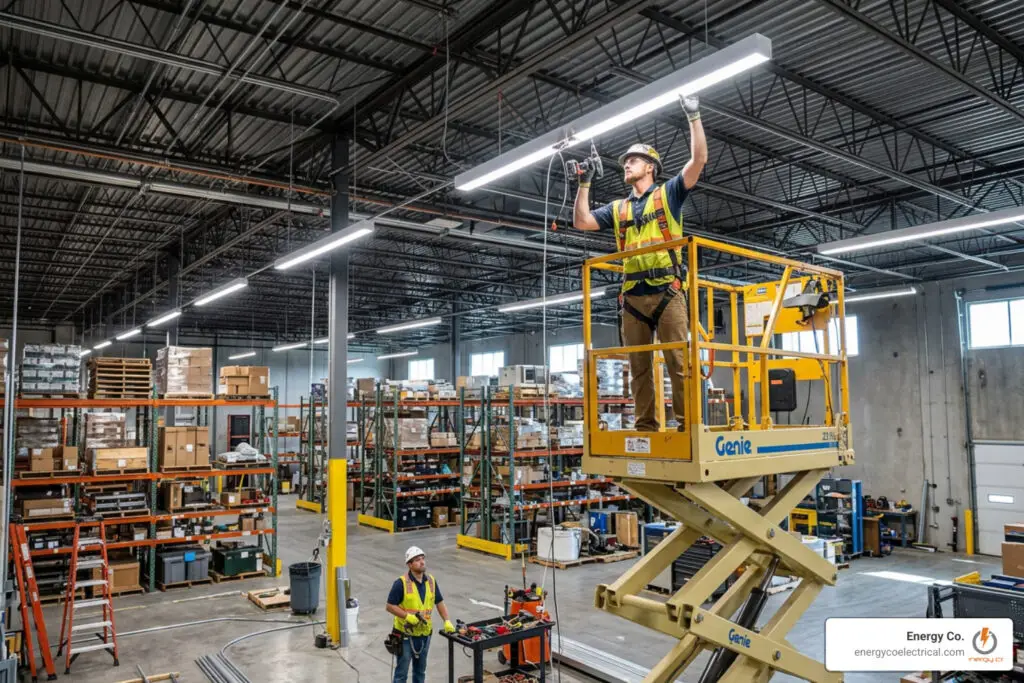
By partnering with a professional team to update your infrastructure, you can experience average energy cost savings of 20% to 30%. To achieve this, let’s look at the core services that modern commercial electrical contractors provide.
Power Distribution and Commercial Wiring Systems
Your power distribution system is the heart of your building’s electrical infrastructure. It takes high-voltage electricity from the utility company and safely steps it down, routes it, and distributes it to your equipment, lighting, and outlets.
If your business is expanding, adding new machinery, or experiencing frequent breaker trips, it is likely time for a system upgrade. We handle everything from basic service upgrades to complete electrical system designs. Here are the primary components of a commercial power distribution system:
- Switchgear: The centralized collection of circuit breakers, fuses, and switches used to distribute, control, and isolate electrical equipment safely.
- Transformers: Devices that step down high-voltage utility power (e.g., 480V) to safer, usable voltages (e.g., 120V or 208V) for standard office equipment.
- Main Service Panels and Distribution Boards: The control points that split the main electrical feed into individual branch circuits.
- Busways and Busducts: Metal duct systems containing copper or aluminum busbars, used to distribute high-current power efficiently across large spaces like warehouses.
- Motor Control Centers (MCCs): Centralized assemblies that control and protect electric motors, commonly used in HVAC systems and manufacturing lines.
Energy-Efficient Lighting and Retrofits
Lighting accounts for a massive portion of a commercial building’s monthly utility bill. Fortunately, it is also one of the easiest areas to optimize for major cost savings. Transitioning from outdated fluorescent or metal halide fixtures to modern light-emitting diode (LED) systems is a highly effective business upgrade.
In fact, LED lighting retrofits in commercial buildings can reduce lighting energy use by 40% to 60% compared to traditional fluorescent systems. When you pair LEDs with smart controls like occupancy sensors, daylight harvesting systems, and automated dimmers, the savings increase even further.
If you are looking to lower your overhead and improve your workplace lighting quality, we highly recommend reading our guide: Save Green by Going Green with Chicago Commercial Lighting Upgrades.
Additionally, exterior and security lighting are critical for protecting your property. Proper illumination of your storefront, pathways, and parking areas deters crime and ensures visitor safety. For details on upgrading your outdoor spaces, explore our specialized services for commercial parking lot lighting.
For businesses located in the Northwest Suburbs, scheduling a professional assessment is easy. Whether you are in Hoffman Estates or Palatine, our team at Energy Co. provides reliable, code-compliant commercial electrical installations and services tailored to your facility’s needs.
Low-Voltage Systems and Smart Building Automation
Not all commercial electrical work involves high voltage. Modern businesses rely heavily on low-voltage systems to handle communication, security, and automation. These systems require precise installation by technicians who understand structured cabling and data integrity.
Our low-voltage commercial services include:
- Structured Cabling and Data Infrastructure: Category 6 (Cat6) and fiber-optic wiring to support high-speed internet, internal networks, and VoIP phone systems.
- Fire Alarm Systems: Code-mandated detection, alarm, and emergency communication systems designed to protect lives and property.
- Security and Access Control: CCTV camera systems, card readers, biometric scanners, and motion sensors to secure your facility.
- Building Automation Systems (BAS): Integrated networks that control HVAC, lighting, and security systems from a single, centralized interface to maximize energy efficiency.
If your facility is located in the Northwest Suburbs, you can access specialized low-voltage and commercial support. Businesses in Elk Grove Village and Rolling Meadows can rely on our dedicated local technicians to receive expert system integration and support.
Specialized Power: EV Charging, Generators, and Backup Systems
As commercial facilities adapt to modern transportation and climate challenges, specialized power installations have shifted from “optional luxury” to “business necessity.”
Commercial EV Charging Stations: With more electric vehicles on the road in June 2026 than ever before, providing EV charging stations is a fantastic way to attract high-value customers, retain top-tier employees, and future-proof your commercial property. We design and install Level 2 and Level 3 (DC Fast) charging stations tailored to your building’s power capacity.
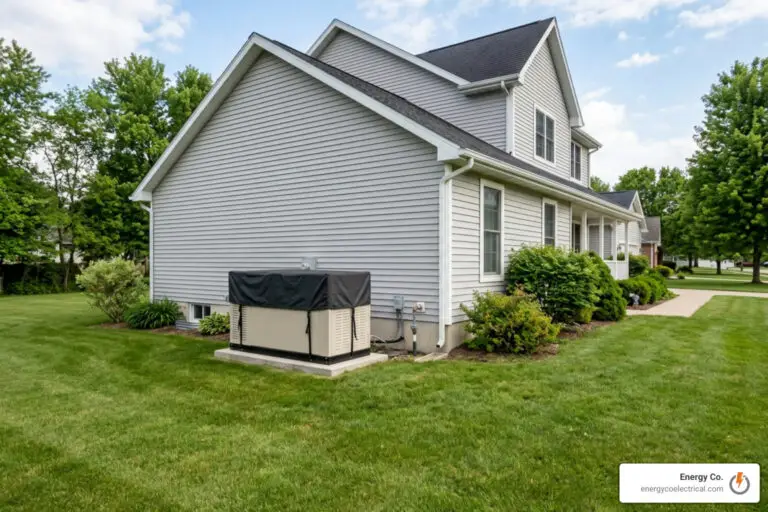
Backup Generators and Emergency Power: A sudden power outage can cost your business thousands of dollars per hour in lost productivity, spoiled inventory, or missed transactions. Installing a commercial standby generator equipped with an Automatic Transfer Switch (ATS) ensures that your critical systems — such as refrigeration, security, servers, and emergency lighting — remain powered during a utility failure.
Uninterruptible Power Supplies (UPS): For businesses running sensitive electronic equipment or data centers, even a momentary power flicker can cause data corruption or system crashes. A UPS system acts as a temporary battery bridge, keeping systems running smoothly until your backup generator kicks in.
For businesses looking to integrate these advanced systems, our team is ready to help. If you are operating in the Schaumburg area or surrounding suburbs, you can easily schedule a consultation with our local experts to explore our comprehensive commercial and residential electrical services.
Safety, Code Compliance, and Choosing the Right Contractor
Electrical work is inherently hazardous. In a commercial setting, a single mistake can result in catastrophic equipment damage, severe injuries, or devastating structural fires. Ensuring that your facility is fully compliant with all local and national safety codes is not just a legal requirement – it is the foundation of your business’s safety.
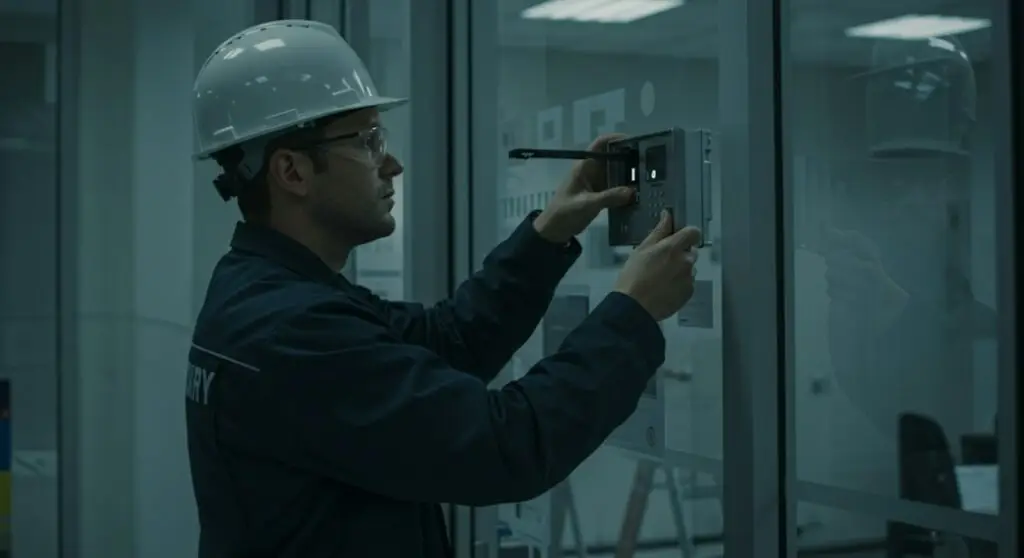
To keep your facility safe and compliant, you need to understand the regulations governing commercial properties and know how to select the right contractor to handle the work. If you are operating a business in the city or surrounding suburbs, you can read our detailed guide on the top commercial electrician services in Chicago to see how professional contractors maintain these high standards.
Ensuring Safety and NEC Code Compliance
All commercial electrical work must strictly adhere to the National Electrical Code, along with specific municipal codes. The City of Chicago, for example, maintains its own highly stringent electrical code, which famously mandates the use of rigid or EMT metal conduit in almost all applications to prevent fire hazards.
In addition to municipal building codes, commercial facilities must comply with federal Occupational Safety and Health Administration requirements, including applicable OSHA electrical safety standards. This includes maintaining proper clearance around electrical panels, implementing lockout/tagout (LOTO) safety procedures during maintenance, and ensuring that all emergency exit lighting is fully functional.
Regular commercial electrical inspections and preventative maintenance are the best ways to catch code violations and safety hazards before they cause an accident. During an inspection, commercial electricians look for:
- Overloaded circuits and unbalanced electrical loads.
- Outdated or deteriorating wiring insulation.
- Corroded connections in main service panels.
- Malfunctioning ground fault circuit interrupters (GFCIs) and arc fault circuit interrupters (AFCIs).
- Non-compliant emergency exit signs and path lighting.
Selecting a Qualified Commercial Electrical Contractor
When it comes to hiring a commercial electrical contractor, cutting corners to save a few dollars can cost you dearly in the long run. Unlicensed or inexperienced handymen can leave you with code violations, failed inspections, and dangerous fire hazards.
When vetting potential contractors for your business, use this checklist to ensure they are qualified to handle commercial-scale work:
- Verify Licensing and Insurance: Ensure the contractor holds an active electrical license in your specific municipality and carries comprehensive liability and workers’ compensation insurance.
- Ask About Commercial Experience: Verify that they specialize in commercial and industrial systems, rather than just residential repairs.
- Request a Project Portfolio: Ask to see examples of completed commercial projects similar in size and scope to yours.
- Look for Transparent Pricing: A reputable contractor will provide detailed, written estimates outlining material and labor costs.
- Check Local Reviews: Look for a track record of reliability, clear communication, and timely project completion.
To learn more about our qualifications and see the wide range of systems we install, you can view Our Services or browse some of our successfully completed commercial build-outs by visiting Our Projects.
For businesses in the outer Northwest Suburbs looking for trusted, licensed professionals, Energy Co. is here to help. Whether your business is in Streamwood or Hanover Park, you can secure reliable, code-compliant services by contacting our team of local experts.
Frequently Asked Questions
How often should a commercial building undergo an electrical inspection?
Generally, commercial buildings should undergo a comprehensive electrical safety inspection every 3 to 5 years. However, the exact frequency depends on the type of business you run, the age of your facility, and your operational demands.
For high-demand environments like manufacturing plants, food processing facilities, or data centers, annual inspections are highly recommended. Regular inspections help identify hidden hazards, prevent unexpected equipment failures, and ensure your business remains in compliance with OSHA and local building codes.
What are the benefits of upgrading to LED lighting in a commercial facility?
Upgrading your commercial facility to LED lighting offers several major advantages:
- Lower Utility Bills: LEDs use up to 75% less energy than traditional incandescent or fluorescent bulbs, drastically lowering your operating costs.
- Longer Lifespan: Commercial-grade LEDs can last 50,000 to 100,000 hours or more, meaning you will spend far less time and money on maintenance and replacement bulbs.
- Improved Workplace Productivity: High-quality LED lighting reduces eye strain, minimizes glare, and creates a more comfortable, productive work environment for your employees.
- Fast ROI: Thanks to dramatic energy savings and available utility rebates, most commercial LED retrofits pay for themselves within 1 to 3 years.
How do commercial electricians handle emergency power outages?
When an unexpected power outage occurs, commercial electricians respond rapidly to minimize your business’s downtime. The emergency response process typically involves:
- Emergency Dispatch: Arriving on-site quickly with fully equipped service vehicles to assess the situation.
- System Diagnostics: Using advanced testing equipment to determine if the outage is caused by an internal system failure (such as a blown transformer or tripped main breaker) or an external utility issue.
- Emergency Power Restoration: Safely routing critical systems to backup generator power or temporary mobile generators if the main utility power cannot be immediately restored.
- Repairs and System Testing: Repairing the faulty components, testing the system for electrical stability, and safely transitioning your facility back to the main power grid.
Conclusion
Your electrical system is the invisible backbone of your business. From the lights that welcome your customers to the heavy-duty switchgear that powers your machinery, keeping these systems safe, efficient, and up to code is vital to your long-term success.
At Energy Co., we are proud to provide the highest quality commercial, industrial, and residential electrical services across Chicago and the surrounding suburbs. Whether you need a simple panel upgrade in Palatine, an LED retrofit in Schaumburg, or 24/7 emergency response in Elk Grove Village, our team of fully licensed, insured professionals is here to help.
We stand behind all of our work with a 100% satisfaction guarantee, ensuring your project is completed safely, on time, and fully compliant with all local codes.
Ready to upgrade your business’s electrical infrastructure, improve your energy efficiency, or schedule a safety inspection? Let’s power your business together. Visit our Commercial Electrical Services page today to schedule a consultation with our expert team!