Last updated:
Understanding NEC Code: Is a Dedicated Circuit for Refrigerator Required?
When evaluating electrical safety for kitchen appliances, homeowners often ask whether national safety standards strictly demand a dedicated circuit for refrigerator installations. Under the National Electrical Code (NEC), specifically section 210.52(B)(1), kitchen countertop receptacles must be supplied by at least two 20-ampere Small Appliance Branch Circuits (SABCs).
Table of Contents
Interestingly, national model code permits a refrigerator to be connected to one of these shared 20-amp small appliance branch circuits. The NEC also includes permissive language allowing an individual branch circuit rated at 15 or 20 amperes for specific equipment like refrigeration units.
However, model codes published by the National Fire Protection Association (NFPA) do not automatically carry the force of law. Electrical codes must be legally adopted by local municipalities, such as Cook County or the City of Chicago. Local building departments often amend national guidelines to mandate higher safety standards, as explained in this guide on Dedicated Circuit for a Refrigerator: Required or Just Recommended? – HomelyVille.
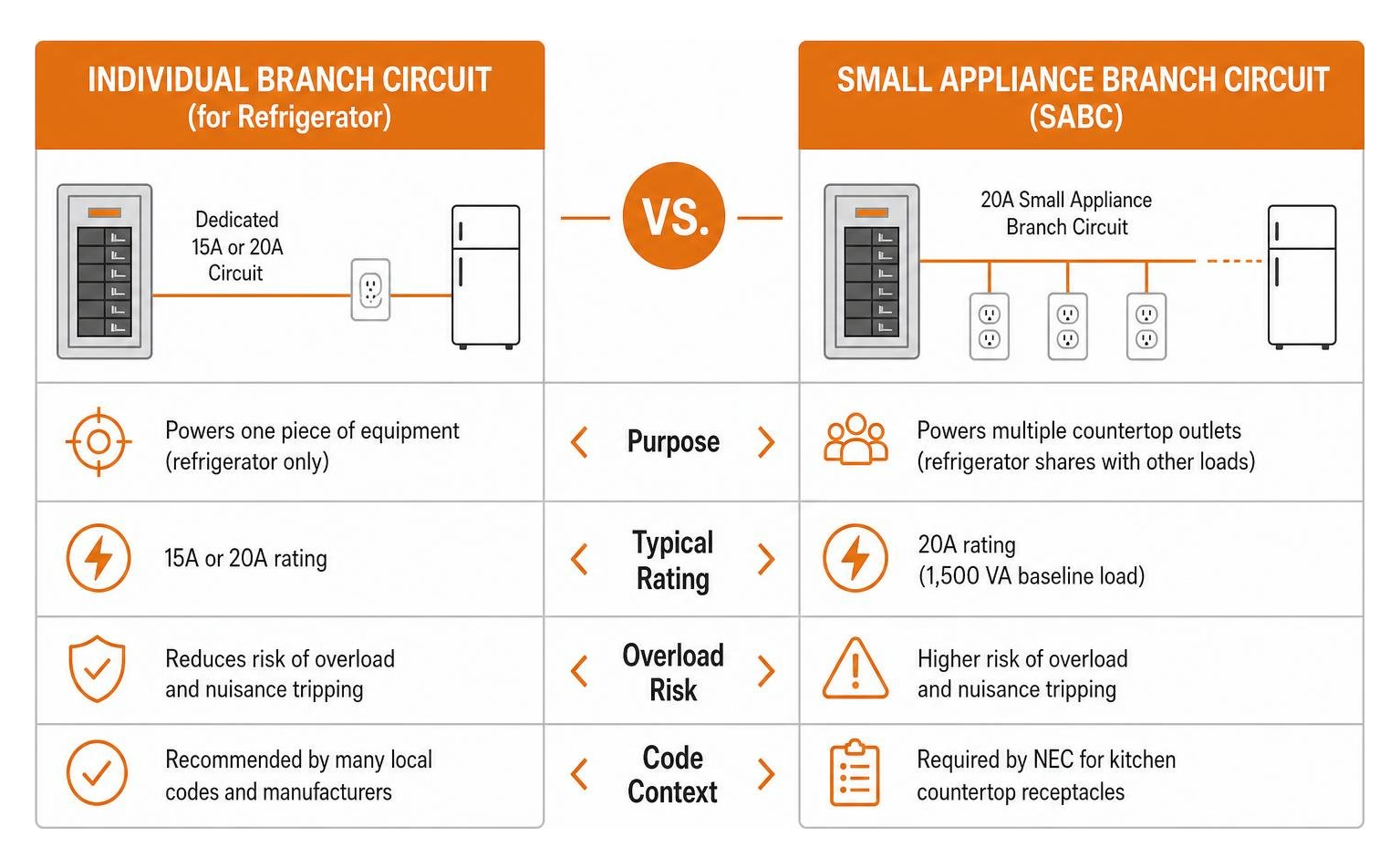
Individual Branch Circuit vs. Small Appliance Branch Circuit (SABC)
Understanding the distinction between circuit types clarifies why shared wiring fails in busy kitchens:
An individual branch circuit supplies power to only one piece of utilization equipment — in this case, your refrigerator. In contrast, Small Appliance Branch Circuits (SABCs) are designed to feed multiple general-purpose kitchen countertop outlets.
Under standard electrical calculations, each SABC is assigned a baseline load of 1,500 volt-amperes (VA). When you plug high-draw countertop items like coffee makers or toaster ovens into a shared SABC, adding the continuous draw of a refrigerator frequently pushes total current beyond 20 amperes. To learn more about standard household wiring setups, review A Complete Guide to Residential Wiring Types and Installation.
IRC 2024, Local AHJ Amendments, and Manufacturer Instructions
While standard NEC text permits shared circuits, newer building standards take a stricter stance. Under the International Residential Code (IRC 2024) Section E3703.3, a kitchen refrigerator requires a dedicated 20-ampere, 120-volt branch circuit that cannot serve any other outlet or load.
Furthermore, NEC 110.3(B) mandates that listed electrical equipment must be installed in accordance with any instructions included in the manufacturer’s listing. If your refrigerator manual specifies a dedicated supply line, failing to provide one violates national code. Local Authorities Having Jurisdiction (AHJs) frequently enforce these manufacturer guidelines during rough-in and final electrical inspections. For a breakdown of IRC code provisions, check IRC 2024 Dedicated Circuits: Refrigerator, Dishwasher, Disposal, and Dryer | Jaspector.
Technical Specifications: Breaker Size, Wire Gauge, and Electrical Load
Properly matching wire size, breaker amperage, and continuous electrical loads is crucial for safe appliance operation.
| Specification | 15-Amp Dedicated Circuit | 20-Amp Dedicated Circuit (Recommended) |
|---|---|---|
| Minimum Wire Gauge | 14 AWG Copper | 12 AWG Copper |
| Max Continuous Load (80%) | 12 Amps (1,440W) | 16 Amps (1,920W) |
| Typical Wire Type | 14/2 NM-B or THHN in Conduit | 12/2 NM-B or THHN in Conduit |
| Startup Surge Tolerance | Moderate | Superior |
| Long-Run Voltage Drop (>50ft) | Requires 12 AWG | Requires 10 AWG |
Sizing Wire Gauge and Breakers Properly
For a dedicated circuit for refrigerator receptacles, running 12 AWG copper wire protected by a single-pole 20-amp breaker is standard professional practice. While a 15-amp breaker with 14 AWG copper wire is technically allowed for units drawing fewer than 12 amps continuous load, a 20-amp setup provides needed headroom for compressor spikes.
In Chicagoland, electrical wiring in many jurisdictions must be installed in metallic conduit (EMT) rather than Romex (NM-B) cable. Additionally, if the wire run from your main service panel to the kitchen exceeds 50 feet, upsizing from 12 AWG to 10 AWG copper helps avoid excessive voltage drop that can damage sensitive electronics. If your electrical panel is short on breaker slots for dedicated homeruns, read The Homeowner Guide to Buying a 200 Amp Electrical Panel.
Handling Inrush Current and Compressor Startup Surges
A standard modern refrigerator runs efficiently, drawing between 100 and 400 watts (roughly 1.5 to 6 amperes) during normal operation. A 700-watt refrigerator operating on a 120V circuit draws about 5.83 amps.
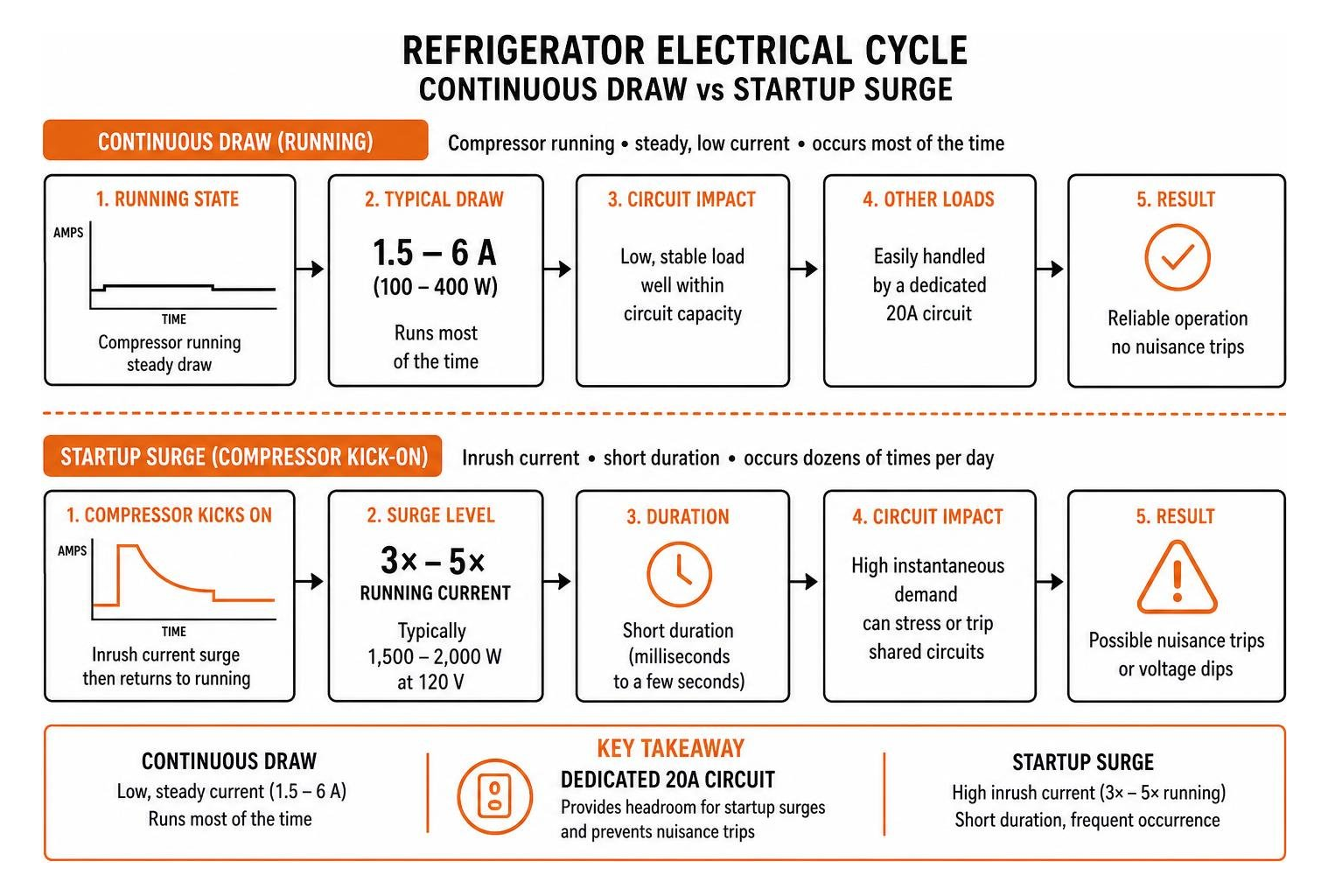
However, when the electric motor compressor kicks on, it draws inrush current — a sudden surge 3 to 5 times its running current. A compressor startup drawing 1,500 to 2,000 watts happens dozens of times a day. Combined with automatic defrost heater cycles running for 30 minutes at high amperage, this total electrical demand highlights why sharing a circuit with other kitchen appliances causes frequent breaker trips.
Safety Mandates: AFCI, GFCI, and Circuit Protection
Recent electrical code updates prioritize arc-fault and ground-fault protection in residential kitchens. Under 2023 NEC Section 210.8(A), all 125-volt through 250-volt kitchen receptacles require Ground-Fault Circuit Interrupter (GFCI) protection. Concurrently, 2023 NEC Section 210.12(A) requires Arc-Fault Circuit Interrupter (AFCI) protection for all 120-volt, 15-amp and 20-amp kitchen branch circuits. If your safety breakers are malfunctioning, learn about Circuit Breaker Repair options.
Why You Need a Dedicated Circuit for Refrigerator Outlets
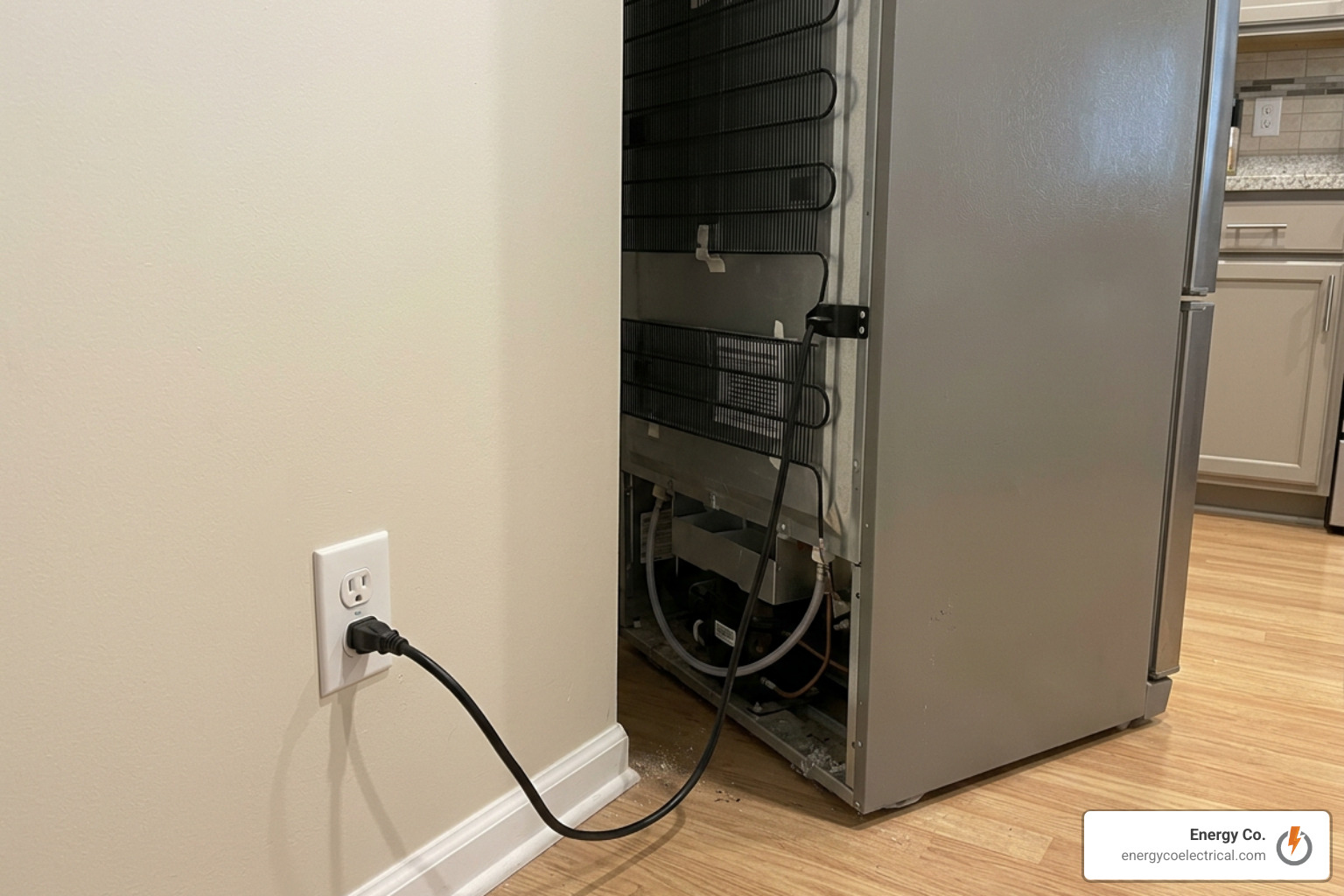
Installing an isolated homerun wire from the breaker panel directly to a dedicated duplex receptacle behind your refrigerator provides clear practical advantages:
- Uninterrupted Preservation: Heavy kitchen loads on adjacent outlets won’t trip your cooling power while you are away from home.
- Isolate Motor Interference: Keeps motor startup harmonics from disrupting delicate kitchen electronics or counter-top devices.
- Code & Warranty Compliance: Meets strict manufacturer specifications and current local building codes.
Solving AFCI and GFCI Nuisance Tripping Issues
Dual-function AFCI/GFCI breakers occasionally experience nuisance tripping connected to refrigerators. As a compressor motor starts, its internal electrical contacts produce a momentary electrical arcing signature. AFCI breakers can misinterpret this harmless motor curve as a dangerous arc fault.
The Association of Home Appliance Manufacturers (AHAM) continues to track compatibility between AFCI signatures and modern appliances. To minimize nuisance trips, electricians install dedicated dual-function breakers paired with modern, high-quality receptacles, ensuring full compliance without sacrificing food preservation safety. You can browse electrician perspectives on this issue in Dedicated circuits and modern appliances | Mike Holt Electrical Forums.
Practical Benefits and Common Electrical Inspection Violations
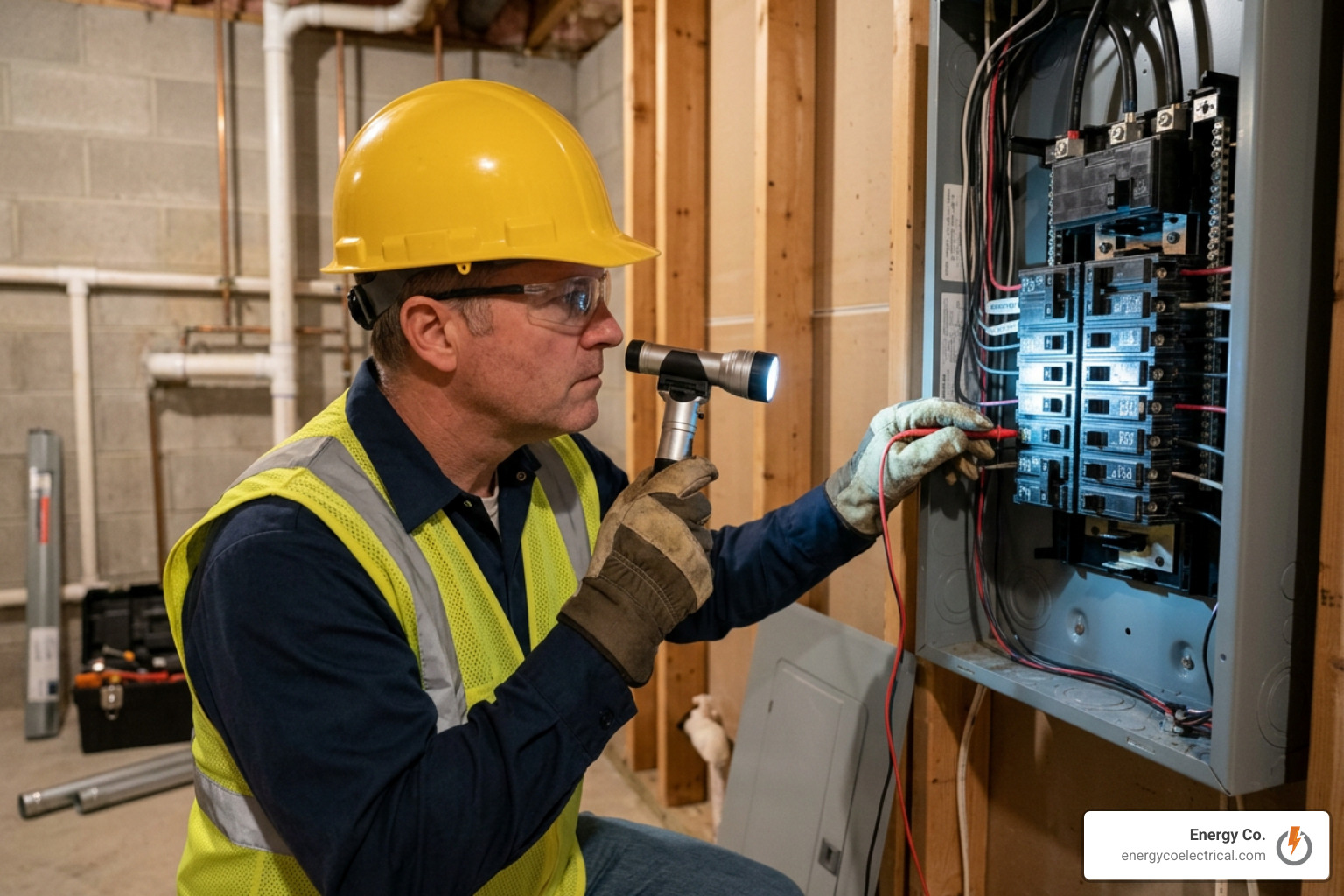
Key Benefits of Installing a Dedicated Circuit for Refrigerator Safety
- Food Spoilage Prevention: Prevents sudden power loss caused by external kitchen appliances tripping shared breakers.
- Extended Compressor Lifespan: Stable, uninterrupted voltage prevents motor overheating and mechanical stress caused by sudden voltage drops.
- Enhanced Home Fire Safety: Dedicated homeruns eliminate overheated pass-through connections inside crowded electrical boxes.
- Protected Warranty Coverage: Meets appliance manufacturer guidelines under NEC 110.3(B) to preserve repair coverage.
Common Electrical Code Violations Home Inspectors Flag
During real estate sales and municipal inspections, building inspectors frequently catch critical kitchen wiring errors:
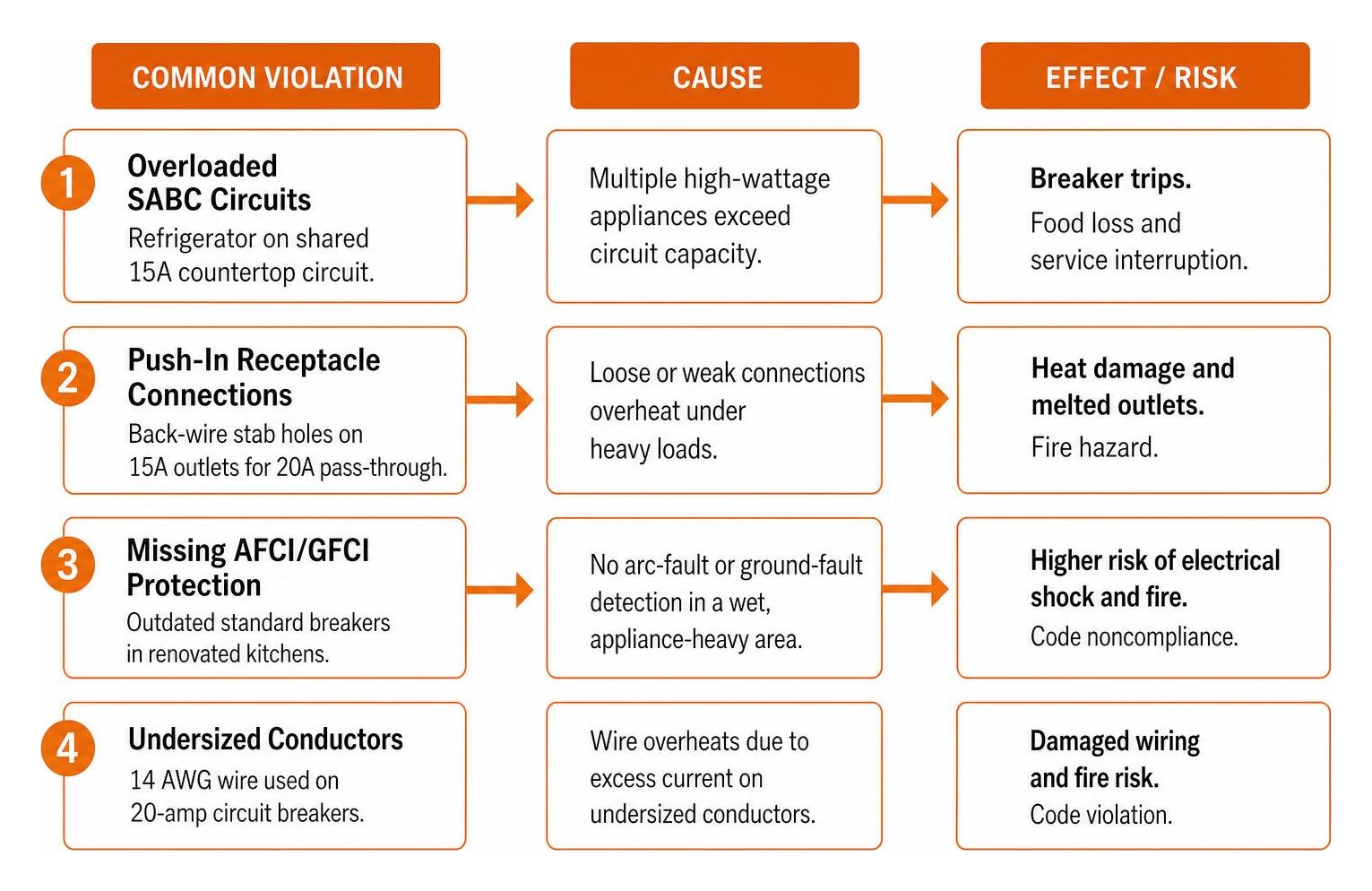
- Overloaded SABC Circuits: Wiring a refrigerator into a shared 15A countertop circuit alongside high-wattage appliances.
- Push-In Receptacle Connections: Using back-wire stab holes on standard 15A outlets for 20A pass-through circuits, which can overheat under heavy loads.
- Missing AFCI/GFCI Protection: Relying on outdated standard breakers in renovated kitchen spaces.
- Undersized Conductors: Running 14 AWG wire on 20-amp circuit breakers, creating a major fire risk.
If your home’s panel exhibits these issues, consider scheduling an Electrical Panel Upgrade.
Frequently Asked Questions about Refrigerator Wiring
What wire size and breaker rating are recommended for a refrigerator circuit?
A 20-amp single-pole circuit breaker paired with 12 AWG copper wire is recommended for modern refrigerators. If the wire run from your main panel exceeds 50 feet, use 10 AWG copper wire to prevent voltage drop. Smaller refrigerators may operate on a 15-amp breaker with 14 AWG wire if allowed by nameplate ratings, but 20-amp circuits offer superior long-term performance. For additional wiring guidance, reference Refrigerator Circuit: Wire Size & Breaker – WireRef.
Does current electrical code require GFCI and AFCI protection on refrigerator outlets?
Yes. Under the 2023 NEC (Sections 210.8(A) and 210.12(A)), all 120-volt, 15-amp and 20-amp kitchen receptacles require both AFCI and GFCI protection. This requirement applies to outlets positioned behind refrigerators unless a local AHJ has adopted specific local exemptions.
Why does a refrigerator cause circuit breakers to trip when starting up?
Compressor startup requires inrush current drawing 3 to 5 times the running wattage for a fraction of a second. If the refrigerator shares a circuit with other operating kitchen appliances, this combined demand exceeds the breaker’s thermal-magnetic trip threshold. Old or worn breakers can also become overly sensitive to standard startup current.
Conclusion
Installing a dedicated circuit for refrigerator power is one of the smartest upgrades you can make for your kitchen’s reliability and safety. It protects against spoiled food, extends compressor life, and keeps your wiring up to modern electrical codes.
At Energy Co., our licensed electricians bring local expertise to homes across Schaumburg, Chicago, Cook County, and the Northwest Suburbs. Whether you need an electrical panel upgrade or a new appliance homerun, we’re here to help. Contact our team today for Residential Electrical Services or explore our Commercial Electrical Services to schedule an inspection.