Is a 200 Amp Electrical Panel Right for Your Home?
A 200 amp electrical panel is the standard power distribution hub for most U.S. homes built after the early 1990s — and in 2026, it’s the baseline for any new residential construction.
Quick answer for buyers:
| What you need to know | The short version |
|---|---|
| What it does | Distributes up to 200A of power (48,000W at 240V) across all home circuits |
| Usable capacity | ~160A continuous load under the NEC 80% rule |
| Typical circuit spaces | 40–42 spaces in most modern panels |
| Who needs one | Homes with EV chargers, heat pumps, solar, or aging 60A/100A panels |
| Average upgrade cost | $3,000–$6,500 in the Chicago area for a full service upgrade |
| DIY? | No — requires a licensed electrician and permit in virtually every jurisdiction |
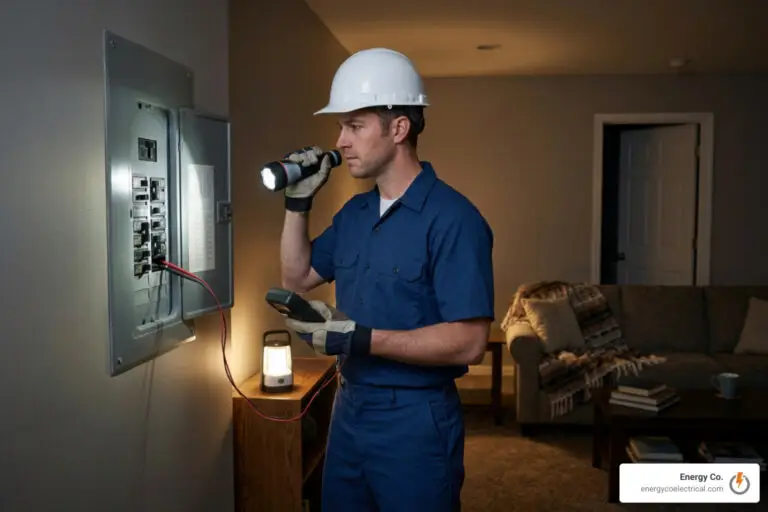
If your lights flicker, breakers trip often, or you’re planning to add an EV charger or heat pump, your current panel may simply not be keeping up. Older Chicago homes in particular — many still running on 60-amp or 100-amp service — weren’t built for today’s electrical demands.
This guide walks you through everything: how these panels work, what they cost, what the code requires, and what to look for when buying one.
I’m Michał Napieralski, licensed electrician and founder of Energy Co. in Schaumburg, IL, and I’ve helped hundreds of Chicago-area homeowners navigate 200 amp electrical panel upgrades safely and up to code. In the sections below, I’ll share exactly what I’ve learned from those projects so you can make a confident, informed decision.
Understanding the 200 Amp Electrical Panel and How It Works
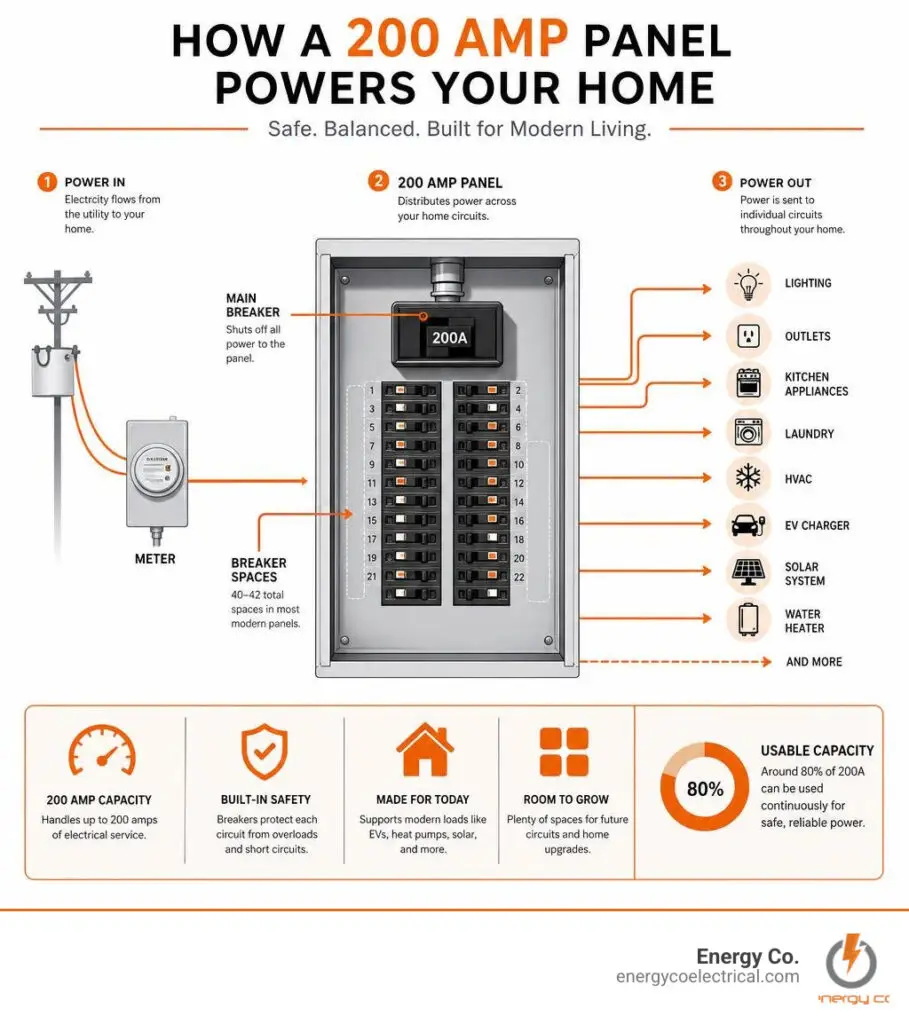
Think of your home’s electrical panel as the central traffic cop for all the power entering your property. Electricity travels from the utility grid (here in northern Illinois, that’s ComEd) through your meter base, and straight into your main service panel.
A 200 amp electrical panel is designed to safely handle a theoretical maximum of 48,000 watts of power (200 amps multiplied by 240 volts). However, the National Electrical Code (NEC) institutes the 80% rule for continuous loads—meaning any load running continuously for three hours or more should not exceed 80% of the panel’s rated capacity. This leaves you with a highly reliable 160 amps of continuous usable capacity, which is more than enough headroom for the vast majority of modern households.
To help you visualize how this compares to other common residential service sizes, here is a quick breakdown:
| Service Size | Max Wattage Capacity | Typical Breaker Spaces | Best Suited For |
|---|---|---|---|
| 100 Amp | 24,000 Watts | 20–30 Spaces | Small homes or condos with gas heating, gas cooking, and no EV charging needs. |
| 200 Amp | 48,000 Watts | 40–42 Spaces | Medium-to-large modern homes with central AC, electric appliances, EV chargers, and solar. |
| 400 Amp | 96,000 Watts | 80–84 Spaces (via dual panels) | Very large luxury estates (over 4,000 sq. ft.) with multiple geothermal heat pumps, pools, and guest houses. |
While a 100-amp setup was perfectly fine when televisions were bulky boxes and phones stayed plugged into the wall, today’s heavy-draw appliances easily push older systems to their absolute limits. If you need a heavy-duty commercial option, specialized units like the Larson Electronics – 200A Power Panelboard, 3PH Main Breaker Panel, 42 Circuit, 480Y/277 (42) Breaker Slots, NEMA 3R, Top Feed, Wall Mount show how robust 200A distribution can get in three-phase commercial environments. But for standard residential single-phase needs, a standard 200A load center is the undisputed sweet spot.
Key Components Inside a 200 Amp Electrical Panel
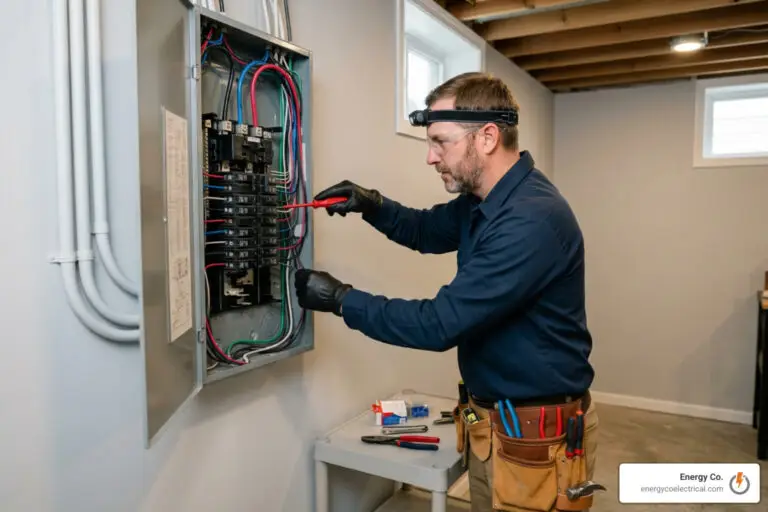
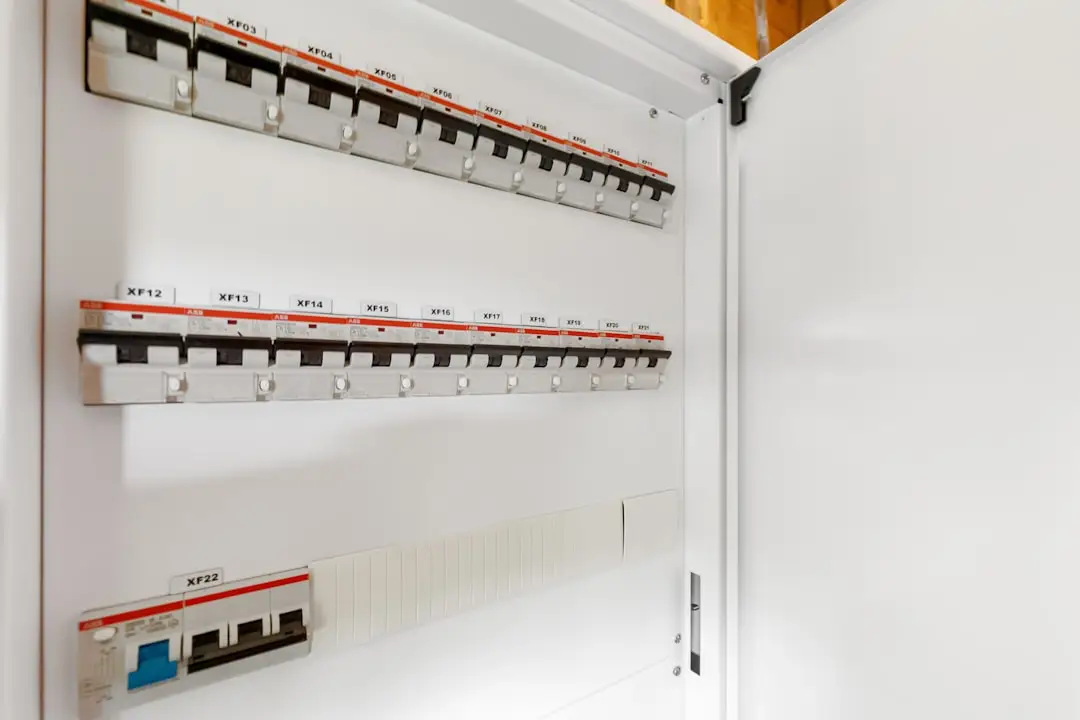
When you open the door of a 200-amp load center, you are looking at a highly engineered safety assembly. Here are the core components that make it work:
- The Main Breaker: This is the master switch, usually located at the very top or bottom of the panel. In an emergency, flipping this single double-pole switch completely cuts off all power to the rest of the panelboard.
- The Bus Bars: These are the thick conductive metal strips running down the center of the panel. Your individual circuit breakers snap directly onto these bars to draw power. High-quality panels, like the Leviton LP420-BPD or top-tier Square D models, feature tin-plated copper bus bars for maximum conductivity and corrosion resistance.
- The Neutral Bus: This is where all the white neutral wires return. It completes the circuit pathways, carrying current back to the grid.
- The Grounding Electrode Terminal: This connects your panel to the physical earth via ground rods, keeping your home safe from lightning strikes and high-voltage surges.
- The Branch Circuit Breakers: These are the individual safety switches (ranging from 15A to 60A or more) that protect the specific wires running to your outlets, lights, and heavy appliances.
Indoor NEMA 1 vs. Outdoor NEMA 3R Enclosures
When buying a 200 amp electrical panel, you must select the correct enclosure rating based on where the panel will be installed. Enclosure standards are governed by the National Electrical Manufacturers Association (NEMA). For a deep dive into enclosure engineering, you can check out Electrical Enclosures | nVent HOFFMAN.
- NEMA 1 (Indoor Rated): These enclosures are designed for indoor use in dry areas, such as a basement, utility room, or attached garage. They protect residents against accidental contact with live parts and keep out dust and debris, but they offer zero protection against water.
- NEMA 3R (Outdoor Rated): If your panel must be mounted on the exterior of your house—which is common in many suburban layouts and utility requirements—you must use a NEMA 3R enclosure. These are weather-resistant, rainproof, and ice-resistant, featuring a protective hood and outdoor-grade seals to keep the elements out.
When to Upgrade and Typical Cost Factors
If you live in an older home in Cicero, Arlington Heights, or Chicago’s historic city neighborhoods, there is a very high probability your electrical system is showing its age.
How to Tell If Your Current Panel Is Overloaded
Your electrical panel won’t always fail silently; it usually drops several hints before it finally calls it quits. Here are the classic warning signs that your panel is overloaded or outdated:
- Flickering or Dimming Lights: If your lights flicker every single time your central air conditioning or refrigerator kicks on, your panel is struggling to allocate enough amperage to meet the sudden demand.
- Frequent Breaker Trips: If you can’t run a hair dryer and a vacuum cleaner at the same time without making a trip to the basement to flip a breaker, your system is crying out for more headroom.
- Buzzing, Hissing, or Humming Sounds: A healthy panel operates in near-silence. If you hear buzzing or clicking coming from the breaker box, it indicates a loose connection or a failing breaker that is actively arcing.
- Warmth or a Burning Smell: If the cover plate of your panel feels warm to the touch, or if you smell a faint scent of fish or burning plastic near the box, you have a severe hazard on your hands. You should immediately contact a professional for Expert Electrical Repair Service in Chicago: Fast, Reliable Solutions.
- Outdated Legacy Brands: If your home still has a fuse box, or a panel manufactured by Federal Pacific Electric (Stab-Lok), Zinsco, or Challenger, these are widely documented fire hazards. Many insurance carriers will actually refuse to renew your homeowner’s policy until these are replaced.
Supporting Modern High-Demand Appliances
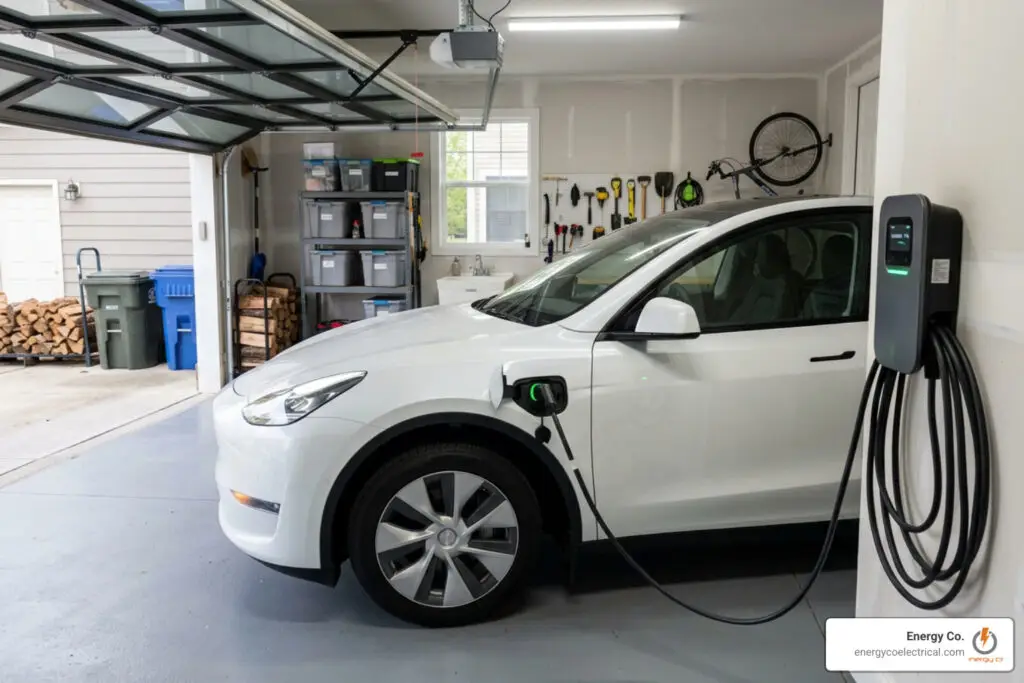
The push toward home electrification in 2026 is the single biggest driver of panel upgrades. Modern high-demand systems require dedicated, heavy-duty circuits that old 100-amp panels simply cannot support:
- Level 2 EV Chargers: A standard Level 2 electric vehicle charger runs on a 240V circuit and typically draws 40 to 50 amps on its own. On a 100-amp panel, running your EV charger while cooking dinner could easily trip your main breaker.
- Heat Pump HVAC Systems: Transitioning from natural gas to an electric heat pump or hybrid heating system can add an additional 30 to 50 amps of demand.
- Solar Photovoltaic Systems: Integrating solar panels requires careful consideration of the 120% rule under the NEC. This rule limits the total amount of power that can be backfed into a panel’s bus bars from combined utility and solar sources. Upgrading to a modern 200-amp panel with a high-rated bus bar makes solar integration seamless and compliant.
Typical Costs and Pricing Factors
When budgeting for a 200 amp electrical panel upgrade, it helps to break down the actual costs. The hardware itself is surprisingly affordable. For example, a mid-tier, high-quality residential unit like the Homeline 200 Amp 30-Space 60-Circuit Indoor Main Breaker plug … or a Leviton 42-space copper-bus panel typically retails between $200 and $350.
However, a complete service upgrade involves much more than just swapping the metal box. It requires replacing the service lateral or overhead mast, installing a new meter socket, upgrading the grounding system, running new heavy-gauge conductors, and installing modern AFCI/GFCI breakers.
In the Chicagoland area, a standard residential 200-amp service upgrade typically ranges from $3,000 to $6,500.
Several key factors will influence where your project lands on this scale:
- Overhead vs. Underground Utility Lines: Overhead drops require a rigid weather mast and weatherhead, while underground feeds require trenching and heavy conduit.
- Required Circuit Upgrades: Modern codes require AFCI (Arc-Fault Circuit Interrupter) breakers on most residential branch circuits. Swapping standard breakers for AFCI breakers adds to the material cost but provides unmatched fire protection.
- Local Permitting: Permit fees and strict local code compliance in Cook County can add to the baseline cost.
To offset these expenses, homeowners in 2026 can take advantage of the federal Energy Efficient Home Improvement Credit (Section 25C), which offers a 30% tax credit up to $600 for qualified electrical panel upgrades. Additionally, local Illinois electrification programs and rebates can sometimes provide up to $4,000 in assistance for low-to-moderate-income households transitioning to clean energy.
If you are planning an upgrade in the northwest suburbs, we highly recommend reading our guide on Residential Electrical Services to see how we structure our installations.
Technical Specifications, Code Requirements, and Installation Steps
An electrical panel upgrade is a highly regulated project. In 2026, most municipalities in Cook County enforce the 2020 or 2023 editions of the National Electrical Code (NEC), which mandate strict guidelines for safety, grounding, and conductor sizing.
Conductor Sizing for a 200 Amp Electrical Panel
One of the most critical aspects of a 200-amp upgrade is ensuring the service entrance conductors are sized correctly to handle the current without overheating. According to NEC Table 310.12 (which applies to 120/240V, single-phase residential services), the minimum wire sizes are:
- Copper Conductors: 2/0 AWG (American Wire Gauge). Copper is highly conductive, runs cooler, and allows for slightly smaller conduit sizes, but it is more expensive.
- Aluminum Conductors: 4/0 AWG. Aluminum is much lighter and significantly more cost-effective, making it the industry standard for main service feeders. When terminating aluminum, electricians must apply a specialized anti-oxidant joint compound to prevent corrosion.
For a detailed breakdown of wire ampacity, termination temperature limits, and how these rules apply to residential services, refer to the technical resources at 200A Service Upgrade: Wire, Panel, and Meter – WireRef and 200A Breaker: Wire Size, Uses & Requirements – WireRef.
Grounding, Bonding, and Safety Standards
A 200-amp panel is only as safe as its grounding system. Under NEC Article 250, a proper installation requires:
- Dual Ground Rods: You must drive two copper-bonded ground rods (minimum 5/8-inch diameter and 8 feet long) into the earth, spaced at least 6 feet apart.
- Water Pipe Bonding: You must run a continuous bare copper grounding electrode conductor (usually #4 AWG copper for a 200A service) to your home’s metal water main, connecting within 5 feet of where the pipe enters the structure.
- The 25-Ohm Rule: The grounding system must achieve a resistance to earth of 25 ohms or less. If a single rod cannot achieve this, a second rod is mandatory (which is why we always install two rods as a standard best practice).
Step-by-Step Upgrade Process
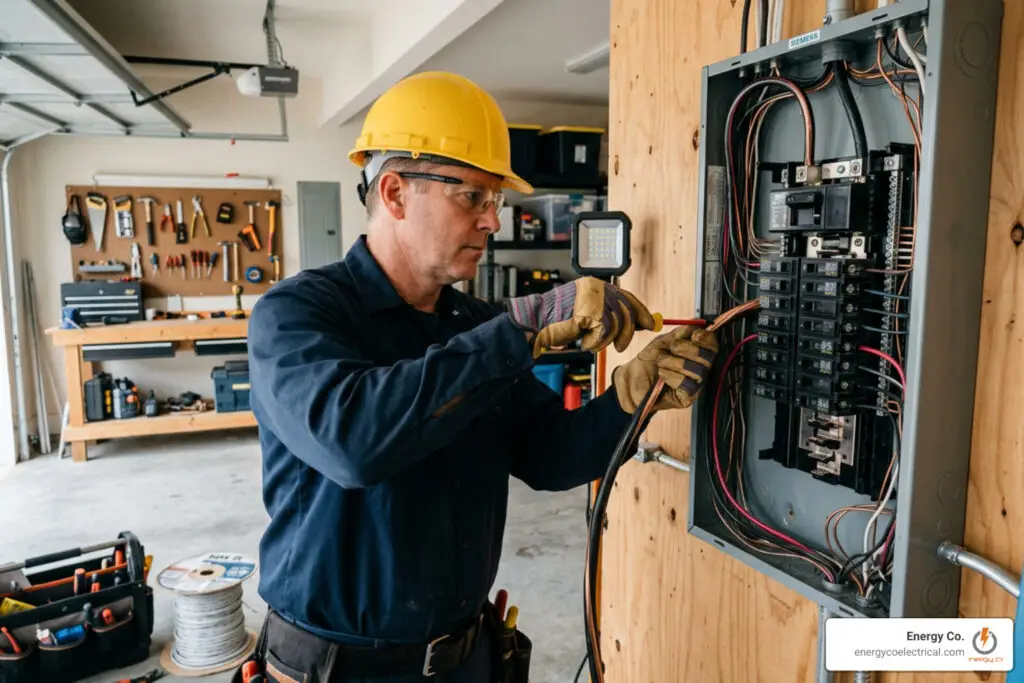
Here is exactly what happens behind the scenes during a professional 200-amp service upgrade:
- Step 1: Load Calculation & Permitting: We perform an official NEC Article 220 load calculation to verify your home’s electrical demand. We then submit the load calculations and panel schedules to your local building department (such as Palatine, Hoffman Estates, or Hanover Park) to secure the required electrical permits.
- Step 2: Utility Coordination: We coordinate with ComEd to schedule a specific date and time for the service disconnect.
- Step 3: Demolition & Prep: Once ComEd cuts the power at the street, we remove the old meter socket, service entrance cables, and your outdated panelboard.
- Step 4: Installing the New Infrastructure: We mount the new 200A-rated meter socket on the exterior wall, install the rigid conduit mast (for overhead services), and pull the new 2/0 copper or 4/0 aluminum conductors.
- Step 5: Setting the New Panel: We install the new 200-amp NEMA-rated load center inside your home, feed the branch circuits into the cabinet, and carefully wire them to the new AFCI and GFCI breakers. We use a calibrated torque screwdriver to tighten every terminal lug to the manufacturer’s exact specifications to prevent hot spots.
- Step 6: Grounding & Bonding: We drive the ground rods and run the bonding jumper to the water main.
- Step 7: Inspection & Re-Energization: The local municipal inspector performs a rough/final inspection to verify code compliance. Once approved, ComEd reconnects the service lateral, and we power up your brand-new system.
If you are looking for a qualified team to handle this complex sequence of events, check out our guide on Finding a Reliable Electrician Near Me: What You Need to Know.
Frequently Asked Questions about 200 Amp Panels
Can I perform a 200 amp panel upgrade as a DIY project?
Absolutely not. Swapping a main electrical panel is not a weekend DIY project. It involves working with live, unfused utility power lines from ComEd that carry enough current to cause fatal arc flashes. Furthermore, virtually all municipalities in the Chicagoland area—including Elk Grove Village, Streamwood, and Mount Prospect—require a licensed electrical contractor to pull the permits for service-level work. If you perform unpermitted electrical work, your homeowner’s insurance carrier has the legal right to deny any future fire claims.
To learn more about why hiring a licensed professional is essential, check out our comprehensive guide: Top Electrical Contractor Services in Chicago: Your Guide.
How long does it take to complete a 200 amp service upgrade?
A standard, straightforward residential 200-amp service upgrade takes about 6 to 8 hours of active on-site work. This means your power will be temporarily shut off for the majority of the workday. We always coordinate closely with you and the utility company to ensure the outage is as brief and minimally disruptive as possible.
What is the difference between a main breaker and a main lug panel?
- Main Breaker Panel: This panel features a built-in main circuit breaker that can shut off all power to the entire panelboard. It is designed to serve as your home’s primary service disconnect.
- Main Lug Panel: This panel does not have a single main breaker. Instead, the incoming hot wires connect directly to “lugs” on the bus bars. Main lug panels are typically used as subpanels (downstream from a main breaker panel) or in specific “meter-main” outdoor combos where the main disconnect is located outside next to the meter.
Conclusion
Upgrading to a 200 amp electrical panel is one of the smartest investments you can make for your home. It provides the essential electrical backbone required to support modern innovations like Level 2 EV chargers, solar power, and energy-efficient heat pumps, all while keeping your family safe from the fire hazards associated with overloaded, outdated breaker boxes.
At Energy Co., we have spent years specializing in the unique electrical needs of homes throughout Chicago and the Northwest Suburbs—including Schaumburg, Hoffman Estates, Rolling Meadows, Palatine, and Roselle. We handle the entire process from start to finish: performing the load calculations, securing the local permits, coordinating with ComEd, and completing a flawless, code-compliant installation backed by our satisfaction guarantee.
If you are ready to future-proof your home’s electrical system, we are here to help. We provide dedicated services across all these communities, ensuring your local electrical upgrades are handled safely, efficiently, and fully up to code.
Ready to take the next step? Schedule your 200 amp electrical panel upgrade with Energy Co. today to request a free, upfront estimate from our licensed team.