Why an AFCI Breaker Upgrade Chicago Homeowners Need Is More Urgent Than You Think
An AFCI breaker upgrade Chicago homeowners and business owners need comes down to one critical fact: older homes and arc faults are a dangerous combination — and Chicago has plenty of both.
Quick Answer: What You Need to Know About AFCI Breaker Upgrades in Chicago
- What they are: Arc-Fault Circuit Interrupter (AFCI) breakers detect dangerous electrical arcing that standard breakers miss
- Who needs them: Any Chicago home being renovated, expanded, or with wiring older than 35 years
- Where required: Bedrooms, living rooms, hallways, dens, and all new construction per the National Electrical Code (NEC)
- Cost: AFCI breakers cost around $55 each (vs. $10 for standard breakers); full upgrades typically run $1,800–$3,500
- Permits: Yes — required in Chicago, with mandatory city inspection after installation
- DIY? No — always hire a licensed electrician for code compliance and safety
Chicago has one of the largest collections of older residential housing in the country. Many of those homes still run on the same wiring installed decades ago — wiring never designed for today’s electrical loads. And here’s the problem: more than 40,000 home fires per year are caused by electrical wiring issues. Most of those fires start silently, from arcing that a standard breaker will never detect.
That’s exactly the gap AFCI breakers were built to close.
Whether you’re planning a home addition, upgrading your service panel, or just trying to keep your family safe, understanding Chicago’s AFCI requirements can save lives — and potentially thousands of dollars in fire damage.
I’m Michał Napieralski, a licensed electrician and founder of Energy Co., serving the Chicago suburbs with specialized expertise in electrical panel upgrades, circuit breaker replacement, and code-compliant residential electrical services — including AFCI breaker upgrade Chicago projects of all sizes. In the sections below, I’ll walk you through everything you need to know to make a smart, informed decision for your home.
What is an AFCI Breaker and Why Does Chicago Need Them?
In electrical safety, we often talk about “tripping a breaker” as a nuisance. But in reality, that trip is your home’s way of screaming for help. While standard breakers protect against overloads and short circuits, they are notoriously “blind” to one of the most common causes of house fires: the arc fault.
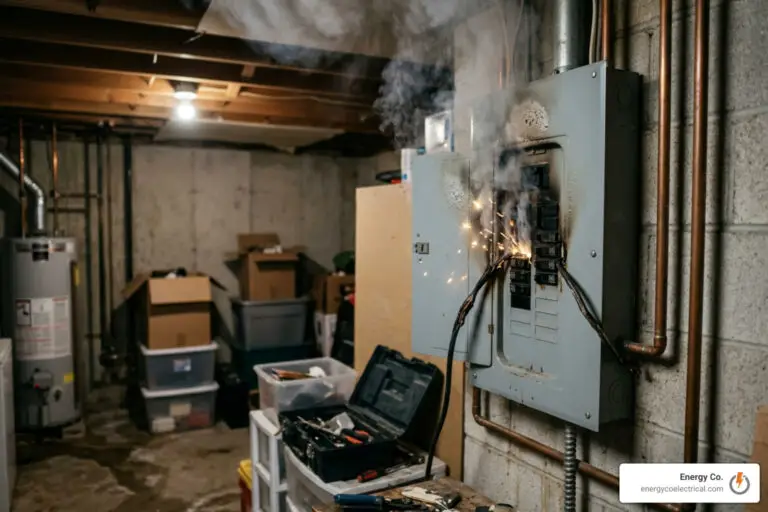
An arc fault occurs when electricity jumps (or “arcs”) between two damaged or loose conductors. This produces intense heat—sometimes exceeding 10,000 degrees Fahrenheit—which can easily ignite wood framing, insulation, or wallpaper.
In our experience providing Residential Electrical Services, we’ve seen everything from rodents chewing through wires in Palatine attics to loose screws in Hoffman Estates outlets. These are the “silent killers” of an electrical system. An AFCI breaker is a specialized device designed to recognize these specific, dangerous arcing patterns and shut off the power before a fire can even begin.
For Chicagoland residents, this isn’t just a “nice-to-have” upgrade. Because our local housing stock includes thousands of historic bungalows and mid-century homes, the wiring is often brittle or stressed by modern appliances. Upgrading to AFCI technology is about bringing 1920s or 1950s infrastructure into the safety standards of 2026.
How AFCI Breakers Work to Prevent Electrical Fires
You might wonder how a simple switch can tell the difference between a dangerous arc and the normal spark you see when you plug in a vacuum cleaner. The secret lies in a tiny microprocessor inside the breaker.
These smart breakers use advanced waveform analysis to monitor the flow of electricity in real-time. They are programmed to recognize the unique “signature” of a dangerous arc. When the microprocessor detects that signature—perhaps caused by a nail driven through a wire behind a wall or a frayed lamp cord—it trips the circuit instantly.
This level of protection is vital because wiring in homes is generally designed to last about 35 years. If your home in Rolling Meadows or Elk Grove Village was built before 1991, your wiring is technically past its prime. AFCI breakers provide a safety net for that aging insulation.
AFCI vs. GFCI: Understanding the Difference
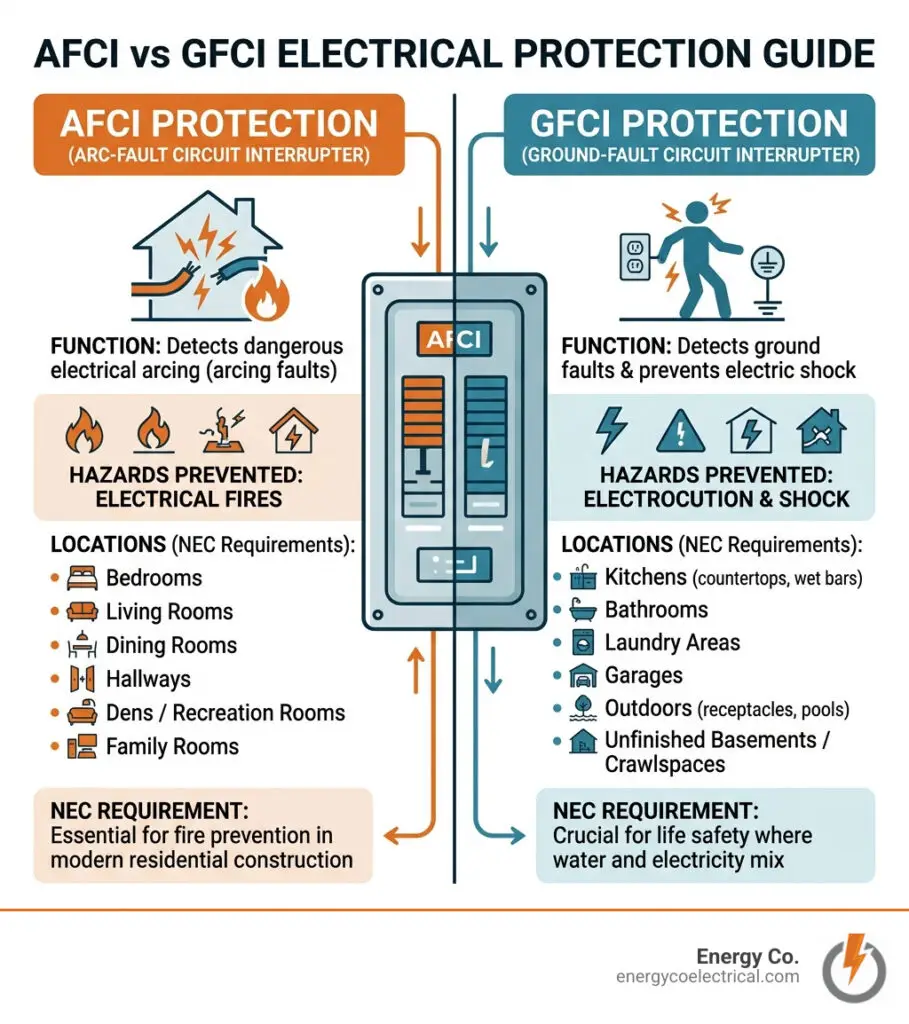
One of the most common questions we get at Energy Co. is, “Don’t I already have those ‘test’ buttons on my outlets?” Usually, they are talking about GFCIs (Ground Fault Circuit Interrupters). While they look similar, they serve completely different masters.
GFCI protection is designed to prevent shocks. It monitors the balance of current and trips if it detects electricity escaping to “ground” (like through a person in a wet bathroom). AFCI protection is designed to prevent fires.
| Feature | GFCI (Ground Fault) | AFCI (Arc Fault) |
|---|---|---|
| Primary Goal | Prevent electrocution/shocks | Prevent electrical fires |
| Detection Method | Current imbalance | Waveform/Arcing patterns |
| Typical Locations | Kitchens, Bathrooms, Garages | Bedrooms, Living Rooms, Dens |
| Hazard Prevented | Electricity through water/human | Heat from sparking/damaged wires |
Many modern Chicago renovations now require “Dual Function” breakers that provide both AFCI and GFCI protection on a single circuit, ensuring you are protected from both shocks and fire.
Navigating Chicago Electrical Codes and NEC Requirements
If you’re planning a project in Mount Prospect or Arlington Heights, you’re going to run into the National Electrical Code (NEC). Specifically, NEC 210.12 is the section that governs AFCI protection.
While the NEC sets the national standard, the City of Chicago and various Cook County municipalities often have their own specific amendments. For example, Chicago’s strict adherence to metal conduit (pipes) for wiring provides a high level of physical protection, but it doesn’t eliminate the risk of arcing at connection points. This is why a professional Circuit Breaker Repair or upgrade is necessary to ensure your specific municipality’s rules are met.
Mandatory Areas for AFCI Breaker Upgrade Chicago
As of 2026, the requirements for AFCI protection have expanded significantly. If you are building a new home or performing a “substantial renovation” (which usually means anything involving a permit), you must install AFCI protection in:
- Bedrooms: This was the original requirement, as many fires start while people are sleeping.
- Living Rooms and Dens: Areas where electronics and lamps are frequently plugged and unplugged.
- Hallways and Closets: Often overlooked, but critical for whole-home safety.
- Kitchens and Laundries: Modern codes now require AFCI protection here in addition to GFCI.
If you are adding a home addition in Streamwood or Hanover Park, the new circuits for those rooms must be AFCI protected to pass inspection.
The Role of Permits and Inspections in Cook County
We cannot stress this enough: do not let a “handyman” swap your breakers without a permit. In Chicago and surrounding suburbs like Cicero, electrical panel work requires a permit from the building department.
Why? Because a AFCI breaker upgrade Chicago involves more than just snapping in a new part. A city inspector will want to verify that the breakers are compatible with your panel brand, that the neutral wires are correctly separated, and that the system is properly grounded.
Permit fees in Cook County typically range from $50 to $300, and while it might seem like a hassle, that “Certificate of Inspection” is your best friend when it comes time to sell your home or file an insurance claim.
Signs Your Older Chicago Home Needs an AFCI Upgrade
How do you know if your home is a candidate for an upgrade? If you live in a house built before the mid-90s, the answer is likely “yes.” But there are specific warning signs that your current system is struggling.
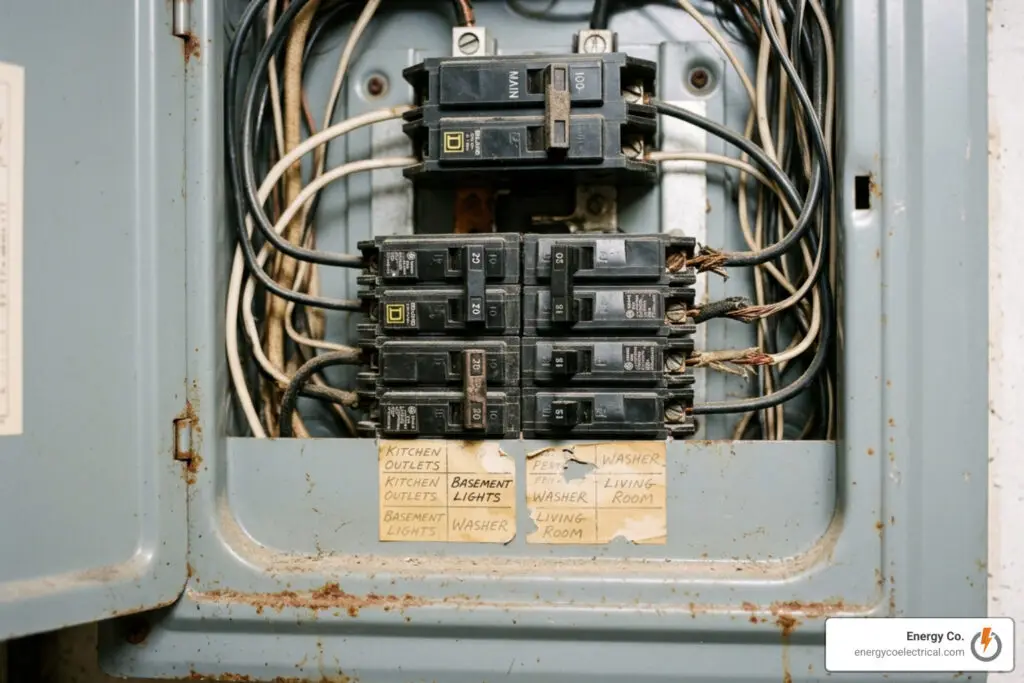
Most Chicago homes were built with 100-amp electrical panels. In the 1960s, that was plenty of power. In 2026, between our EV chargers, high-end HVAC systems, and home offices, 100 amps is often pushing the limit. If you notice your panel is warm to the touch, or you hear a faint buzzing sound, you need an Electrical Panel Upgrade immediately.
Identifying Hazards in Aging Wiring and Aluminum Circuits
If your home in the Northwest Suburbs was built between 1965 and 1973, there is a chance you have aluminum wiring. Due to the high cost of copper during that era, many builders switched to aluminum.
The problem? Aluminum expands and contracts more than copper, which leads to loose connections at outlets and switches. These loose connections are a prime source of arcing. An AFCI breaker upgrade Chicago is one of the most effective ways to mitigate the fire risk associated with aluminum wiring without having to tear out every wire in your walls.
Other hazards include:
- Brittle Insulation: Over time, the plastic coating on wires becomes “crispy” and can flake off, exposing bare wire.
- Overcrowded Boxes: Too many wires stuffed into a single outlet box can lead to pinched insulation and arcing.
- DIY Mistakes: Previous owners who didn’t know the difference between a hot and a neutral wire.
Planning Your AFCI Breaker Upgrade Chicago Process
When you decide to move forward with an upgrade, the process is more than just a quick service call. At Energy Co., we follow a strict protocol:
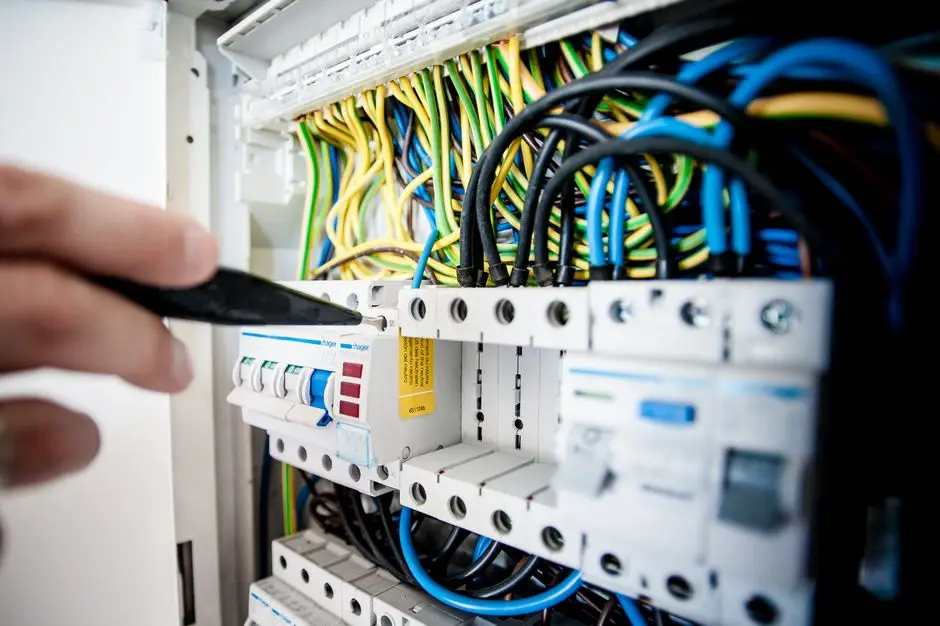
- Professional Assessment: We inspect your current panel for brand compatibility (avoiding dangerous recalled brands like Federal Pacific or Zinsco).
- ComEd Coordination: If we are upgrading your entire service (e.g., from 100-amp to 200-amp), we coordinate with ComEd to disconnect and reconnect your power safely.
- Installation: We install the new AFCI breakers and, if necessary, a new bus bar or entire panel.
- Testing: We use specialized equipment to simulate arc faults and ensure every breaker trips exactly when it should.
If you find yourself in a situation where a breaker won’t reset or you smell “fishy” burning plastic, our Emergency Electrical Services are available 24/7 to stabilize your home.
The Benefits and Costs of an AFCI Breaker Upgrade Chicago
Let’s talk numbers. We know that the cost of living in the Chicago area isn’t getting any cheaper, so we want to be transparent about the investment.
A standard 15-amp breaker might cost $10 at a big-box store. An AFCI breaker? You’re looking at about $55. When you multiply that across 15 or 20 circuits, the material costs add up. However, when you compare the cost of an upgrade to the average cost of fire restoration—which can exceed $50,000—the ROI is clear.
Factors Influencing Installation Pricing in 2026
The total cost for an AFCI breaker upgrade Chicago typically falls between $1,800 and $3,500. Why the wide range? Several factors come into play:
- Panel Capacity: If your current panel is full, we may need to install a sub-panel or upgrade you to a 200-amp service. A 100-Amp to 200-Amp panel upgrade in Chicago generally costs $2,200 – $3,500.
- Wiring Condition: If we find “bootleg grounds” or shared neutrals (common in older Schaumburg homes), we have to fix those issues before an AFCI breaker will even stay on.
- Labor Rates: Chicago labor rates reflect the high level of licensing and insurance required to operate safely in the city.
- Permit Fees: As mentioned, these vary by suburb.
Long-term Value and Safety ROI
Beyond the primary benefit of not having your house catch fire (which is a pretty big benefit!), there are financial perks.
- Home Value: A modern electrical panel upgrade can increase your home’s resale value by $3,000 to $5,000 in the current Chicago market. Buyers in 2026 are tech-savvy; they look at the electrical panel as a sign of how well the home has been maintained.
- Insurance Discounts: Many insurance providers in Illinois offer discounts for homes with updated electrical systems and AFCI/GFCI protection.
- Energy Efficiency: While the breakers themselves don’t save energy, the process of balancing your circuits and tightening connections can lead to more efficient power distribution. Some Chicago residents save up to $1,200 annually after comprehensive electrical upgrades.
Frequently Asked Questions about AFCI Upgrades
Can AFCI breakers be added to my existing panel?
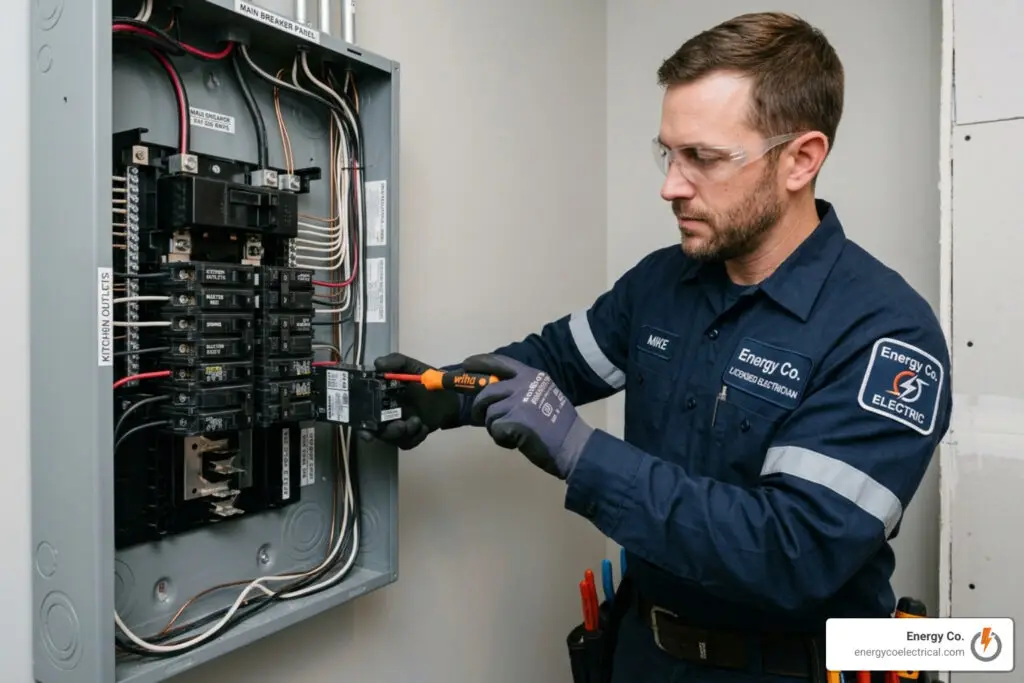
In many cases, yes. If your panel is a modern brand (like Square D, Siemens, or Eaton) and has available space, we can often swap standard breakers for AFCI versions. However, if your panel is more than 25 years old or is a discontinued brand, a full Electrical Panel Upgrade is usually the safer and more cost-effective route in the long run.
How long does a typical AFCI installation take?
For a standard breaker swap-out on a healthy panel, we can usually finish in about 4 to 8 hours. This includes the time needed for testing each circuit. If a full panel replacement is required, it may take a full day, including the time for the ComEd disconnect/reconnect and the initial city inspection.
Why do AFCI breakers trip more than standard ones?
This is what we call “nuisance tripping,” and it’s the number one complaint about AFCI technology. However, it’s often not the breaker’s fault. Because AFCI breakers are so sensitive, they might trip because of:
- Damaged Cords: A frayed toaster cord that you didn’t notice.
- Cheap Electronics: Some low-quality power supplies create “dirty” power that looks like an arc to the breaker.
- Vacuum Motors: Older vacuums with worn-out “brushes” create internal sparks that can trigger a trip.
If your new breaker is tripping, don’t just swap it back to a standard one. It’s doing its job by telling you there is a problem somewhere on that line. We can help you troubleshoot and find the specific device or wire causing the issue.
Conclusion
At the end of the day, your home’s electrical system is like its nervous system. It’s complex, it’s vital, and when it’s outdated, it can be dangerous. An AFCI breaker upgrade Chicago is one of the single most effective steps you can take to protect your property and your loved ones from the devastating reality of electrical fires.
At Energy Co., we take pride in our deep roots in the Chicagoland area. Whether you’re in the heart of the city, the Northwest Suburbs, or anywhere in Cook County, our team of licensed professionals is ready to bring your home up to 2026 safety standards. We don’t just “fix wires”—we provide peace of mind with a satisfaction guarantee.
Ready to secure your home? Explore Our Services or Contact Us today for a professional assessment of your electrical panel. Don’t wait for a spark to tell you it’s time for an upgrade.
Energy Co. Serving Chicago, Schaumburg, Hoffman Estates, and the Greater Chicagoland Area. Contact Us Today