What Does an Electrical Panel Upgrade Actually Cost in 2026?
Electric panel price varies widely — and if you’re staring down a tripping breaker or planning to add an EV charger, you need real numbers fast. Here’s a quick snapshot:
| Project Type | Typical Cost Range |
|---|---|
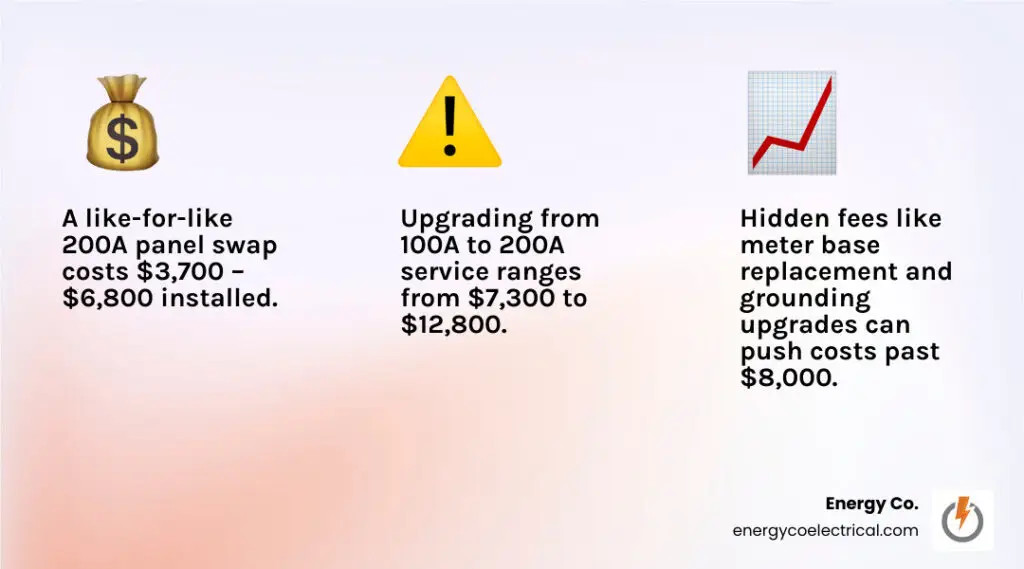
| Like-for-like 200A panel swap | $3,700 – $6,800 |
| 100A to 200A service upgrade | $7,300 – $12,800 |
| Upgrade to 400A service | $8,200 – $14,900 |
| Add a 100A sub-panel | $2,800 – $5,100 |
| Smart panel (e.g., Span Drive) | $5,800 – $9,000 |
These are installed costs — meaning labor, materials, and permits included. The panel hardware itself is only a fraction of what you’ll pay.
Most homeowners are caught off guard. You budget for a “panel swap” and then discover you also need a new meter base, utility coordination, grounding upgrades, and AFCI breakers to meet current code. Costs that looked like $2,000 can quietly climb past $8,000.
This guide breaks down every cost driver — amperage, labor, permits, smart panels, and Chicago-specific factors — so you can compare quotes with confidence and avoid expensive surprises.
I’m Michał Napieralski, a licensed electrician serving the Chicago suburbs, and I’ve helped hundreds of Chicagoland homeowners navigate electric panel price decisions across everything from century-old bungalows to modern commercial builds. Let’s walk through what you actually need to know before you call a contractor.
Simple guide to electric panel price terms:
Understanding the Average Electric Panel Price and Installation Costs
When you start researching the electric panel price, it is easy to get overwhelmed by the range of numbers you find online. Nationally, the average cost to replace an electrical panel is around $1,342, with a broad range from $125 (for a basic, small DIY subpanel unit) up to $4,500 or more for complex residential projects. However, a complete, professional service-side upgrade in 2026 typically starts higher because of labor, permitting, and strict safety codes.
To understand where your money actually goes, we have to look at the three core pillars of any electrical estimate: materials, labor, and compliance.
The Material Cost
The physical breaker box is only a small portion of the total bill. A standard, high-quality 200-amp traditional panel costs between $400 and $700 for the hardware alone. Brands like Square D, Siemens, Eaton, and Leviton all offer excellent residential panels, but their prices vary slightly depending on the number of spaces and the type of bus bars used. If you are looking at Typical cost ranges and factors for U.S. buyers, you will see that premium solid-state or highly branded lines can add $200 to $800 in base materials.
The Labor Rate
The majority of your investment goes toward professional labor. Working with high-voltage electricity is inherently dangerous and requires years of specialized training. Professional electricians typically charge between $50 and $150 per hour. For a standard panel replacement, expect 4 to 8 hours of active labor. If we are running complex new lines through older finished walls, that time can easily double.
At Energy Co., we always tell our clients that paying for experienced labor is about buying peace of mind. A poorly installed panel is a major fire hazard and can lead to expensive code violations down the road. You can learn more about how these systems function in our guide on Demystifying your home electric panel.
Permits and Inspections
You should never trust a contractor who offers to replace your main panel without pulling a permit. In almost every U.S. jurisdiction, main panel and service-side work strictly require a permit and a final inspection by the local Authority Having Jurisdiction (AHJ). Permit fees typically range from $150 to $1,500 depending on your municipality. Skipping this step can void your homeowners insurance policy and make it incredibly difficult to sell your home in the future.
How Amperage Affects the Base Electric Panel Price
The electrical capacity of your home is measured in amperes (amps). The higher the amperage, the more electrical current your home can safely draw at one time. Naturally, as capacity increases, the physical size of the panel, the thickness of the service wires, and the overall electric panel price go up.
Here is a detailed breakdown of how amperage impacts your bottom line:
| Amperage Capacity | Best Suited For | Typical Installed Cost Range (2026) |
|---|---|---|
| 100 Amps | Small homes, gas-heated properties, minimal high-draw appliances | $1,200 – $2,000 |
| 200 Amps | Standard modern homes, homes with central AC, EV chargers, or hot tubs | $3,700 – $6,800 (Like-for-Like Swap) $7,300 – $12,800 (Service Upgrade) |
| 400 Amps | Large luxury estates, fully electrified homes, multiple heat pumps, dual EV chargers | $8,200 – $14,900 |
- 100-Amp Panels: While 100A was the standard for decades, it is now considered the bare minimum. If you have a smaller home with gas appliances, a 100A panel might suffice, but it leaves almost no room for future expansion like solar panels or electric vehicles.
- 200-Amp Panels: This is the baseline standard for modern residential construction. A standard 200A panel provides enough breathing room to run a central air conditioner, a Level 2 EV charger, and everyday household appliances simultaneously without overloading the system.
- 400-Amps (Class 320): This is increasingly becoming the go-to choice for homeowners who want to fully electrify their properties. If you are planning to install multiple heat pumps, solar arrays, battery backups, and dual EV chargers, a 400A service upgrade ensures your home is fully future-proofed.
Hidden Fees That Drive Up the Total Electric Panel Price
When homeowners receive a quote that is higher than the basic national averages, it is usually because of necessary, code-mandated upgrades that are not part of a simple “box swap.” When upgrading your service, we are legally required to bring the entire service entrance up to the latest National Electrical Code (NEC) standards.
Here are the most common hidden fees that can drive up your total electric panel price:
- Utility Coordination Fees ($470 – $800): Upgrading your service capacity means coordinating with your local utility company (like ComEd in Chicagoland) to disconnect the power from the street, verify the service drop, and reconnect the system.
- New Meter Base ($294 – $500): Your old meter box on the outside of your house is likely rated for only 100 or 150 amps. When upgrading to 200A or 400A, we must install a new, modern meter socket that can handle the higher current.
- Service-Entrance Cables ($470 – $800): The thick wires running from the utility connection on your roof (or underground) down to your meter and into your panel must be replaced with heavier-gauge copper or aluminum wires.
- Grounding and Bonding Upgrades ($235 – $400): Modern codes require robust grounding. This typically involves driving two 8-foot copper grounding rods into the earth outside your home and bonding your electrical system to your main metal water service line.
- Arc-Fault Circuit Interrupter (AFCI) Breakers: Under the modern NEC, almost all residential branch circuits must be protected by AFCI breakers, which detect dangerous electrical sparking. While a standard breaker costs $10 to $20, an AFCI breaker costs $50 to $100. If your home has 20 circuits, upgrading them to AFCI can add $1,000 to $2,000 in materials alone.
To get a better sense of how these individual components come together, take a look at our Step-by-step guide to electric panel upgrade costs.
Upgrading vs. Replacing: When to Swap the Box
Many homeowners ask us if they really need a full service upgrade or if a simple like-for-like replacement is enough.
To make the right choice, it helps to understand the difference:
- Panel Replacement: This is a “like-for-like” swap. If you currently have a 200-amp panel that is damaged, rusted, or obsolete, we swap it with a brand-new 200-amp panel. The service lines from the street remain the same.
- Panel Upgrade: This involves increasing your home’s electrical capacity (e.g., upgrading from 100A to 200A or 200A to 400A). This requires replacing the meter socket, the service wires, and coordinating with the utility company.
Electrical panels typically last between 25 and 40 years. If your panel is approaching or has exceeded this age limit, it is time to plan for a replacement. For a detailed breakdown of what a standard replacement looks like, check out our guide on How much to swap the box.
The Danger of Obsolete Panel Brands
If your home has an electrical panel manufactured by Federal Pacific Electric (FPE) or Zinsco, you should not wait for it to fail. These legacy brands have documented design flaws. FPE “Stab-Lok” breakers are notorious for failing to trip during an overload, which can cause the wires to overheat and catch fire. Many homeowners insurance companies will actively refuse to cover or renew policies for homes that still contain these dangerous, recalled panels. Replacing them is not just an aesthetic upgrade; it is a critical safety necessity.
Signs Your Panel is Failing and Needs Immediate Replacement
How do you know if your electrical panel is actively failing? Look out for these warning signs:
- Flickering or Dimming Lights: If your lights flicker whenever your refrigerator kicks on or you start the microwave, your panel is struggling to distribute power evenly.
- A Warm Panel or Breakers: Touch the front cover of your electrical panel. It should feel cool to the touch. If individual breakers or the panel door itself feel warm, it indicates loose connections or a dangerous overload.
- A Faint Burning Smell: A fishy or plastic-like burning odor near your breaker box is a critical emergency. It means wire insulation is melting due to extreme heat.
- Corrosion and Rust: If your panel is located in a damp basement or has experienced water intrusion from the service cable, rust can ruin the connection points between the breakers and the bus bars.
- Frequently Tripping Breakers: While breakers are designed to trip to protect your home, constant tripping means your circuits are overloaded and cannot support your modern lifestyle.
If you are experiencing these issues, you might want to read about The shocking truth about circuit breaker replacement costs to see if the issue is isolated or requires a complete panel overhaul.
Can You Repair a Circuit Breaker Instead of Replacing the Panel?
If you only have one or two troublesome circuits, you might not need a whole new panel. In some cases, we can simply replace an individual faulty circuit breaker or add tandem breakers to create more space.
- Individual Breaker Replacement: If a single breaker has worn out but the rest of the panel and the underlying bus bars are in pristine condition, replacing that single breaker is a quick and affordable fix.
- Bus Bar Damage: If a breaker has melted or arced, it often damages the metal “bus bar” it snaps onto. Once a bus bar is pitted, rusted, or burned, the panel cannot be safely repaired. In this scenario, a full panel replacement is the only safe option.
For budget-friendly repair options, you can explore The cheapest ways to repair a circuit breaker or look into our professional Circuit breaker repair services.
Smart Panels vs. Traditional Panels: Is the Premium Worth It?
As we move deeper into 2026, home energy technology is evolving rapidly. One of the biggest decisions homeowners face today is whether to install a traditional electrical panel or invest in a modern smart electrical panel.
Smart panels use software-controlled breakers to give you unprecedented control over your home’s energy. Here is how the costs and features stack up:
- Traditional 200A Panel ($2,400 – $5,800 installed): This is a standard analog panel. It works wonderfully, lasts for decades, and is highly reliable. However, it offers no data tracking, no remote control, and cannot dynamically manage your power.
- Span Drive Smart Panel ($5,800 – $9,000 installed): Span is the market leader in smart panels. It allows you to monitor your energy consumption down to the individual circuit level via a smartphone app. You can turn circuits on or off remotely and prioritize backup power during an outage.
- Schneider Square D Energy Center ($5,200 – $8,500 installed): This system combines smart circuit management, solar inverter connections, and battery storage readiness into a single, clean outdoor-rated enclosure.
- Lumin Smart Panel ($2,800 – $4,800 installed): Lumin is an “add-on” smart platform. Instead of replacing your entire main panel, Lumin installs next to your existing panel and makes up to 12 of your high-draw circuits fully smart and controllable.
To run the numbers for your specific setup, you can use a Smart electrical panel cost calculator or consult The homeowner guide to buying a 200 amp electrical panel.
Electrification Without a Service Upgrade
One of the coolest features of smart panels and modern load-shedding devices is their ability to perform dynamic load management.
If you live in an older home with 100-amp or 150-amp service, upgrading to a 200-amp service can sometimes be incredibly expensive — especially if your utility lines are buried underground and require extensive trenching.
With dynamic load management, a smart panel or a dedicated load-shedding device ($1,000 – $2,400 installed) can monitor your home’s total power draw in real time. If you are charging your EV and turn on your electric dryer and electric range at the same time, the smart system will temporarily pause or throttle the EV charger to prevent your main breaker from tripping. Once the range or dryer is turned off, the system automatically resumes charging your car.
This technology allows you to fully electrify your home without paying for a costly physical service upgrade from your utility provider, potentially saving you between $1,500 and $5,500. Additionally, under the High-Efficiency Electric Home and Appliance Rebates (HEEHRA) program, income-qualified households may eligible for up to $4,000 in rebates for panel upgrades. Learn more about avoiding unexpected costs in our detailed guide: The cost to upgrade to a 200 amp panel without getting zapped.
Regional Cost Factors and What to Expect in Chicagoland
If you live in Chicago or the surrounding suburbs, your electric panel price will look different than national averages. In fact, electrical panel upgrades in the Chicagoland area typically cost about 24% more than the national average, with a standard 100A to 200A service upgrade ranging between $9,000 and $15,850.
Why is Chicagoland more expensive? It comes down to two major local factors:
- Strict Metal Conduit Requirements: Unlike most parts of the country where contractors can run flexible plastic-sheathed Romex wire through walls, the City of Chicago and many surrounding Cook County suburbs strictly mandate the use of rigid metal conduit (EMT) for all residential wiring. Bending and running steel pipes through finished walls requires an incredibly high level of craftsmanship and takes significantly more time, which drives up labor costs.
- ComEd Coordination and Weather: Coordinating service disconnects and reconnects with Commonwealth Edison (ComEd) requires careful planning. Additionally, our severe Midwest winters can make outdoor meter installations and ground rod installations much more difficult, meaning late spring, summer, and early fall are peak seasons with higher demand and longer lead times.
If you are planning a project in our area, check out this Electrical panel upgrade cost guide to see how local factors influence regional pricing.
Frequently Asked Questions About Electrical Panel Upgrades
How long does an electrical panel replacement take, and will my power be off?
A standard panel replacement or service upgrade typically takes 4 to 8 hours of active installation time for a team of professional electricians. During this window, your power will be completely turned off. We coordinate directly with ComEd to pull your meter and safely disconnect the power from the street. We recommend keeping your refrigerator and freezer doors closed during the installation to preserve your food. Once our work is complete and passes safety checks, the power is turned back on.
Does homeowners insurance or a home warranty cover panel replacement?
Generally speaking, homeowners insurance and home warranties do not cover standard panel replacements due to normal wear, tear, or old age. However, there are two exceptions:
- Accidental Damage: If your panel is damaged by a lightning strike, a fallen tree limb on your service line, or a house fire, your homeowners insurance will typically cover the replacement cost (minus your deductible).
- Obsolete Panels: If you have a recalled, fire-prone panel like Federal Pacific or Zinsco, some insurance companies may require you to replace it as a condition for keeping or renewing your policy.
Do I need a permit for an electrical panel upgrade?
Yes, absolutely. In Chicago, Schaumburg, Hoffman Estates, and every other Cook County municipality, pulling a permit is legally required for any main service panel work. A permit ensures that a certified local building inspector will visit your home to verify that our work complies with the latest electrical safety codes. To estimate your permit and overall project fees, you can use this Electrical panel upgrade cost calculator.
Conclusion
Upgrading or replacing your electrical panel is a major investment, but it is one of the most important steps you can take to protect your family, secure your home’s equity, and prepare for a clean energy future.
Whether you live in a historic bungalow in Chicago, a modern home in Schaumburg, or a commercial property in Arlington Heights, our team at Energy Co. is here to help. We provide residential, commercial, and industrial electrical services across Cook County and the Northwest Suburbs — including Rolling Meadows, Palatine, Roselle, Streamwood, Hanover Park, Mount Prospect, Elk Grove Village, and Cicero.
With our deep local expertise in Chicago’s unique metal conduit codes, licensed professionals, and a 100% satisfaction guarantee, we make the process simple, safe, and transparent.
Ready to get an accurate, honest quote for your home? Schedule your electrical panel upgrade today with the trusted team at Energy Co.