How to Schedule a Commercial Electrical Inspection
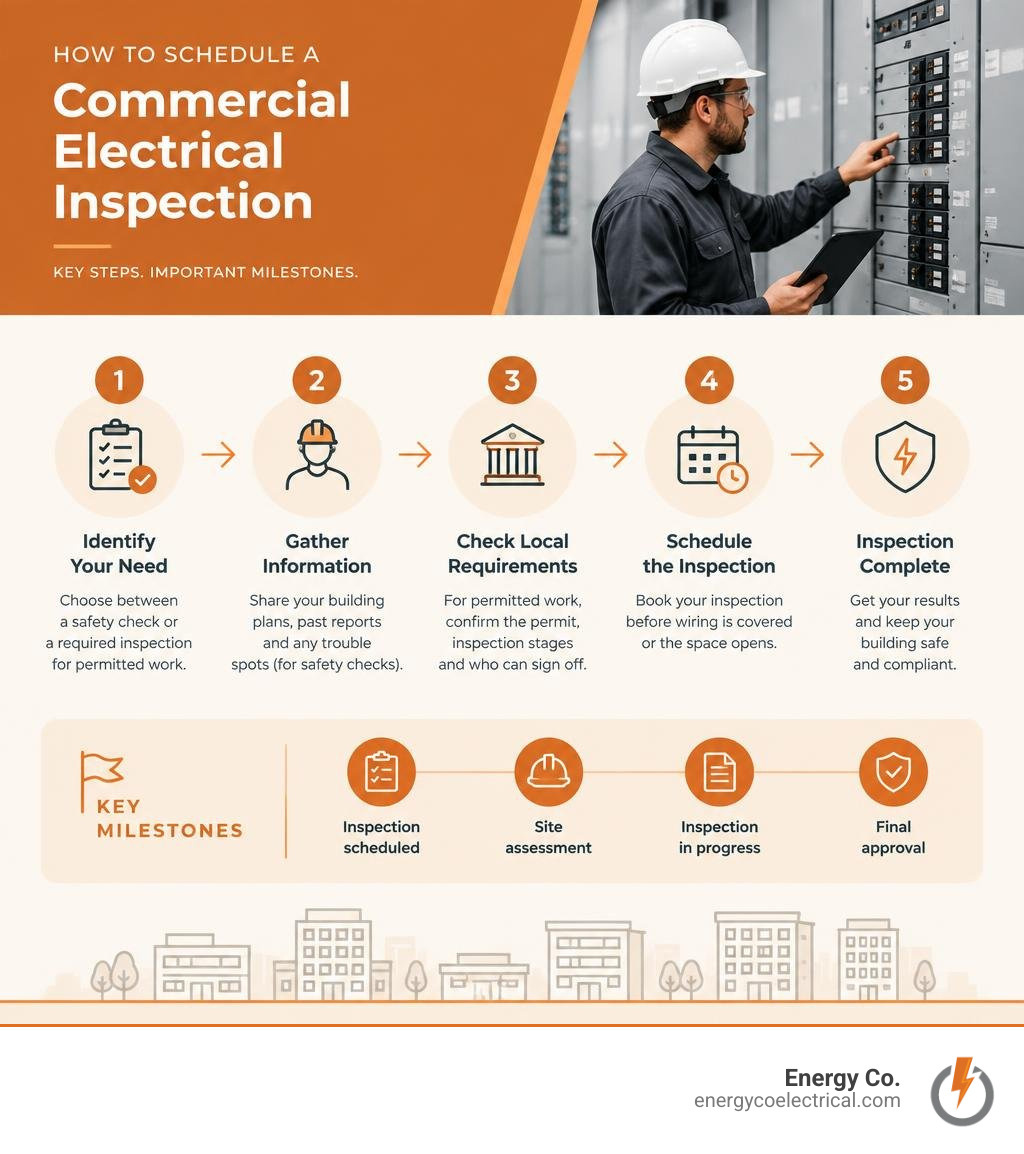
To schedule a commercial electrical inspection, first decide what you need: a safety check of an existing building or a required inspection for permitted work. For a safety check, contact a qualified commercial electrician and share your building’s plans, past inspection reports, and any trouble spots. For permitted work, check with your local building department about the permit, inspection stages, and who can sign off. Schedule before wiring is covered or the space opens.
I’m Michał Napieralski, and I’ll show you what to expect at each step.
Quick commercial electrical inspection terms:
What Is a Commercial Electrical Inspection and Why Is It Vital?
A commercial electrical inspection is a comprehensive evaluation of a building’s entire electrical distribution network, life-safety hardware, and heavy machinery feeds. Unlike standard maintenance, an inspection measures your property against strict safety standards to ensure electrical fire risks, life-safety hazards, and code violations are identified before they lead to structural damage or municipal fines.
For property managers, building owners, and business operators across Chicago, Schaumburg, Hoffman Estates, and throughout Cook County, keeping systems compliant protects your bottom line. An electrical audit mitigates operational risks, prevents unexpected downtime, and satisfies property insurance mandates.
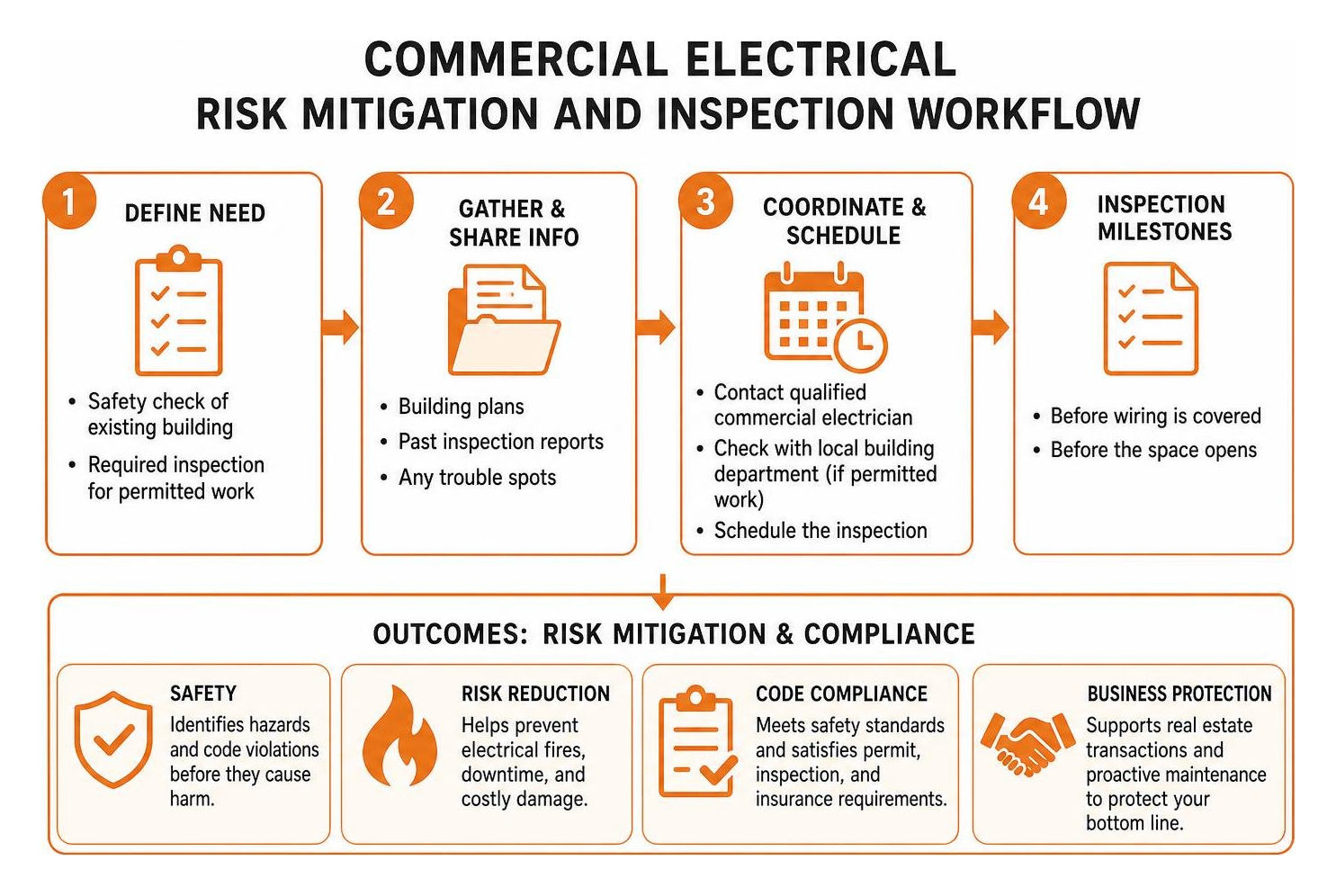
Conducting a thorough electrical review is equally vital during real estate transactions. When entering a commercial lease or purchasing an industrial facility in Elk Grove Village or Palatine, a pre-purchase or pre-lease inspection prevents you from inheriting thousands of dollars in hidden wiring defects. Having documented verification of code compliance gives business owners leverage during lease negotiations and establishes a benchmark for proactive commercial electrical repair strategies that extend equipment longevity.
Commercial vs. Residential Electrical Systems
Commercial electrical infrastructure operates on an entirely different scale than residential wiring. While a typical home runs on single-phase 120/240V power with non-metallic sheathed cables behind drywall, commercial facilities demand three-phase distribution networks delivering 120/208V or 277/480V to handle massive inductive loads from HVAC systems, industrial machinery, and complex lighting arrays.
| Inspection Factor | Residential Electrical Systems | Commercial Electrical Systems |
|---|---|---|
| Primary Voltage | 120/240V Single-Phase | 120/208V or 277/480V Three-Phase |
| Typical Service Size | 100A to 200A (Rarely 400A) | 400A to 4000A+ Switchgear |
| Wiring Protection | NM-B (Romex) permitted in framing | Rigid conduit, EMT, or MC metallic raceways |
| Working Clearances | Standard 30″ wide clearance | Strict dedicated 36″ x 30″ x 78″+ clear work zones |
| Life-Safety Mandates | Smoke/CO alarms, local AFCI/GFCI | Emergency illuminated exit signs, generators, central fire alarms |
| Regulatory Oversight | Basic municipal residential codes | NEC, IBC, IECC, OSHA, NFPA, and local amendments |
Because commercial environments experience higher electrical stresses, raceways must rely on rigid metallic tubing rather than exposed cables. Enforcing these parameters protects facility occupants and avoids electrical arc-flash incidents.
Core Codes and Compliance Standards
Commercial installations must satisfy multiple overlapping regulatory standards:
- National Electrical Code (NEC / NFPA 70): Establishes the baseline rules for conductor sizing, overcurrent protection, grounding, bonding, and equipment clearances.
- International Building Code (IBC) & International Energy Conservation Code (IECC): Dictate structural penetration firestopping, automated lighting controls, and energy efficiency baselines.
- Occupational Safety and Health Administration (OSHA): Focuses on worker safety, arc-flash boundary labeling, lock-out/tag-out mechanisms, and open panel hazards.
- International Standards of Practice for Inspecting Commercial Properties (ComSOP): Governs third-party baseline condition assessments.
- Americans with Disabilities Act (ADA): Defines reach ranges and maximum mounting heights for switches, disconnects, and service controls.
Implementing professional commercial wiring methods ensures your facility effortlessly complies with these layered standards and passes local municipal reviews.
Navigating the Commercial Electrical Inspection Process Step-by-Step
A commercial electrical inspection follows a structured sequence coordinated with your local Authority Having Jurisdiction (AHJ). The process begins with obtaining building permits and submitting architectural engineering plans. In many regional jurisdictions, commercial installations exceeding 400-amp service require comprehensive plan reviews before permits are issued.
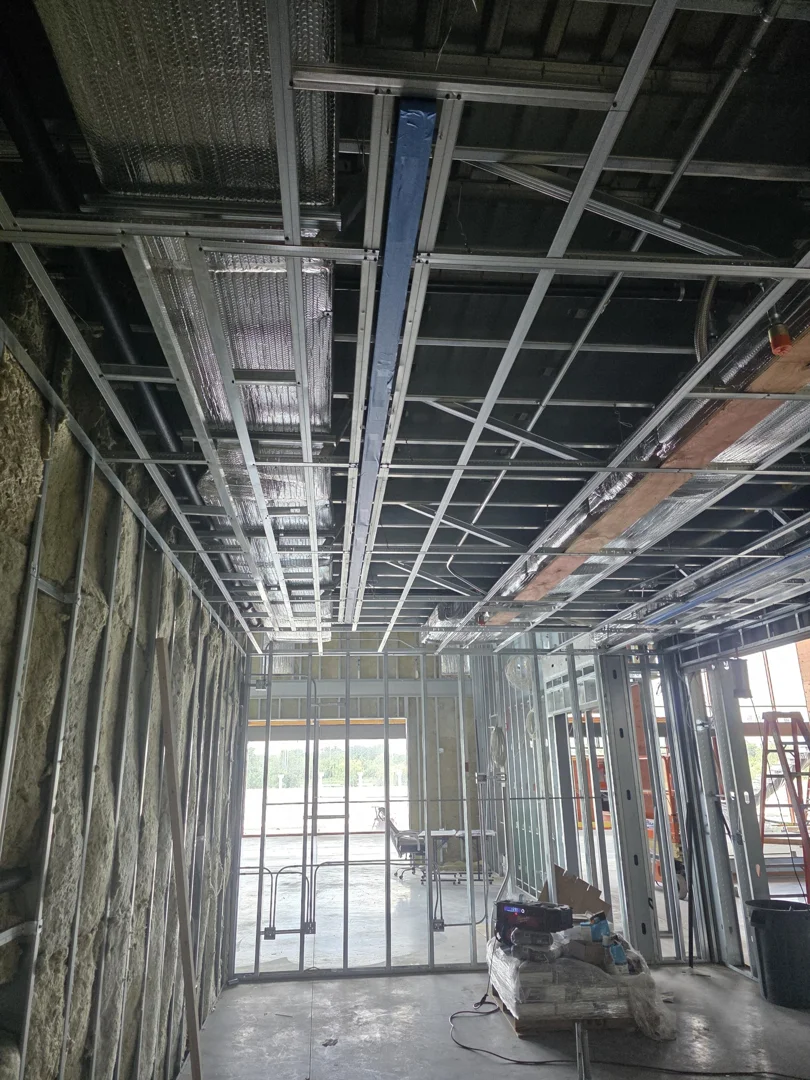
During construction or remodeling, inspectors from local building departments—such as those serving Streamwood, Rolling Meadows, or Hanover Park—coordinate with electrical contractors to evaluate the installation at critical build milestones before any power is energized.
Phase-by-Phase Inspection Milestones
Commercial builds move through distinct inspection phases to confirm compliance at every layer:
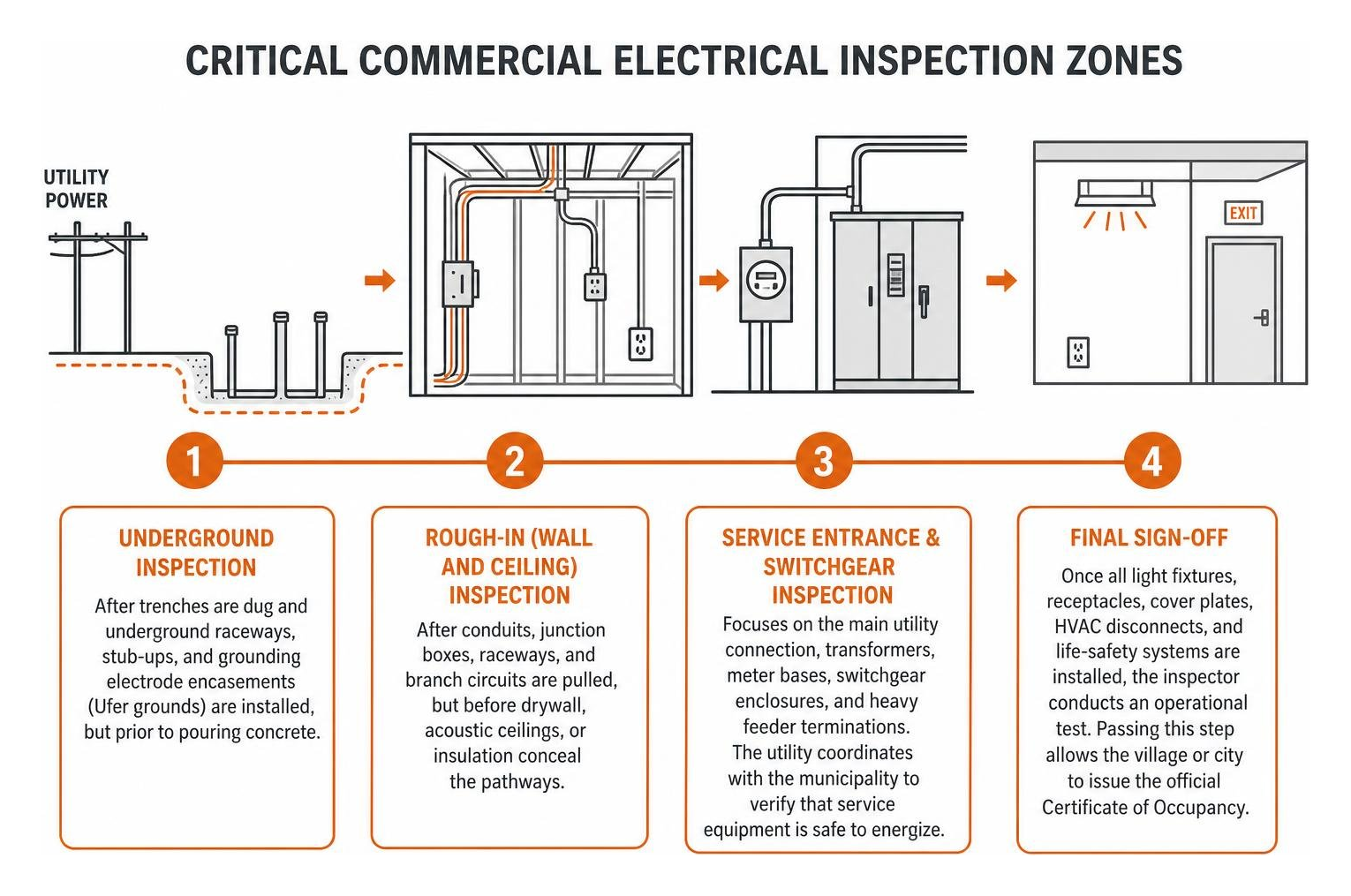
- Underground Inspection: Conducted after trenches are dug and underground raceways, stub-ups, and grounding electrode encasements (Ufer grounds) are installed, but prior to pouring concrete.
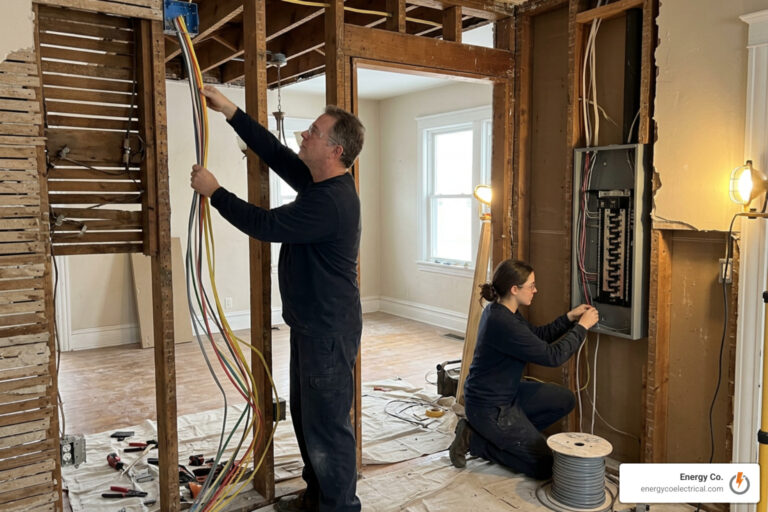
- Rough-In (Wall and Ceiling) Inspection: Scheduled after conduits, junction boxes, raceways, and branch circuits are pulled, but before drywall, acoustic ceilings, or insulation conceal the pathways. Inspectors confirm box support, raceway bonding, and wire ampacity.
- Service Entrance & Switchgear Inspection: Focuses on the main utility connection, transformers, meter bases, switchgear enclosures, and heavy feeder terminations. The utility coordinates with the municipality to verify that service equipment is safe to energize.
- Final Sign-Off: Once all light fixtures, receptacles, cover plates, HVAC disconnects, and life-safety systems are installed, the inspector conducts an operational test. Passing this step allows the village or city to issue the official Certificate of Occupancy.
Commercial inspectors prepare for these milestones by mastering rigorous testing standards. In fact, professional examinations such as the certified commercial electrical inspector exam domains test candidates extensively across branch circuit requirements (19%), wiring methods (19%), service installations (17%), and general equipment (12%) to ensure no detail is overlooked.
Preparing Your Facility for a Commercial Electrical Inspection
Preparation is the best way to prevent re-inspection fees and job site delays. When preparing an existing building or active build-out:
- Clear Dedicated Working Spaces: Maintain the mandatory 36-inch clearance in front of panels, switchgear, and transformers. Keep these areas entirely free of pallets, boxes, or stored materials.
- Verify Panel Labeling and Schedules: Ensure every circuit breaker in every distribution panel is clearly identified with a permanent, typed schedule.
- Check Conductor Terminations: Verify that all phase tape, terminal torques, and splices inside enclosures are cleanly executed with no exposed copper strands.
- Implement Safety Signage: Install required arc-flash warning labels, service disconnect identification, and voltage rating plaques on all panel doors.
- Audit Your Maintenance Records: Having documentation ready demonstrates compliance and ties directly into preventive commercial electrical maintenance practices.
Critical Systems and Components Inspected in Commercial Facilities
A thorough inspection examines your entire distribution network from where utility power enters the building to the individual branch devices powering office equipment.
Special attention is paid to main service equipment, grounding electrode systems, bonding jumpers, and overcurrent protection devices. Inspectors check that modern commercial lighting and retrofit systems meet energy code shut-off parameters and emergency battery-pack illumination requirements.
Service Entrance, Panels, and Distribution Systems
The service entrance serves as the core of your facility’s electrical network. Inspectors assess:
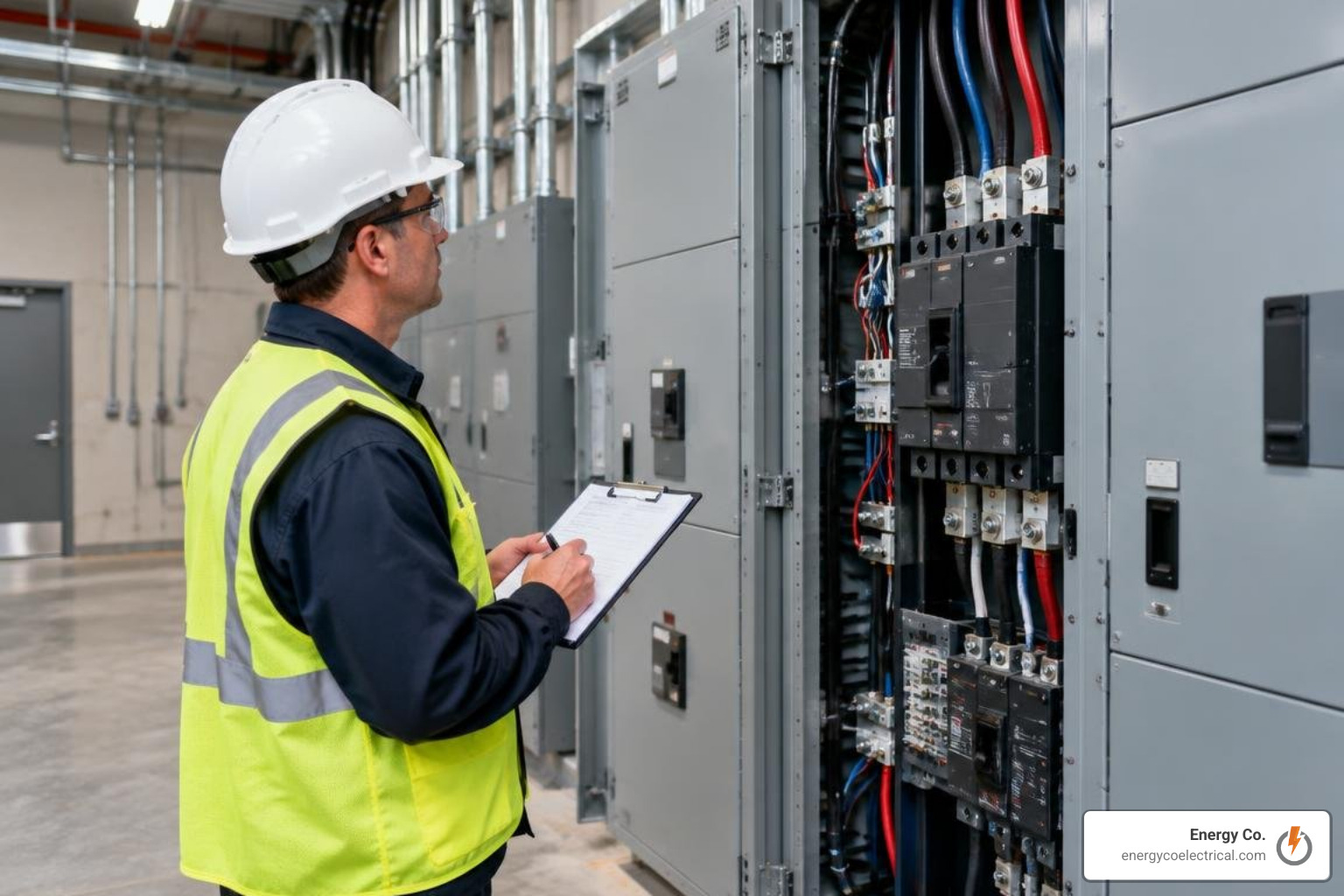
- Switchgear and Panelboard Integrity: Checking for physical corrosion, moisture intrusion, and adequate ventilation.
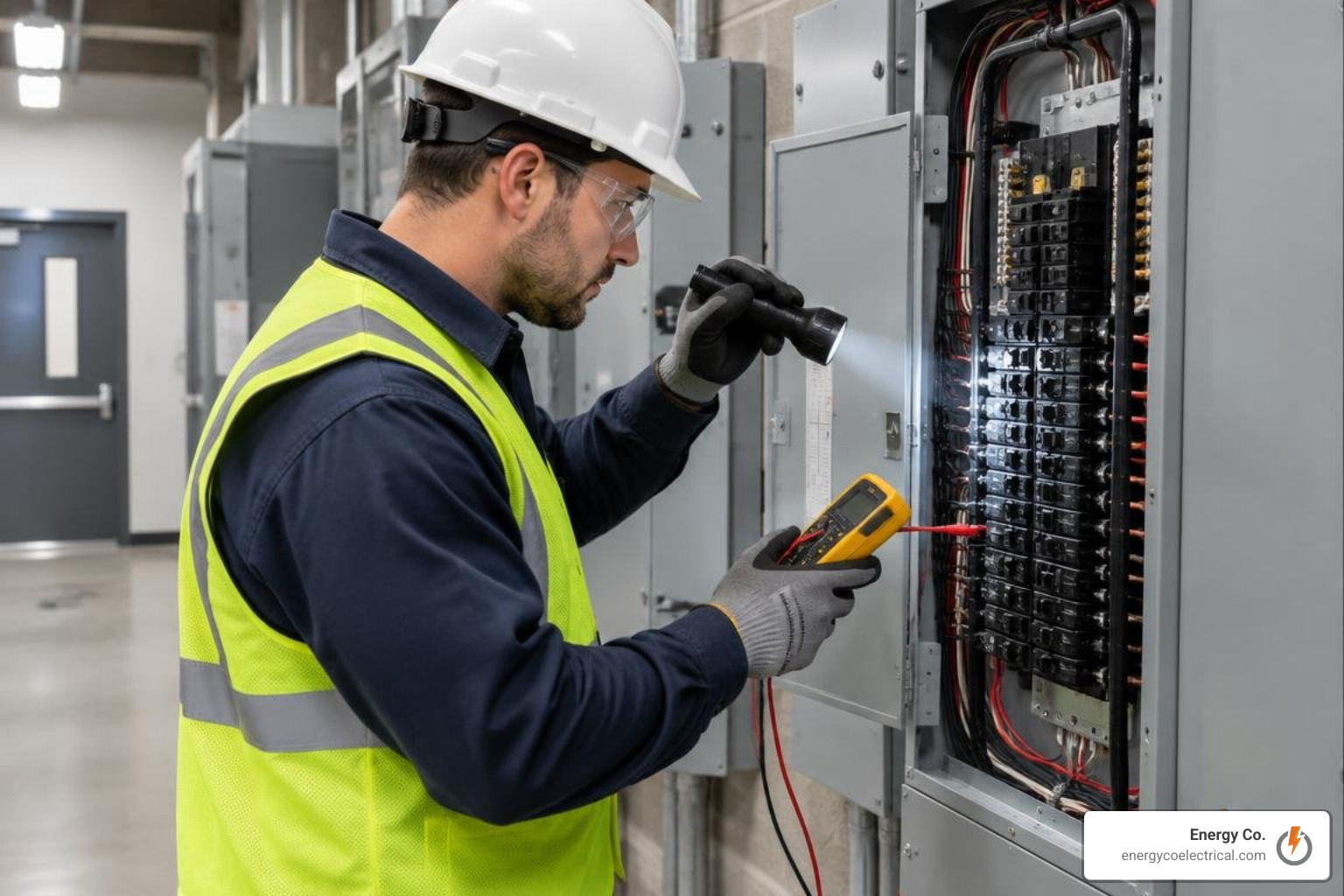
- Thermal Imaging Evaluations: Using infrared thermography to identify loose lug connections, unbalanced phase loads, or overloaded breakers radiating excessive heat.
- Step-Down Transformers: Verifying correct grounding of separately derived systems, secondary conductor overcurrent protection, and adequate clearance around ventilation louvers.
- Feeder Sizing: Cross-referencing conductor gauge against actual building load calculations as detailed in commercial wiring specifications.
Life-Safety, Emergency Lighting, and Special Occupancies
Commercial facilities house specialized systems that protect life and property during an emergency. Inspectors verify that emergency lighting and illuminated exit signs remain energized on internal battery backup for a minimum of 90 minutes during a power failure.
Specialized commercial occupancies require additional inspection protocols:
- Healthcare Facilities (NEC Article 517): Requires redundant equipment grounding, isolated power systems in operating suites, and emergency branch circuits split into critical, life-safety, and equipment branches.
- Hazardous Locations (NEC Articles 500-516): Chemical storage areas, spray booths, and industrial processing plants require explosion-proof enclosures, rigid threaded conduit seals, and intrinsically safe wiring to prevent sparks from igniting flammable vapors or combustible dust.
- Commercial Garages and Repair Shops (NEC Article 511): Areas subject to volatile fumes demand elevated receptacle heights, hazardous-area classifications, and robust ventilation interlocks.
- Industrial Facilities: Plants with heavy motor banks require specialized testing, making specialized industrial electrical solutions essential for continuous compliance.
Managing Costs, Inspector Credentials, and Code Violations
Commercial electrical inspections in regional markets like Cook County typically range from $300 to $500 for standard retail spaces or small offices, with larger industrial complexes and multi-tenant commercial centers costing more depending on system complexity and total square footage.
Failing an inspection carries steep financial consequences. Beyond paying municipal re-inspection fees for every subsequent visit, uncorrected safety violations can result in formal Stop Work Orders or municipal fines ranging from $1,250 to upwards of $25,000 per violation in high-liability jurisdictions.
Most Common Commercial Code Violations
When commercial properties fail audits, inspectors frequently cite the same recurring issues:
- Outdated or Dangerous Panelboards: Aging split-bus panels, obsolete switchgear, or discontinued panels with known failure rates (such as Federal Pacific or Zinsco).
- Missing or Defective GFCI Protection: Receptacles within 6 feet of sinks, in commercial kitchens, outdoors, rooftops, and utility rooms lacking operational Ground Fault Circuit Interrupters.
- Double-Tapped Circuit Breakers: Inserting two branch circuit conductors into a terminal lug designed specifically for a single wire.
- Missing Junction Box Covers: Open electrical boxes exposing live wire splices in drop ceilings or utility closets.
- Unlisted Equipment and Alterations: Unpermitted alterations or non-UL listed equipment wired into industrial equipment lines.
How to Pass Your Commercial Electrical Inspection and Avoid Costly Fines
Passing your commercial electrical review on the first walk-through requires partnering with certified professionals. In the Midwest, commercial inspectors must demonstrate rigorous real-world competency. For instance, neighboring jurisdictions like Wisconsin require inspectors to accumulate at least 1,000 hours of electrical experience per year for 3 to 6 years, or possess advanced engineering credentials, alongside 24 hours of mandatory continuing education as outlined in Wisconsin commercial electrical inspector certification rules.
If an inspector issues a written correction notice, act immediately:
- Obtain the itemized deficiency report citing specific NEC code sections.
- Have a licensed commercial electrical contractor complete the necessary repairs.
- Submit documentation showing compliance to the AHJ and request a re-inspection before the remediation deadline expires.
Frequently Asked Questions About Commercial Electrical Inspections
How often should a commercial building undergo an electrical inspection?
Commercial facilities should have an electrical safety inspection at least once a year. Facilities that handle heavy machinery, high thermal loads, hazardous materials, or frequent tenant turnover benefit from semi-annual reviews. Periodic inspections are also recommended prior to signing a lease, during property refinancing, or following significant power surges.
How much does a commercial electrical audit typically cost?
A basic commercial electrical inspection for a standard commercial space typically ranges from $300 to $500. Large industrial facilities, distribution centers, or multi-story buildings that require infrared thermal imaging, arc-flash studies, and power quality logging will scale higher based on square footage and total service amperage.
What is the difference between US and UK commercial electrical inspection standards?
In the United States, commercial electrical systems are governed primarily by the National Electrical Code (NFPA 70), OSHA, and local municipal amendments, utilizing rigid conduit and metallic raceway systems enforced by local building department inspectors. In the UK, commercial facilities follow the IET Wiring Regulations (BS 7671). Periodic inspections in the UK result in a standardized Electrical Installation Condition Report (EICR) issued by NICEIC-accredited contractors under the Health and Safety Executive (HSE) regulatory framework.
Conclusion
A successful commercial electrical inspection protects your building, safeguards your employees, and keeps your operations running without unexpected downtime. From evaluating switchgear integrity to verifying emergency backup systems, keeping your electrical infrastructure up to code is essential for every business.
At Energy Co., we specialize in helping businesses across Chicago, Schaumburg, Hoffman Estates, Elk Grove Village, Palatine, Rolling Meadows, Streamwood, Hanover Park, and the surrounding Northwest Suburbs pass municipal inspections and maintain safe, high-performing facilities. Contact our licensed team today to schedule your comprehensive commercial electrical services and keep your property fully compliant.