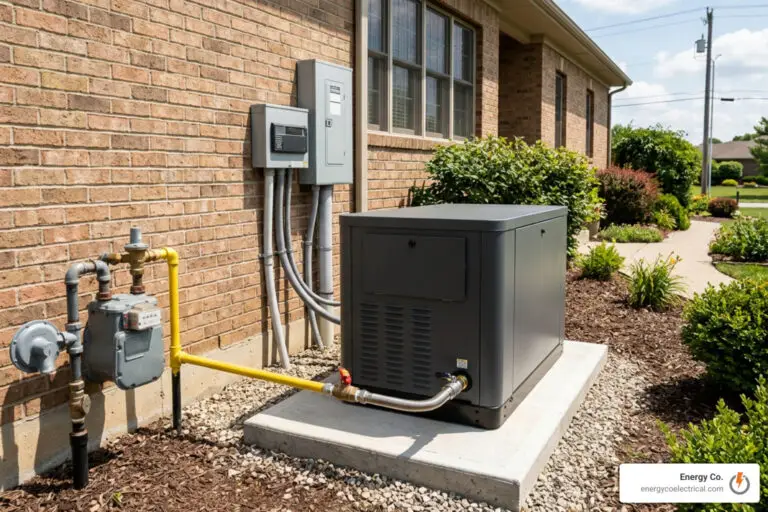
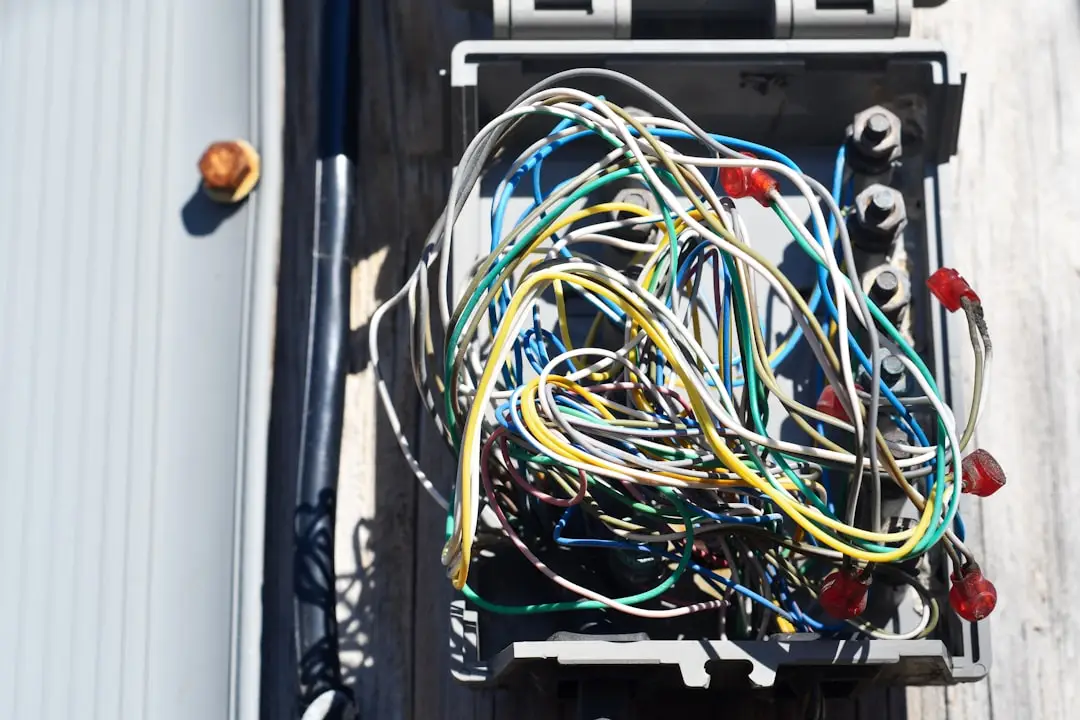
Why Choosing the Right Hot Tub Electrical Cable Matters for Safety and Code Compliance
Choosing the correct hot tub electrical cable is one of the most critical decisions you’ll make before your spa ever heats a drop of water. Get it wrong and you risk tripped breakers, voided warranties, failed inspections — or worse, a serious electrical hazard in a wet environment.
Here’s a quick-reference summary of what most standard hot tub installations require:
| Component | Standard Requirement |
|---|---|
| Wire type | #6 AWG copper THHN/THWN in conduit |
| Circuit voltage | 240V dedicated circuit |
| Breaker size | 50A (for 40A spa) or 60A (for 50A spa) |
| GFCI protection | Required — 50A or 60A GFCI breaker |
| Conduit type | Liquid-tight flexible non-metallic (LFNC) for final run |
| Burial depth | 18 inches minimum for PVC conduit |
| Disconnect location | Within sight, at least 5 feet from water’s edge |
Most 240V outdoor hot tubs need a dedicated circuit — not a shared one. The National Electrical Code (NEC) Article 680 governs every aspect of this installation, from wire gauge to how far your disconnect panel must sit from the water.
This guide walks you through every component — cable types, conduit, GFCI panels, and common mistakes — so you can make informed decisions before work begins.
I’m Michał Napieralski, and as the lead electrician at Energy Co. serving the Chicago suburbs, I’ve overseen dozens of hot tub electrical cable installations across Schaumburg and the surrounding area, including panel upgrades, conduit runs, and GFCI disconnect setups. In the sections below, I’ll share exactly what our licensed team looks for on every spa wiring job so yours is safe, code-compliant, and built to last.
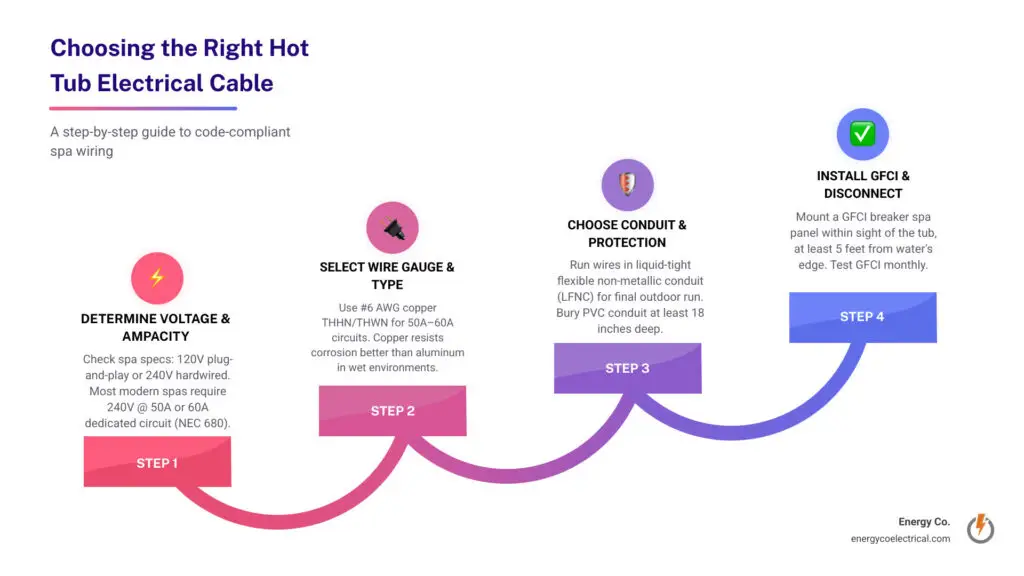
Understanding Hot Tub Electrical Requirements: Amperage and Voltage
Before we can pull a single foot of hot tub electrical cable, we must understand the fundamental power needs of your spa. Hot tubs are heavy energy consumers. Unlike a standard household appliance, a hot tub runs multiple high-horsepower water pumps, an air blower, LED lighting systems, and a powerful electric heater — often all at the exact same time.
To understand why a dedicated circuit is required, it helps to compare the two main categories of home spas:
| Feature | 120V “Plug-and-Play” Systems | 240V Hardwired Systems |
|---|---|---|
| Power Connection | Standard NEMA 5-15 or 5-20 plug | Hardwired to external disconnect box |
| Circuit Capacity | Dedicated 15A or 20A circuit | Dedicated 40A, 50A, or 60A circuit |
| Heating Output | Typically 1.0 kW to 1.5 kW | Typically 4.0 kW to 5.5 kW |
| Performance Limit | Heater turns off when pumps run on high speed | Heater and pumps run simultaneously |
| Water Heating Speed | Slow (1-2 degrees per hour) | Fast (3-5 degrees per hour) |
As detailed in A Guide to Hot Tub Electrics, attempting to run a large, multi-jet family spa on a standard 120V outlet is highly inefficient. At 120V, a hot tub heater can only output about 1.4 kW of heating power. In the freezing winters we experience here in Chicagoland, a 120V heater simply cannot keep up with the heat loss when you open the cover. Upgrading to a 240V system provides up to 5.5 kW of heating capacity, allowing the tub to maintain its temperature even when the winter wind is howling across Cook County.
Determining Your Spa’s Amperage: 50 Amp vs. 60 Amp Circuits
To size your hot tub electrical cable and circuit breaker correctly, you must look at the manufacturer’s nameplate ratings on the spa control pack. The total continuous load of the hot tub determines the minimum breaker size.
Under the National Electrical Code (NEC), hot tubs are classified as continuous loads because they can run for three hours or more at a time. This means we must apply a continuous load factor of 125% to the nameplate rating to determine the breaker and wire size:
- 40A Continuous Load: Sized at 125% equals a 50A breaker (40A x 1.25 = 50A).
- 48A Continuous Load: Sized at 125% equals a 60A breaker (48A x 1.25 = 60A).
Adding a heavy continuous load like a 50A or 60A breaker to your home requires a thorough assessment of your existing electrical service. If your home still operates on an older 100-amp service panel, adding a 50-amp hot tub load could easily overload your system when other major appliances (like your central air conditioner or electric dryer) are running. In these cases, performing an Electrical Panel Upgrade to a modern 200-amp panel is a necessary first step to ensure your home can handle the load safely.
Why 240V Split-Phase Power is Essential for Modern Spas
Standard US household outlets provide 120V single-phase power. However, to power a heavy-duty 240V hot tub, we utilize a split-phase system. This system combines two separate 120V hot lines (commonly referred to as Line 1 and Line 2, or the red and black wires) from opposite sides of your main service panel.
By combining these two lines, we deliver a full 240V to the spa. This higher voltage allows the hot tub to draw less current (amperage) to achieve the same amount of power (wattage) according to Ohm’s Law (Watts = Volts x Amps).
If you tried to run a 5.5 kW heater at 120V, it would require an impractical and highly dangerous 45.8 amps of current just for the heater alone. Running it at 240V drops that current draw to a manageable 22.9 amps, leaving plenty of electrical capacity for the pumps and blowers. To understand how your home’s panel distributes this split-phase power, you can read our guide on Demystifying Your Home Electric Panel Without Getting Shocked.
Selecting the Correct Hot Tub Electrical Cable and Wire Gauge
Once the voltage and amperage requirements are established, the next step is selecting the physical wires that will carry this current. Because water and electricity are a deadly combination, the NEC enforces strict rules on the material, insulation, and sizing of these conductors.
When sizing your wire, you can use a tool like the Hot Tub Calculator — NEC Article 680 to verify that your calculations meet the code requirements for your specific run length.
Copper vs. Aluminum: Why Copper is the Best Hot Tub Electrical Cable
While aluminum wire is often used for main service feeders because it is lightweight and inexpensive, it is highly discouraged — and often explicitly banned by spa manufacturers — for hot tub branch circuits.
We always recommend and install stranded copper conductors for hot tub installations for several critical reasons:
- Corrosion Resistance: Hot tubs use sanitizing chemicals like chlorine and bromine, which create a highly corrosive environment. Aluminum oxidizes rapidly when exposed to moisture and chemical vapors, leading to loose, high-resistance connections that can overheat and cause fires.
- Terminal Lug Compatibility: The terminal lugs inside spa control packs are typically designed and listed only for copper wire. Connecting aluminum wire to a copper-only terminal causes galvanic corrosion.
- Physical Size: Aluminum has lower conductivity than copper, meaning you must use a larger wire gauge to carry the same current. For example, a 50A circuit requires a #6 AWG copper wire, but would require a much thicker #4 AWG aluminum wire. Many spa terminal blocks physically cannot accommodate wire sizes larger than #6 AWG.
To learn more about the differences between residential wiring materials, check out A Complete Guide to Residential Wiring Types and Installation.
Wire Sizing: Why #6 AWG is the Standard Hot Tub Electrical Cable
For a standard 50-amp hot tub installation, #6 AWG copper wire is the industry standard. This wire size consists of four individual conductors:
- Line 1 (Hot): Black insulation
- Line 2 (Hot): Red insulation
- Neutral: White insulation
- Ground: Green insulation (or bare copper in specific indoor-only runs)
There is a common debate in the electrical industry regarding whether #8 AWG copper wire can be used for a 50-amp spa. Under the NEC, 75°C-rated #8 THHN copper wire has an ampacity of 50 amps, which technically meets the code minimum. However, as discussed in the professional Hot tub installation manual. forum, many spa manufacturers explicitly specify #6 AWG copper wire in their installation manuals.
Failing to follow the manufacturer’s installation instructions violates NEC Section 110.3(B) and can instantly void your hot tub’s warranty. Furthermore, if the terminal lugs inside the spa pack are only rated for 60°C, the entire circuit must be sized using the 60°C ampacity column, where #8 AWG is only rated for 40 amps. Therefore, we always install #6 AWG copper wire to guarantee safety, code compliance, and full warranty protection.
Comparing Cable Types: NM-B, THHN, and SOOW
Not all electrical cables are built the same. The environment through which the cable travels determines the type of insulation and jacketing required.
As outlined in Hot Tub Wiring: Wire Size, GFCI, and Breaker, using the wrong cable type in an outdoor or underground location is one of the most common reasons installations fail municipal inspections.
Indoor vs. Outdoor Wiring: Transitioning from NM-B to THHN
A typical hot tub installation requires running wire from an indoor main panel, through the home’s basement or crawlspace, out through an exterior wall, and across the yard to the spa. This journey requires two completely different wiring methods:
- Inside the Home: We can use Type NM-B (Non-Metallic Sheathed Cable), commonly known by the brand name Romex. A product like the Southwire 63950002 125ft. 6 Gauge 3 Conductor NM-B Cable (which features three insulated #6 conductors and a bare ground) is perfect for running through dry indoor floor joists. However, NM-B cable is strictly prohibited in wet or damp locations, including inside outdoor conduit.
- Outside the Home: Once the circuit exits the exterior wall of the house, it enters a wet environment. Here, we must transition to individual THHN/THWN-2 (Thermoplastic High Heat-resistant Nylon-coated / Thermoplastic Wet-resistant) stranded copper conductors pulled through an approved conduit system.
To bridge these two zones, we install a junction box inside the home’s conditioned space (such as a basement or utility room) to transition from the indoor NM-B cable to the outdoor THHN wires. For a step-by-step look at how these transitions are executed in residential settings, read our A Practical Guide to Electrical Installation.
The Danger of Using UF-B or SOOW for Permanent Installations
Some DIY installers attempt to use Type UF-B (Underground Feeder) cable or SOOW (Service, Oil-resistant, Outdoor, Water-resistant) flexible cords to wire their hot tubs to save time and money. This is a highly dangerous practice that violates multiple NEC codes:
- Type UF-B Cable: While UF-B is rated for direct burial in the ground, it features a bare copper grounding wire. NEC Article 680 strictly requires that the equipment grounding conductor for outdoor pools and spas be insulated (typically green) to protect it from corrosion in wet, chemically treated environments. A corroded ground wire can fail to trip the breaker during a ground fault, leaving the water energized.
- SOOW Cord: SOOW is a flexible, rubber-jacketed extension-style cord. While it is excellent for temporary, heavy-duty industrial power, the NEC prohibits using flexible cords as a substitute for the permanent wiring of a structure. Flexible cords are susceptible to physical damage, UV degradation, and rodent damage when left outdoors permanently.
Essential Conduit and Safety Components for Outdoor Wiring
Once your hot tub electrical cable exits the home, it must be housed in a protective conduit system to shield it from physical damage, moisture, and soil pressure.
According to the Hot Tub Wiring Guide: Safe, Code-Compliant, planning the physical layout of your conduit and safety disconnect is just as important as choosing the correct wire size.
Liquid-Tight Flexible Conduit and Power Whips
For the final connection between your outdoor disconnect panel (spa panel) and the hot tub’s internal control pack, we use Liquid-tight Flexible Non-metallic Conduit (LFNC). This flexible, waterproof conduit allows for the slight movement and vibration of the hot tub without putting stress on the electrical connections.
For this final run, many installers utilize pre-assembled power whips, such as the Sealproof Power Whip Assembly (3/4-Inch x 6 Ft), which comes pre-loaded with the correct gauge wires and watertight fittings. When selecting conduit and fittings, always look for products that carry a UL Listing (Underwriters Laboratories) or other recognized safety certifications. Using non-certified, cheap imports — such as unlisted conduit kits — can lead to water leaks, cracked fittings, and failed electrical inspections.
GFCI Protection and Spa Panel Disconnect Requirements
The single most important safety device in your hot tub circuit is the Ground Fault Circuit Interrupter (GFCI). A GFCI breaker constantly monitors the balance of current between the hot lines and the neutral line. If it detects a leakage of current as small as 5 milliamperes (which could indicate electricity escaping through the water or a human body), it instantly shuts off the power in a fraction of a second.
The NEC mandates that a manual disconnect switch (often called a spa panel or load center) be installed within sight of the hot tub. This panel serves two critical functions:
- Emergency Shut-off: It allows anyone to quickly cut power to the spa in an emergency without running inside the house.
- Maintenance Isolation: It allows service technicians to safely work on the spa’s pumps and heaters knowing the power is locked out.
To comply with the “5-foot rule” (NEC 680.43), the disconnect panel must be installed at least 5 feet away from the inside wall of the hot tub. This ensures that a person sitting in the water cannot physically reach out and touch the metal electrical panel, eliminating the risk of shock. However, it must also be located no further than 50 feet away and remain within a direct line of sight from the spa.
Popular code-compliant options for this disconnect include:
- Square D HOME250SPA: A Homeline Spa Panel featuring a built-in 50-Amp GFCI breaker.
- Siemens W0408L1125SPA60: A 125 Amp outdoor spa panel equipped with a 60-Amp GFCI breaker, perfect for larger luxury spas requiring a 60A circuit.
Frequently Asked Questions about Hot Tub Wiring
Wiring a hot tub is a complex task with many moving parts. Here are some of the most common questions we receive from homeowners in the Chicagoland area.
Why does my hot tub GFCI breaker trip immediately after installation?
This is the single most common troubleshooting call we receive for newly installed hot tubs. In 95% of cases, an instant trip upon powering up is caused by a miswired neutral connection in the spa panel.
In a standard electrical panel, the neutral wires and grounding wires are often connected to the same bus bar. However, in a GFCI subpanel, the white neutral wire coming from the hot tub must be connected directly to the neutral terminal on the GFCI breaker itself, not to the panel’s ground bar. The pigtail wire attached to the GFCI breaker is then connected to the panel’s neutral bar. If the neutral is connected to the ground bar, the GFCI breaker senses an imbalance in the current return path and trips instantly to protect the system.
How deep does the hot tub electrical conduit need to be buried?
The required burial depth for outdoor conduit depends on the type of conduit material used and the location of the trench:
- Rigid PVC Conduit (Schedule 40/80): Must be buried at a minimum depth of 18 inches in residential yards.
- Rigid Metal Conduit (RMC) or Intermediate Metal Conduit (IMC): Can be buried at a shallower depth of 6 inches, though it is significantly more expensive and difficult to install.
When trenching in Cook County, we always recommend placing a bright red plastic electrical warning tape in the trench about 12 inches above the buried conduit. If anyone digs in your yard in the future, they will strike the warning tape first, alerting them to the live high-voltage line below. Always remember to call 811 (Chicago Utility Alert Network) to have buried utility lines marked before you begin digging your trench.
Can I use a pre-assembled power whip for the final connection?
Yes, you can use a pre-assembled liquid-tight power whip (such as a 3/4-inch by 6-foot whip) for the final run from the disconnect panel to the hot tub. However, the NEC limits the length of flexible conduit runs to a maximum of 6 feet for outdoor spa installations. The main run from your home’s exterior wall to the disconnect panel must be constructed using rigid PVC or metal conduit.
Conclusion
Wiring a hot tub is not a standard DIY weekend project. It requires a deep understanding of electrical load calculations, trenching codes, wet-location wiring methods, and critical life-safety GFCI systems. A single loose terminal lug or miswired neutral can damage your expensive new spa, void your manufacturer’s warranty, or create a life-threatening shock hazard.
At Energy Co., our team of licensed, bonded, and insured professional electricians has been serving Chicago and the Northwest Suburbs for years. Whether you are in Schaumburg, Hoffman Estates, Arlington Heights, Mount Prospect, or Chicago proper, we have the local expertise to handle your hot tub installation safely and efficiently. We understand the specific local amendments to the Cook County and Chicago Electrical Codes, and we guarantee our work passes municipal inspections with flying colors.
Don’t take risks with water and electricity. Let our certified team handle the heavy lifting so you can relax in your backyard oasis with complete peace of mind. Schedule Residential Electrical Services with Energy Co. today, or Contact Us to request a professional estimate for your hot tub installation!