
What Electrical Installation Actually Means (And Why It Matters)
Electrical installation refers to the complete assembly of wiring, devices, and equipment used to distribute, control, and use electricity safely inside a building or structure.
Here’s a quick summary of what you need to know:
| Topic | Key Point |
|---|---|
| What it is | All wiring, circuits, panels, and devices that deliver and control electricity in a building |
| Main types | Residential, commercial, and industrial |
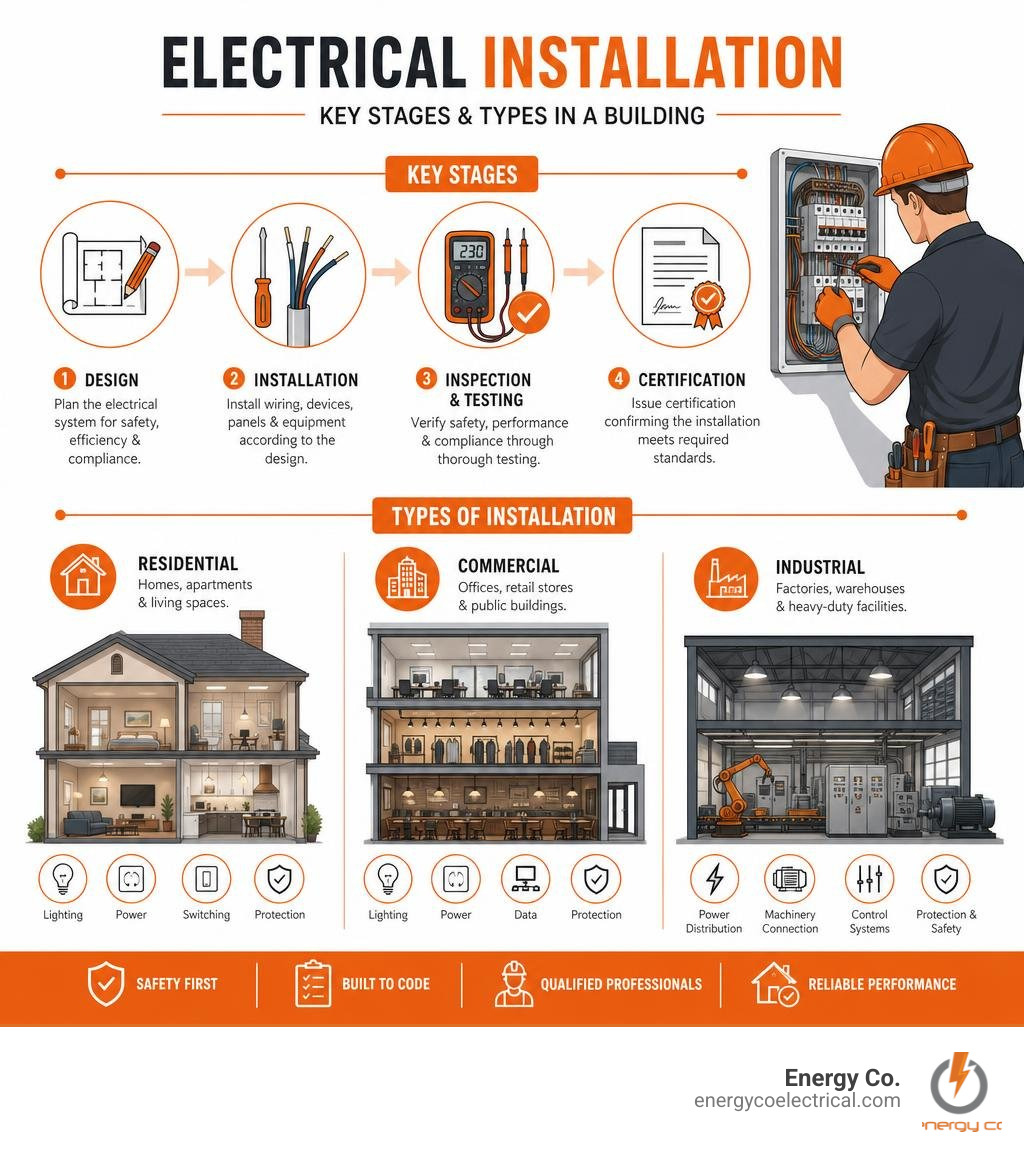
| Core process | Design → Installation → Inspection & Testing → Certification |
| Key regulations (UK/Ireland) | BS 7671:2018+A3:2024, I.S. 10101, Electricity at Work Regulations 1989 |
| Who should do it | A licensed, registered electrician — always |
Whether you’re dealing with a tripped breaker, outdated wiring in an older Chicago home, or planning a full commercial fit-out, understanding electrical installation helps you make smarter, safer decisions.
It’s not just about convenience. Poor electrical work has serious consequences. In one documented case from the UK, an electrician received a suspended prison sentence after a death caused by shoddy central heating wiring. The stakes are real.
More than 40,000 accidents reported to the HSE each year are linked to building-related activities — and electrical faults are a major contributor.
I’m Michał Napieralski, a licensed electrician with hands-on experience across residential and commercial electrical installation projects throughout the Chicagoland area. In this guide, I’ll walk you through everything you need to know — from types and processes to safety rules and regulations.
What is an Electrical Installation and What Does It Include?
At its core, an electrical installation is not just a bunch of wires thrown behind a drywall. It is a highly engineered, interconnected system designed to deliver power from a utility source directly to your appliances, lights, and machinery without starting a fire or shocking anyone.
Every safe installation must follow rigorous standards. For example, the official British Standard Requirements for Electrical Installations (BS 7671) outlines precise rules for how these systems must be constructed and maintained to prevent danger.
An electrical installation typically includes:
- The Wiring Assembly: Insulated conductors (cables) that run through walls, ceilings, and conduits to carry electrical currents.
- Control Devices: Switches, relays, smart controllers, and dimmers that let you manage the flow of power.
- Overcurrent Protection: Circuit breakers, fuses, and residual current devices (RCDs) designed to cut off power instantly if a fault or overload occurs.
- Power Distribution Panels: The main “breaker box” or switchboard where electricity is divided into individual branch circuits.
- Earthing and Bonding: Crucial safety pathways that redirect stray electricity safely into the ground rather than through your body.

Main Types of Electrical Installations
Different buildings have vastly different power needs. A small apartment doesn’t require the same robust infrastructure as a heavy manufacturing plant. Because of this, we categorize installations into three primary types.
| Feature | Residential | Commercial | Industrial |
|---|---|---|---|
| Primary Voltage Levels | 120V / 240V (Single-Phase) | 120V / 208V / 480V (Three-Phase) | 480V up to 11,000V+ (Three-Phase) |
| Load Requirements | Low to Medium | Medium to High | Exceptionally High |
| System Complexity | Standard (Branch circuits, simple panels) | Moderate to High (Conduits, sub-panels, backup power) | Very High (Heavy machinery, complex control systems) |
| Wiring Protection | NM-B cables (Romex), simple conduits | Metal-clad (MC) cables, rigid metal conduits | Heavy-duty armored cables, busways, cable trays |
Residential Electrical Installation Requirements
For your home, safety and seamless integration are key. Whether you live in a historic bungalow in Palatine or a modern condo in Chicago, your home’s system needs to keep up with modern life.
At Energy Co., we specialize in comprehensive Residential Electrical Services that keep your home running smoothly. As technology evolves, standard residential installations now regularly incorporate advanced features such as:
- Smart Home Systems: Upgrading your traditional switches to support modern Smart Home Integration for voice and automated control.
- Electric Vehicle Chargers: Installing dedicated high-voltage circuits so you can Power Up Your Ride with a Home EV Charging Station.
- Backup Power: Keeping your family safe during storms with a Reliable Generator Installation Service in Chicago: Get Expert Help Today.
- Panel Upgrades: Older homes often require an Electrical Panel Upgrade to safely handle modern appliance loads without overloading the system.
For specific local needs, such as a specialized dedicated circuit installation, having dedicated pathways for power-heavy appliances prevents frequent breaker trips and reduces fire hazards.
Commercial and Industrial Electrical Installation Standards
Commercial and industrial spaces operate on a completely different scale. Commercial environments—like offices in Rolling Meadows or retail stores in Schaumburg—rely heavily on three-phase power systems to run large HVAC units, extensive lighting systems, and complex server rooms.
Industrial installations, such as manufacturing plants in Elk Grove Village, deal with high-voltage machinery and automated assembly lines. These systems must be engineered to withstand harsh environments, extreme temperatures, and chemical exposure.
Many international frameworks, such as the comprehensive guidelines in S T A T U T O R Y I N S T R U M E N T S 2019 No. 58., detail strict rules for commercial switchboards, underground cabling, and sub-metering systems to ensure energy efficiency and safety.
Because commercial and industrial projects demand specialized engineering, we provide highly tailored Commercial Electrical Services and robust Industrial Electrical Services to ensure complete compliance with all local and national building codes.
The Electrical Installation Process: From Design to Certification
A successful electrical installation is a structured, step-by-step process. Cutting corners at any point can lead to catastrophic system failures or code violations.

- Technical Design & Planning: Before a single wire is run, we create a detailed technical blueprint. This includes calculating total load requirements to ensure the incoming service can handle the demand without overheating.
- Physical Installation: This is where the physical work happens—mounting panels, running conduits, pulling cables, and connecting devices. Professional training is vital here. In fact, programs like the City & Guilds Level 1 Diploma in Electrical Installation (7202-01) highlight how essential fundamental skills and fabrication techniques are to ensuring neat, secure, and safe physical installations.
- Inspection and Testing: Once the physical installation is complete, the system must undergo rigorous testing. We check for insulation resistance, polarity, earthing continuity, and the proper operation of all protective devices.
- Certification: After passing all safety checks, a formal completion certificate is issued. This document proves that the installation complies with all relevant safety standards and local building codes.
The industry’s future relies on proper training; each year over 8,000 young people are in apprenticeships in the electrical contracting industry, learning these exact steps to keep our communities safe.
Electrical Safety, Regulations, and Emergency Protocols
Electricity is an incredibly powerful force. When respect for that force is lost, accidents happen. To protect lives, strict legal frameworks govern our industry.
In the UK, pieces of legislation like the Health and Safety at Work Act 1974 and the Electricity at Work Regulations 1989 place clear, legally binding responsibilities on everyone on a job site:
- Employers must provide safe working conditions, maintain tools in perfect working order, provide necessary personal protective equipment (PPE), and ensure all staff are properly trained.
- Employees must take reasonable care to protect themselves and others, use all safety equipment correctly, and report any potential hazards immediately.
To keep workers safe on busy, noisy sites, regulations also mandate a continuous exposure noise limit of below 85 dB for an 8-hour working day.
Safe Isolation Procedures to Prevent Electric Shock
Safe isolation is the golden rule of electrical work. You must never assume a circuit is dead just because a switch is turned off.
The lethal level of electrical current is surprisingly small. A current of approximately 50 mA is enough to cause muscles to contract, the heart to flutter (fibrillation), and breathing to stop entirely.
To prevent electric shock, we follow a strict lock-out tag-out (LOTO) safe isolation process:
- Identify the correct source of supply.
- Isolate the supply by turning off the breaker or disconnecting the switch.
- Lock the isolation device and place a warning tag on it so no one else can turn it back on.
- Test your voltage tester against a known “proving unit” to ensure the tester is working.
- Verify that the isolated circuit is completely dead using the tested voltage tester.
- Re-test your voltage tester against the proving unit once more to confirm it didn’t fail during the check.
Personal Protective Equipment (PPE) and Site Safety
When working on any electrical installation, wearing the correct PPE is a non-negotiable requirement. This includes safety goggles, insulated hand tools, steel-toe boots, and arc-flash-rated clothing when working near high-energy systems.
Site safety is especially critical on construction projects where temporary electrical supplies are used. Temporary supplies are highly vulnerable to physical damage, water intrusion, and wear, meaning they require constant inspection, robust grounding, and heavy-duty RCD protection to keep workers safe.
Fire Safety and First Aid Protocols
Electrical fires are classified as Class C fires (or electrical fires). Never use water on an electrical fire, as water conducts electricity and will cause severe shocks or explosions. Instead, you must use Carbon Dioxide (CO2) or dry powder fire extinguishers.
If an electrical accident occurs, follow these emergency steps:
- Do not touch the victim if they are still in contact with the live electrical source.
- Disconnect the power immediately at the main switch or breaker. If that isn’t possible, use a dry, non-conductive object (like a wooden broom handle) to safely push the victim away from the source.
- Call emergency services immediately.
- Assess the victim. If they are not breathing, begin CPR immediately and locate an Automated External Defibrillator (AED) if one is nearby.
Frequently Asked Questions about Electrical Installations
What is the difference between unidirectional and bidirectional protective devices?
Under the latest BS 7671 Amendment 3 standards, the distinction between unidirectional and bidirectional protective devices has become highly important, especially with the rise of solar PV systems and home battery storage.
A unidirectional device is designed to receive power from one specific direction (the grid) and protect circuits downstream. A bidirectional device is engineered to handle power flowing in both directions (such as power coming from the grid and excess power being fed back into the grid from your solar panels). Installing a unidirectional device in a bidirectional system can lead to premature failure or a failure to trip during a fault.
How often should an electrical installation be inspected?
It depends on the type of building. For owner-occupied residential homes, we recommend a professional inspection at least once every 10 years, or whenever you move into a new property. For rental properties, commercial spaces, and industrial facilities, inspections should occur every 3 to 5 years (or at change of tenancy) to ensure ongoing safety and compliance.
What should I do if I suspect asbestos during an installation?
If you are working in an older building (especially those built before the year 2000) and encounter suspicious material, stop work immediately. Do not disturb, cut, or drill into the material. Evacuate the immediate area, report the hazard to the building owner or safety representative, and have a licensed specialist test the material before resuming work.
Conclusion
An electrical installation is the invisible backbone of your daily life, powering everything from your morning coffee maker to heavy industrial machinery. Because of the serious safety risks involved, electrical work should never be a DIY project.
At Energy Co., we provide expert residential, commercial, and industrial electrical services across Chicago and the surrounding Northwest Suburbs—including Schaumburg, Hoffman Estates, Elk Grove Village, Rolling Meadows, Palatine, Roselle, Streamwood, Hanover Park, Arlington Heights, and Mount Prospect.
Our team of licensed, highly trained professionals brings deep local expertise in handling Chicago’s unique building codes and older architectural structures. Backed by our ironclad satisfaction guarantee, we are committed to keeping your power reliable and your property safe.
Need a reliable partner for your next project or a 24/7 emergency repair? Check out our Top Rated Electrical Installation Service in Chicago: Your Guide to Reliable Power and let our team power up your property safely today!