Last updated:
How to Choose a Qualified Commercial Electrical Contractor
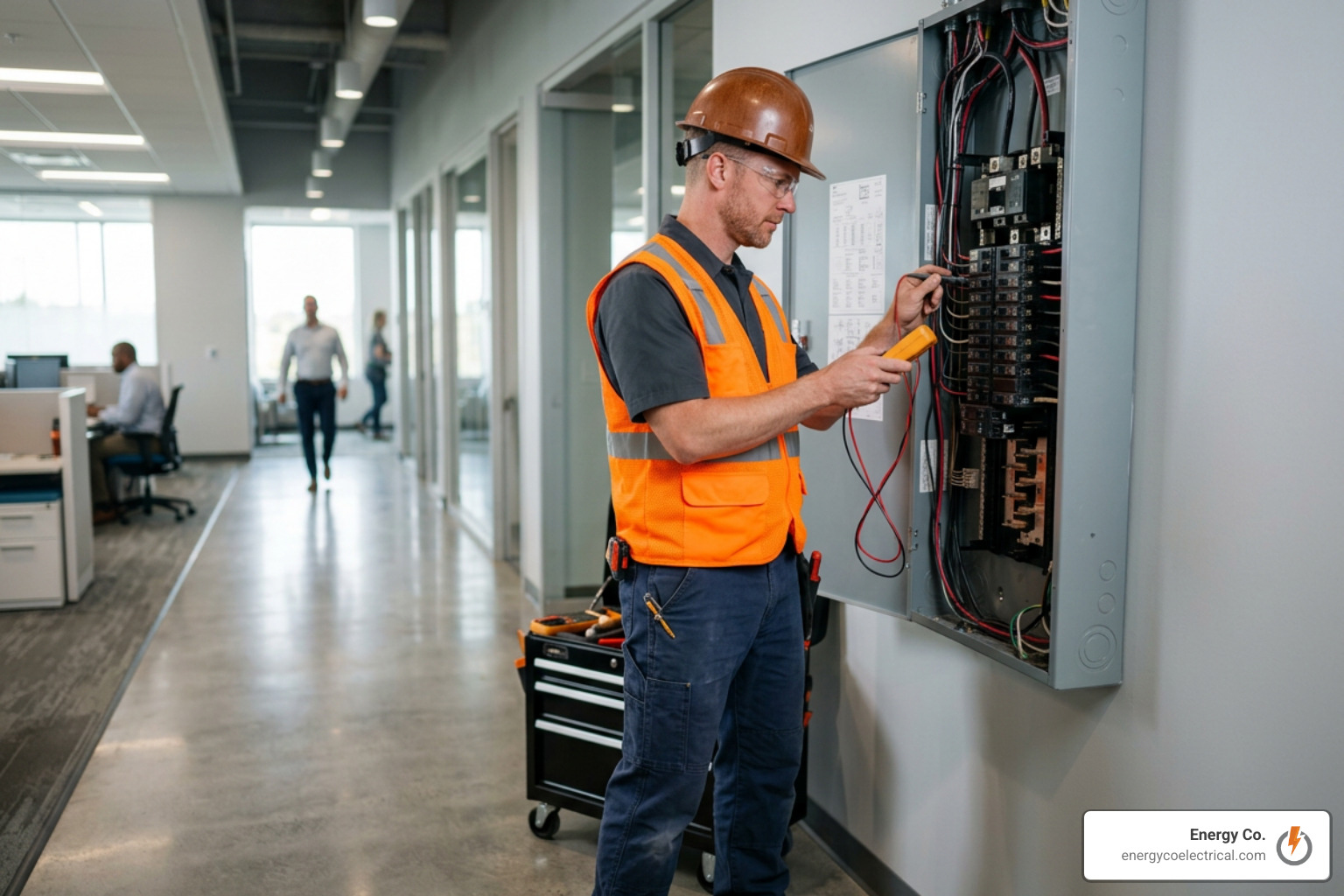
A qualified commercial electrical contractor plans, installs, repairs, and maintains the electrical systems that keep a business operating safely. For a Chicago-area project, choose a contractor who is properly licensed and insured, understands local permits and code requirements, has experience with work like yours, and can clearly explain the scope, schedule, price, and emergency-service options.
Table of Contents
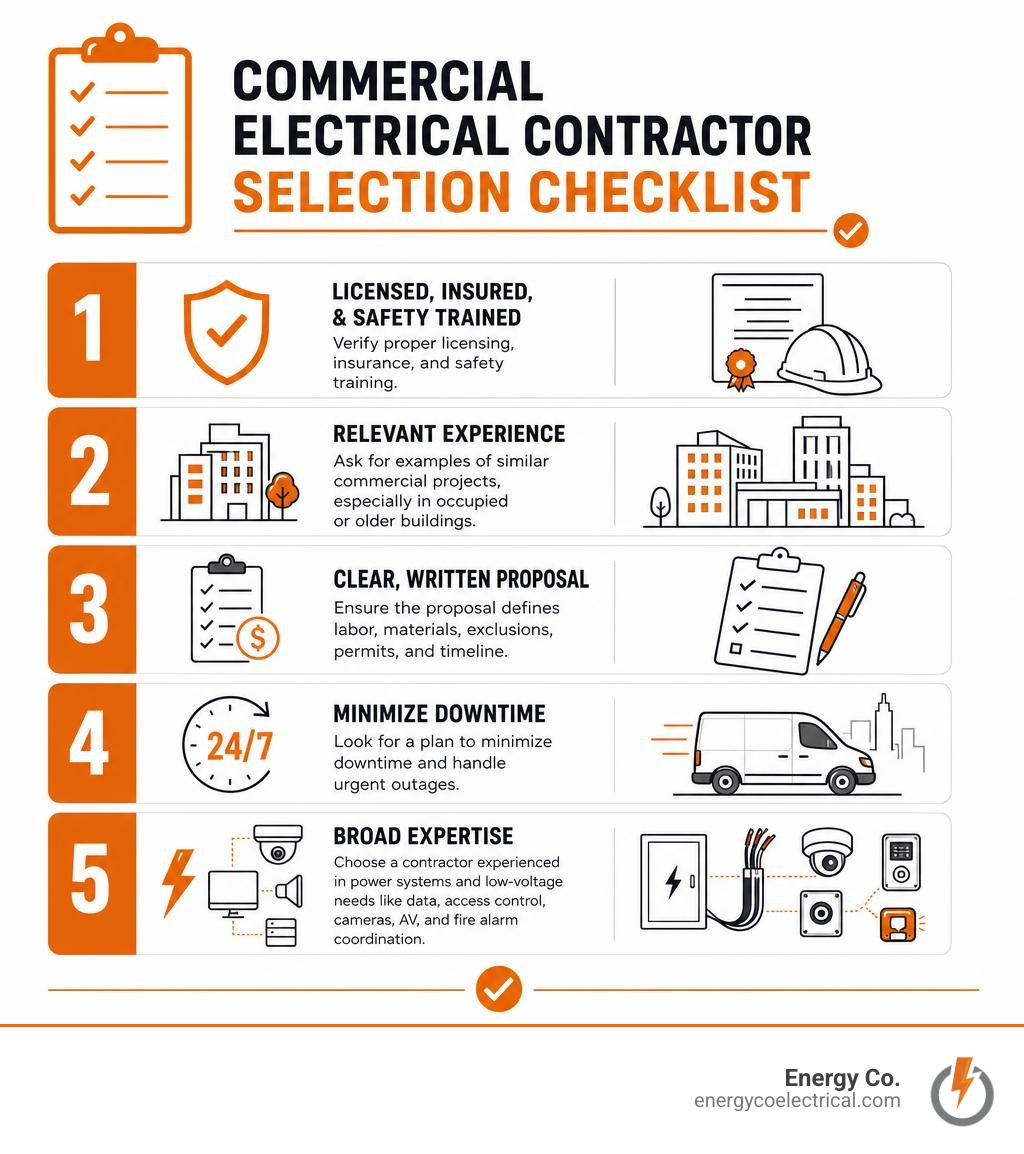
Before hiring, ask for:
- Proof of licensing, insurance, and safety training.
- Examples of similar commercial projects, especially in occupied or older buildings.
- A written proposal that defines labor, materials, exclusions, permits, and timeline.
- A plan for minimizing downtime and handling urgent outages.
- Experience with both power systems and low-voltage needs, such as data cabling, access control, cameras, AV, and fire alarm coordination.
The right partner does more than pull wire. They help identify load limits, upgrade aging panels, coordinate with other trades, and make sure the finished system is safe, reliable, and ready for your facility’s daily demands.
I am Michał Napieralski of Energy Co., and I work with residential and commercial clients on panel upgrades, wiring repairs, inspections, lighting, EV chargers, and ongoing electrical maintenance. As a commercial electrical contractor serving Schaumburg and the Chicago suburbs, our focus is code-compliant work that helps businesses resolve urgent issues and plan smarter upgrades.
Core Services Provided by a Commercial Electrical Contractor
Commercial electrical systems operate under demands that far exceed typical residential needs. From high-capacity power distribution to continuous load management, a commercial facility relies on robust infrastructure to avoid catastrophic downtime and safety hazards. We provide a full suite of services designed to keep local enterprises running smoothly, safely, and efficiently.
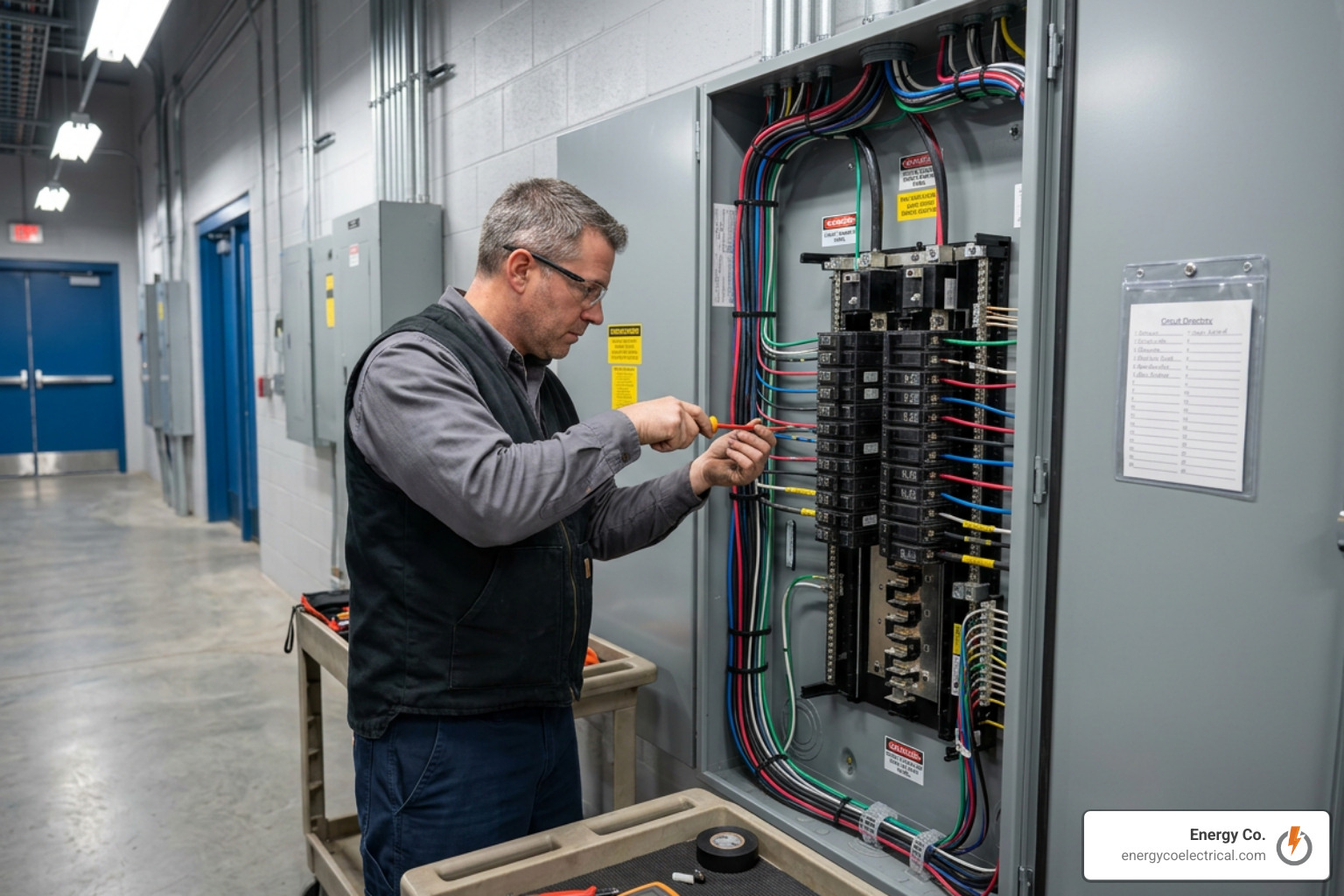
A full-scale service offering covers everything from initial rough-ins to final commissioning:
- Heavy-Duty Power Distribution: Sizing, installing, and servicing switchgear, transformers, and distribution panels capable of handling intense industrial and commercial loads.
- Infrastructure Upgrades: Replacing obsolete fuse boxes and split-bus panels with modern distribution boards to expand capacity.
- Specialized Cabling: Installing durable commercial wiring designed to withstand high environmental demands, physical wear, and strict municipal building codes.
- Electric Vehicle (EV) Infrastructure: Planning and deploying Level 2 and Level 3 DC fast-charging stations for commercial fleets, employee parking, and retail customer access.
- Preventive Maintenance & Diagnostics: Routine infrared thermography, load balance testing, and power quality analysis to spot heat buildup before equipment fails.
- 24/7 Rapid Response: Immediate troubleshooting and fault isolation to restore operational power when unexpected disruptions strike.
Power Distribution, High-Voltage Systems, and Lighting
The backbone of any commercial enterprise is its power delivery infrastructure. Main service panels and switchboards must channel electricity to machinery, HVAC systems, lighting arrays, and office equipment without thermal overloading or voltage sags. In historic masonry structures across Cook County, this often involves replacing undersized feeders with modern, high-capacity conduit runs.
Lighting represents both a major operational expense and an essential safety element. Upgrading outdated fluorescent and metal-halide fixtures to intelligent LED networks delivers immediate financial and practical returns. Our team focuses on shining a light on commercial lighting services and retrofits to trim operating costs, often reducing energy overhead by up to 30%.
Exterior illumination is just as critical for safety and premises liability. Implementing dedicated commercial parking lot lighting ensures employee safety during evening shifts, deters property crime, and maintains clean sightlines for security cameras across retail and corporate properties in places like Arlington Heights and Mount Prospect.
Low-Voltage, Life Safety, and Systems Technology Integration
Modern enterprises rely heavily on low-voltage networks to drive communication, data, and building security. Treating low-voltage wiring as an afterthought often leads to electromagnetic interference, messy cable runs, and poor connectivity.
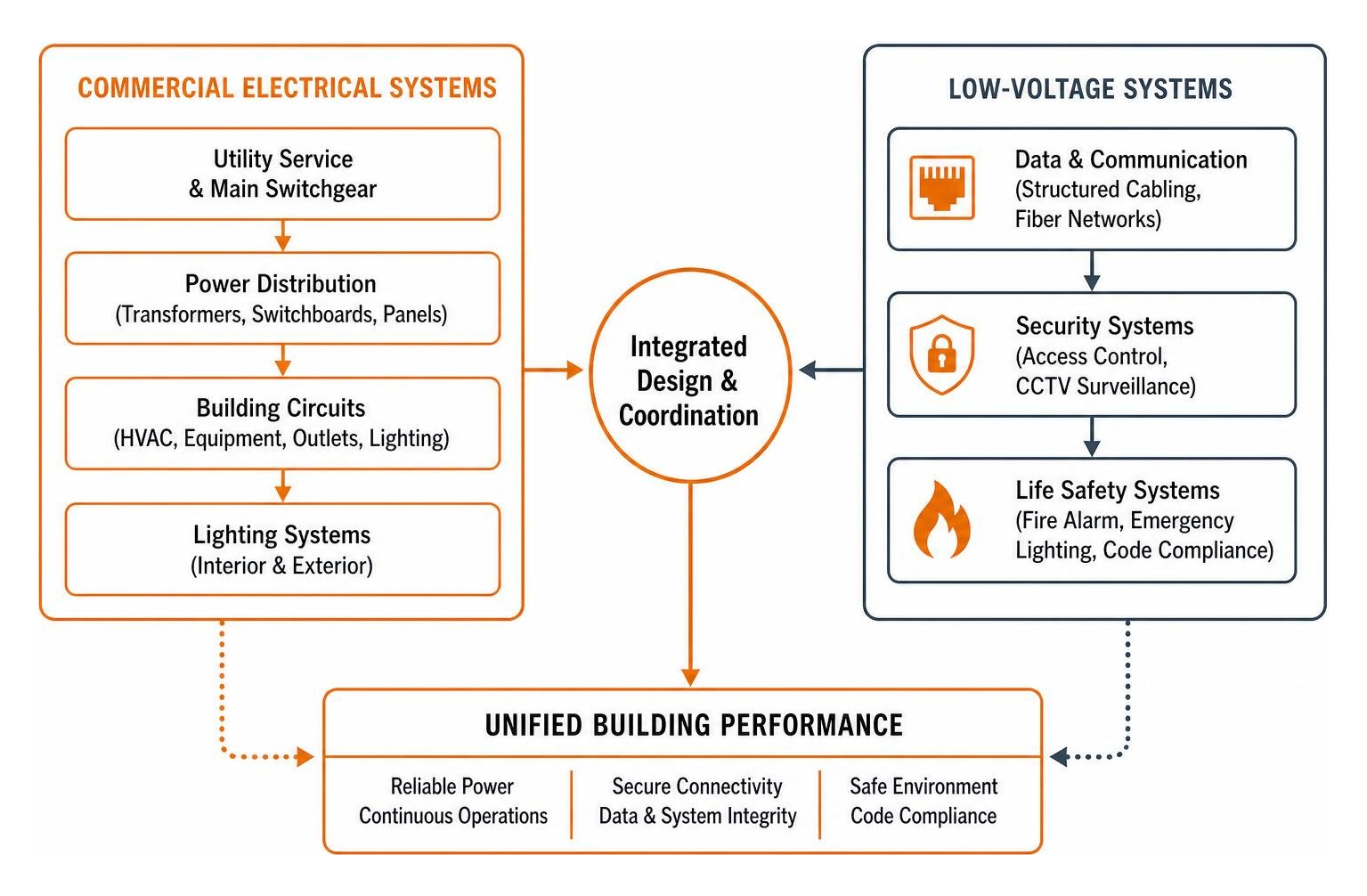
We seamlessly integrate power systems alongside core digital and life-safety networks:
- Structured Cabling & Data Infrastructure: Cat6A, Cat7, and fiber optic backbones routed through dedicated pathways to prevent data packet loss from power line induction.
- Access Control & CCTV Surveillance: Electronic door strikes, biometric scanners, and IP-based cameras wired directly to centralized monitoring hubs.
- Life-Safety & Fire Alarm Coordination: Fire alarm panels, strobe arrays, smoke evacuation dampers, and emergency exit lighting wired to meet strict municipal life-safety codes.
- Building Automation & Energy Management: Automated lighting controls, daylight harvesting sensors, and programmable smart power switches that optimize consumption when facilities are unoccupied.
How to Evaluate and Select the Right Contracting Partner
Selecting an electrical partner requires looking past bottom-line price tags. Choosing the lowest bidder without evaluating their credentials, experience with older architecture, and safety culture often leads to project delays, change orders, and costly rework.
| Delivery Model | Accountability Structure | Design Flexibility | Schedule Control | Risk to Property Owner |
|---|---|---|---|---|
| Traditional Design-Bid-Build | Split between separate engineering firm and electrical contractor | Low; revisions require formal change orders | Slower; bidding occurs only after designs finish | High; owner mediates disputes between engineer and installer |
| Integrated Design-Build | Single point of contact (one unified team handles design and install) | High; real-time field adjustments and value engineering | Accelerated; preconstruction and procurement overlap | Low; contractor assumes total responsibility for budget and code compliance |
Essential Qualifications of a Commercial Electrical Contractor
A dependable trade partner must possess deep technical capabilities and thorough knowledge of regional regulations. In our area, local municipal amendments can vary between Cicero, Elk Grove Village, and Palatine.
When vetting candidates, prioritize finding the right spark for your business with local commercial electricians who hold Master Electrician credentials, active municipal licenses, comprehensive general liability coverage, and workers’ compensation policies.
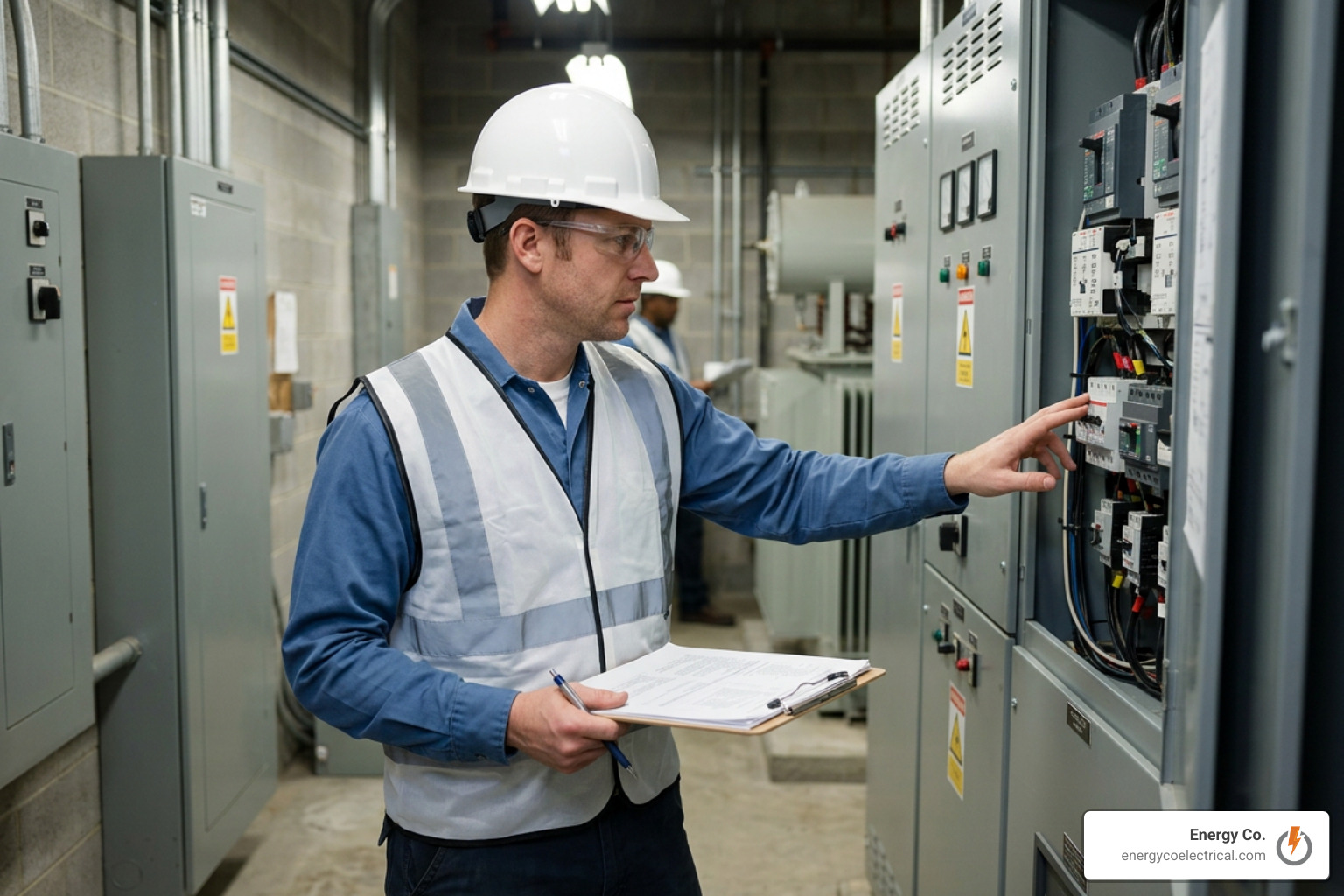
Contractors who regularly work in our region know how to handle specific local challenges, such as:
- Navigating rigid conduit requirements inside older Chicago commercial spaces.
- Managing permitting workflows across Cook County building departments.
- Identifying legacy, ungrounded wiring systems hidden inside masonry walls.
- Calculating true load profiles before adding modern, high-draw machinery.
Safety Records, EMR Ratings, and Industry Certifications
Commercial electrical work carries inherent hazards, including arc flash events, high-voltage shocks, and structural fire risks. A contractor’s safety record speaks volumes about their operational discipline.
Request a contractor’s Experience Modification Rate (EMR). An EMR of 1.0 represents the industry average; a score below 1.0 indicates an exceptional safety record with fewer workplace incidents.
Our technicians strictly adhere to OSHA guidelines and NFPA 70E standards for electrical workplace safety. This includes conducting formal arc flash risk assessments, enforcing personal protective equipment (PPE) protocols, performing lockout/tagout (LOTO) procedures, and maintaining continuous safety education. A strong safety program protects workers on the ground, shields building owners from liability, and prevents disruptive job-site shutdowns.
Project Delivery Models, Bidding, and Preconstruction
The success of a major electrical installation or retrofit is decided long before the first wire is pulled. Thorough preconstruction planning, constructability reviews, and realistic cost estimating keep projects on schedule and within budget.
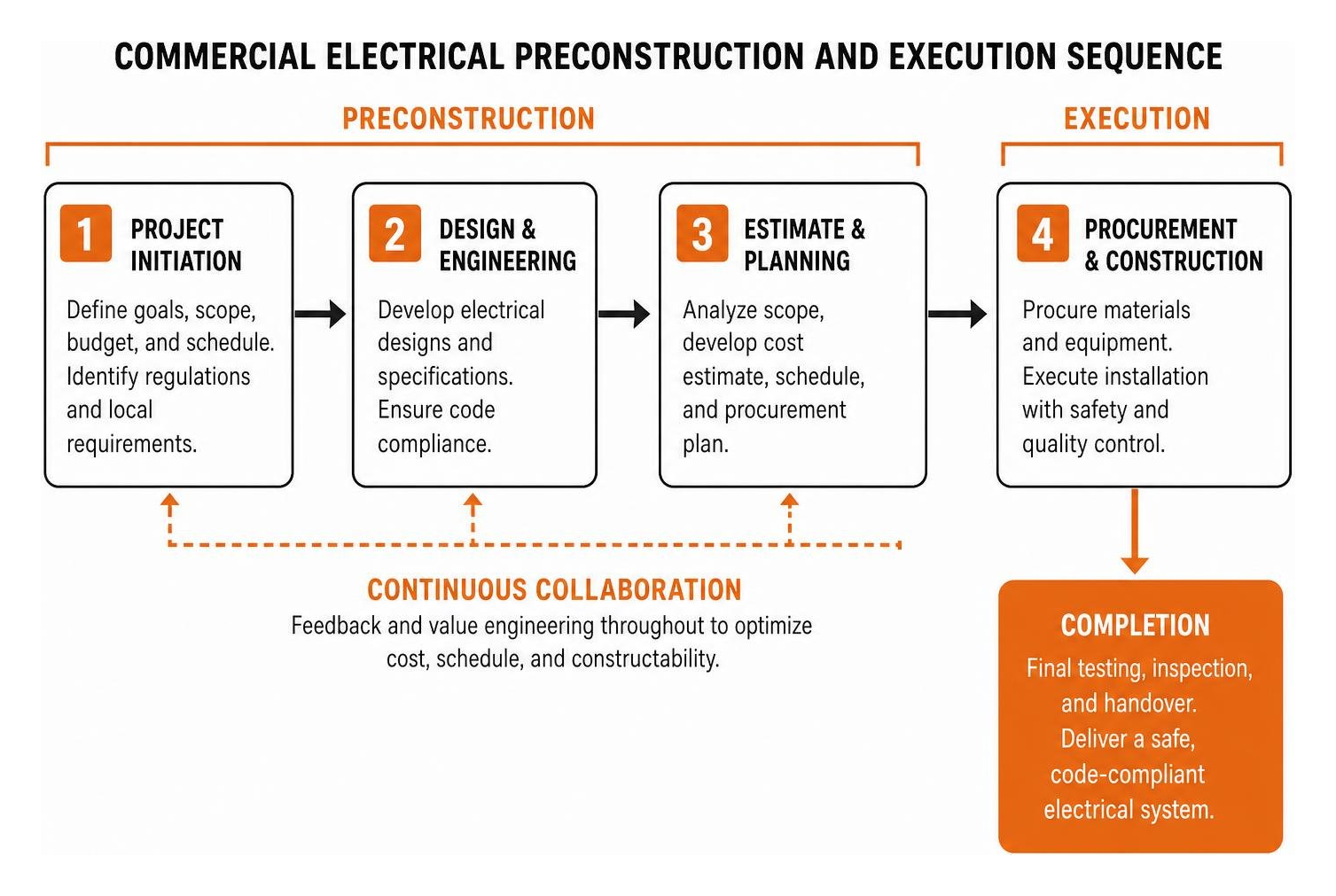
Benefits of Design-Build with a Commercial Electrical Contractor
The integrated design-build model brings engineering, budgeting, and physical construction under one roof. Instead of hiring an engineering firm to draw plans and then putting those blueprints out to bid, working with an integrated team streamlines the entire process.
Taking advantage of the business guide to commercial electric solutions and incentives during preconstruction allows you to identify utility rebates, optimize equipment efficiency, and lower upfront capital expenses.
Key advantages of design-build include:
- Single-Point Accountability: One contract, one point of contact, and zero finger-pointing between design engineers and field technicians.
- Virtual Modeling (BIM): Building Information Modeling identifies spatial clashes with HVAC ducts, plumbing pipes, and structural steel before rough-in begins.
- Off-Site Prefabrication: Assembling conduit racks, panel boards, and junction boxes in a controlled workshop environment cuts on-site installation time and reduces job-site clutter.
- Budget Certainty: Real-time material pricing and practical value engineering prevent surprise change orders later in the construction phase.
Managing Bids, Estimating, and Scope Coordination
When reviewing bids, look for clear, itemized transparency rather than generic lump sums. A well-organized bid package should clearly specify:
- Exact Material Specifications: Conduit types, wire gauges, panel brands, and fixture models.
- Permits and Inspections: Clear itemization of municipal permit costs and inspection coordination fees.
- Scope Demarcation: Defined boundaries showing where high-voltage utility work ends, where low-voltage runs begin, and who handles patch-and-repair for walls and ceilings.
- Realistic Project Timelines: Clear milestones for rough-in, conduit runs, service cutovers, inspections, and final equipment commissioning.
Identifying Warning Signs Your Facility Needs an Upgrade
Many business owners only think about their electrical systems when the power goes out. However, aging infrastructure usually shows clear warning signs long before a total failure occurs. Ignoring these signals risks sudden business disruption, equipment damage, and electrical fires.
Watch for these common issues:
- Frequent Circuit Breaker Tripping: Breakers that trip under routine operational loads indicate overloaded circuits or failing bus connections.
- Flickering or Dimming Lights: Observable voltage fluctuations when heavy equipment, compressors, or HVAC units cycle on.
- Hot Enclosures or Burning Odors: Discolored switch plates, warm breaker handles, or a sharp ozone smell near panel boxes point to active heat buildup and loose terminations.
- Outdated Service Panels: Old panels or fuse boxes that lack replacement parts, have double-tapped breakers, or violate modern codes.
- Extension Cord Clutter: Relying on extension cords and power strips because your facility lacks sufficient, properly positioned branch outlets.
Understanding why your chicago business needs a proactive electrical repair plan helps you move away from costly emergency fixes and shift toward planned, budget-friendly equipment upgrades.
Frequently Asked Questions About Commercial Electrical Contracting
What industries and facilities do commercial electrical contractors serve?
Commercial electrical teams support a diverse range of business properties, each with distinct power, lighting, and safety needs:
- Manufacturing and Industrial Plants: Heavy-machinery hookups, three-phase motor controls, and high-capacity transformer installations.
- Corporate Offices and Tenant Build-Outs: Dedicated computer branch circuits, low-voltage communication cabling, and energy-efficient office lighting.
- Retail and Dining: Architectural showcase lighting, commercial kitchen power runs, POS network wiring, and illuminated signage.
- Warehousing and Logistics: High-bay LED installations, automated conveyor controls, and dedicated forklift charging stations.
- Medical and Dental Clinics: Isolated grounding systems, emergency life-safety circuits, and backup generator transfer switches.
How do electrical contractors handle emergency and 24/7 service calls?
Commercial electrical emergencies rarely happen during convenient business hours. When a critical transformer fails or a main distribution breaker trips in the middle of a shift, companies face thousands of dollars in lost revenue for every hour of downtime.
A reliable emergency response service includes:
- Live Dispatch: Round-the-clock call intake to dispatch certified technicians immediately.
- Fully Equipped Service Vehicles: Service trucks stocked with commercial-grade breakers, fuses, high-amperage cables, and testing equipment to complete repairs on the initial visit.
- Rapid Fault Isolation: Advanced diagnostic tools, such as thermal imagers and digital insulation testers, to pinpoint short circuits quickly.
- Temporary Power Deployment: Connecting mobile emergency generators to maintain essential refrigeration, lighting, and data servers while permanent repairs are made.
How far will commercial electrical teams travel for major projects?
Most commercial electrical contractors focus on defined regional service territories where their technicians hold active municipal trade licenses and understand local building departments.
At Energy Co., our primary commercial service footprint covers the greater Chicago metropolitan area and Northwest Suburbs, including Schaumburg, Hoffman Estates, Elk Grove Village, Rolling Meadows, Palatine, Roselle, Streamwood, Hanover Park, Arlington Heights, Mount Prospect, and Cicero.
Focusing on these core communities in Cook County allows us to maintain rapid dispatch times, complete scheduled projects efficiently, and quickly handle unexpected service emergencies.
Conclusion
Choosing the right commercial electrical partner is a critical operational decision for any business. The right contractor does much more than connect wires—they protect your physical assets, ensure full code compliance, prevent expensive downtime, and design scalable electrical infrastructure that grows with your business.
From preconstruction planning and detailed value engineering to power distribution and 24/7 emergency response, Energy Co. delivers reliable, high-standard trade solutions. Whether you are expanding a light industrial warehouse in Elk Grove Village, modernizing an office suite in Schaumburg, or upgrading service panels across an older commercial building in Chicago, our team brings the local knowledge and technical skill your project demands.
Explore our comprehensive commercial electrical services to see how we can safeguard your facility, streamline your power infrastructure, and help you plan your next commercial project with confidence.