Standby Generator Cost Breakdown in 2026: Equipment vs. Installation
In 2026, the total turnkey standby generator cost typically ranges from $6,000 to $13,500 for standard residential homes, with larger estate installations reaching $17,000 to $39,000+. While standalone generator equipment costs between $3,500 and $11,000, professional electrical installation, gas plumbing, and permitting account for $2,400 to $6,000+, representing 30% to 50% of the total project budget.
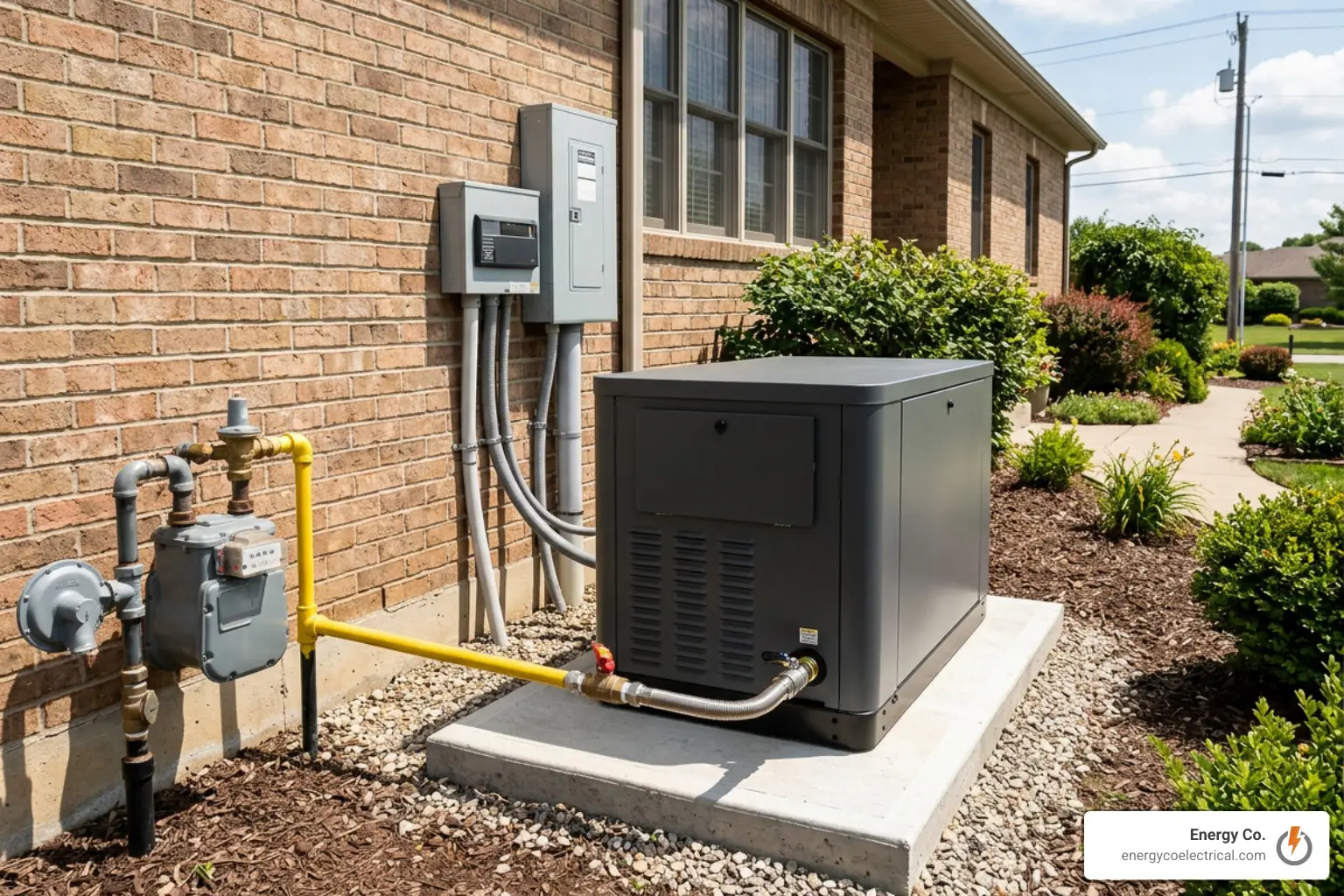
Equipment costs include the generator itself, an automatic transfer switch (ATS), mounting accessories, and remote monitoring modules. Installation costs encompass the physical labor of licensed electricians and gas plumbers, structural pad installation, fuel pipe fitting, municipal permitting, utility coordination, and formal startup commissioning. Understanding both hardware and labor prevents unexpected financial surprises when planning your installation.
| Generator System Capacity | Equipment Only (Unit + ATS) | Professional Installation & Plumbing | Total Installed Range (2026) | Typical Household Coverage |
|---|---|---|---|---|
| 8–10 kW (Compact/Essentials) | $3,600 – $4,800 | $2,400 – $4,200 | $6,000 – $9,000 | Sump pump, refrigerator, furnace fan, security, basic lighting circuits |
| 14–16 kW (Mid-Size Home) | $4,500 – $6,200 | $3,000 – $5,000 | $7,500 – $11,200 | Essentials plus one central air conditioner, microwave, and home office circuits |
| 20–22 kW (Whole-House Standard) | $6,100 – $7,500 | $3,400 – $6,000 | $9,500 – $13,500 | Full electrical coverage for average suburban homes (2,000–2,800 sq. ft.) |
| 24–28 kW (Large Whole-House) | $7,000 – $9,500 | $4,000 – $7,500 | $11,000 – $17,000 | Large residences, multiple AC compressors, electric ranges, and high-draw appliances |
| 30–50 kW (Liquid-Cooled / Estate) | $13,500 – $24,000 | $8,500 – $15,000+ | $22,000 – $39,000+ | Estate properties, 400A service panels, commercial-grade continuous backup loads |
Professional installation labor by a licensed electrician typically runs between $3,000 and $6,000 for standard residential settings, while natural gas line integration or dedicated propane plumbing by a licensed trade professional adds another $500 to $1,500. Municipal permits, plan reviews, and municipal inspections generally add $200 to $600 depending on your local jurisdiction.
Sizing Your System to Estimate Standby Generator Cost
The physical size of your house does not directly dictate what generator you need—your peak electrical power draw does. Sizing mistakes are among the most expensive errors a homeowner can make. Buying an undersized generator will cause system overloads and shut down during heavy demand, while purchasing an oversized generator wastes thousands of dollars in upfront equipment expenses and needlessly burns through fuel during weekly exercise cycles and actual power outages.
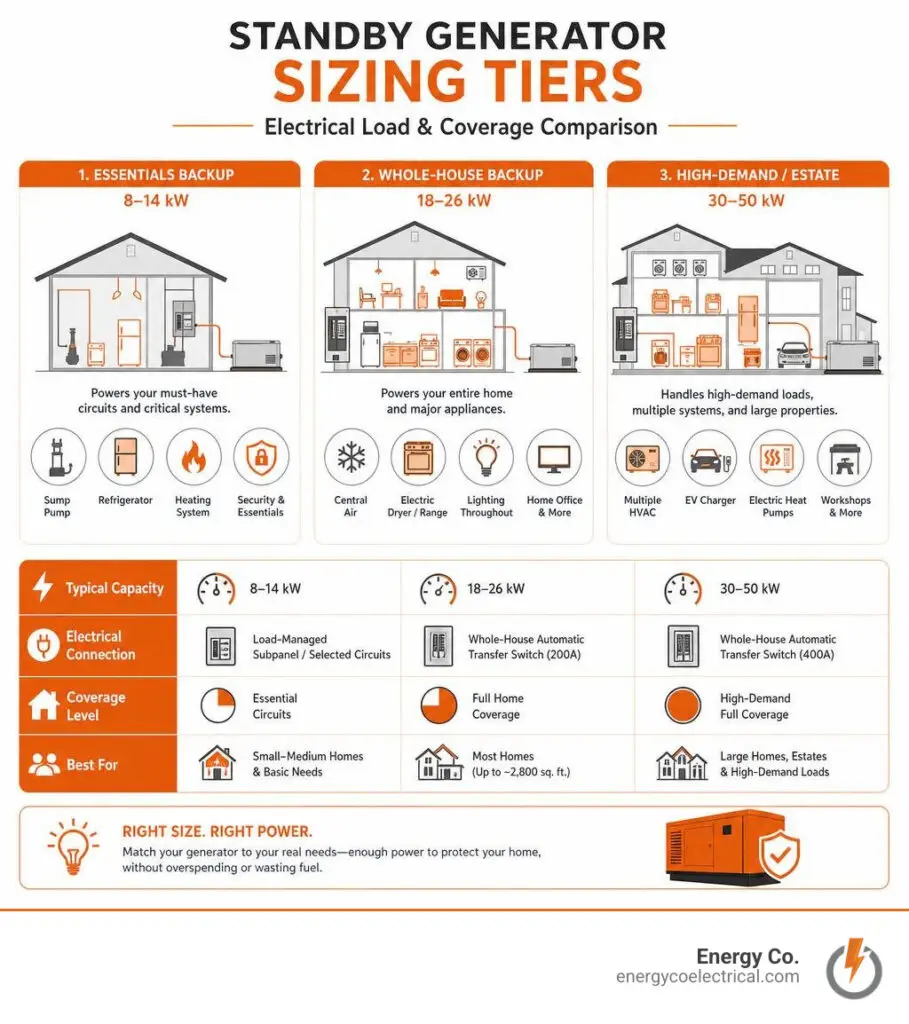
To calculate the right capacity, we look at running wattage (the power required to keep an appliance running) and starting wattage (the surge required to kick over electric motors like central AC compressors, sump pumps, and refrigerators):
- Essentials Backup (8–14 kW): Powers specific dedicated circuits wired through a load-managed subpanel or 16-circuit transfer switch. This ensures your heating system, sump pumps, refrigeration, medical equipment, and router remain running during severe weather without trying to power your whole panel.
- Whole-House Backup (18–26 kW): Connects to your entire 200-amp main service panel through a whole-house automatic transfer switch. A standard 22 kW generator comfortably powers an entire 2,500-square-foot home, including central air conditioning, an electric dryer, and everyday lighting simultaneously.
- High-Demand / Estate Systems (30–50 kW): Designed for larger structures with 400-amp service, multiple HVAC condensers, electric vehicle chargers, electric heat pumps, or detached workshops. These units use liquid-cooled engines rather than air-cooled engines, built for extended industrial duty cycles.
If you are planning your overall project budget and want to break down specific hardware tiers, you can calculate keyword generator installation cost and process to evaluate exactly how different appliance combinations influence sizing requirements.
Installation Variables That Drive Standby Generator Cost
No two generator installations have identical project quotes because every home presents a distinct physical and electrical footprint. Even identical houses located on the same street can vary by thousands of dollars depending on where utility meters and mechanical rooms sit.
Several primary site conditions determine where your project falls within the general pricing spectrum:
- Main Electrical Panel Capacity and Condition: Connecting an automatic transfer switch requires integrating with your existing service panel. If your home still operates on an outdated 100-amp panel, has obsolete panel hardware (like split-bus configurations), or lacks physical breaker capacity, an electrical panel upgrade or service replacement is necessary, adding $1,500 to $4,500. Homes with 400-amp service require either a dedicated 400-amp ATS or dual 200-amp transfer switches, which adds $1,500 to $3,500 in specialized equipment and wiring labor.
- Transfer Switch Specifications: A standard 200-amp service-entrance-rated automatic transfer switch ranges from $800 to $1,500 for the switch itself. Load-managed transfer switches equipped with smart load-shed modules ($500 to $1,000) allow you to install a smaller generator capacity by temporarily shedding heavy electrical loads (like electric water heaters or second AC compressors) during peak generator demand.
- Mounting Foundation and Site Preparation: Generators require a level, structurally sound, non-combustible base. A pre-formed composite pad costs between $200 and $400, whereas pouring a thick reinforced concrete pad for stability and frost-heave protection runs $350 to $600.
- Trenching and Conduit Distance: The ideal placement is close to both your main electrical service panel and your natural gas meter. If the generator must be placed on the opposite side of the home to satisfy lot line setbacks or bedroom window clearance rules, contractors must trench conduit and pipe underground. Long runs can add $1,000 to $3,500 depending on soil conditions, hardscaping, and distance.
- Gas Plumbing and Meter Sizing: A 14 kW to 26 kW standby generator demands significant fuel volume under load, often requiring an upgraded 1-1/4-inch gas line rather than a standard 1/2-inch or 3/4-inch branch. If the utility meter cannot deliver sufficient BTU volume for the furnace, water heater, range, and generator running at the same time, the utility company must perform a meter upgrade.
Comparing Fuel Sources: Natural Gas vs. Liquid Propane
Your choice of fuel determines not only your initial installation setup but also your ongoing operating reliability and fuel expenses during long-duration grid outages.
Standby generators are designed to run on either natural gas (NG) supplied directly by a municipal utility or liquid propane (LP) delivered from on-site storage tanks. Both fuels burn cleanly, operate reliably in freezing temperatures, and provide reliable power, but they involve different infrastructure costs.
Natural Gas (NG)
Natural gas is generally the most cost-effective and convenient fuel source if your property is already connected to utility gas service.
- Upfront Hookup Costs: Connecting a standby generator to an existing residential natural gas line typically costs between $500 and $1,500 for piping, shut-off valves, and sediment traps.
- Supply Reliability: Natural gas provides an uninterrupted, continuous fuel supply. You never have to worry about scheduling fuel deliveries, monitoring tank levels, or running out of fuel during widespread winter storms when road conditions delay delivery trucks.
- Operating Consumption: A standard 22 kW standby generator running at a 50% electrical load consumes approximately 250 to 300 cubic feet of natural gas per hour. Under typical residential utility rates, this equals roughly $2.00 to $4.50 per hour of operation.
Liquid Propane (LP)
Propane is the primary solution for properties without municipal natural gas service.
- Upfront Storage Costs: If you do not already have large propane storage on-site, purchasing and installing a dedicated 500-gallon to 1,000-gallon above-ground or buried propane tank costs between $2,500 and $5,000 including tank placement, regulators, pressure testing, and supply line trenching.
- Runtime Duration: A 14 kW unit burns roughly 2 gallons of propane per hour at full load (or ~1.5 gal/hr at half load). A dedicated 250-gallon tank provides roughly 100 hours of continuous runtime, while a 500-gallon tank (filled to the standard 80% capacity of 400 gallons) can run a typical 22 kW generator for approximately 6 to 7 continuous days at half load.
- Operating Consumption: A 22 kW unit under moderate load burns approximately 2 to 3 gallons of LP per hour. Depending on local propane delivery prices, fuel costs range between $4.50 and $9.00 per hour of continuous operation.
To ensure your supply line delivers sufficient volume and pressure to prevent engine starvation, review our comprehensive guide to standby generator gas line setup before finalizing your mechanical placement.
Standby Generators vs. Portable Generators: Weighing Price and Performance
Homeowners weighing backup power options frequently compare permanently installed standby generators to portable generators connected through a manual transfer switch or interlock kit.
While a portable generator setup requires a lower initial investment, the differences in automation, capacity, safety, and operation are significant.
1. Operation and Activation Speed
- Standby Generators: An automatic transfer switch constantly monitors grid voltage. When utility power drops out, the ATS signals the generator to start, confirms voltage stabilization, and switches your home’s circuits over within 10 to 20 seconds. The process is completely hands-free whether you are asleep, at work, or away on travel.
- Portable Units with Manual Interlock: A portable generator paired with a manual interlock switch costs between $4,400 and $7,700 installed. When an outage hits, you must wheel the unit out from the garage, position it at least 20 feet away from doors and windows, connect a heavy 30-amp or 50-amp power cord to the exterior inlet box, start the engine manually, and physically toggle the interlock breaker in your electrical panel.
2. Fuel Management and Extended Outages
Portable generators run primarily on gasoline or small portable propane cylinders. Gasoline goes stale within a few months unless treated with stabilizers, and storing 30 to 50 gallons of volatile gasoline safely on residential property presents fire hazards. In a severe, multi-day winter storm, local gas stations may lack electrical power to run their pumps, leaving you without a way to refuel a portable unit that burns through 8 to 15 gallons of fuel every 24 hours. A natural gas standby generator draws from an underground utility line, running continuously without manual refueling trips.
3. Noise Levels and Sound Attenuation
Standby generators are housed in insulated, corrosion-resistant steel or aluminum enclosures with integrated residential-grade mufflers. They typically operate between 60 and 70 decibels (dB), which sounds like a central air conditioning compressor running in the yard or a normal conversational voice. Portable generators feature open metal frames with basic exhaust mufflers, regularly producing 80 to 88+ dB, loud enough to disturb your household and close neighbors.
Permitting, Code Compliance, and Long-Term Operating Expenses
Installing a standby generator is a complex infrastructure project that ties directly into high-voltage electrical distribution and pressurized gas plumbing lines. To protect structural safety and neighborhood livability, municipal building departments enforce strict building, fire, and electrical safety codes.
For example, homeowners in the Northwest Suburbs can review the official Generator Resource Guide | Schaumburg, IL to understand local engineering requirements, utility clearance rules, and municipal submission processes.
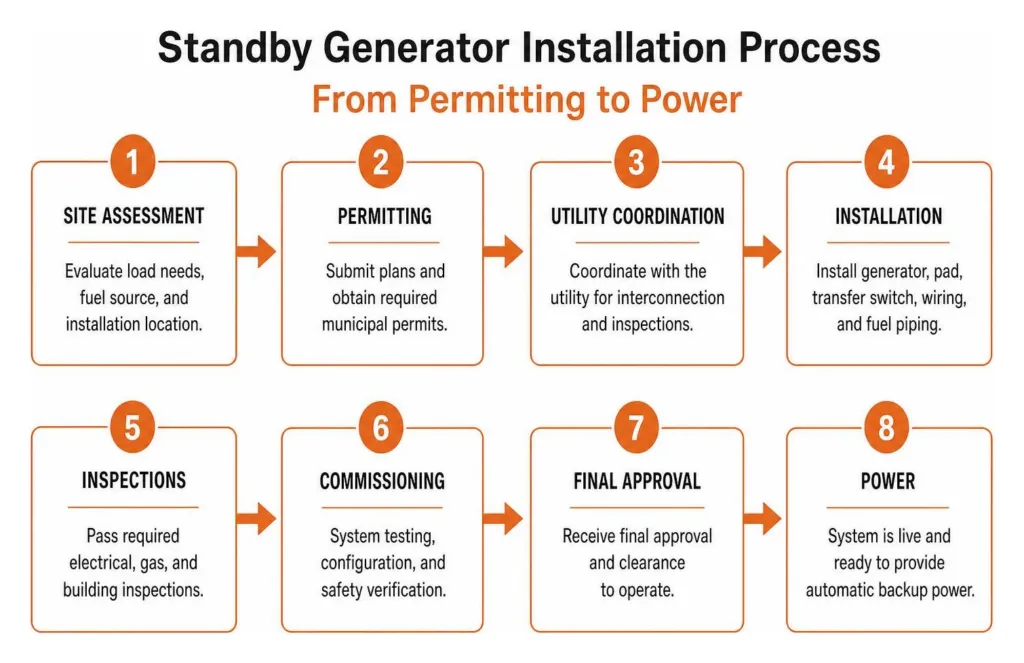
Navigating municipal permit applications, third-party plan reviews, and rough-in inspections is essential to protect your home’s insurance coverage and guarantee that safety systems comply with National Electrical Code (NEC) Article 702 and NFPA 37 standards. We outline the detailed procedural steps for navigating local requirements in our guide to Cook County generator installation from permits to power up.
Long-Term Operating and Maintenance Expenses
Beyond the initial purchase and installation, budgeting for regular maintenance protects your investment and ensures the engine starts reliably when grid power fails.
- Annual Maintenance Contracts ($200 to $600/year): Standby generator engines require oil changes, oil filter replacements, fresh air filters, spark plug changes, and valve clearance adjustments every 100 to 200 operating hours or at least once per year. Professional maintenance packages also include transfer switch testing, voltage calibration, and safety shutdown testing.
- Starter Battery Replacement ($100 to $300 every 2–4 years): Standby units rely on a dedicated 12V automotive-style starter battery (such as a Group 26R or Group 35 AGM) connected to an internal trickle charger. Because batteries degrade under continuous float charge and extreme seasonal temperature swings, replacing the battery every 2 to 4 years prevents unexpected starting failures.
- Weekly Self-Test Fuel Costs ($60 to $200/year): Standby systems automatically run a programmed 5- to 15-minute self-test once a week to circulate engine oil, lubricate seals, and verify battery voltage. These brief test cycles use a negligible amount of fuel each month.
- Cold Weather Accessories ($200 to $450): In cold northern winters where temperatures routinely drop below freezing, adding thermostatically controlled battery warmers and oil heaters guarantees fast engine ignition and prevents cold-crank wear during sub-zero winter storms.
Grid instability and severe storm cycles make automated power security an essential consideration for local property owners. You can review current utility conditions by exploring how severe weather and utility distribution charges influence power stability via Compare Elk Grove Village, IL electricity rates (August 2026) or Compare Rolling Meadows, IL electricity rates (August 2026).
Frequently Asked Questions About Standby Generators
Does a standby generator increase property value?
Yes. A professionally installed standby generator adds an estimated 3% to 5% to your home value (representing $12,000 to $20,000 in added equity on a $400,000 home). In suburban markets where overhead power lines are vulnerable to summer windstorms, heavy ice, and severe blizzards, a turnkey backup generator is an attractive selling feature that speeds up real estate transactions. Many major property insurance carriers also offer a 3% to 5% discount on homeowners insurance premiums because automated backup power prevents catastrophic basement flooding from failed sump pumps and prevents burst pipes caused by heating failures.
How long does a standby generator installation take?
The physical on-site installation work typically takes 1 to 2 days for our licensed electrical and plumbing crews. Day one focuses on setting the structural pad, positioning the generator, mounting the automatic transfer switch, and running electrical conduit. Day two covers running gas piping, completing panel tie-ins, pressure-testing the lines, and performing startup commissioning.
However, the complete project timeline from initial site evaluation to final municipal sign-off usually ranges from 4 to 8 weeks. This lead time accounts for engineering plan reviews, municipal building and electrical permit approvals, and scheduling final inspections with your local building department. You can read more about code-compliant procedures in our walkthrough on how to safely install a backup generator for your home.
What ongoing maintenance costs should I budget for?
Most homeowners should budget between $200 and $600 annually for routine preventive maintenance. This budget covers an annual professional inspection, synthetic oil and filter changes, spark plug service, fuel pressure verification, and an electrical transfer test. Starter batteries should be replaced every 2 to 4 years for $100 to $300. Keeping thorough maintenance records ensures you maintain compliance with manufacturer warranty requirements across the unit’s 5- to 10-year coverage period.
Choose Energy Co. for Reliable Standby Power in Chicagoland
Investing in a standby generator is one of the most effective steps you can take to safeguard your home, protect sensitive electronics, prevent flood damage, and maintain continuous family comfort during severe weather outages. Because proper sizing, code-compliant electrical panel integration, and high-volume gas plumbing are critical to safety, partnering with experienced, licensed tradespeople makes all the difference.
At Energy Co., our licensed electricians specialize in turnkey residential standby generator installations, service panel upgrades, and 24/7 emergency response throughout the Chicagoland area, including Schaumburg, Elk Grove Village, Rolling Meadows, Palatine, Hoffman Estates, Arlington Heights, Mount Prospect, Cicero, and surrounding Cook County communities. We handle the entire process in-house—from load calculations and municipal permit applications to precision transfer switch installation and final testing.
For a detailed breakdown of labor scopes and system packages, read the definitive guide to standby generator installation costs, or contact the licensed professionals at Energy Co. today to schedule your comprehensive on-site electrical assessment and project quote.