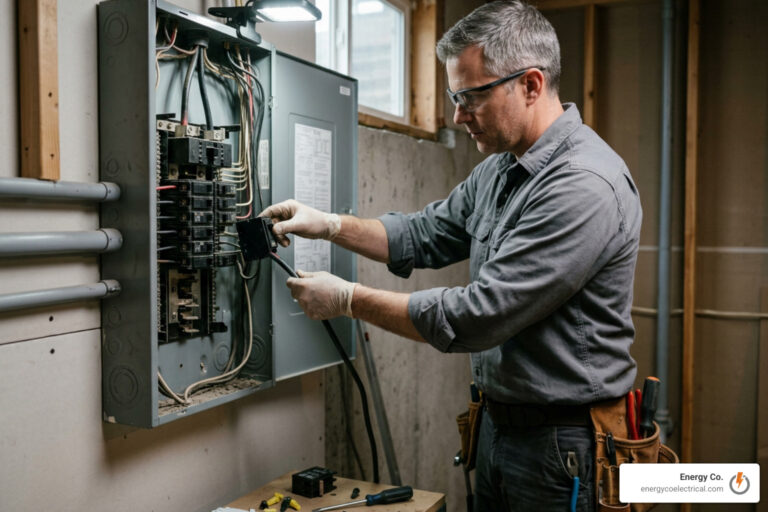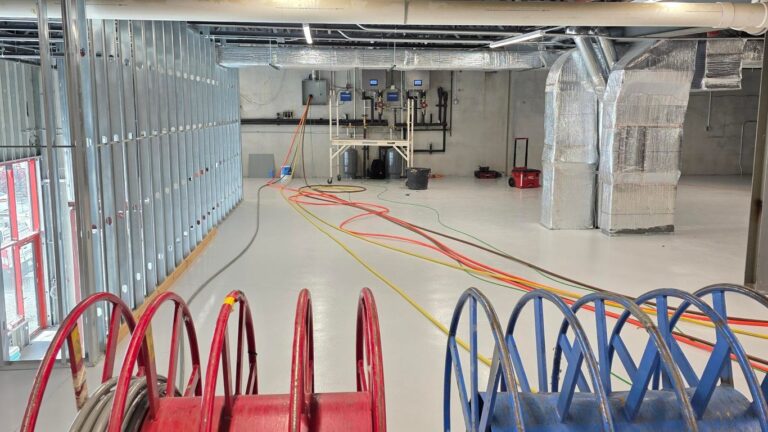
How to Find Reliable Commercial Electrical Contractors Near You
To find a commercial electrical contractor near you, start with firms that serve your area and handle your type of building. Verify their license with the local licensing authority, ask for proof of insurance, and check their experience with similar jobs. Get written estimates from at least two firms. If you have an outage, ask about emergency availability and how soon they can arrive.
The right contractor can help with repairs, panel upgrades, lighting, and routine maintenance. I’m Michał Napieralski, and I’ll show you what to check before you hire. For a broader overview of how commercial power distribution works, the National Electrical Code provides the baseline safety standard that licensed contractors follow.

Commercial electrical contractors near me terms made easy:
Core Services and Warning Signs: When to Hire a Commercial Electrician
Operating a commercial facility across the Chicagoland area—whether in Chicago, Schaumburg, Cicero, or Arlington Heights—demands an electrical infrastructure that performs flawlessly every single day. A single unexpected power interruption can bring assembly lines to a halt, corrupt critical point-of-sale systems, or leave a retail floor in complete darkness. Understanding the scope of the best commercial electrical services for your business ensures your property stays safe, compliant, and continuously operational.
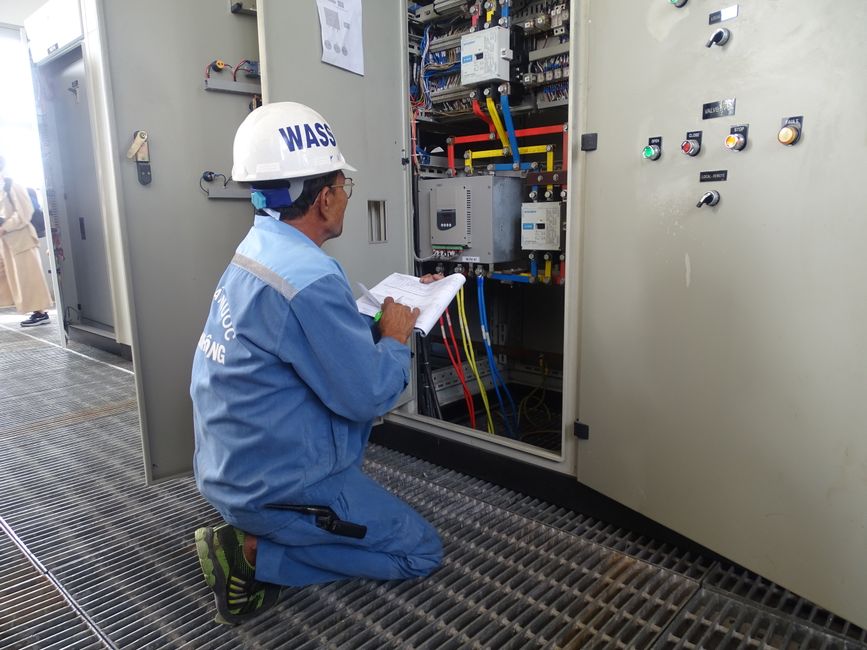
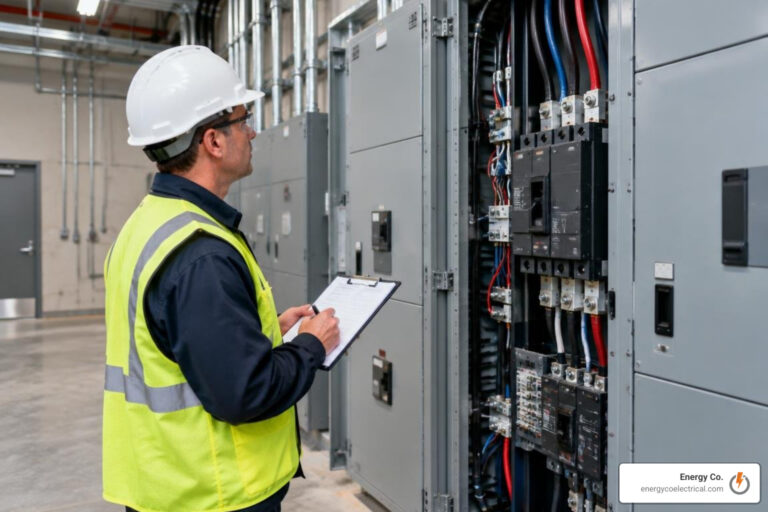
Commercial electrical systems operate under significantly heavier loads than standard residential setups. They require specialized design, high-capacity distribution components, and rigorous compliance with both local municipal codes and the National Electrical Code (NEC). Knowing what services are available and recognizing early warning signs of equipment failure will protect your bottom line.
High-Demand Commercial Electrical Installations and Repairs
Modern businesses frequently expand, install heavier machinery, or reconfigure layouts. Meeting these growing operational demands requires advanced distribution engineering and certified craftsmanship.
Common high-demand installations and repairs include:
- Switchgear Service and Upgrades: Heavy-duty switchgear handles main service entrances ranging from 800A to 4000A. Regular maintenance and timely upgrades protect against catastrophic arc faults and catastrophic main breaker trips.
- Three-Phase Power Distribution: Commercial operations rely on balanced 3-phase power (120/208V or 277/480V) to run high-load HVAC equipment, heavy compressors, and server infrastructure efficiently.
- Tenant Build-Outs and Dedicated Circuits: New commercial leases require customized branch wiring, dedicated server circuits, and subpanel distribution built specifically around the tenant’s equipment footprint, as detailed in the complete guide to commercial wiring.
- Dry-Type Transformers and Surge Protection: Facility-wide surge protection units and step-down transformers prevent volatile voltage spikes from frying sensitive computing hardware and industrial controllers.
- Heavy Machinery Connections: High-amperage equipment in manufacturing plants and warehouses requires specialized disconnects, motor control centers, and rugged raceways provided through dedicated industrial electrical services.
Urgent Warning Signs Your Facility Needs Immediate Electrical Service
Electrical systems rarely fail without warning. Catching minor system anomalies before they evolve into multi-thousand-dollar outages or hazardous fire conditions is critical for every facility manager.
If you notice any of the following symptoms, schedule a professional commercial inspection immediately:
- Overheated Enclosures and Disconnects: Switchgear panels, disconnect handles, and breaker covers should never feel warm to the touch. Excess heat indicates loose busbar terminations, internal arcing, or severe circuit overloading.
- Buzzing, Hissing, or Humming Switchgear: While mild transformer hum is normal, distinct buzzing or snapping noises inside panelboards signal dangerous loose connections or failing breaker assemblies.
- Frequent Breaker Trips and Blown Fuses: Breakers that trip repeatedly under standard operating loads are doing their job—preventing wire meltdown. Forcing a reset without diagnosing the underlying short or load imbalance risks catastrophic thermal damage.
- Flickering or Dimming Lights During Equipment Startup: When large motors, chillers, or industrial equipment kick on, significant voltage dips that cause lights to flicker indicate inadequate branch circuit sizing or unbalanced service phases.
- Burning Plastic Odors: A persistent chemical or fishy odor near outlets, panels, or raceways indicates burning wire insulation. This requires immediate isolation of the affected circuit, highlighting why your Chicago business needs a proactive electrical repair plan.
7 Steps to Choosing the Best Commercial Electrical Contractors Near Me
Selecting the right commercial team protects your property, keeps projects on schedule, and prevents expensive code violations. A disciplined vetting process ensures you partner with contractors capable of handling complex commercial and industrial electrical environments.
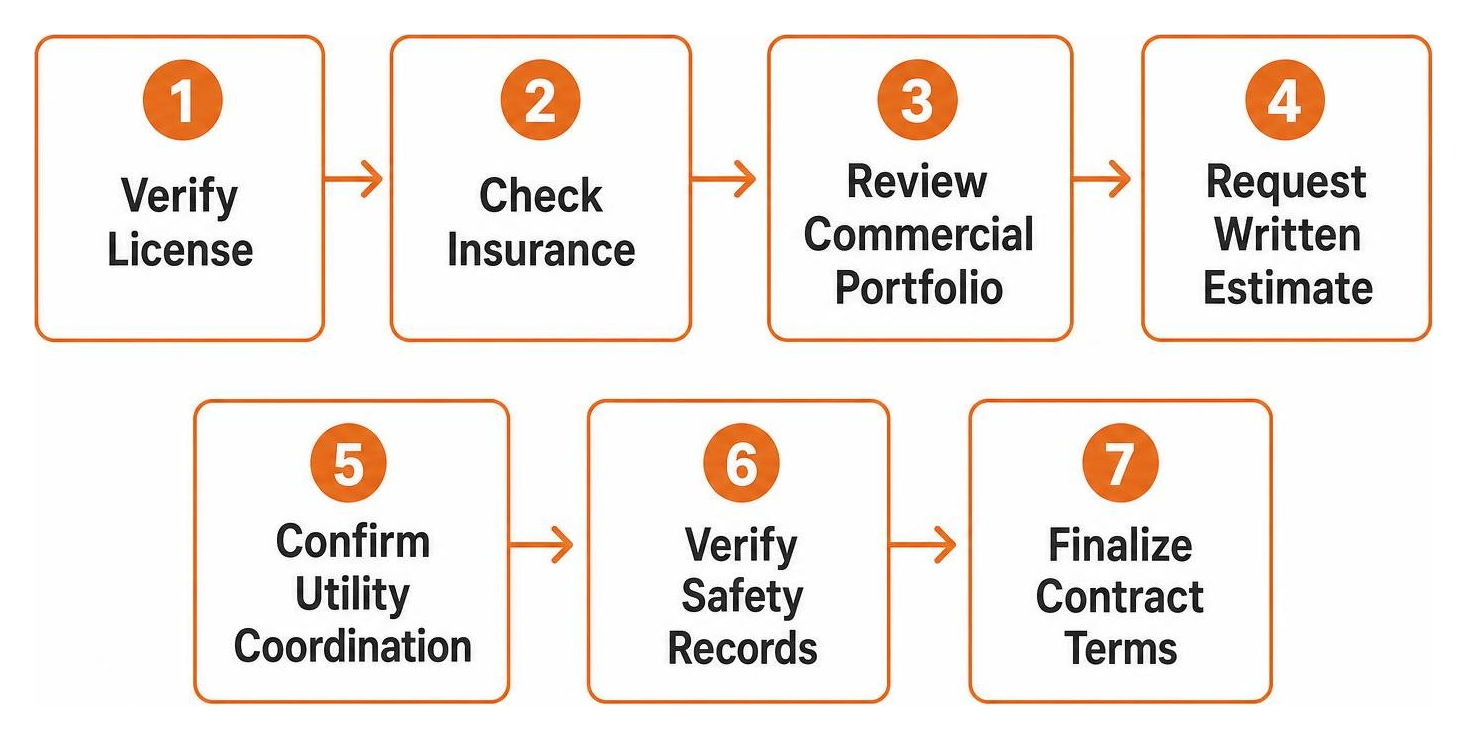
- Define Your Exact Project Scope: Document your facility’s requirements clearly, whether you need emergency repairs, scheduled lighting retrofits, or a comprehensive switchgear replacement.
- Verify Active Municipal and State Licensing: Confirm the contractor holds valid, active master electrician and electrical contractor licenses in your specific Cook County or Northwest Suburbs jurisdiction.
- Confirm Full Insurance Coverage: Demand direct certificates of insurance (COIs) detailing at least $2M in general liability coverage, full statutory workers’ compensation, and commercial umbrella protection.
- Evaluate Verifiable Commercial Experience: Ensure the contractor has a proven track record delivering commercial work similar to your facility type—be it retail, medical, light industrial, or multi-tenant office properties.
- Review Safety Compliance and EMR Ratings: Ask about their internal safety protocols, OSHA compliance history, and Experience Modification Rate (EMR) to verify job site safety standards.
- Secure Transparent, Itemized Estimates: Compare detailed quotes covering labor, materials, permit acquisition, and realistic milestone schedules to avoid unexpected change orders.
- Assess Communication and Emergency Readiness: Confirm their direct point of contact, 24/7 emergency dispatch capabilities, and expected response times for unscheduled outages.
Taking a structured approach to finding the right spark for your business with local commercial electricians prevents costly scheduling delays, unpermitted work, and premature equipment failures down the road.
How to Vet Commercial Electrical Contractors Near Me for Licensing and Insurance
Never assume a contractor holds proper commercial credentials simply because they have a fleet of branded service vans. Commercial installations carry significant financial and legal liability. Unlicensed or underinsured electrical work can void commercial property insurance policies and lead to immediate stop-work orders from local building inspectors.
When vetting local contractors, verify:
- Active Municipal Licenses: Chicago and Cook County municipalities maintain strict licensing frameworks. Contractors must hold valid credentials registered with the local building department in locations like Elk Grove Village, Palatine, Mount Prospect, and Rolling Meadows.
- Commercial General Liability: A minimum of $2,000,000 in general liability insurance protects your facility against accidental property damage, fire risks, or third-party claims during construction.
- Statutory Workers’ Compensation: Ensure full coverage for all technicians working on your site. Without verifiable workers’ compensation, your business could be held liable for workplace injuries occurring on your premises.
- Surety Bonding: Performance and surety bonds protect your investment against project abandonment, incomplete scopes, or failure to satisfy sub-tier suppliers.
Essential Questions to Ask Before Signing a Commercial Contract
Before signing a commercial electrical contract, sit down with the project manager and ask direct questions to uncover how they manage job sites and coordinate administrative requirements. Reviewing top electrical contractor services in Chicago your guide can help you benchmark contractor capabilities.
Key questions to ask include:
- Do you handle the entire permit acquisition and code inspection process in-house?
- Will this project be self-performed by your licensed full-time technicians, or will parts of the scope be subcontracted?
- How do you handle utility coordination and planned shutdown schedules with the local utility provider?
- What specific warranties cover your commercial workmanship and installed hardware?
- What is your standard protocol for managing unforeseen site conditions or requested change orders?
- What is your guaranteed response time if our facility experiences an unexpected critical outage?
Commercial vs. Residential Electrical Work: Differences, Costs, and Emergency Response
Commercial and residential electrical work share basic physical principles of electricity, but their practical execution, regulatory environments, and system capacities are worlds apart. While residential wiring focuses on standard single-phase 120/240V circuits behind drywall, commercial systems manage heavy 3-phase power loads, rigid metallic raceways, and stringent life-safety networks.
| System Characteristic | Residential Electrical Work | Commercial Electrical Work |
|---|---|---|
| Voltage & Phases | 120V / 240V Single-Phase | 120/208V, 277/480V Three-Phase |
| Conduit & Wiring Methods | Non-Metallic Sheathed Cable (Romex) | EMT, Rigid Metallic Conduit (RMC), MC Cable |
| Service Capacity | Typically 100A – 400A Panels | 400A – 4000A+ Switchgear & Distribution |
| Load Characteristics | Intermittent, Domestic Appliances | Continuous Industrial, Heavy Motors, HVAC, Servers |
| Safety & Code Standards | Basic Residential NEC Guidelines | Strict Commercial NEC, NFPA 70E, Life-Safety Codes |
| Permit & Inspection Rigor | Standard Municipal Home Permits | Advanced Plan Review, Engineered Drawings, Site Audits |
Navigating these complex technical demands requires specialized commercial training, as explored in detail across top industrial electrician services in Chicago ensuring safety and efficiency.
Commercial Electrical Service Pricing Factors and Cost Benchmarks
Commercial electrical service costs depend on several core operational variables rather than a simple flat rate. Pricing models must account for project scale, system complexity, structural constraints, and utility coordination requirements.
Primary factors influencing total project pricing include:
- System Capacity and Amperage Requirements: Supplying power for a 200A office suite tenant build-out involves significantly lower material and labor investment than installing a 2000A service entrance switchgear for a warehouse distribution hub.
- Conduit Installation Complexity: Running exposed Electrical Metallic Tubing (EMT) or heavy rigid conduit through concrete walls, high open-truss industrial ceilings, or historic building infrastructure requires specialized hydraulic bending tools, scissor lifts, and skilled labor.
- Permitting Fees and Engineering Plan Reviews: Commercial projects require sealed architectural or electrical engineering drawings, rigorous plan reviews, and dedicated municipal inspection fees that vary by municipality.
- Off-Hours and Phased Scheduling: To minimize daytime operational disruptions, commercial projects often require evening, weekend, or holiday work shifts to complete tie-ins safely without interrupting normal business hours.
- Utility Coordination Costs: Connecting high-capacity service lines often requires coordinating planned shutdowns, transformer drops, and meter sets with local utility providers.
For business owners in suburban areas, locating dedicated regional services like commercial electrical services Naperville ensures your project stays aligned with local building department guidelines and regional labor standards.
Why Emergency Preparedness Requires Commercial Electrical Contractors Near Me
When unexpected power failures occur, every minute of facility downtime translates directly to lost revenue, wasted inventory, or halted client services. A manufacturing plant with downed assembly lines or a healthcare clinic without reliable backup circuits cannot afford to wait days for a service call.
Having a dedicated commercial partner equipped for 24/7 rapid dispatch is essential for business continuity. Professional teams arrive on-site with advanced diagnostic gear, temporary generator hookups, and high-capacity replacement components ready for immediate deployment.
Understanding what commercial electrician emergency response teams do on site provides peace of mind that your facility will be stabilized safely, diagnosed accurately, and re-energized in compliance with local utility regulations.
Preventive Maintenance and Modern Energy Efficiency Solutions
Modern commercial facility management relies on proactive system care rather than waiting for catastrophic breakdowns. Preventive electrical maintenance protects your capital investments, extends equipment lifecycles, and significantly reduces the risk of electrical fires and unscheduled downtime.
Implementing regular diagnostic checks ensures your electrical infrastructure operates within designed thermal and electrical tolerances year-round.
Preventive Maintenance Contracts and System Longevity
Neglecting commercial electrical panels and switchgear leads to loose terminations, dust accumulation, component overheating, and eventual component failure. Routine maintenance plans provide a predictable operational schedule that keeps systems running smoothly.
Comprehensive preventive maintenance programs include:
- Infrared Thermography Scanning: Non-destructive thermal imaging pinpoints loose lugs, overloaded breakers, and failing busbars by identifying abnormal heat signatures before components fail.
- Torque Audits on Critical Terminations: Natural thermal expansion and mechanical vibration loosen electrical lugs over time. Periodic torque verification ensures every connection meets manufacturer specifications.
- Switchgear and Panel Cleaning: Dust, metal filings, and humidity buildup inside distribution enclosures create conductive paths that cause phase-to-phase short circuits. Regular vacuuming and cleaning mitigate flashover risks.
- Arc Flash Risk Assessments: Reviewing panel labeling, trip settings, and personal protective equipment (PPE) requirements keeps your facility aligned with NFPA 70E safety standards.
- Power Quality Analysis: Monitoring harmonic distortion, voltage sags, and transient spikes protects expensive electronic machinery from premature motor failure.
Proactive care helps facility managers avoid emergencies—learn why you don’t get zapped by poor commercial electrical system maintenance before avoidable damage occurs.
Energy-Smart Upgrades: LED Retrofits, EV Charging, and Controls
Energy efficiency retrofits represent one of the fastest ways for commercial enterprises to reduce monthly overhead while improving building aesthetics and functionality. Upgrading legacy fluorescent and high-pressure sodium fixtures directly lowers utility bills and cuts ongoing maintenance costs.
- Commercial LED Upgrades: Modern LED lighting systems use up to 75% less energy than outdated metal-halide or fluorescent fixtures, producing cleaner illumination with less heat output. Explore how you can save green by going green with Chicago commercial lighting upgrades.
- Commercial EV Charging Stations: Installing Level 2 and DC Fast Charging units attracts eco-conscious customers, provides employee perks, and adds a modern amenity to commercial properties.
- Parking Lot and Perimeter Illumination: Upgraded exterior lighting improves security, eliminates dark spots, and reduces liability across commercial parking structures and walkways, as outlined in our guide on commercial parking lot lighting.
- Automated Lighting Controls and Occupancy Sensors: Smart daylight harvesting systems and scheduled dimming ensure energy is consumed only when and where it is needed.
Upgrading your electrical efficiency often qualifies your business for substantial local utility rebates and state clean-energy incentives. Reviewing the business guide to commercial electric solutions and incentives will help you maximize your return on investment.
Frequently Asked Questions About Commercial Electrical Services
What is the primary difference between residential and commercial electrical work?
Commercial electrical work relies primarily on three-phase power systems (120/208V or 277/480V) designed to carry high continuous electrical loads. Commercial wiring is routed through metallic raceways and rigid conduit (EMT) rather than standard non-metallic sheathed cable (Romex). Commercial projects must also satisfy stricter life-safety codes, emergency egress illumination requirements, and municipal plan review standards.
How do commercial contractors handle emergency outages and repairs?
Commercial electrical contractors maintain 24/7 emergency dispatch services. When an urgent call arrives, master electricians are deployed with specialized diagnostic tools, fault locators, and temporary power solutions like portable industrial generators. The team stabilizes the site, isolates the faulted circuits, coordinates with the local power utility if needed, and performs code-compliant repairs to restore power quickly.
What factors impact the total cost of a commercial electrical project?
The overall cost of a commercial electrical project depends on system amperage and service capacity, square footage, structural layout, equipment specs, and material requirements (such as heavy EMT conduit versus MC cable). Additional cost drivers include local municipal permitting fees, specialized engineering reviews, off-hours labor schedules, and the complexity of coordinating utility shutdowns.
Conclusion
Finding the right local commercial electrical partner makes all the difference in keeping your facility safe, energy-efficient, and fully operational. From routine preventive maintenance and comprehensive LED retrofits to heavy switchgear replacements and rapid 24/7 emergency response, your electrical infrastructure requires licensed, experienced professionals who understand the nuances of local building codes and legacy commercial architecture.
At Energy Co., we deliver turnkey, code-compliant solutions tailored to your unique facility needs. Serving Chicago, Cicero, Schaumburg, Hoffman Estates, Elk Grove Village, Palatine, Roselle, Streamwood, Hanover Park, Arlington Heights, Mount Prospect, Rolling Meadows, and the greater Cook County and Northwest Suburbs, our licensed electricians ensure your systems operate with complete reliability.
Contact our team today to schedule an on-site consultation or explore our full suite of commercial electrical services designed to power your business into the future.