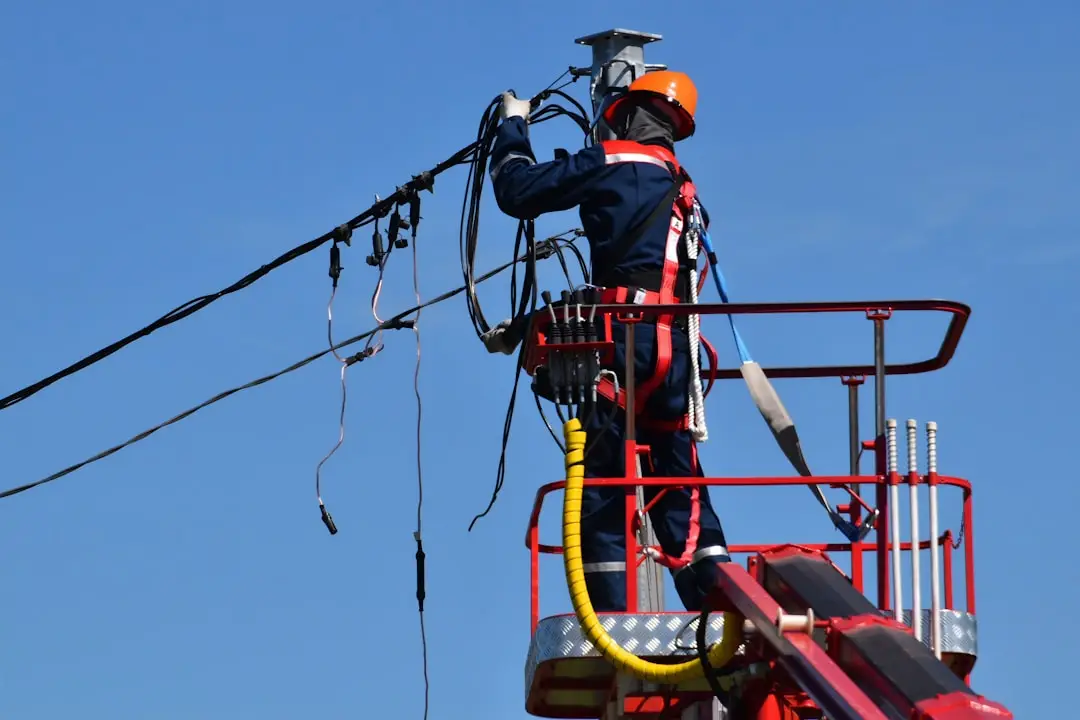
Commercial Electrician Emergency Response Protects People and Business Uptime
A commercial electrician emergency response team should be called right away when an electrical problem creates a fire, shock, safety-system, or major downtime risk. This includes smoke or burning-wire odors, sparks, a hot or buzzing panel, repeated breaker trips, loss of three-phase power, or an outage affecting refrigeration, security, emergency lighting, medical equipment, or production machinery.
Before help arrives:
- Keep people away from the affected area. Evacuate and call 911 if there is fire or heavy smoke.
- Shut off the affected breaker or main disconnect only if it is safe to do so.
- Do not touch damaged wiring, wet electrical equipment, or a sparking panel.
- Record the time, affected equipment, and visible damage for the electrician and insurer.
Commercial emergencies need a contractor who understands higher electrical loads, three-phase systems, business occupancy rules, and the need to restore safe operation without cutting corners. Fast after-hours help can limit lost inventory, interrupted work, security exposure, and equipment damage.
I am Michał Napieralski of Energy Co., a licensed electrical professional serving Schaumburg and the Chicago suburbs with commercial maintenance, panel upgrades, breaker replacement, wiring repairs, and inspections. That hands-on work informs this guide to commercial electrician emergency response, from making the site safe to documenting compliant repairs.
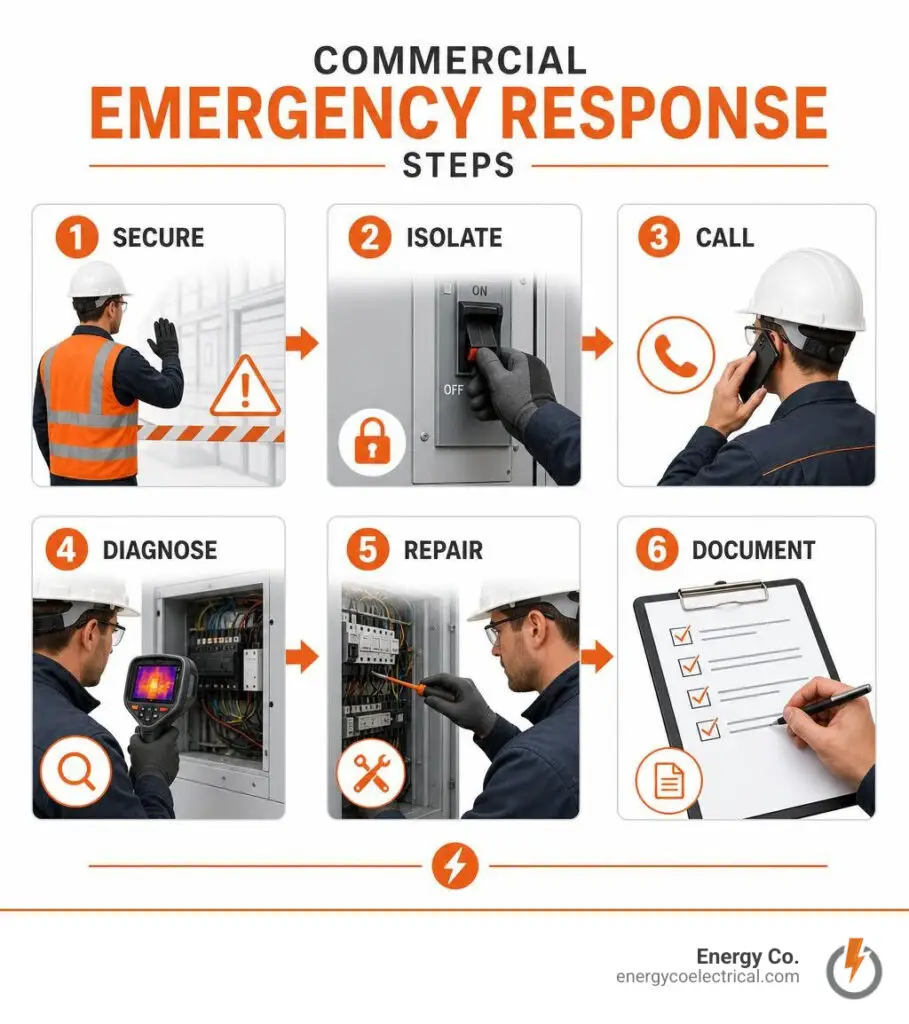
Quick commercial electrician emergency response definitions:
Identifying Commercial Electrical Emergencies vs Routine Issues
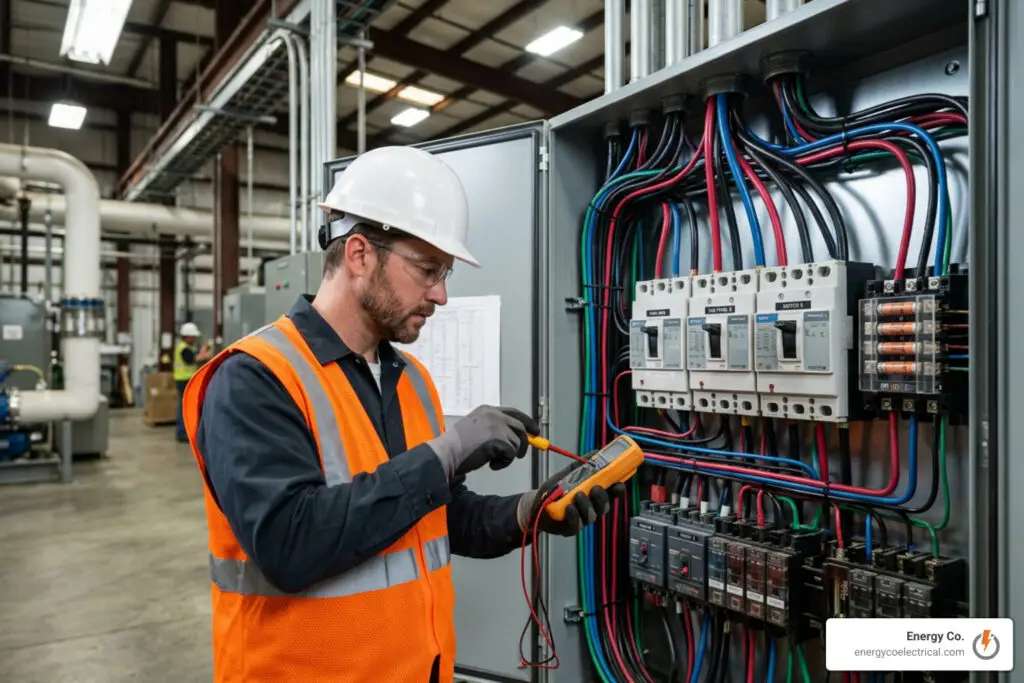
In a commercial environment, electrical failures carry immediate financial, legal, and life-safety implications. A flickering lamp in a breakroom is an annoyance that can wait for a scheduled service call. In contrast, sudden phase loss shutting down an assembly line or an overheating switchboard poses an imminent danger that demands rapid-response commercial electrical services.
Distinguishing between routine maintenance issues and genuine emergencies helps facility managers protect employees, maintain regulatory compliance, and prevent catastrophic property loss.
Critical Warning Signs and High-Risk Electrical Hazards
Certain electrical symptoms require an immediate shutdown and rapid intervention. If you notice any of the following critical warning signs, treat the situation as an emergency:
- Visible Arcing and Sparking: Any visible electrical discharge at switchgear, motor control centers, or wall receptacles indicates severe insulation breakdown or mechanical failure.
- Burning Odors and Scorched Enclosures: Acrid plastic or fishy chemical smells near electrical distribution panels signal that wire insulation is melting under high resistive heating.
- Buzzing or Humming Switchgear: Low-frequency humming can be normal in large transformers, but loud buzzing or sizzling noises inside panels point to loose busbar connections or imminent breaker failure.
- Warm Conduit and Overheated Panels: Enclosures or metallic raceways that feel hot to the touch indicate overloaded circuits carrying amperage beyond their safe thermal limits.
- Repeated GFCI or Breaker Trips: If a commercial breaker immediately trips after being reset, never force it back on. This indicates an active dead short or ground fault that could trigger an arc flash.
- Localized Power Surges: Random voltage spikes that damage computer terminals, POS networks, or programmable logic controllers (PLCs) often stem from a compromised neutral wire or damaged transformer.
Diagnosing Internal Facility Failures vs Utility Grid Outages
When lights go dark, the first task is establishing whether the outage is internal to your facility or part of a wider utility distribution failure.
Start by looking at neighboring facilities, street lights, and traffic signals along your corridor. If adjacent commercial properties in your business park or retail strip are fully powered, the fault lies within your electrical infrastructure.
Next, inspect your main service disconnect. If the main service breaker or medium-voltage disconnect switch has tripped, your facility has experienced an internal overload or ground fault. Check your utility transformer meter outside; if the digital display is active, power is arriving from the grid, pinpointing the failure to your main switchboard, distribution feeders, or downstream sub-panels. A single-phase drop from the utility can also cause partial brownouts, running single-phase lighting while causing three-phase motors to stall and overheat.
Immediate Facility Safety Steps Before Technicians Arrive
When an electrical crisis occurs, facility managers and shift supervisors must take decisive steps to protect personnel and property before our emergency technicians reach your location.
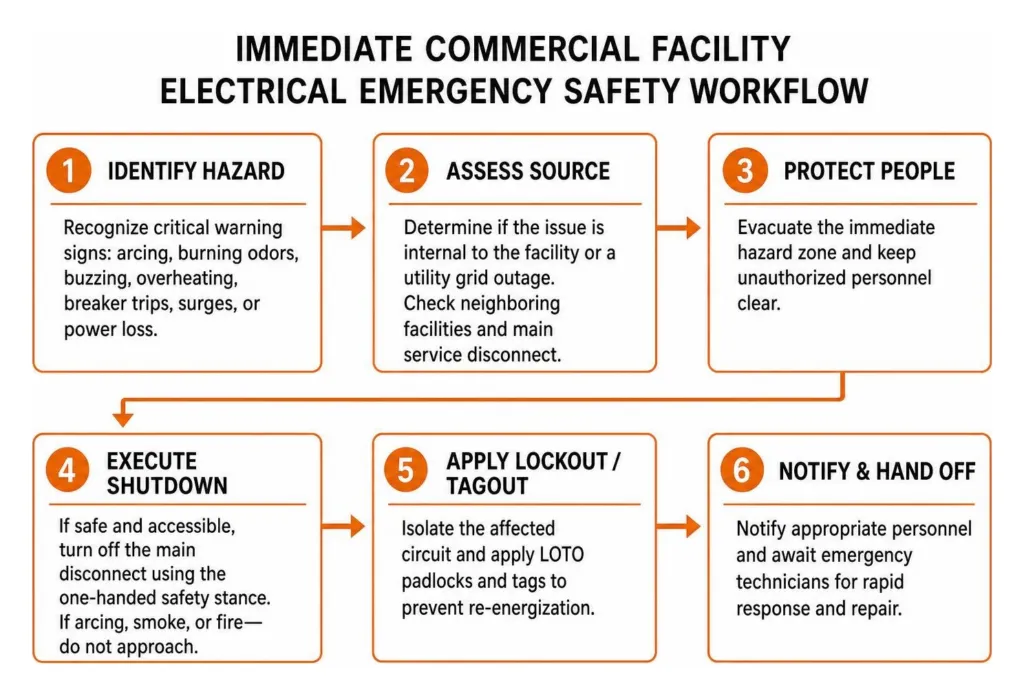
Prioritize human life above all equipment and operational continuity:
- Evacuate the Immediate Hazard Zone: Establish a clear safety perimeter around sparking panels, flooded electrical vaults, or smoking machinery. Keep unauthorized staff completely clear of the area.
- Execute Emergency Shutdowns: If the main disconnect switch is accessible and shows no signs of active arcing, smoke, or physical damage, turn it off using the standard one-handed safety stance (standing to the side, facing away, and using your non-dominant hand). If there is active fire or arcing, do not approach the panel—evacuate immediately and call 911.
- Apply Lockout/Tagout (LOTO) Procedures: When qualified maintenance staff isolate a damaged sub-circuit, apply standard LOTO padlocks and tags to prevent anyone from accidentally re-energizing the circuit.
- Avoid Arc Flash Boundaries: Never open panelboard doors or dead-front covers during an active fault. Arc flashes can reach temperatures over 35,000°F and produce lethal blast pressures.
- Isolate Sensitive Equipment: If safely accessible via secondary disconnects, isolate critical computer servers, medical devices, or industrial chillers to protect them from high-voltage transients during grid or generator changeovers.
Immediate Containment and Electrical Incident Documentation
While maintaining a safe distance, document the incident thoroughly. Commercial insurance adjusters and municipal inspectors require detailed records before approving claims and occupancy permits.
- Capture High-Resolution Photos and Video: Record images of scorched enclosures, tripped breakers, damaged equipment, and surrounding environmental conditions from a safe vantage point.
- Preserve Security Footage: Save camera recordings showing the time and location where the electrical fault initiated. This aids forensic troubleshooting and helps establish timeline clarity.
- Maintain Time-Stamped Incident Logs: Note the precise sequence of events: when odors were first detected, which machinery stalled, when breakers tripped, and which areas lost power.
- Ventilate Smoke and Fumes: If safe to do so, engage facility exhaust fans to clear toxic fumes produced by vaporized PVC insulation and synthetic materials.
- Disconnect Surge Suppression: If whole-facility surge protective devices (SPDs) took a direct lightning or transformer surge hit, check if their diagnostic status LEDs indicate failure.
Step-by-Step Commercial Electrician Emergency Response on Site
When our dispatch receives an urgent call, our emergency response protocols initiate immediately. We mobilize fully equipped service vans carrying diagnostic tools, replacement breakers, industrial fuses, cabling, and safety gear.
Our licensed technicians work through a structured emergency restoration process:
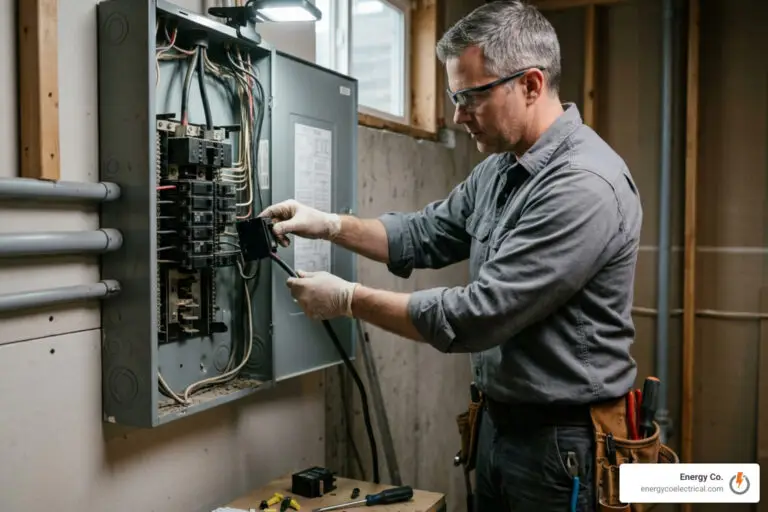
- Initial Site Evaluation: Upon arrival, technicians meet with facility management to review incident logs, review single-line diagrams, and assess immediate structural hazards.
- Hazard Isolation and Lockout: Technicians establish arc flash safety boundaries according to NFPA 70E standards and verify zero energy state using calibrated test instruments.
- Systematic Fault Diagnosis: Using advanced diagnostic testing, electricians isolate whether the fault is in the service entrance, feeder busway, branch circuitry, or connected machinery.
- Emergency Repairs and Bypass: Damaged components are repaired or temporarily bypassed safely to restore critical life-safety, refrigeration, and security systems.
- Load Testing and System Restoration: Circuits are systematically re-energized under controlled conditions while monitoring voltage balance and current draw.
- Documentation and Certification: Technicians provide compliance documentation and outline any required permanent follow-up repairs.
For round-the-clock commercial site emergencies across our service areas, businesses rely on our dedicated 24/7 emergency electrical services to resolve complex high-voltage faults quickly and safely.
Safety Diagnostics During Commercial Electrician Emergency Response Calls
Safety diagnostics require specialized instrumentation to pinpoint hidden failures inside commercial conduits and switchgear. Our technicians apply rigorous testing standards before touching any conductor:
- True-RMS Voltage and Current Testing: Calibrated meters measure phase-to-phase and phase-to-neutral voltages to identify phase imbalances, harmonic distortions, and dropped utility legs.
- Infrared Thermal Imaging: Thermal cameras locate high-resistance connections, overloaded conductors, and internal busbar hot spots through panel covers without invasive shutdowns.
- Insulation Resistance (Megohmmeter) Testing: High-voltage insulation testing verifies that cable insulation hasn’t broken down inside underground or concealed conduits due to thermal degradation or water intrusion.
- Ground Fault and Loop Impedance Detection: Specialized analyzers trace short-to-ground paths and verify that protective bonding systems will clear future faults safely.
- NFPA 70E Arc Flash Compliance: Electricians wear appropriate Personal Protective Equipment (PPE)—ranging from Category 2 to Category 4 flash suits—whenever testing energized equipment or verifying electrical isolation.
Restoring Three-Phase Power, Distribution Panels, and Backup Generators
Restoring industrial three-phase power involves far more than simply replacing a fuse. Three-phase systems (208Y/120V or 480Y/277V) require precise phase sequencing; reversing phases can cause commercial motors, pumps, and compressors to spin backwards, destroying expensive equipment instantly.
Emergency teams perform rapid component replacements, swapping out compromised molded-case circuit breakers, rebuilding burnt switchboard busbars, and installing emergency feeder jumpers.
When utility power is entirely lost, technicians troubleshoot and repair Automatic Transfer Switches (ATS) to restore emergency power or establish temporary generator tap boxes for portable high-capacity generators. Once power is reconnected, technicians perform dynamic phase balancing to ensure no single phase carries excessive current that could trigger another outage.
Post-Repair Testing, Compliance Audits, and NFPA Documentation
Emergency repairs must comply with stringent regulatory standards. Once power is stabilized, our technicians conduct comprehensive verification protocols:
- Load Verification Under Operating Conditions: We monitor full operational loads as plant machinery or HVAC chillers restart, confirming total amperage remains within safety margins.
- NFPA 70B Maintenance Records: In line with NFPA 70B standards for electrical equipment maintenance, all diagnostic findings, torque checks, and repairs are recorded for facility logs.
- Permitting and Municipal Compliance: When emergency repairs involve service entrance equipment, new feeder circuits, or panelboard rebuilds, we interface directly with local building authorities to ensure all work meets city building codes.
- Insurer-Ready Incident Reports: We provide complete written summaries detailing the root cause of failure, actions taken, parts replaced, and preventive recommendations for your insurance adjusters.
Commercial vs. Residential Emergency Needs Across Industries
Commercial facilities operate under vastly different electrical demands than residential homes. A residential outage generally impacts comfort and convenience, whereas commercial electrical failures can risk hundreds of thousands of dollars in spoiled inventory, halted production lines, and life-safety liabilities.
| Feature / Requirement | Commercial Electrical Emergency | Residential Electrical Emergency |
|---|---|---|
| Typical Voltage & Phase | 208V, 240V, 480V (Three-Phase) | 120V / 240V (Single-Phase) |
| Current Loads | 400A to 4,000A+ Switchgear | 100A to 200A Load Centers |
| Conduit & Wiring | Rigid Metal Conduit (RMC), EMT, High-Amperage Busways | Non-Metallic Sheathed Cable (NM-B/Romex) |
| Safety Regulations | OSHA, NFPA 70E, NFPA 70B, IBC Life Safety | Local Residential Building Codes |
| Downtime Impact | Severe financial loss, production shutdown, safety risk | Inconvenience, loss of domestic comfort |
| Documentation Needs | Detailed audit logs, insurance reports, code sign-offs | Basic repair invoice |
When businesses encounter specialized high-voltage infrastructure faults, partnering with the providers of the top commercial electrician services in Chicago ensures technicians arrive with the correct heavy-duty industrial components and diagnostic certifications.
Deploying Rapid Commercial Electrician Emergency Response for Critical Facilities
Different industries face distinct risks during electrical emergencies, requiring tailored response procedures:
- Data Centers and Server Rooms: Uninterruptible Power Supply (UPS) failure or Power Distribution Unit (PDU) shorts demand immediate bypass repairs to prevent catastrophic data loss and IT hardware damage.
- Healthcare Facilities and Outpatient Clinics: Operating suites, life-support monitors, and medication refrigeration units require continuous, clean power and immediate ATS recovery.
- Cold Storage and Supermarkets: Large-scale commercial refrigeration racks risk massive food spoilage within hours of a compressor control circuit or main feed failure.
- Manufacturing and Light Industrial: Stalled stamping presses, robotic assembly lines, or CNC machinery incur substantial downtime costs per hour, requiring rapid motor control center (MCC) troubleshooting.
- Restaurants and Hospitality: Commercial kitchen exhaust hoods, walk-in coolers, and grease-trap pumps must remain fully functional to maintain health department compliance and uninterrupted service.
Commercial Load Complexity, Three-Phase Systems, and Pricing Factors
Commercial emergency work requires specialized labor rates, heavy equipment, and complex load calculations. When emergency teams arrive on site, pricing is dictated by several critical factors:
- System Complexity (480V vs 120/240V): Higher voltage systems require higher PPE category ratings, two-person safety teams, and specialized switchgear components.
- After-Hours and Mobilization Timing: Dedicated emergency dispatch during weekends, holidays, or late-night shifts involves premium labor rates reflecting 24/7 readiness.
- Equipment and Heavy Materials: Replacing 800-amp industrial fuses, large-gauge copper feeder cables (500 kcmil+), or commercial circuit breakers involves significant material costs compared to standard residential components.
- Rental Equipment: In scenarios requiring temporary generator backups, crane lifts for rooftop transformers, or medium-voltage cable pullers, equipment rentals are incorporated into the overall project scope.
Prevention Strategies and Choosing Reliable Emergency Electricians
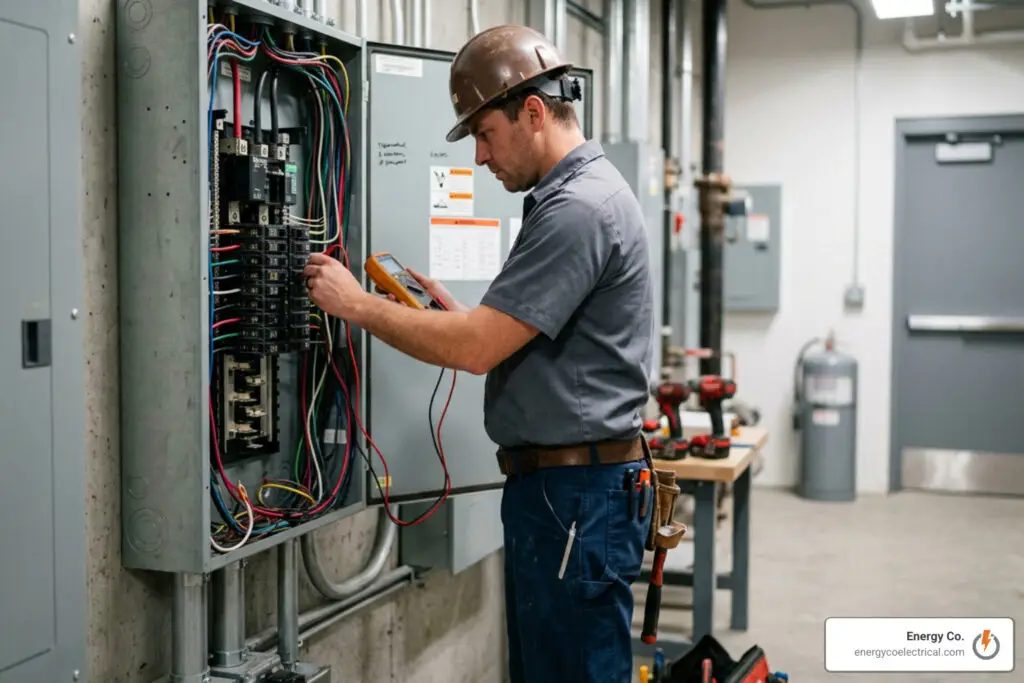
While emergency response teams are vital when crises occur, the best emergency is the one that never happens. Proactive facility maintenance dramatically cuts down on catastrophic electrical failures and protects long-term capital investments. Discover why your Chicago business needs a proactive electrical repair plan to identify component wear before it turns into an unexpected midnight shutdown.
Preventive Thermal Imaging and Electrical Maintenance Plans
Modern commercial maintenance relies heavily on non-destructive testing methodologies to identify failure points before they disrupt operations:
- Routine Infrared (IR) Thermography: Scheduled thermographic scans of distribution switchboards, disconnect switches, and panelboards identify loose lugs, corroded terminals, and overloaded circuits invisible to the naked eye.
- NFPA 70B Compliance Maintenance: Adhering to structured NFPA 70B standards ensures scheduled mechanical cleaning, lubrication, torque verification, and contact resistance testing of switchgear.
- Ultrasonic and Partial Discharge Testing: For medium-voltage switchgear, ultrasonic detection identifies micro-arcing and corona discharge within insulation before complete dielectric breakdown occurs.
- Transformer Oil Analysis and Health Checks: Regular testing of liquid-filled transformers detects moisture, dissolved gasses, and insulation degradation before internal winding failure happens.
Criteria for Selecting Licensed 24/7 Commercial Contractors
When your facility is down, you cannot afford to call an inexperienced contractor. When finding a reliable weekend emergency electrician in Chicago, ensure they meet essential commercial qualifications:
- Comprehensive Licensing, Bonding, and Insurance: Verify that the electrical contracting firm holds active commercial licenses and carries multi-million-dollar general liability and workers’ compensation coverage.
- IBEW / Certified Commercial Journeymen: Ensure on-site technicians have completed certified apprenticeship programs and hold current NFPA 70E safety training certifications.
- Dedicated Fleet and Stocked Service Trucks: A qualified contractor maintains service vehicles stocked with commercial-grade breakers, fuses, high-amperage lugs, and diagnostic equipment.
- Clear Response Guarantees and Direct Dispatch: Look for companies with dedicated dispatch dispatchers rather than unmonitored answering services, ensuring rapid technician mobilization.
Frequently Asked Questions About Commercial Electrical Emergencies
How quickly can a commercial electrician arrive on site during an emergency?
Professional emergency electrical teams typically maintain an arrival window of 30 to 90 minutes within their core metropolitan service corridors. Response times vary depending on traffic conditions, severe weather events, and current call volume, but dedicated commercial response contractors prioritize life-safety hazards and critical production shutdowns for immediate dispatch.
Do emergency commercial electrical repairs require permits and inspections?
Yes. While emergency repairs necessary to protect life, property, and restore basic service can be performed immediately, most municipal building departments require retroactive permits. Your electrical contractor will submit emergency repair documentation, pull the required permits on the next business day, and coordinate with the local electrical inspector for final sign-offs.
Can electrical maintenance plans prevent emergency service calls?
Routine electrical maintenance and annual infrared thermal imaging can eliminate up to 70% of sudden commercial electrical failures. Scheduled testing identifies loose connections, thermal anomalies, ground faults, and aging components, allowing your facility to repair them during planned maintenance windows rather than suffering unexpected emergency downtime.
Conclusion
When commercial electrical infrastructure fails, the risks to your employees, property, and bottom line escalate by the minute. Having a dedicated commercial electrician emergency response plan ensures your business can contain hazards immediately, restore operations safely, and maintain full regulatory compliance.
From diagnosing complex three-phase power failures to deploying emergency generators and providing insurer-ready documentation, Energy Co. delivers fast, licensed 24/7 commercial emergency support across Chicago and the surrounding suburbs. Protect your business continuity today by saving our emergency dispatch line or contacting our team for immediate emergency electrical services.