Why Proper Hot Tub Wiring Can Make or Break Your Installation
Hot tub wiring is one of the most safety-critical electrical projects a homeowner can take on — and getting it wrong can mean tripped breakers, damaged equipment, or serious electrocution risk.
Here’s what most homeowners need to know at a glance:
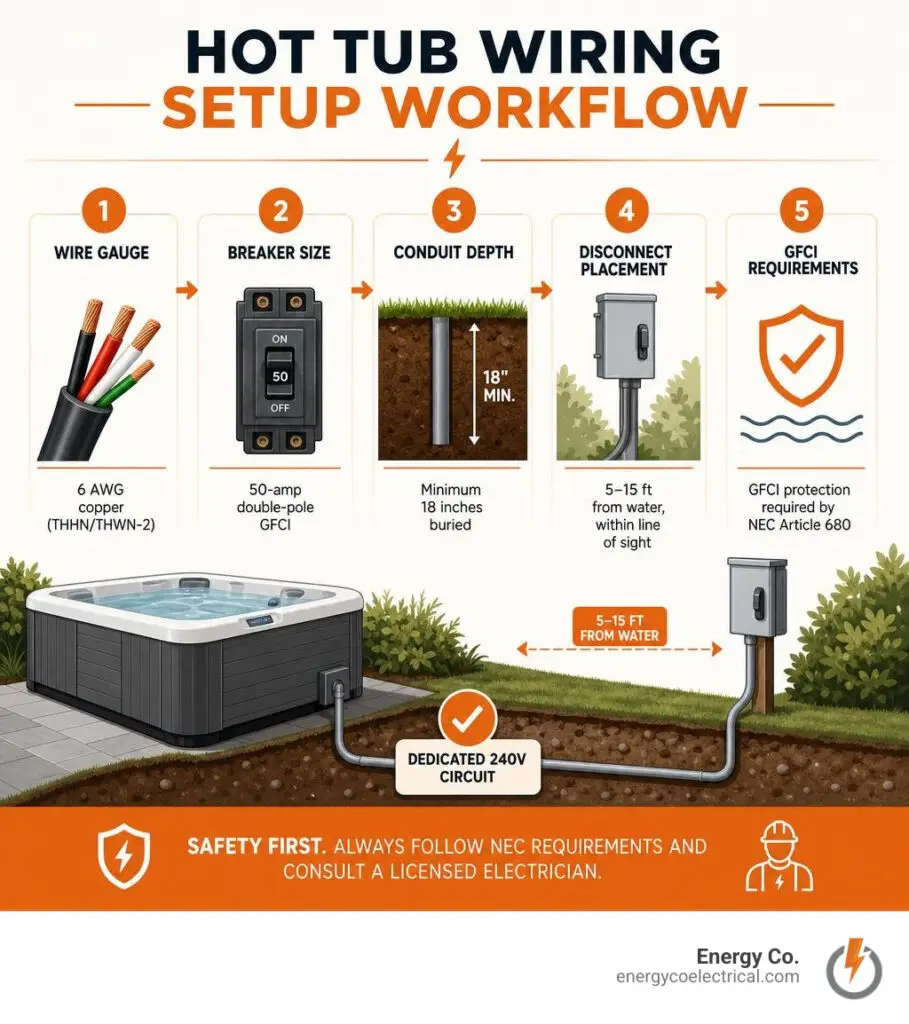
| What You Need | Standard Requirement |
|---|---|
| Wire gauge | 6 AWG copper (THHN/THWN-2) |
| Breaker size | 50-amp double-pole GFCI (most models) |
| Voltage | 240V dedicated circuit |
| Disconnect location | 5–15 ft from water, within line of sight |
| Conduit burial depth | Minimum 18 inches |
| GFCI protection | Required by NEC Article 680 |
| Wire configuration | 4-wire: 2 hots, 1 neutral, 1 ground |
Most full-size hot tubs run on a dedicated 240V circuit with a 50-amp GFCI breaker. Plug-and-play 120V models exist, but they heat slowly and can’t run jets and the heater at the same time.
The rules for this type of installation come from NEC Article 680 — the national code that governs all electrical work near pools, spas, and hot tubs. Local municipalities (including many Chicago suburbs) may add their own requirements on top of that.
This is not a project to wing. Water and electricity are a dangerous combination, and mistakes here have real consequences.
I’m Michał Napieralski, a licensed electrician serving the Chicagoland area with extensive hands-on experience in hot tub wiring and outdoor electrical installations for both residential and commercial clients. In this guide, I’ll walk you through everything you need to know — from wire selection and conduit runs to GFCI protection and common mistakes that cause breakers to fail.
Hot Tub Wiring Requirements and Wire Selection
When planning hot tub wiring, selecting the correct wire gauge and conductor type is the foundation of a safe, long-lasting installation. Hot tubs are continuous-load appliances under the National Electrical Code (NEC). Because the heating elements and hydrotherapy jet pumps run continuously for hours, electrical safety codes mandate applying a 125% continuous load multiplier when sizing your circuit protection and conductors.
For example, a hot tub with a nameplate draw of 40 amps continuous load requires a circuit breaker sized to at least 50 amps (40A × 1.25 = 50A). To safely carry this current over typical residential distances without hazardous heat accumulation, 6 AWG (American Wire Gauge) copper wire is standard across the industry. For larger luxury units or swim spas drawing 48 amps continuous, a 60-amp circuit with 4 AWG copper conductors is required.
All conductors used in outdoor spa installations must be pure copper with THHN/THWN-2 insulation ratings. Standard aluminum or copper-clad aluminum wire should never be used for hot tub connections; aluminum is prone to oxidation, expansion, and terminal screw loosening when subject to high continuous current in wet environments. Always look for UL (Underwriters Laboratories) safety certifications on all electrical wire, subpanels, and breakers to guarantee product safety and local building code compliance.
For an in-depth breakdown of wire types, review our detailed guide on How to Choose the Right Electrical Cable for Hot Tub Installations.
| Feature / Spec | 50-Amp Spa Panel | 60-Amp Spa Panel |
|---|---|---|
| Continuous Spa Load Rating | Up to 40 Amps | Up to 48 Amps |
| Required Wire Gauge (Copper) | #6 AWG THHN/THWN-2 | #4 AWG THHN/THWN-2 |
| Typical Heater Wattage Supported | 4.0 kW – 5.5 kW | 5.5 kW – 11.5 kW |
| Typical Spa Size | 4–6 Person Standard Spas | 7–8 Person Luxury Spas / Swim Spas |
| Circuit Breaker Requirement | 50A Double-Pole GFCI | 60A Double-Pole GFCI |
| Minimum PVC Conduit Size | 3/4-inch (1-inch recommended) | 1-inch |
Can You Use NM-B Cable for Hot Tub Wiring?
A frequent point of confusion for homeowners is whether standard Type NM-B (Non-Metallic Sheathed) indoor cable, commonly referred to as Romex, can be used for hot tub wiring.
The short answer is: NM-B cable can only be used for the indoor portion of the circuit run.
NM-B cable is strictly restricted by NEC regulations to dry, indoor interior framing spaces (such as running inside basement ceiling joists from your main service panel to the home’s exterior wall). The moment the wiring exits the building footprint or enters an exterior conduit system, it is legally classified as a “wet location.” NM-B paper wrapping absorbs outdoor moisture and degrades rapidly, causing catastrophic ground faults.
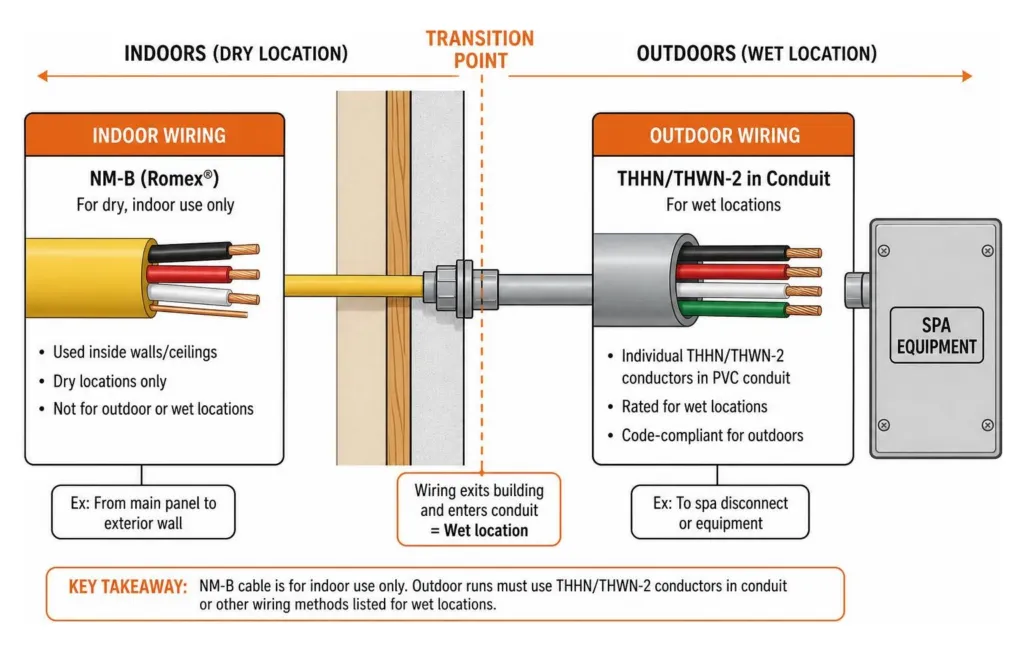
When running wiring outdoors, you have two primary code-compliant methods:
- THHN/THWN-2 Individual Conductors in Conduit: Run four individual insulated stranded copper wires (hot, hot, neutral, and an insulated green ground) inside PVC conduit.
- PVC-Jacketed Direct-Burial MC Cable: Metal-clad cable explicitly listed and labeled for direct burial and wet locations.
To double-check exact wire ampacity and distance-based voltage drop specs for your project, consult the online Hot Tub Calculator — NEC Article 680.
Conduit, Disconnect Boxes, and Fittings
Protecting your electrical wires from weather, physical lawnmower damage, and soil movement requires proper conduit selection and box placement.
For underground runs from the house foundation to the spa site, standard Schedule 40 PVC electrical conduit is required, buried at a minimum depth of 18 inches. Where the conduit emerges above ground or is exposed to potential physical impacts along exterior walls, Schedule 80 PVC conduit (which has a thicker, impact-resistant wall) must be used.
While 3/4-inch conduit meets minimum code fill capacities for four #6 conductors, we at Energy Co. strongly recommend installing 1-inch Schedule 40 PVC conduit. Squeezing four heavy-gauge #6 wires through 3/4-inch PVC elbows generates extreme friction, often damaging wire insulation during the pull.
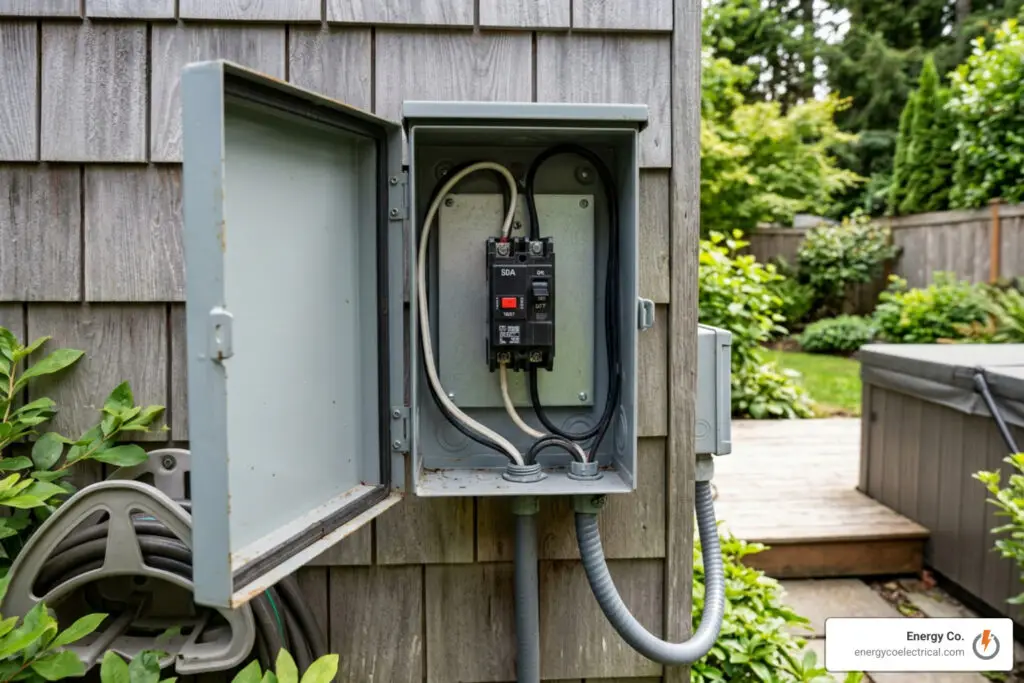
For the final connection between the outdoor disconnect subpanel and the spa pack inside the cabinet, use Liquid-tight Flexible Nonmetallic Conduit (LFNC) alongside approved wet-location compression connectors. Liquid-tight conduit dampens motor vibrations and protects wiring while offering flex movement during seasonal ground expansion.
NEC Article 680 strictly enforces the 5-foot disconnect clearance rule:
- The manual emergency disconnect box must be installed within direct line-of-sight of the hot tub.
- It must be located at least 5 feet away from the inside water’s edge (so occupants cannot touch the switch while soaking in water).
- It cannot be located further than 50 feet away from the spa.
Electrical Panel Capacity and GFCI Protection
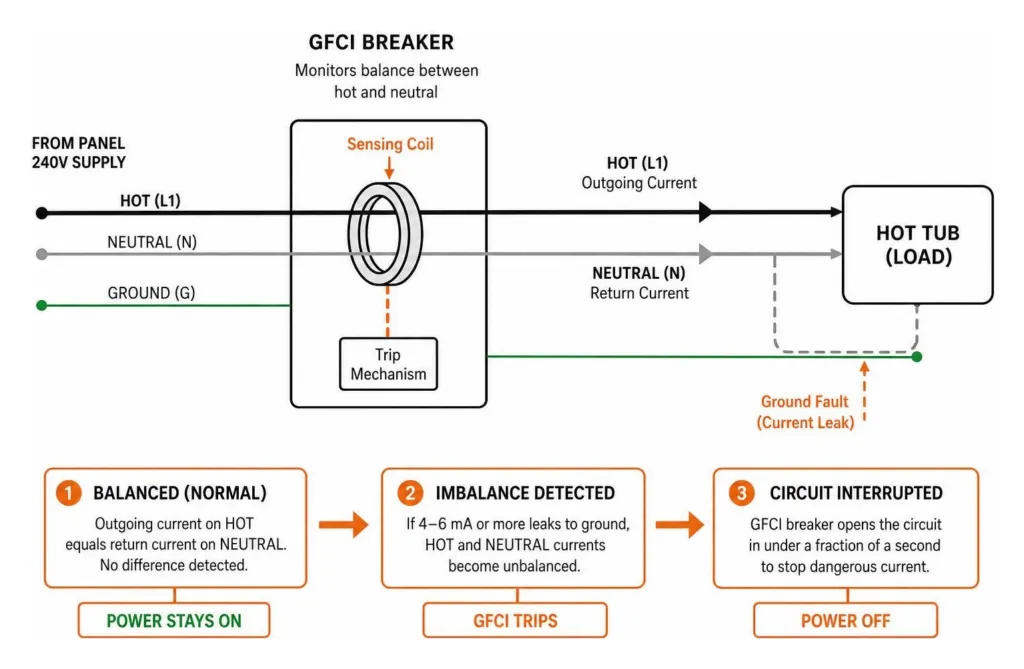
Every 240V hot tub installation requires dedicated Ground Fault Circuit Interrupter (GFCI) protection. A standard circuit breaker only trips when excessive current (overload or short circuit) is detected. A Class A GFCI breaker continuously monitors the electrical balance between the hot and neutral conductors; if it detects as little as 4 to 6 milliamperes (mA) of current leaking into the surrounding environment, it cuts off power in under a fraction of a second to prevent electrocution.
Before installing a dedicated 50-amp spa circuit, we must verify that your main service panel has sufficient capacity. Adding a continuous 50A 240V load to an older 100-amp main panel that already powers central air conditioning, an electric clothes dryer, and kitchen appliances can easily trigger main breaker trips during peak hours.
Calculating total household electrical demand requires formal load calculations rather than simply summing the numbers printed on your existing breakers. If your panel lacks available breaker slot spaces or physical load capacity, an upgrade is necessary.
Explore your options in our articles on performing an Electrical Panel Upgrade and The Homeowner Guide to Buying a 200 Amp Electrical Panel.
Step-by-Step Hot Tub Wiring and Conduit Installation
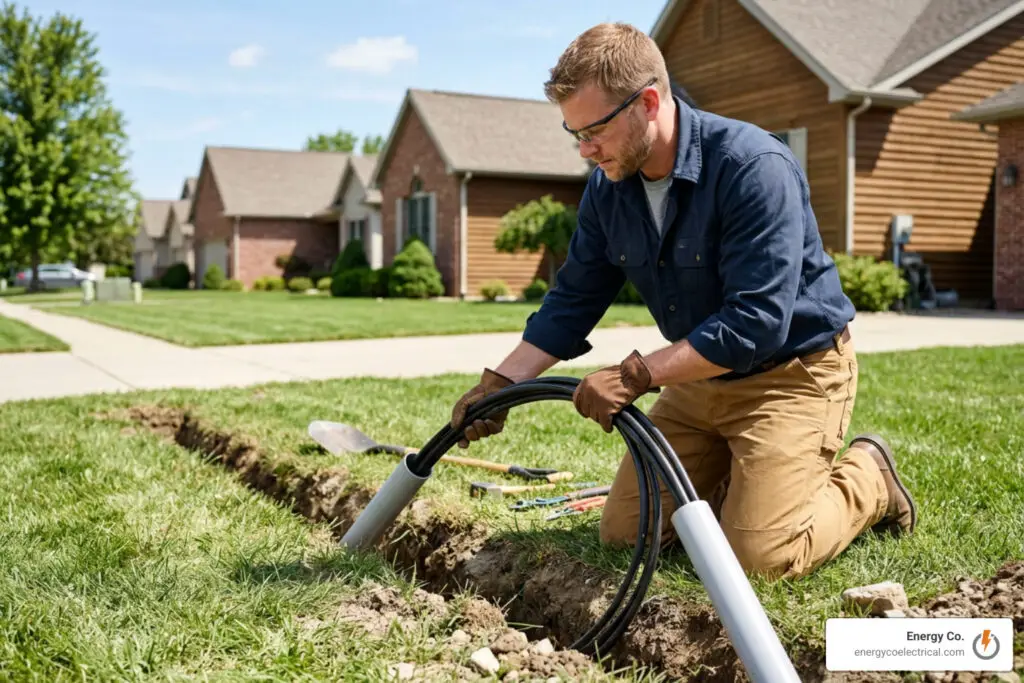
Executing a code-compliant outdoor hot tub wiring installation involves a precise sequence of structural and electrical steps:
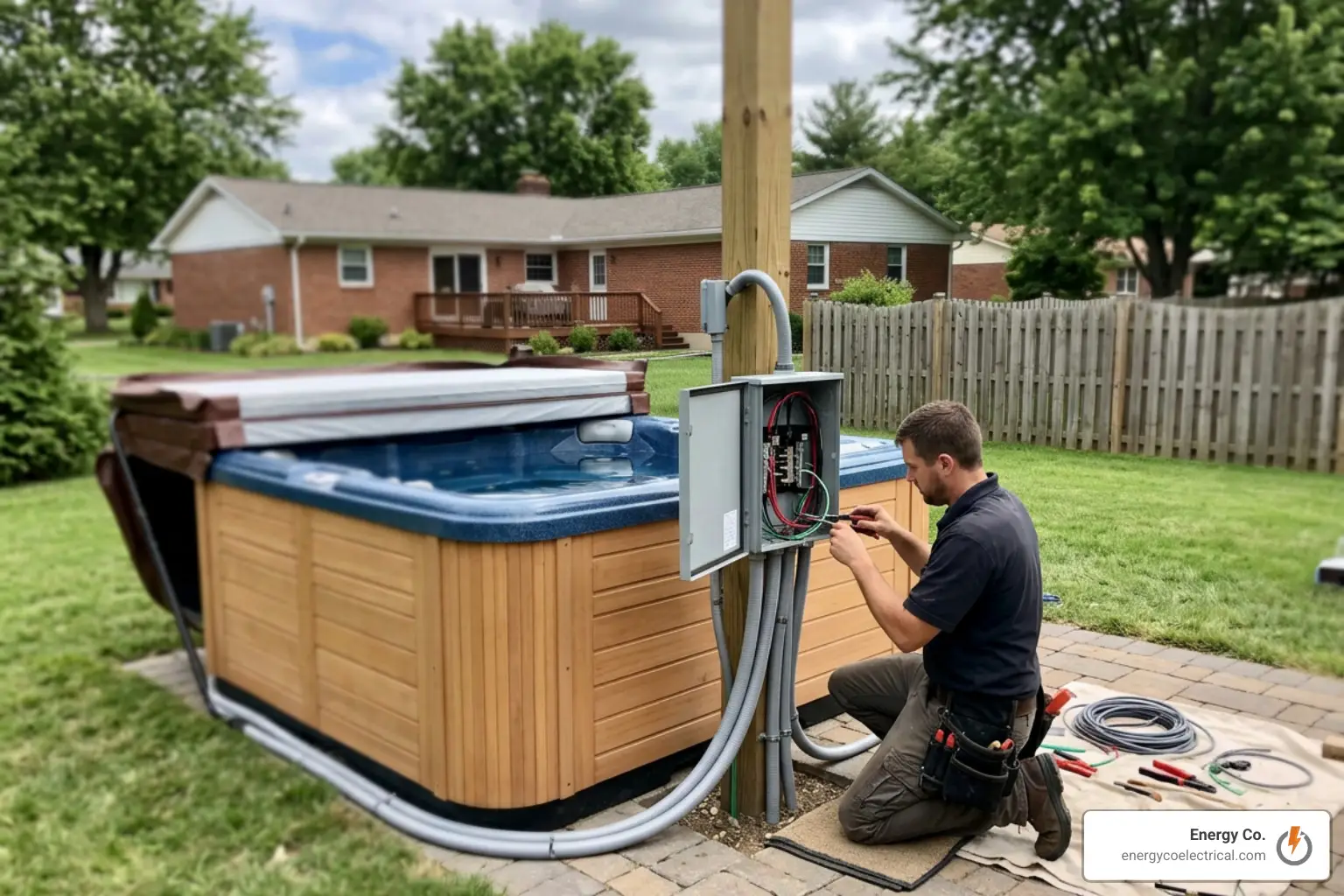
- Mounting the Outdoor Spa Panel: Securely mount a NEMA 3R outdoor-rated GFCI disconnect subpanel on an exterior house wall or sturdy post structure, maintaining line-of-sight to the tub between 5 and 50 feet away.
- Trenching and Conduit Placement: Dig a trench at least 18 inches deep from the home line to the hot tub pad. Lay Schedule 40 PVC conduit in the trench. Install a PVC frost expansion slip joint on vertical riser segments emerging from frozen ground to prevent heave damage during harsh Chicagoland winters.
- Pulling the Conductors: Secure fish tape to your four individual #6 THHN/THWN-2 copper conductors. Coat the wires thoroughly with non-flammable electrical wire pulling lubricant to minimize friction when sliding through PVC sweep elbows.
- Terminating Panel Connections: Connect the feeder conductors to your double-pole GFCI breaker and subpanel buses. Tighten all screw lugs using a calibrated torque screwdriver to manufacturer torque specifications (typically 35–45 inch-pounds) to prevent loose-wire arcing.
Equipotential Bonding and Grounding Standards
Proper grounding and equipotential bonding are two distinct safety requirements that save lives:
- Equipment Grounding Conductor (EGC): An insulated green copper wire (minimum #10 AWG for 50A circuits, though #6 AWG is standard in 4-wire cables) runs continuously inside the conduit alongside circuit conductors. It routes fault current back to the main panel ground bar to immediately trip circuit breakers during internal equipment shorts.
- Equipotential Bonding Grid (NEC 680.43): Water, metal frames, pump housings, and concrete ground pads develop subtle differences in electrical potential. To eliminate touch-voltage shocks, NEC 680.43 mandates connecting all metal hot tub components, metal pump casings, steel frame supports, and adjacent metallic structures within 5 feet to a solid, bare 8 AWG copper bonding wire.
This bonding loop ensures every conductive object surrounding the hot tub maintains an identical zero-voltage potential.
Material Costs, Permits, and Common Mistakes to Avoid
Budgeting for a hot tub installation involves balancing high-grade materials with professional installation labor.
A typical residential hot tub wiring project incurs the following material costs:
- 6/3 NM-B Wire (Interior Run, ~50 ft): $250 – $400
- #6 AWG THHN Copper Wire (Outdoor Run, 4 Conductor): $200 – $350
- Outdoor GFCI Spa Disconnect Subpanel (50A/60A): $120 – $220
- PVC Conduit, Fittings, Liquid-Tight Flex & Boxes: $150 – $300
- Main Panel Feeder Breaker & Hardware: $80 – $150
- Total Material Range: $800 – $1,420
Professional electrical labor costs typically range between $1,500 and $3,000, depending on trenching conditions, total run distance, wall penetrations, and main panel capacity.
Obtaining municipal building and electrical permits is legally mandatory across Cook County and all Chicagoland municipalities. Permits ensure independent inspectors verify trench depth, wire gauge, bonding grids, and GFCI operation before the tub is filled with water. Review the official Hoffman Estates Swimming Pools and Spas Permit Guide for a practical example of local Chicagoland permit requirements.
Critical Mistakes That Trip Breakers and Cause Failures
Even seasoned DIYers regularly fall into installation traps when wiring outdoor spas. Here are the top installation errors we encounter in the field:
- Miswiring the GFCI Neutral Wire: The single most common error is connecting the incoming white neutral wire from the spa pack directly to the subpanel ground/neutral bar instead of terminating it directly onto the load neutral terminal on the GFCI breaker. This mistake causes the GFCI breaker to trip instantly the moment main power is switched on.
- Using Aluminum Conductor Wire: Aluminum wire expands and contracts under heavy electrical loads, causing terminal lug looseness, arcing hazards, and voided manufacturer warranties.
- Inadequate Conduit Burial Depth: Burying conduit only 6 to 12 inches deep leads to severed lines during future landscaping or freezing ground-heave cracking.
- Underestimating Panel Load: Adding a 50A continuous load without verifying existing main electrical service capacity causes random main breaker outages.
Frequently Asked Questions About Hot Tub Electrical Hookups
What wire size and breaker size do I need for a 50-amp hot tub?
A 50-amp hot tub installation requires a dedicated 50-amp double-pole GFCI breaker protecting a 4-wire system consisting of two hot wires (black and red), one insulated neutral wire (white), and one insulated equipment grounding conductor (green). All conductors must be #6 AWG copper rated THHN/THWN-2 for outdoor conduit runs.
Why does my hot tub GFCI breaker trip immediately when powered on?
An immediate GFCI trip upon flipping the breaker switch usually points to a miswired neutral wire inside the spa panel (connecting the neutral wire to the grounding bar rather than directly to the GFCI breaker’s dedicated neutral terminal). Other common causes include a damaged heating element ground fault, water intrusion inside the spa control pack, or pinched wire insulation inside the flex conduit.
Do I need a permit to install hot tub electrical wiring?
Yes, virtually all Chicagoland municipalities (including Chicago, Schaumburg, Hoffman Estates, Palatine, Cicero, and Arlington Heights) require building and electrical permits for hot tub wiring installations. A licensed electrician will submit load calculations and arrange rough-in and final electrical inspections to ensure full compliance with NEC Article 680.
Professional Installation vs DIY: Getting It Done Right
Attempting DIY hot tub wiring without formal trade experience poses extreme safety hazards. Combining high-voltage 240V electricity with heavy water volume leaves zero margin for error. Improper wire sizing, missing bonding grids, or incorrect GFCI wiring can result in hidden shock hazards or fire damage.
By choosing Energy Co., you get peace of mind knowing your outdoor electrical work is handled by fully licensed, insured electricians who specialize in Chicagoland electrical infrastructure. We evaluate your electrical panel, navigate local municipal permits, execute neat conduit runs, and back all our work with a 100% satisfaction guarantee.
Ready to power your new backyard retreat safely? Contact Energy Co. today to schedule your expert spa installation or learn more about our comprehensive Residential Electrical Services.