Why Your Commercial Electrical Panel Is the Heart of Your Building’s Power System
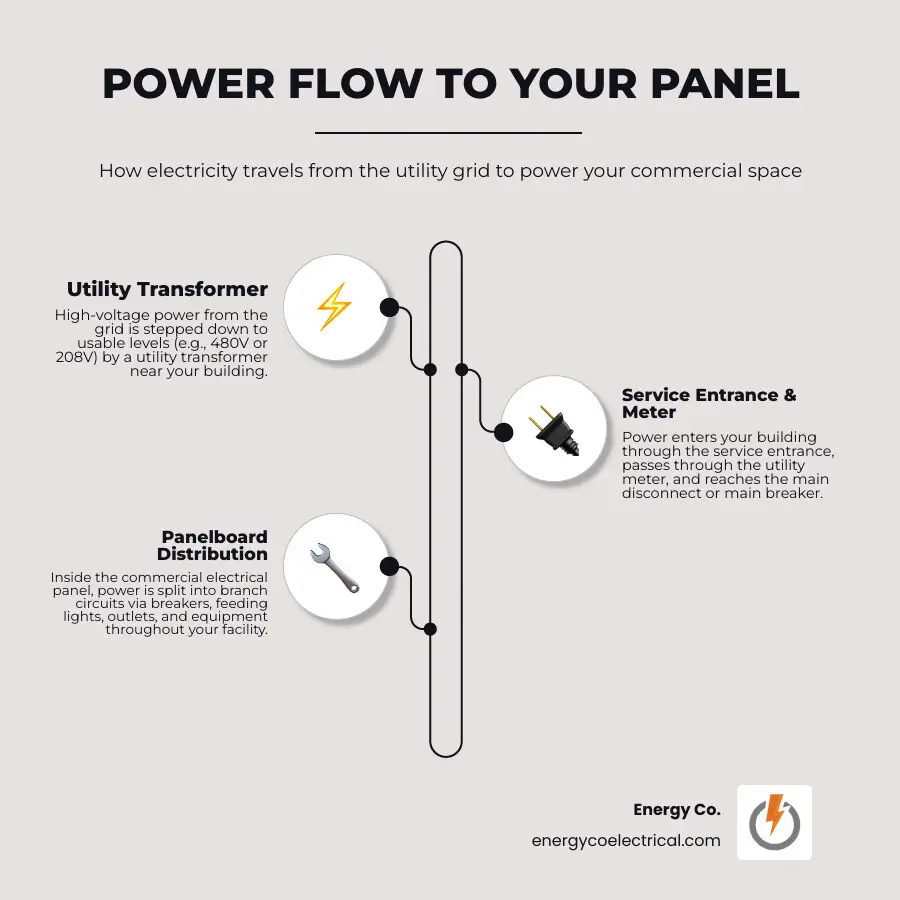
A commercial electrical panel is the central hub that receives power from the utility and distributes it safely to every circuit in your building. Here’s a quick overview of what you need to know:
- What it does: Distributes electricity to all branch circuits and protects them from overloads and short circuits
- Common types: Lighting and appliance panelboards, power distribution panelboards, and switchboards
- Typical capacities: 100A to 1200A, at voltages from 120/208V up to 277/480V
- Key configurations: Single-phase (smaller buildings) or three-phase (heavy commercial loads)
- Main variants: Main Circuit Breaker (MCB) panels and Main Lug Only (MLO) panels
- Governing standards: NEC Article 408, UL 67, and UL 891
Every light, outlet, HVAC unit, and piece of equipment in your building depends on this one system working correctly. When it fails — or when it’s undersized, outdated, or poorly maintained — the consequences range from nuisance tripped breakers all the way to electrical fires and costly downtime.
Table of Contents
For Chicago-area business owners managing older commercial spaces, that risk is very real. Many buildings in the region still run on panels that were never designed to handle today’s electrical loads.
I’m Michał Napieralski from Energy Co., a licensed electrician with hands-on experience installing, upgrading, and maintaining commercial electrical panels across the Chicagoland area. In this guide, I’ll walk you through everything you need to make smart, safe decisions about your commercial power system.
Commercial electrical panel glossary:
Understanding the Commercial Electrical Panel: Types and Configurations
When you look at a commercial building, the electrical demands are vastly different from those of a standard home. While a home might run perfectly fine on a 100A or 200A single-phase panel, a commercial property often requires hundreds or thousands of amps delivered via three-phase systems. To manage this massive flow of energy, we use specialized commercial wiring strategies and distinct tiers of panelboards.
Rather than relying on a single “breaker box” to run everything, commercial facilities use a hierarchical system of switchboards, distribution panelboards, and branch lighting panelboards. Selecting the right hardware is critical to ensuring safety and code compliance. To dive deeper into how these configurations are engineered, you can consult this comprehensive commercial panelboard technical guide.
Lighting and Appliance Panelboards
These are the final distribution points in a commercial electrical system—the panels that directly feed your lights, office outlets, and standard appliances. In the commercial world, two of the most widely used standards for these are NQ and NF panelboards:
- NQ Panelboards: Rated for a maximum of 240 Vac. They offer bus capacities ranging from 100A to 600A and provide circuit protection for branch circuits between 10A and 200A. These are ideal for standard office environments, retail shops, and school classrooms where 120V and 208V loads dominate.
- NF Panelboards: Engineered for higher-voltage commercial demands, NF panelboards support systems up to 480Y/277 Vac. They offer bus capacities from 125A to 800A and provide lighting and appliance circuit protection up to 125A. You will typically find these in large warehouses, manufacturing plants, and high-rise office buildings where lighting and HVAC systems run on 277V or 480V to maximize efficiency.
Power Distribution Panelboards and Switchboards
Before power reaches your lighting panelboards, it must be safely stepped down and divided at a higher level. This is where power distribution panelboards and low-voltage switchboards come into play.
- Power Distribution Panelboards (e.g., I-Line): These heavy-duty panels act as the “middle managers” of your electrical system. High-capacity distribution panels, such as I-Line panelboards, are UL Listed for use on systems with up to 200K max short-circuit current ratings (SCCR). They are specifically designed to feed downstream NQ and NF panelboards, grouping high-amperage breakers together in a single, safe enclosure.
- Low-Voltage Switchboards (e.g., Square D QED-2): For massive commercial and industrial facilities, a standard panelboard isn’t enough. Switchboards are free-standing, floor-mounted units rated under UL 891. They are designed to safely transmit power from one or more primary utility sources or large generators down to your distribution panelboards.
Single-Phase vs. Three-Phase Power in a Commercial Electrical Panel
In smaller residential properties, single-phase power is the standard. Single-phase alternating current (AC) utilizes a single conductor where the voltage wave oscillates from positive to negative peaks.
However, in commercial facilities, three-phase power is the gold standard. A three-phase system utilizes three separate conductor wires, each carrying an alternating current wave synchronized and offset by 120 degrees. This offset ensures that power delivery never drops to zero, providing continuous, stable, and highly efficient energy.
Three-phase panels are essential for driving heavy-duty commercial loads, such as large electric motors, commercial HVAC compressors, and extensive server rooms, without risking voltage dips. If you want to understand how these phases are routed through a facility, check out the complete guide to commercial wiring.
Main Breaker (MCB) vs. Main Lug Only (MLO) Panelboards
One of the most important decisions when configuring a commercial electrical panel is choosing how the main electrical feed connects to the panel’s interior. This choice determines how the panel is protected and how it can be shut off in an emergency.
Main Circuit Breaker (MCB) Panelboards
An MCB panelboard features a single, large main circuit breaker installed directly at the point where the primary feed lines enter the panel. This main breaker serves two critical functions:
- Primary Overcurrent Protection: It protects the entire panel’s bus bars and downstream branch breakers from catastrophic overcurrent or short circuits.
- Single Disconnect Point: It allows maintenance personnel or emergency responders to completely cut power to the entire panel with a single flip of a switch.
Under the National Electrical Code (NEC), an MCB configuration is typically required when a panel serves as the “service entrance” equipment (the very first panel connected directly to the utility meter).
Main Lug Only (MLO) Panelboards
In an MLO panelboard, the incoming electrical cables terminate directly onto mechanical lugs mounted on the bus bars. There is no built-in main breaker to shut off the panel locally. Instead, an MLO panel relies entirely on an upstream breaker or disconnect switch located in a different panelboard or switchboard for its overcurrent protection.
MLO panels are highly useful as sub-panels located downstream from a main distribution board. They are also incredibly versatile; for instance, modern designs like the Square D NQ series are field-convertible, allowing electricians to easily convert an MLO panel to an MCB panel using ready-to-install manufacturer kits. If you are looking at configuring a high-density sub-panel, you can examine the technical specifications for a 225A panelboard interior to see how field-convertible main lugs simplify installation.
Inside the Panel: Key Components and Material Choices
To understand how a commercial panelboard operates safely under heavy loads, we need to look at the anatomy of its interior. Every component must be engineered to handle high currents and mitigate thermal stress.
Core Components of a Commercial Electrical Panel
- Bus Bars: These are the solid metal conductive plates that run down the center of the panel. They carry the primary electrical current from the main lugs or main breaker and distribute it to the branch circuit breakers plugged or bolted onto them.
- Neutral Bars: In a three-phase system, the neutral bar provides the return path for current back to the source. It is critical for maintaining system balance.
- Ground Bars: The ground bar connects the panel enclosure and all equipment grounding conductors directly to the earth. This provides a safe, low-resistance path for fault currents, preventing severe shocks.
- Branch Breakers: These individual safety switches protect specific circuits (e.g., lighting, outlets, machinery) from localized overloads or short circuits.
Copper vs. Aluminum Bus Bars
When purchasing a commercial panelboard, you will have to choose between copper and aluminum bus bars. Both are code-compliant, but they offer distinct performance profiles:
| Feature | Copper Bus Bars | Aluminum Bus Bars |
|---|---|---|
| Thermal Conductivity | Excellent; runs cooler under heavy continuous loads | Good, but requires larger physical dimensions for the same ampacity |
| Corrosion Resistance | Highly resistant to oxidation; ideal for humid environments | Susceptible to galvanic corrosion; requires joint compounds |
| Material Cost | Premium pricing | Highly cost-effective |
| Weight | Heavy | Lightweight and easier to install |
For high-demand environments where reliability and thermal performance are paramount, we highly recommend investing in copper. For example, high-capacity commercial panels like the Square D NQ430L6C utilize a solid copper busbar rated for 600A to ensure maximum conductivity and longevity in demanding office and industrial settings.
Safety Standards, Enclosures, and Generator Integration
Commercial electrical panels are subject to rigorous testing and strict installation codes to protect building occupants and utility workers.
NEMA Enclosure Ratings and Environmental Protection
Where you install your electrical panel dictates the type of enclosure you must use. The National Electrical Manufacturers Association (NEMA) defines standards for these enclosures:
- NEMA 1: Designed for general-purpose indoor use. It protects against dust and light indirect splashing but offers no protection against moisture or extreme weather.
- NEMA 3R: Weatherproof and rainproof. These enclosures are constructed using TGIC Polyester Powder Coating to protect internal components from falling rain, sleet, and external ice formation. They are the standard choice for outdoor service entrances, shipyards, and construction sites.
- NEMA 4 & 4X: Watertight and dust-tight. NEMA 4X enclosures add superior corrosion resistance (often using stainless steel or heavy-duty plastics), making them essential for food processing washdown areas, chemical plants, and highly corrosive coastal environments.
To ensure your custom panelboards meet these environmental and structural safety standards, look for custom builds that comply with UL 67 panelboard standards, which govern structural integrity and electrical clearances.
The Role of Automatic Transfer Switches (ATS)
For many commercial facilities in Cook County and the surrounding Chicagoland area—such as medical clinics, data centers, and cold storage warehouses—power outages are not just an inconvenience; they are a financial emergency.
An Automatic Transfer Switch (ATS) is installed between your primary utility feed, your backup generator, and your main distribution panel. The ATS constantly monitors incoming utility power. If it detects a voltage drop or grid failure, it automatically triggers the backup generator to start, disconnects the building from the dead utility grid, and connects it to the generator. Once utility power is restored, the ATS safely reverses the process.
Sizing, Load Calculations, and Maintenance Best Practices
Installing a commercial electrical panel without proper planning is a recipe for disaster. If the panel is undersized, you face constant breaker trips, overheated wiring, and code violations. If you are suspecting your current setup is falling short, it might be time to plan an electrical panel upgrade.
How to Calculate Commercial Electrical Load Capacity
Calculating the load capacity of a commercial facility is far more complex than residential calculations. We must follow strict NEC guidelines:
- Identify Continuous vs. Non-Continuous Loads: A continuous load is any load expected to run for 3 hours or more (such as office lighting or store sign displays). Under NEC rules, continuous loads must be calculated at 125% of their actual amperage, while non-continuous loads are calculated at 100%.
- Apply Demand Factors: Not every appliance or motor in a building runs at 100% capacity at the exact same second. We apply demand factors (per NEC Article 220) to adjust the calculated load realistically.
- Account for Future Expansion: We always advise adding a 20% to 30% safety margin to the final load calculation to allow your business to grow without requiring a costly panel replacement a few years down the road.
Installation, Maintenance, and Upgrading Best Practices
To keep your commercial system running safely, we recommend implementing a proactive electrical maintenance plan.
- Infrared Thermal Imaging: Over time, thermal expansion and contraction can cause electrical connections to loosen. Loose connections create high resistance, which generates extreme heat. By conducting annual infrared thermal scans, we can identify “hot spots” inside your panels and repair them before they cause a fire or system failure.
- Torque Specifications: Every terminal lug in a commercial panel has a strict manufacturer torque rating (often measured in Newton-meters or inch-pounds). During installation and maintenance, our licensed electricians use calibrated torque wrenches to ensure connections are neither too loose (creating resistance) nor too tight (damaging the wire).
- Proactive Repairs: If you notice flickering lights, warm panel doors, or unusual humming sounds, do not wait. Discover why your chicago business needs a proactive electrical repair plan to safeguard your operations.
Frequently Asked Questions
What is the difference between NQ and NF panelboards?
The primary difference lies in their voltage ratings and application:
- NQ panelboards support up to 240 Vac maximum and are used for standard 120V/208V branch circuits (computers, standard outlets, office lighting).
- NF panelboards support higher voltages up to 480Y/277 Vac and are used to power heavy-duty lighting systems, commercial HVAC, and industrial equipment.
Why do commercial panels require a 200% rated neutral?
Modern offices are packed with non-linear loads, such as computers, servers, printers, and LED lighting. These devices draw current in short pulses rather than smooth waves, which generates harmonic currents. These harmonics do not cancel each other out in a three-phase system; instead, they accumulate on the neutral wire. A standard neutral wire can easily overheat under these conditions. A 200% rated neutral is double the size of a standard neutral, allowing it to safely handle these harmonic currents without overheating.
How often should a commercial electrical panel be inspected?
We highly recommend having your commercial panels professionally inspected at least once a year. This annual audit should include visual inspections, torque testing, and infrared thermal imaging to identify hidden hot spots and prevent unexpected downtime.
Conclusion
Your commercial electrical panel is the literal heart of your business’s physical infrastructure. Keeping it properly sized, balanced, and maintained is essential to protecting your property, your employees, and your bottom line.
At Energy Co., we bring licensed, professional expertise to commercial and industrial properties throughout the Chicagoland area—including Schaumburg, Hoffman Estates, Arlington Heights, Mount Prospect, Cicero, and Chicago. Whether you need a routine thermal scan, a custom panel build, or a complete system upgrade, we back all our work with a satisfaction guarantee.
Don’t wait for a costly power failure to think about your electrical system. Contact us today to schedule your commercial inspection or explore our comprehensive commercial electrical services.