Home Electrical Wiring Basics: What Every Owner Should Know
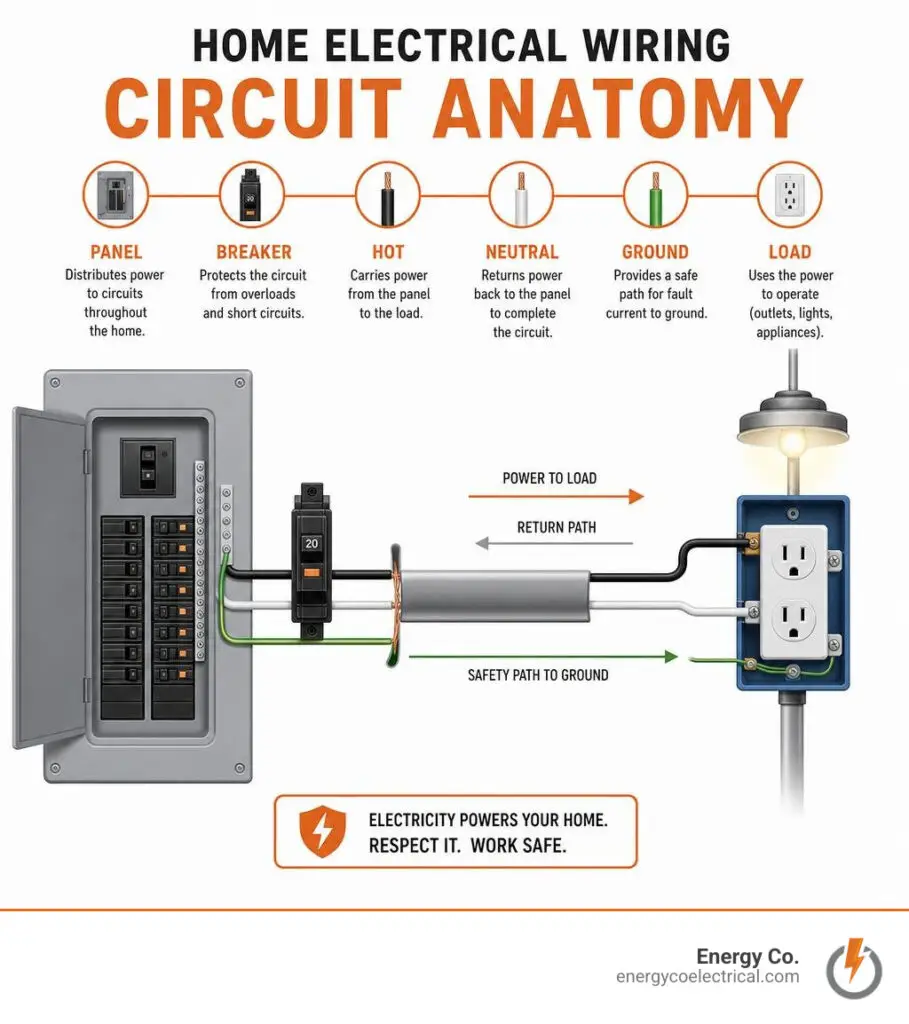
Home electrical wiring safely moves 120/240-volt power from the breaker panel to lights, outlets, and appliances. The basics are simple: use the correct wire size for the breaker, keep every splice inside a covered electrical box, connect grounding properly, and turn off and test power before touching any conductor.
For a quick starting point:
- 14 AWG copper pairs with a 15-amp breaker, often for lighting.
- 12 AWG copper pairs with a 20-amp breaker, common for outlets and small-appliance circuits.
- 10 AWG copper pairs with a 30-amp breaker, often for dedicated equipment such as some dryers or water heaters.
- Black or red usually means hot, white or gray means neutral, and green or bare copper is the equipment ground.
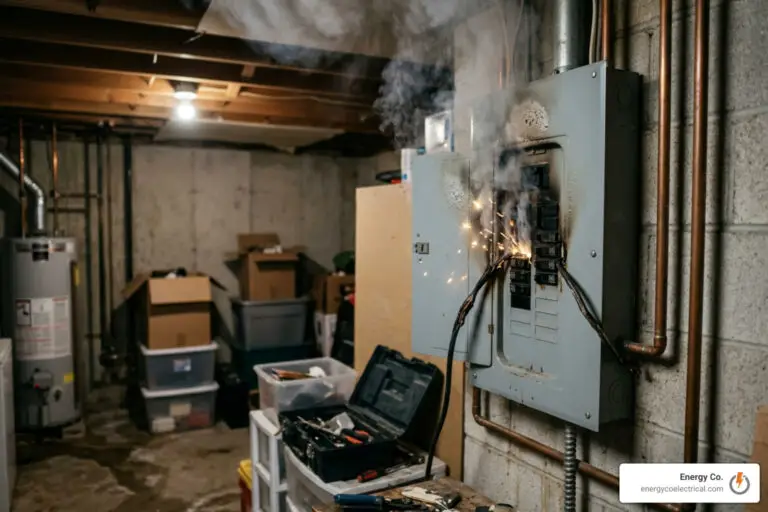
- Wet, unfinished, damaged, or older-home wiring deserves extra caution. A repeated breaker trip, warm outlet, burning smell, or flickering lights is a reason to stop and call a licensed electrician.
Modern systems use circuit breakers, grounding, and protective devices such as GFCIs and AFCIs to reduce shock and fire risks. But safety depends on correct installation and local code compliance, especially in Chicago-area properties where older wiring and local rules can affect what work is appropriate.
I’m Michał Napieralski of Energy Co., an electrician serving Schaumburg and the Chicago suburbs with panel upgrades, circuit repairs, inspections, outlets, lighting, and home electrical wiring projects. In the sections ahead, I’ll break down how these parts work and where DIY should end and professional help should begin.
Discover more about home electrical wiring:
Core Types and Standards of Home Electrical Wiring
Understanding residential wiring begins with grasping the materials that make up modern branch circuits. In standard residential construction, non-metallic sheathed cable (commonly referred to by the trade name Romex) is the most widespread material for indoor branch circuits. However, across the Chicagoland area—including Cook County municipalities like Cicero, Arlington Heights, and Chicago proper—local building codes often require rigid metal conduit or Electrical Metallic Tubing (EMT) housing individual insulated conductors rather than bare non-metallic runs.
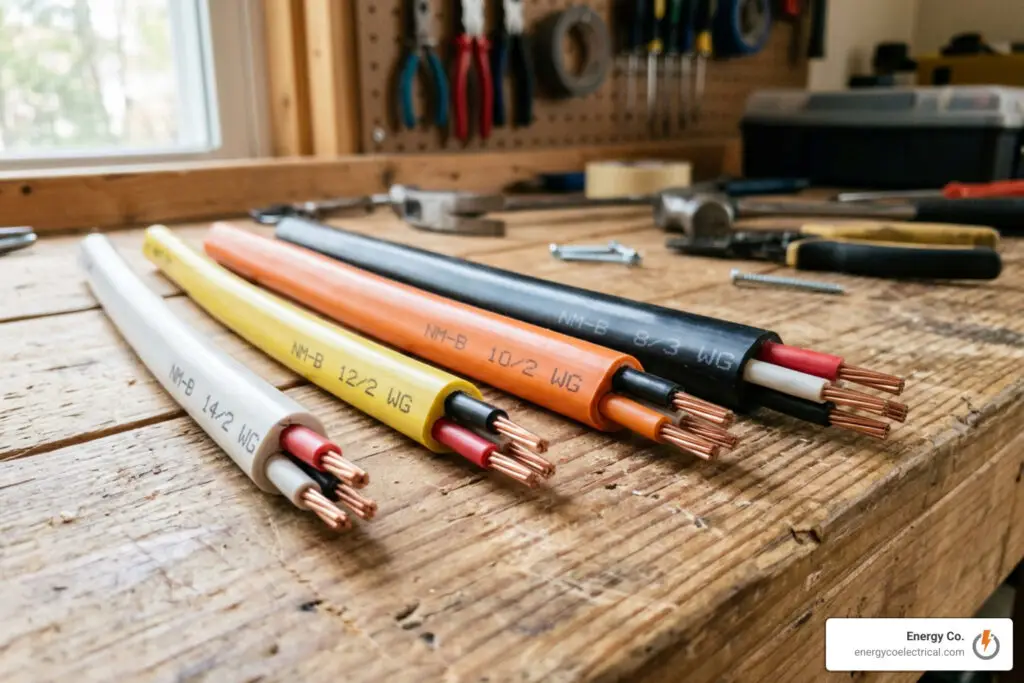
Whenever you examine modern non-metallic (NM-B) cables, you will notice an outer jacket color-coding system designed to make visual identification straightforward on the job site:
| Wire Gauge (AWG) | Max Circuit Amperage | Outer Sheath Color | Recommended Continuous Load (80% at 120V) | Typical Residential Use Cases |
|---|---|---|---|---|
| 14 AWG | 15 Amps | White | 1,440 Watts | General LED/incandescent lighting, standard bedroom circuits |
| 12 AWG | 20 Amps | Yellow | 1,920 Watts | Kitchen countertop receptacles, bathroom outlets, utility rooms |
| 10 AWG | 30 Amps | Orange | 2,880 Watts | Electric clothes dryers, 240V water heaters, dedicated AC units |
| 8 AWG | 40–50 Amps | Black | 7,680 Watts (at 240V) | Electric ranges, cooktops, large heat pumps |
| 6 AWG | 55–65 Amps | Black | 10,560 Watts (at 240V) | High-output EV chargers, subpanels, central electric furnaces |
Copper is the standard conductor material used in residential installations due to its exceptional electrical conductivity, high tensile strength, and natural resistance to thermal degradation. For conduit systems, individual conductors are labeled THHN/THWN, designating thermoplastic insulation that is high-heat resistant (up to 90°C / 194°F), nylon-coated, and moisture resistant. In areas where physical protection is paramount—such as unfinished basements, exposed garage walls, or service utility areas—metal-clad (MC) cable provides an interlocking metal armor that prevents accidental punctures.
For those looking deeper into technical standards, reviewing resources like the 2026 Electrical Wiring Guide alongside our own walkthrough of residential wiring types and installation will give you a firm grounding in code requirements.
Wire vs Cable in Home Electrical Wiring Systems
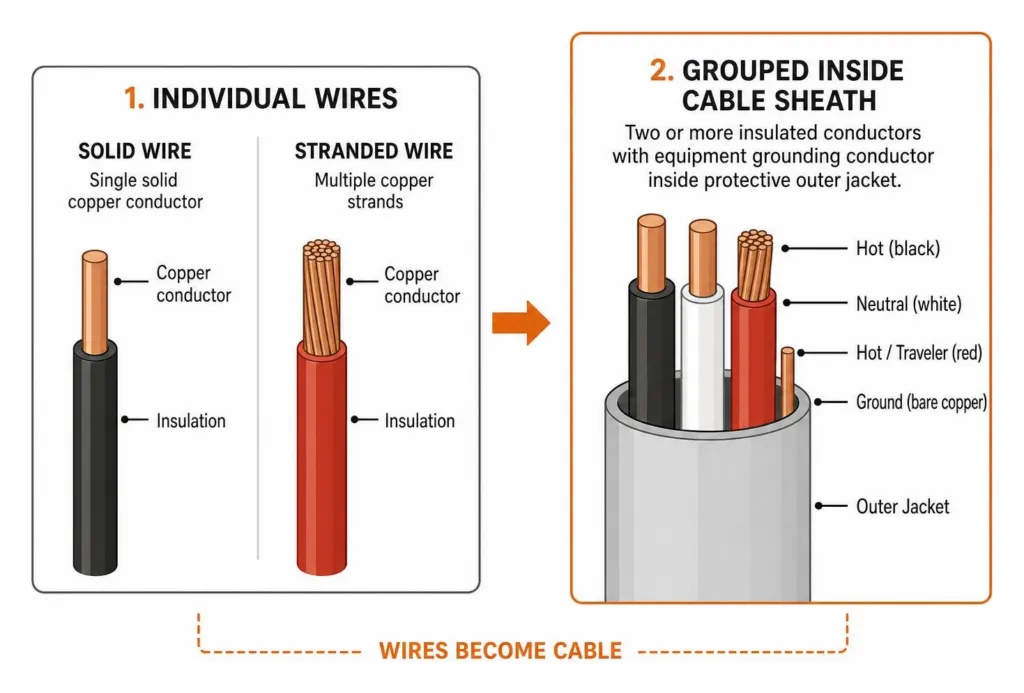
While the terms are often used interchangeably in everyday conversation, there is an important technical difference between a wire and a cable:
- Electrical Wire: A single solid or stranded electrical conductor. Individual wires, such as single THHN conductors pulled through metal conduit, consist of copper wrapped in color-coded thermoplastic insulation.
- Electrical Cable: A complete factory assembly containing two or more insulated conductors grouped together inside a protective outer jacket (such as thermoplastic NM-B or armored metal sheath), typically accompanied by a bare equipment grounding wire.
Cable jackets feature standardized factory stamps that reveal their internal anatomy. For example, a stamp reading “12/2 WITH GROUND” indicates the cable contains two insulated 12-gauge conductors (one hot, one neutral) along with a bare copper equipment grounding conductor. A stamp reading “14/3 WITH GROUND” indicates three insulated 14-gauge conductors (typically black, red, and white) plus a ground, commonly used for three-way switch setups, split circuits, or ceiling fan installations.
Decoding Color Codes in Home Electrical Wiring
The insulation color on individual conductors serves a life-safety function by establishing the role of every wire in the circuit:
- Black: Primary hot conductor. It carries ungrounded live current at 120 volts from the circuit breaker to the load (switches, outlets, fixtures). It must always be treated as live.
- Red: Secondary hot conductor. Found in 3-wire cables, red wires carry 120-volt current and are used for 240-volt appliance circuits, traveler legs in 3-way/4-way light switches, or independent ceiling fan light controls.
- White or Gray: Grounded neutral conductor. The neutral completes the electrical circuit by returning current from the fixture back to the main service panel. While nominally at zero volts relative to earth, neutral wires carry active electrical current whenever a load is running and can deliver a dangerous shock if broken or disconnected under load.
- Green or Bare Copper: Equipment grounding conductor. This path carries no current during normal operation. Its purpose is to bond metal frames, outlet boxes, and appliance chassis back to the panel, providing a safe, low-resistance path that instantly trips the breaker if a loose hot wire contacts metal.
- Blue and Yellow: Traveler and switched hot conductors. Often encountered when pulling THHN wires through conduit in Chicago-area homes, blue and yellow wires are used as traveler legs between multi-location switches.
When a white wire is used as an ungrounded hot conductor (such as in an older switch loop), the National Electrical Code (NEC) mandates that it must be permanently re-identified by wrapping black or red electrical tape around the exposed insulation at both termination ends.
How to Select the Right Wire Gauge and Amperage
Matching the correct conductor size to the circuit amperage rating is a fundamental rule of electrical fire safety. Wire diameter is measured using the American Wire Gauge (AWG) system, where a smaller numerical gauge denotes a thicker copper conductor capable of carrying higher electrical current.
When an undersized wire is subjected to excessive current, the electrical resistance causes the copper to heat up. If the circuit breaker is oversized (for instance, a 20-amp breaker protecting a thin 14-gauge wire), the conductor can reach temperatures capable of igniting surrounding framing lumber and wall insulation long before the breaker ever detects an overload.
To ensure long-term safety, residential systems are designed around the 80% continuous load rule. A standard circuit should not carry a sustained load (running continuously for three hours or more) exceeding 80% of its rated capacity:
$$text{Continuous Load Limit} = text{Breaker Amps} times text{Voltage} times 0.80$$
- 15-Amp / 120V Circuit: Maximum continuous wattage of 1,440 Watts (1,800W absolute maximum).
- 20-Amp / 120V Circuit: Maximum continuous wattage of 1,920 Watts (2,400W absolute maximum).
- 30-Amp / 240V Circuit: Maximum continuous wattage of 5,760 Watts (7,200W absolute maximum).
Over long cable runs exceeding 80 to 100 feet from the main breaker panel, electrical resistance causes voltage drop—a gradual decrease in voltage that can cause motors to run hot and lights to flicker. In these extended runs, electricians upsize the wire gauge (for example, stepping up from 14 AWG to 12 AWG on a long 15-amp run) to maintain consistent operating voltage.
Sizing Branch Circuits for General Lighting and Outlets
For standard living spaces like bedrooms, living rooms, and hallways, 14 AWG copper wire paired with a 15-amp circuit breaker provides adequate capacity for LED lighting, televisions, and general electronics. A useful rule of thumb is allocating one 15-amp lighting circuit for every 500 square feet of living space, limiting each branch circuit to roughly 8 to 10 general receptacle outlets.
In high-draw living zones, however, 12 AWG copper wire paired with a 20-amp breaker is required by code:
- Kitchen Small Appliance Circuits: The NEC requires at least two dedicated 20-amp small appliance branch circuits serving countertop receptacles. These circuits power high-draw heating appliances like toasters, coffee makers, and air fryers, and cannot serve lighting outlets.
- Bathroom Branch Circuits: Bathrooms require at least one dedicated 20-amp circuit supplying the receptacle near the sink vanity to accommodate high-wattage hair dryers and curling irons without tripping bedroom lights.
- Laundry and Dedicated Utility Outlets: Dedicated 20-amp lines must supply washing machine outlets and garage utility receptacles.
Heavy-Duty Circuits for Dedicated Major Appliances
Large household appliances require dedicated circuits that run straight from the main panel to the appliance without sharing power with other outlets:
- 10 AWG Copper (30 Amps): Used for dedicated 240V appliances such as electric clothes dryers, residential electric water heaters, and central air conditioning condenser units.
- 8 AWG Copper (40–50 Amps): Standard for electric cooktops, high-output heat pumps, and built-in ovens.
- 6 AWG Copper (50–60 Amps): Required for all-in-one electric ranges (stoves), dedicated electric vehicle (EV) Level 2 charging stations, and whole-home electric furnaces.
Circuit Breaker Panels, Grounding, and System Safety
The main electrical service panel is the central distribution point for your home. Incoming utility power (typically 120/240 volts via two hot conductors and one neutral conductor) enters through a heavy service head, passes through the electric meter, and connects directly to the panel’s main service disconnect breaker.
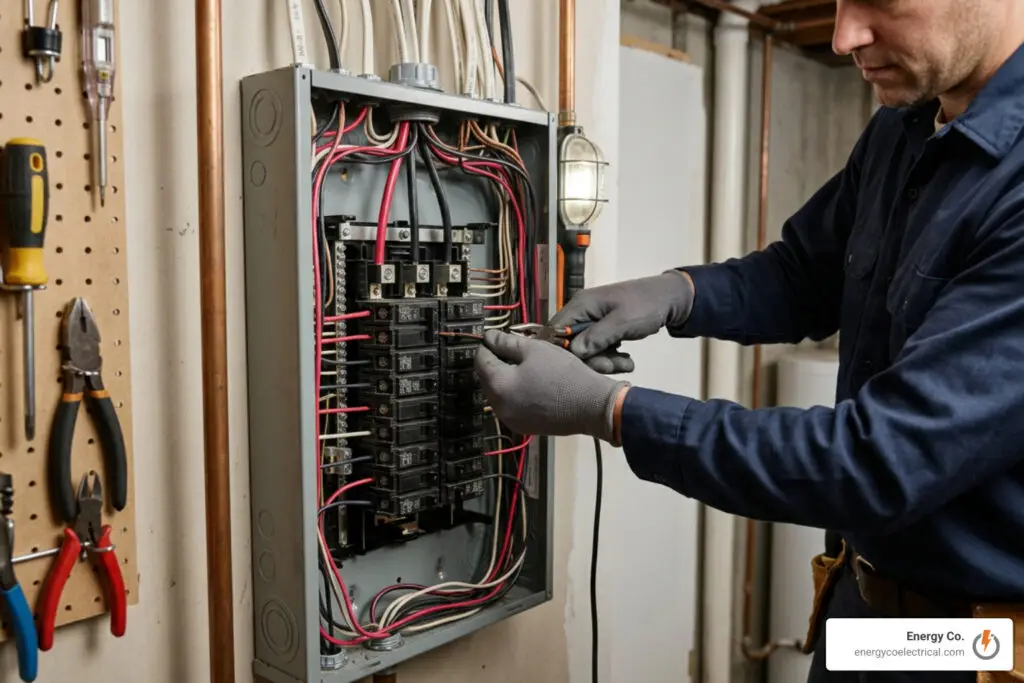
Inside the panel, two parallel copper or aluminum bus bars carry 120 volts each (out of phase with one another). Single-pole circuit breakers clip onto a single bus bar to supply 120V branch circuits, while double-pole circuit breakers span both bus bars simultaneously to deliver 240V service. If you are curious about what happens behind the steel cover, our guide on demystifying your home electric panel without getting shocked breaks down the internal components in detail. For broader planning advice, the General Wiring Guidelines offer helpful insights on proper system layout.
Grounding Electrode Systems vs Equipment Bonding
Grounding and bonding are governed strictly by NEC Article 250:
- Grounding Electrode System: The physical connection tying your electrical system directly to the earth. This is accomplished using two copper-clad steel ground rods driven at least 8 feet into the ground outside, or via a concrete-encased electrode (commonly called a UFER ground) connected to the reinforcing steel in your foundation footings. This system dissipates external high-voltage surges from lightning strikes and stabilizes system voltage against utility spikes.
- Equipment Bonding: The internal network of bare copper or green wires that connects all metal enclosures, conduit pipes, device boxes, and interior metallic water piping back to the panel’s ground bar. Bonding ensures that if an energized wire slips and touches a metal surface, current flows immediately back to the source with low resistance, instantly tripping the breaker rather than leaving the metal pipe or appliance energized.
In the main service panel, the neutral bus and the grounding bus are bonded together using a main bonding jumper screw. However, in subpanels (such as in detached garages or additions), the neutral and ground buses must remain strictly isolated from one another to prevent dangerous return currents from traveling along equipment grounding conductors.
Crucial Shock and Fire Protection: GFCI and AFCI Devices
Modern residential codes rely on two specialized safety technologies to prevent injury and house fires:
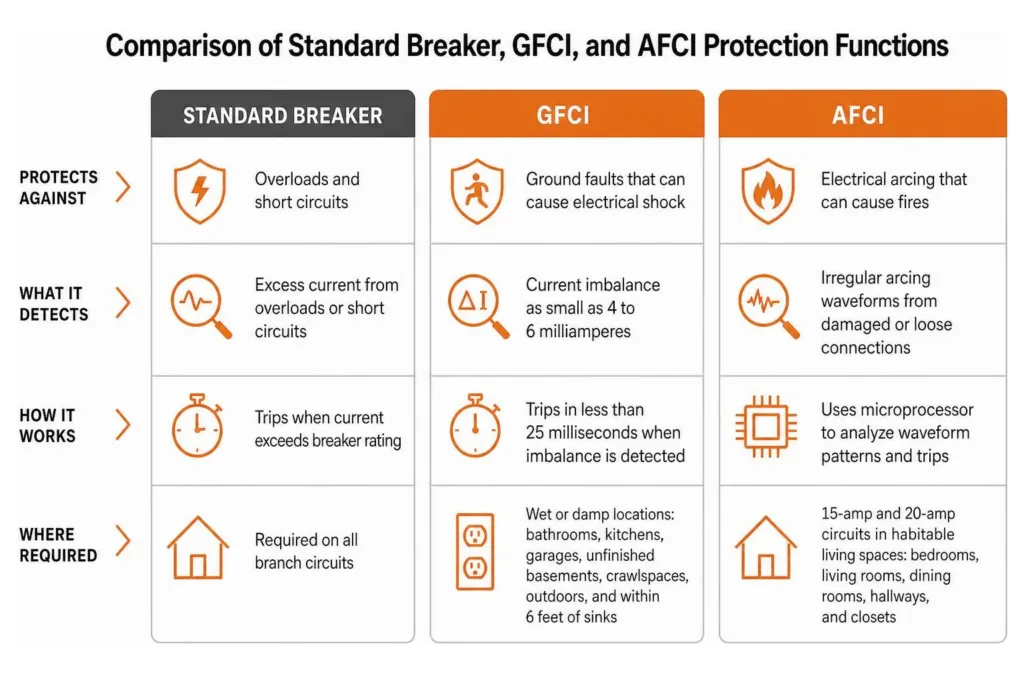
- Ground-Fault Circuit-Interrupters (GFCI): GFCIs monitor the balance of electrical current traveling between the hot and neutral conductors. If an imbalance as small as 4 to 6 milliamperes is detected—meaning current is leaking through water or a human body to ground—the GFCI disconnects power in less than 25 milliseconds. GFCIs are mandatory in all wet or damp locations: bathrooms, kitchen countertops, garages, unfinished basements, crawlspaces, outdoor receptacles, and within 6 feet of any sink.
- Arc-Fault Circuit-Interrupters (AFCI): While standard breakers protect against short circuits and overloads, AFCIs use microprocessors to detect irregular arcing waveforms created by cracked wire insulation, loose screw terminals, or a nail driven through a wall cable. Modern codes require AFCI protection on all 15-amp and 20-amp circuits supplying habitable living spaces, including bedrooms, living rooms, dining rooms, hallways, and closets.
- Tamper-Resistant (TR) Outlets: Built with internal spring-loaded plastic shutters, TR receptacles prevent small children from inserting foreign metal objects like paperclips into live slots. They are mandatory across all general dwelling unit locations.
Essential Rules for Safe Residential Box and Cable Installation
Working safely with residential electrical systems demands careful habits and the right diagnostic tools.
- De-energize and Lock Out: Always shut off the dedicated branch breaker at the main service panel. If the panel is out of sight, apply a panel lockout tag to prevent someone from flipping the power back on while you work.
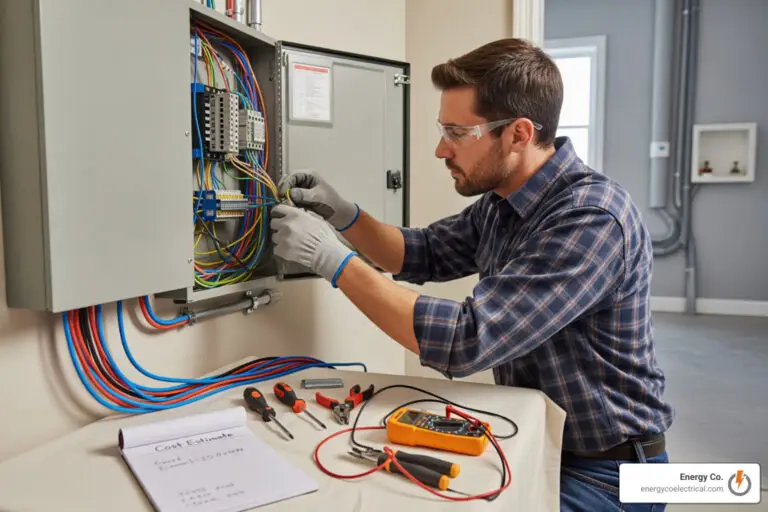
- Verify with a Voltage Tester: Never assume a circuit is dead. Use a reliable non-contact voltage tester to verify the absence of power, followed by a digital multimeter checking hot-to-neutral, hot-to-ground, and neutral-to-ground.
- Use Dedicated Wire Strippers: Never use utility knives, pliers, or scissors to strip wire insulation. Proper wire strippers have precision-machined cutting notches calibrated for specific AWG sizes, preventing nicks in the copper conductor that create localized hot spots under load.
- Preserve Conductor Lengths: Maintain at least 6 inches of free conductor inside the box, with at least 3 inches extending past the front edge of the box face. Cutting conductors too short makes secure wire-nut or terminal make-up difficult and creates loose connections.
For a broader perspective on installation fundamentals, take a look at our practical guide to electrical installation.
Calculating Electrical Box Fill Capacity
Overcrowding wires inside an electrical box causes heat buildup and risks pinching insulation against sharp metal brackets. NEC Section 314.16 sets strict box fill volume rules:
- 18 AWG: 1.50 cu. in. per conductor
- 14 AWG: 2.00 cu. in. per conductor
- 12 AWG: 2.25 cu. in. per conductor
- 10 AWG: 2.50 cu. in. per conductor
- 8 AWG: 3.00 cu. in. per conductor
- 6 AWG: 5.00 cu. in. per conductor
For instance, an 18-cubic-inch junction box can accommodate up to nine 14 AWG wires with no devices. If an outlet receptacle is installed, the receptacle counts as two conductors (4.0 cu. in.), and all equipment grounds together count as one conductor allowance (2.0 cu. in.), leaving room for up to six 14 AWG conductors.
Common Residential Wiring Mistakes to Avoid
During service calls across Hoffman Estates, Palatine, and Mount Prospect, our team regularly resolves dangerous installation errors made during unpermitted DIY work. If you’re planning a project, reviewing our overview of rewiring basics will help you spot common pitfalls early:
- Open Wire Splices: Splicing wires together inside wall cavities or attics without an enclosed, accessible junction box is a major fire hazard. All splices must be contained within a listed metal or plastic electrical box fitted with a secure cover plate.
- Mismatched Breaker and Wire Sizing: Installing a 20-amp breaker on a circuit wired with 14 AWG conductors. The wire can overheat before the breaker trips.
- Overfilled Electrical Boxes: Cramming excessive conductors into undersized boxes, which can pinch wire insulation and cause ground faults.
- Improper Cable Securing: Failing to staple NM cable within 12 inches of entering an electrical box or exceeding the maximum 4.5-foot strapping intervals along framing members.
- Missing Nail Strike Plates: Running cable through studs closer than 1-1/4 inches from the framing edge without installing 1/16-inch steel nail protection plates, leaving wires vulnerable to drywall screws.
Frequently Asked Questions About Residential Wiring
What is the difference between 12-gauge and 14-gauge wire?
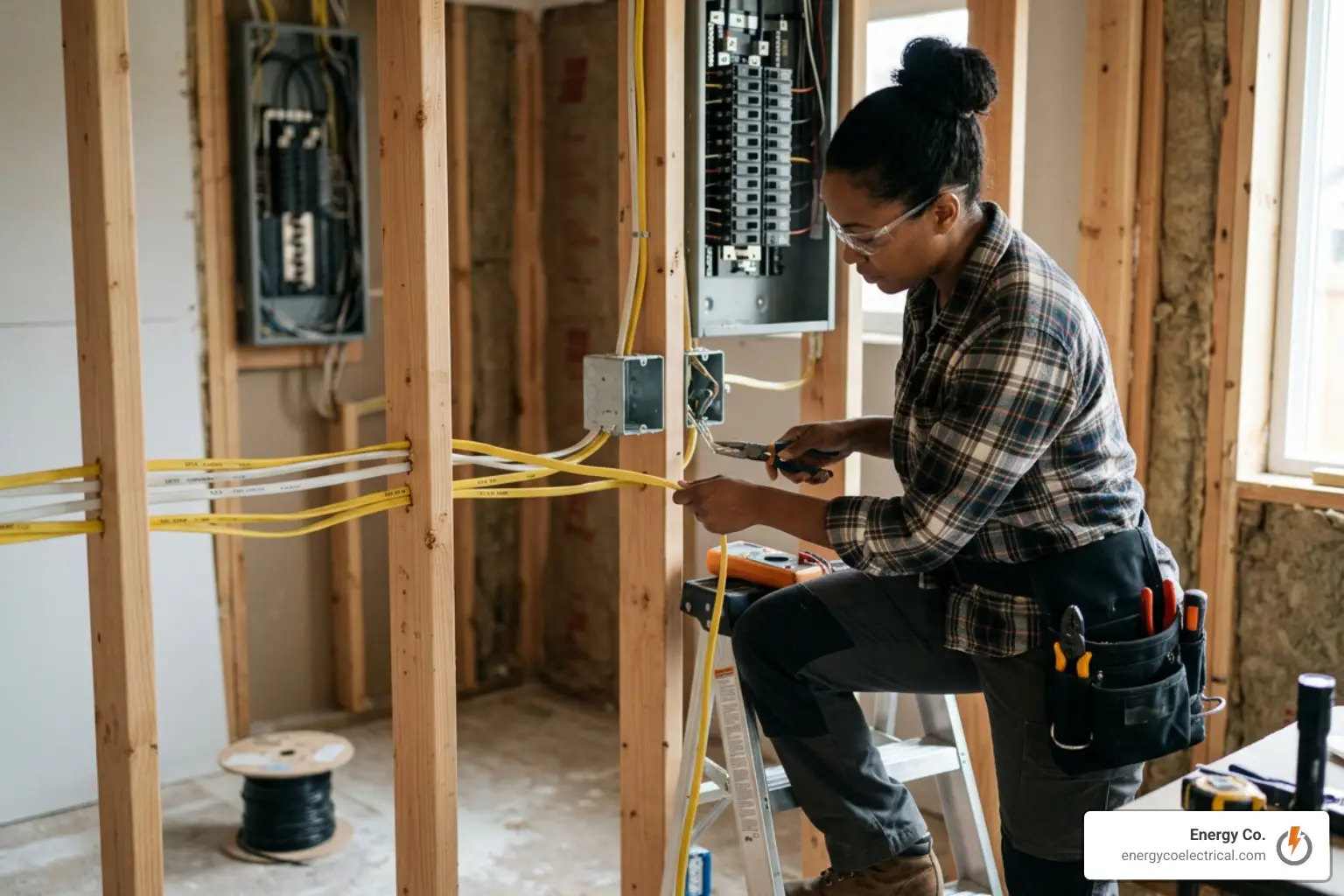
The fundamental difference lies in conductor thickness and current-carrying capacity. A 12-gauge wire is thicker, comes in a yellow jacket (for NM-B cable), and is rated for 20 amps of electrical current. It is required for heavy-use circuits such as kitchen countertops, bathroom vanities, and workshops.
A 14-gauge wire is thinner, comes in a white jacket, and is rated for 15 amps. It is standard for general household lighting circuits and standard bedroom receptacle outlets. A 14-gauge wire must never be connected to a 20-amp circuit breaker.
When is direct-burial UF-B cable required instead of standard NM-B cable?
Standard NM-B (Romex) cable is strictly rated for dry, interior locations behind walls, ceilings, and floors. Direct-burial cable—designated as Type UF-B (Underground Feeder)—is required whenever running electrical lines underground outdoors (such as feeding power to a detached garage, garden shed, or post light) or in wet interior locations.
Unlike NM-B cable, where insulated conductors sit loosely within an outer jacket, UF-B cable embeds each individual copper conductor solidly within moisture-proof, UV-resistant vinyl. Under standard residential rules, UF-B cable buried directly in the ground must be buried at a minimum depth of 24 inches (or 12 inches for 120V residential GFCI-protected circuits rated at 20A or less). If PVC non-metallic conduit is used, the burial depth may be reduced to 18 inches, while rigid metal conduit requires a minimum burial depth of 6 inches.
Can a homeowner legally do their own electrical wiring?
In many jurisdictions, single-family homeowners are legally permitted to perform electrical work on their primary residence under a homeowner permit exemption, provided they obtain all required municipal permits, follow the National Electrical Code, and successfully pass mandatory rough-in and final inspections.
However, local municipal regulations vary widely. In parts of Cook County and across specific Chicagoland suburbs (such as Chicago, Cicero, and Rolling Meadows), strict local building codes require rigid conduit systems and require major service panel upgrades, EV charger installations, and whole-home rewiring to be performed by a licensed, bonded, and insured electrical contractor. Work on energized service panels, meter bases, and utility service lines should always be left to experienced professionals.
Conclusion
A safe, reliable home electrical system depends on proper design: matching the right wire gauge to circuit loads, maintaining grounding and bonding paths, using GFCI and AFCI protection, and containing every splice within a properly sized junction box.
Whether you need to replace an outdated fuse box, upgrade your service panel for modern capacity, or wire a new addition to code in Schaumburg, Elk Grove Village, Roselle, Streamwood, or anywhere in the Northwest Suburbs, our licensed electricians at Energy Co. are here to help. Reach out to our team today to schedule professional residential electrical services and keep your home powered safely.