Why Electrical Problems in House Wiring Deserve Your Attention
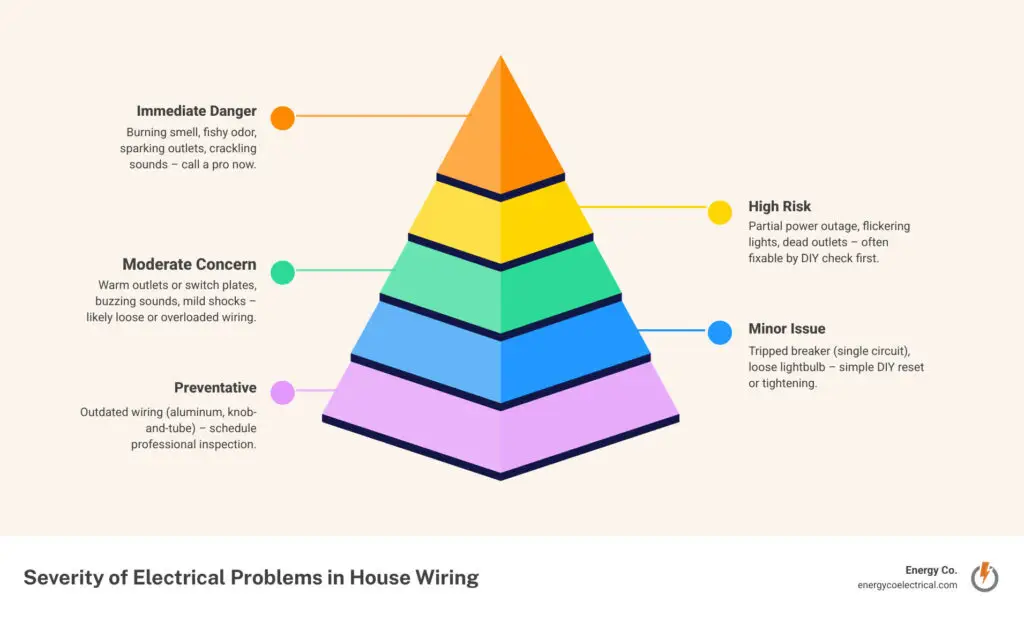
Electrical problems in house wiring are more common than most homeowners realize — and they rarely announce themselves loudly. Here’s a quick overview of the most common issues you may be dealing with:
| Problem | Common Cause | DIY or Pro? |
|---|---|---|
| Tripped circuit breaker | Overloaded circuit | DIY reset |
| Dead outlet | Tripped GFCI or loose wiring | DIY check first |
| Flickering lights | Loose connection or voltage fluctuation | DIY check first |
| Burning or fishy smell | Overheating wires or components | Call a pro immediately |
| Warm outlets or switch plates | Loose wiring or overload | Call a pro immediately |
| Partial power outage | Tripped breaker, GFCI, or lost service leg | DIY check first |
| Buzzing or crackling sounds | Arcing or loose connections | Call a pro immediately |
| Outdated wiring | Age, aluminum wiring, or knob-and-tube | Call a pro |
Most of these problems are something your home has been quietly signaling for a while. A flickering light here, a warm outlet there — easy to brush off, but important not to ignore. Left unchecked, minor electrical faults can escalate into fire hazards, equipment damage, or full outages at the worst possible time.
This guide walks you through the most common household electrical issues, how to safely identify them, which ones you can troubleshoot yourself, and — critically — when to stop and call a licensed electrician.
I’m Michał Napieralski, licensed electrician and founder of Energy Co., with years of hands-on experience diagnosing and repairing electrical problems in house wiring across Chicago and the surrounding suburbs. Whether it’s an aging panel in a 1960s bungalow or a tripped GFCI in a modern kitchen, I’ve seen it all — and I’ll help you understand exactly what you’re dealing with.
Electrical problems in house terms to learn:
Diagnosing Common Electrical Problems in House Wiring
When we talk about diagnosing electrical problems in house wiring, we are looking at how electrical current behaves inside your walls. Your home’s electrical system is designed to distribute electricity safely, but physical wear, high power demands, and poor installations can disrupt this flow.
To diagnose these issues safely, we must first understand the primary electrical faults that occur in residential systems:
- Overloaded Circuits: This happens when we plug too many high-wattage appliances into a single circuit. For example, running a space heater, a hair dryer, and a microwave on the same bedroom or kitchen circuit will pull more amperage than the circuit breaker is rated to handle. The breaker trips to prevent the wires from overheating.
- Short Circuits: A short circuit occurs when a hot (live) wire directly touches a neutral wire. This creates an immediate pathway of near-zero resistance, causing a massive surge of current. The breaker will trip instantly to prevent a fire. Short circuits are often caused by damaged appliance cords, pests chewing on wires, or loose connections inside outlet boxes.
- Ground Faults: Similar to a short circuit, a ground fault occurs when a hot wire touches a grounded portion of the junction box, an appliance frame, or the ground wire itself. This is highly common in areas with moisture, such as kitchens, bathrooms, and basements.
Understanding these basic faults is the first step in identifying when your home’s electrical system requires professional attention. If you are looking for a systematic approach to pinpointing these issues, we recommend reading about The Easiest Way to Troubleshoot Electrical Problems to build a solid foundation before touching any hardware.
Why Flickering Lights Indicate Electrical Problems in House Systems
One of the most frequent complaints we hear from homeowners in Chicago and suburbs like Schaumburg or Arlington Heights is that their lights are flickering or dimming. While a single flickering bulb is usually just a sign of a loose lightbulb or a dying LED, whole-house flickering points to deeper issues.
- Voltage Fluctuations: If you notice your lights dim or flicker momentarily when a large appliance, like your central air conditioner or refrigerator, kicks on, this indicates a high power draw. The appliance is pulling a massive amount of starting current, briefly lowering the voltage available to your lighting circuits.
- Loose Fixture Wiring: If flickering is localized to a single room or fixture, it often points to a loose wire connection inside the light switch, junction box, or fixture itself. Over time, thermal expansion and contraction can cause wire nuts to loosen.
- Corroded Connections or Utility Issues: In older Chicagoland homes, corroded main service connections at the weatherhead (where power lines enter your house) can cause severe flickering across multiple rooms. This is a fire hazard and requires immediate professional attention.
To understand the difference between a harmless bulb issue and a dangerous system-wide failure, check out our detailed guide on Why Is My House Flickering? Diagnosing Home Electrical Problems and How to Fix Them.
Dead Outlets and Loose Wiring Connections
A dead outlet can be highly frustrating. You plug in your phone or vacuum cleaner, and nothing happens. In some cases, a dead outlet is caused by a simple tripped breaker, but often, it is a symptom of loose wiring connections behind the drywall.
One of the biggest culprits we find in homes built over the last few decades is backstabbed wiring. This refers to a quick-installation method where the electrician pushes the bare copper wire into spring-loaded slots on the back of the outlet, rather than wrapping the wire securely around the side terminal screws. Over time, these spring clips lose their tension, leading to loose connections, intermittent power, or a completely dead outlet.
Furthermore, a loose neutral wire can cause an outlet to stop functioning entirely while the hot wire remains fully live. This means the outlet looks dead, but it can still deliver a severe shock if you attempt to work on it. Worn-out outlet prongs are another mechanical issue; if plug prongs slide out of the receptacle with zero resistance, the internal metal contacts have worn down, creating high electrical resistance and a fire risk. For step-by-step diagnostic advice, see our resource on Outlet & Switch Troubleshooting.
Safe DIY Troubleshooting and Tracing Outages
Before you attempt any DIY diagnostic work, we must emphasize safety. Working with electricity carries inherent risks of shock, electrocution, and fire.
If you plan to perform basic checks, you must have the right tools and follow strict safety protocols. At a minimum, you should invest in:
- A non-contact voltage detector (to verify wires are dead before touching them).
- A digital multimeter (to check for proper voltage and identify hot vs. neutral wires).
- Insulated hand tools (screwdrivers and wire cutters).
Always turn off the main power at the breaker panel before inspecting any wiring, and never work in wet conditions or stand on damp basement floors. For a complete list of safety rules, read Electrical Repairs: Do’s and Don’ts for Beginners.
How to Safely Reset a Tripped Circuit Breaker
When a circuit breaker trips, it is doing its job to protect your home. However, resetting it incorrectly or repeatedly forcing it back on can cause severe damage.
- Locate the Panel: Find your main service panel. Open the door (do not remove the metal safety cover that exposes the internal busbars).
- Identify the Tripped Breaker: Look for a breaker handle that is resting in the middle position, between ON and OFF. It may also show a red indicator window.
- The Correct Reset Sequence: To reset it, you cannot simply push it back to ON. You must first push the handle firmly all the way to the OFF position until you hear a distinct click. This resets the internal spring mechanism. Once it is fully OFF, flip it firmly to the ON position.
- What If It Trips Again? If the breaker trips again immediately, do not force it. There is an active short circuit or a severe overload on the line.
If you are dealing with a stubborn breaker, we recommend consulting our guides on Demystifying Your Home Electric Panel (Without Getting Shocked) and Circuit Breaker Repair.
Testing and Resetting GFCI Outlets
Ground Fault Circuit Interrupters (GFCIs) are special outlets designed to detect tiny leaks of electrical current (ground faults) and cut power in milliseconds to prevent electrocution. They are legally required in wet areas like kitchens, bathrooms, basements, and garages.
To safely check and reset a GFCI outlet:
- Locate the GFCI outlet (it will have “TEST” and “RESET” buttons on the face).
- Press the TEST button. You should hear a click, and the RESET button should pop out. Power to the outlet (and any standard outlets connected downstream) will cut off.
- Press the RESET button firmly until it clicks back into place to restore power.
If the GFCI refuses to reset, it means there is no power coming to the outlet (such as a tripped breaker), there is an active ground fault downstream, or the GFCI receptacle itself has failed and must be replaced. For a complete checklist of what to look for, refer to the safety guidelines provided by the Electrical Safety Foundation International (ESFI).
Tracing a Partial Power Outage Safely
A partial power outage is when some rooms or major appliances lose power, while the rest of your house remains fully lit. This is different from a utility blackout.
| Outage Type | Affected Areas | Most Likely Cause | Action to Take |
|---|---|---|---|
| Partial Outage | One room, a group of outlets, or 240V appliances | Tripped breaker, tripped GFCI, or lost service leg | Check panel, reset GFCIs, contact utility/electrician |
| Complete Blackout | Whole house and neighboring homes | Utility grid failure, storm damage, downed power lines | Check neighbors, report to utility company |
If half of your house loses power, or if some lights work but your 240-volt electric clothes dryer or central AC fails to start, you are likely dealing with a lost service leg. Standard North American homes receive split-phase power consisting of two 120-volt hot legs. If one of these legs fails at the utility pole, weatherhead, or electric meter, you will lose power to exactly half of your 120V circuits, and all of your 240V appliances will fail.
Before calling an electrician for a partial outage, check if your neighbors are experiencing similar issues, as a lost leg is often a utility company problem. Tracing a partial house outage safely requires understanding your panel’s layout and verifying whether the issue originates from the utility side or your home’s internal wiring.
Red Flags: When to Call a Professional Immediately
While basic troubleshooting can save you time, some electrical problems in house wiring represent immediate, severe fire hazards.
If you notice any of the following red flags, you must stop what you are doing, turn off the power at the main breaker if safe to do so, and contact us for Emergency Electrical Services immediately:
- Burning Smells: An electrical burning smell often mimics the scent of burnt plastic or hot rubber.
- Fishy Odors: Overheating electrical insulation and plastic components inside outlet boxes release chemical compounds that smell distinctly like rotten fish. If you notice a fishy smell in a room that comes and goes, it is an overheating outlet or switch.
- Warm Cover Plates: Outlets and switches should never be warm to the touch. If they are, it indicates high electrical resistance or a severe overload. Use the back of your hand to feel the cover plate safely.
If you suspect an active emergency, you must act quickly to isolate the issue, turn off the main power supply if it is safe to do so, and contact emergency services or a licensed electrician immediately to protect your home.
When to Worry About Electrical Problems in House Panels and Outlets
Your electrical panel and wall outlets are the gatekeepers of your home’s power. When they start failing, the consequences can be catastrophic.
- Buzzing or Crackling Sounds: A steady humming sound from an outlet or panel can indicate a loose wire. A crackling or sizzling sound indicates arcing, where electricity is jumping across a gap between loose connections. Arcing generates intense heat and is a direct cause of house fires.
- Sparking Outlets: While a tiny, momentary blue spark when plugging in a device can be normal, a large yellow spark, or sparks that jump out of the outlet, indicate a short circuit or moisture damage.
- Mild Shocks: If you feel a mild shock or tingle when touching a metal switch plate, appliance, or faucet, your electrical system has a bad earth/ground connection. This means electrical current is using your body as a path to the ground, which is highly dangerous.
If you experience these alarming signs, do not wait for the morning. Find out What to Do When Your Power Goes Bump in the Night to handle the situation safely.
Outdated Wiring and Older Home Hazards
If you live in an older Chicago neighborhood or suburbs like Cicero, Elk Grove Village, or Palatine, your home may contain outdated wiring that was never designed to handle modern electrical loads.
- Aluminum Wiring: Popular in homes built during the 1960s and 1970s, aluminum wiring expands and contracts significantly more than copper. This natural movement loosens connections over time, creating high resistance and fire risks.
- Knob-and-Tube Wiring: Found in homes built before the 1940s, this system uses ceramic knobs and tubes to run single insulated wires through wall cavities. It lacks a ground wire, is insulated with disintegrating cloth, and cannot be safely covered with modern home insulation.
- Ungrounded Two-Prong Outlets: These outlets lack a ground pathway, leaving your sensitive electronics unprotected from surges and increasing your shock risk.
- Chicago Metal Conduit Codes: Chicago has some of the strictest electrical codes in the country, requiring all wiring to be housed in rigid metal conduit (EMT) rather than flexible plastic Romex cable. This protects wires from physical damage and rodents, but makes retrofitting older homes a highly specialized task.
Upgrading these older systems requires specialized local knowledge. To ensure your home is safe and compliant with local municipal codes, contact our team at Top-Rated Electrical Repair Shop Chicago – Your Guide to Reliable Service.
Frequently Asked Questions about Home Electrical Issues
Why does my power go out in only one room?
A localized power outage is usually caused by a tripped circuit breaker due to an overloaded circuit (such as running a space heater and a gaming computer at the same time). However, it can also be caused by a tripped GFCI outlet.
Because GFCIs protect downstream outlets, a tripped GFCI in a bathroom or garage can cut power to standard outlets in a completely different room, such as a bedroom or outdoor patio. Understanding this downstream relationship is key to resolving localized power issues safely.
Is a fishy smell in my house an electrical emergency?
Yes, a fishy smell is a major electrical emergency. It indicates that plastic casing, wire insulation, or outlet components are actively melting behind your walls due to high resistance or arcing.
This is a direct precursor to an electrical fire. You should immediately turn off the breaker to that area and call a professional electrician.
How often should I have my home’s electrical system inspected?
For modern homes (less than 40 years old), we recommend a professional electrical inspection every 3 to 5 years. However, if your home is more than 40 years old, has never been rewired, or is located in historic parts of Cook County, you should have it inspected annually to ensure safety compliance and check for degrading wire insulation.
Conclusion
Dealing with electrical problems in house wiring can be stressful, but understanding the warning signs and knowing when to call in the professionals is the best way to keep your family safe. While simple tasks like resetting a circuit breaker or testing a GFCI outlet are safe DIY procedures, complex diagnostic work, rewiring, and panel upgrades must be handled by licensed experts.
At Energy Co., we specialize in providing top-tier residential and commercial electrical services throughout Chicago and the surrounding Northwest Suburbs, including Roselle, Streamwood, Hoffman Estates, and Mount Prospect. Our licensed pros understand the unique challenges of Chicago’s historic architecture and strict metal conduit codes. We back all of our repairs and installations with a 100% satisfaction guarantee.
If you are noticing flickering lights, dead outlets, or suspect your older home needs an upgrade, don’t wait for a minor issue to become a major hazard. Contact us today for Expert Electrical Repair Service in Chicago – Fast, Reliable Solutions or schedule an inspection. For more troubleshooting advice, visit our Outlet & Switch Troubleshooting portal.