Last updated:
How to Wire a Spa GFCI Breaker Safely
Start with the spa’s installation manual. It specifies the circuit size and whether the 240-volt spa needs four wires: two hot wires, a neutral, and a ground. A licensed electrician can then choose a compatible spa GFCI breaker, install it on a dedicated circuit, connect the wires according to the breaker diagram, and test that it shuts off power when a ground fault is detected.
That test matters. A GFCI helps protect people from electric shock, but a wrong connection can keep it from working as intended. In older Chicagoland buildings, the existing panel and wiring also need to be checked before the spa is connected.
I’m Michał Napieralski, and I’ll walk you through what each installation step involves and what to check before the first soak.
Spa gfci breaker terms simplified:
Understanding Spa GFCI Protection and Sizing Requirements
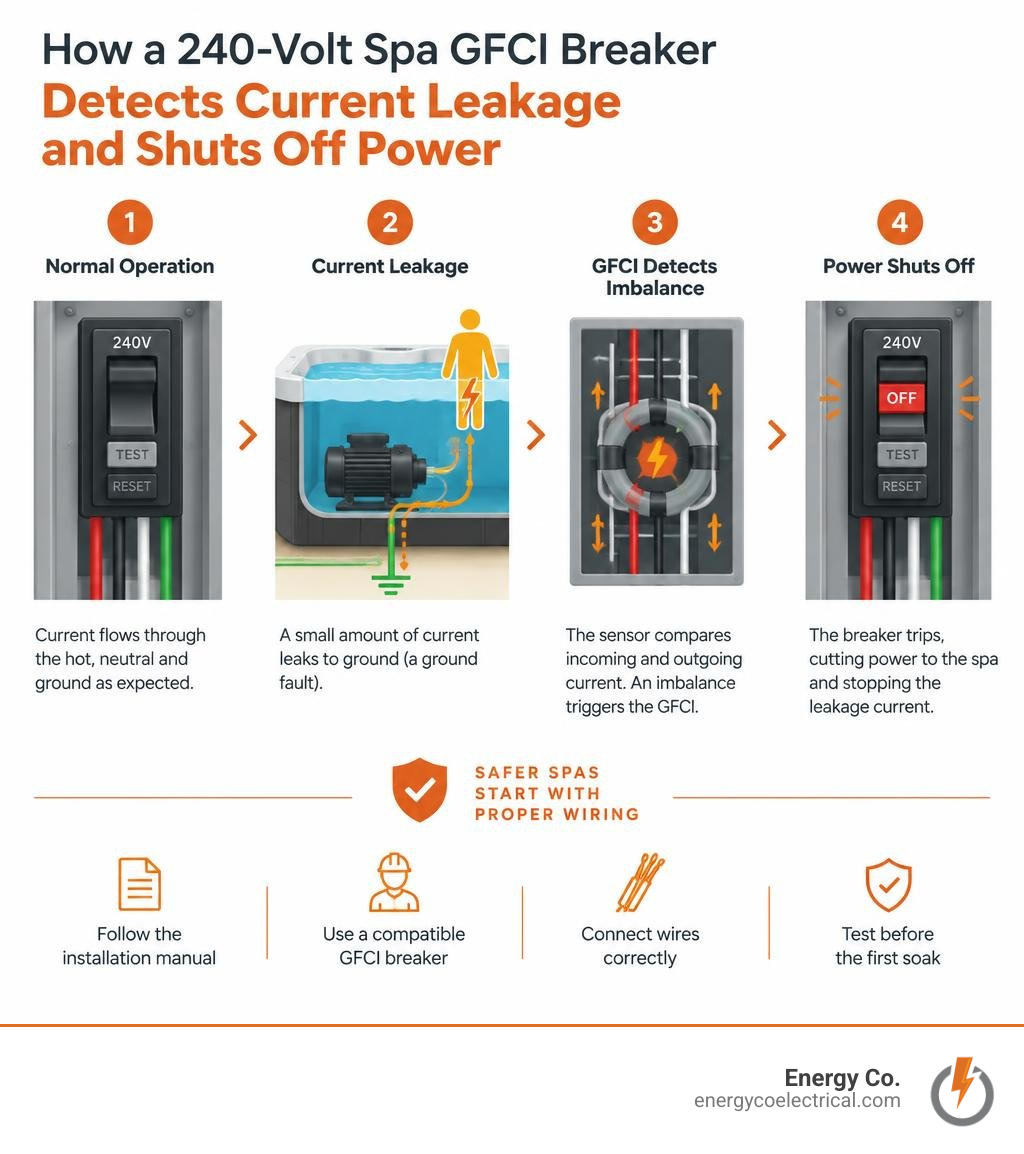
Water and electricity are a disastrous combination without proper safeguards. A Ground Fault Circuit Interrupter (GFCI) monitors the current flowing through hot and neutral conductors. When current leaves the intended circuit—such as leaking into water or flowing through a person—the GFCI senses this imbalance and cuts off power in a fraction of a second.
Under National Electrical Code (NEC) Article 680.44, GFCI protection is strictly mandated for all outdoor hot tubs, spas, and hydrotherapy equipment. Standard household circuit breakers only trip during sustained overloads or direct short circuits (often requiring 15 to 50 amps of fault current). In contrast, a Class A GFCI detects a current leakage as tiny as 4 to 6 milliamperes (5 mA nominal) and shuts off power within milliseconds, preventing lethal electrocution.
Modern 240V residential hot tubs demand dedicated branch circuits. Because modern tubs incorporate sophisticated digital topside controllers, ozonators, multi-speed pumps, and high-output heaters, they require a 240V 4-wire configuration (two hot lines, one neutral, and one insulated ground conductor) to power both 120V auxiliary components and 240V heating elements simultaneously. To make sure your setup meets modern safety standards, it is essential to properly wire a hot tub for safety.
Choosing the Right Spa GFCI Breaker Amperage: 50A vs. 60A
Selecting the correct amperage ensures your spa operates smoothly without tripping during peak use. While some compact plug-and-play models operate on 120V/15A circuits, most hardwired outdoor spas require dedicated 240V circuits rated at 40A, 50A, or 60A.
- 40-Amp Circuits: Found on smaller, single-pump spas or older units. In many 40A configurations, the controller turns off the 4 kW heater whenever the jet pump switches to high speed.
- 50-Amp Circuits: The industry standard for residential spas. A 50A setup typically supports a 4 kW to 5.5 kW heater alongside one or two jet pumps running concurrently.
- 60-Amp Circuits: Increasingly common for large luxury spas, swim spas, and multi-pump hydrotherapy systems equipped with dual 4 kW or 5.5 kW heaters and high-output blowers.
The National Electrical Code dictates that continuous loads must not exceed 80% of the circuit’s overcurrent protection rating. For example, a 50A breaker safely accommodates a continuous load of 40A (9,600 watts at 240 volts).
| Circuit Rating | Voltage | Typical Wire Gauge (Copper THHN) | Typical Heater Capacity | Max Continuous Load (80%) |
|---|---|---|---|---|
| 40 Amp | 240V (4-wire) | 8 AWG | 3.0 kW – 4.0 kW | 32 Amps (7,680 Watts) |
| 50 Amp | 240V (4-wire) | 6 AWG | 4.0 kW – 5.5 kW | 40 Amps (9,600 Watts) |
| 60 Amp | 240V (4-wire) | 6 AWG (or 4 AWG for long runs) | 5.5 kW – 11.0 kW | 48 Amps (11,520 Watts) |
Before buying wire or breakers, check the nameplate inside your spa’s equipment bay and focus on selecting the right electrical cable for hot tubs to handle the electrical load safely.
GFCI Breakers vs. Spa Disconnect Panels
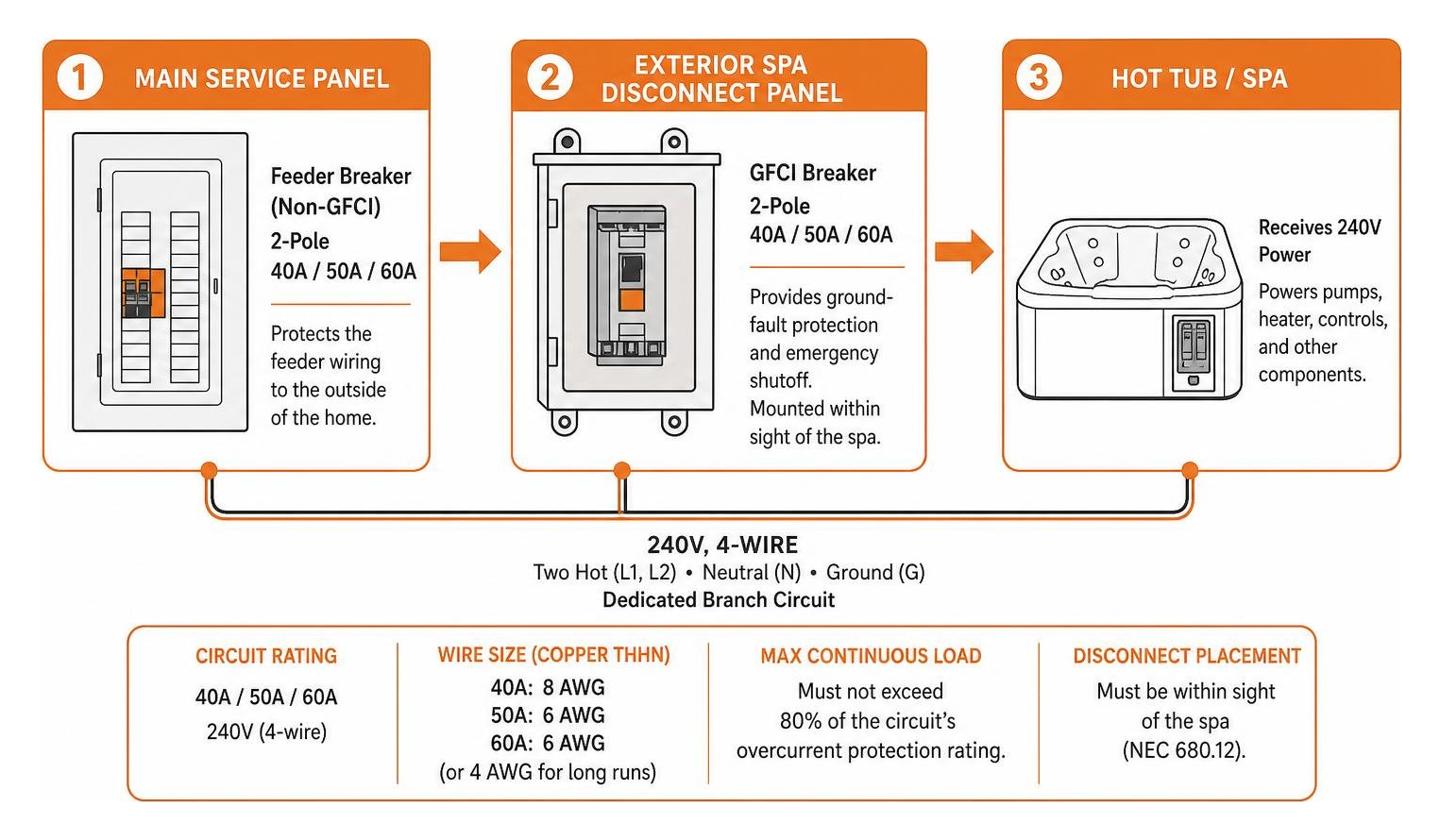
Homeowners often wonder whether they need a GFCI breaker inside their home’s main service panel or an exterior spa disconnect box. In practical installations, the setup involves both:
- Main Service Panel Feeder Breaker: A standard, non-GFCI 2-pole breaker (e.g., 50A or 60A) installed in your basement or garage load center. This breaker protects the feeder wiring running to the outside of the home.
- Exterior Spa Disconnect Panel: A weatherproof NEMA 3R outdoor enclosure mounted within sight of the spa. This enclosure houses a 2-pole GFCI breaker that provides both ground-fault protection and an emergency shutoff switch.
Using an outdoor GFCI subpanel is preferred because it places the manual disconnect within immediate reach of someone near the hot tub. If a fault occurs, resetting the GFCI can be done right in the backyard without trekking down to the basement. You can see the full setup process when hooking up an outdoor hot tub disconnect box.
NEC Code and Placement Rules for Outdoor Spa Disconnects
Outdoor spa installations must adhere strictly to local ordinances and NEC requirements, particularly NEC 680.12 and 680.42.
- Line-of-Sight Visibility (NEC 680.12): The disconnect switch must be readily accessible and visible from the hot tub. If someone in the tub experiences an emergency or a pump fails, a person nearby must be able to spot the switch instantly and cut power.
- Distance Requirements: The disconnect must be located at least 5 feet from the inside wall of the spa (to prevent an occupant from touching the switch while submerged) and no further than 50 feet away (with 5 to 10 feet being the optimal placement).
- Conduit Limits (NEC 680.42): Liquid-tight flexible metal conduit (LFMC) or liquid-tight flexible nonmetallic conduit (LFNC) is limited to a maximum length of 6 feet (1.8 meters) for the final hookup between the external disconnect and the spa pack.
- Burial Depths: Underground conduit runs from the home to the disconnect must be buried at code-specified depths: 18 inches for rigid nonmetallic conduit (Schedule 40/80 PVC) or 6 inches for rigid metal conduit (RMC).
Always check your local municipal regulations. For example, local suburban jurisdictions often maintain specific permit and bonding requirements, such as those detailed in the Municipal Swimming Pool and Spa Code Guidelines.
How to Wire a 240V Spa GFCI Breaker Step-by-Step
Wiring a 240V spa subpanel requires careful attention to detail, as an improperly wired neutral is the most common reason a brand-new GFCI trips immediately.
Required Tools and Electrical Supplies
- Weatherproof NEMA 3R Spa Disconnect Panel with 50A or 60A 2-pole GFCI breaker
- Dedicated 2-pole breaker for the main panel
- Individual THHN/THWN-2 copper conductors (Line 1/Black, Line 2/Red, Neutral/White, Ground/Green)
- Schedule 40 or 80 PVC conduit, liquid-tight flexible conduit, and waterproof conduit fittings
- Digital multimeter or voltage tester
- Wire strippers, linesman pliers, torque screwdriver, and fish tape
Step 1: Shut Off Main Power and Verify
Turn off the main electrical supply feeding the subpanel work area. Use a calibrated multimeter to test all terminals and ensure no voltage is present before handling any wiring. Review proven 50-amp hot tub breaker wiring methods before beginning.
Step 2: Mount the NEMA 3R Disconnect Box
Secure the outdoor enclosure to an exterior wall or mounting post between 5 and 10 feet from the spa. Secure conduit runs using watertight connectors to prevent rain and condensation from entering the enclosure.
Step 3: Connect the Line-Side (Supply) Conductors
Pull your four THHN conductors from the home’s main panel into the disconnect box:
- Land the incoming Black wire (Line 1) and Red wire (Line 2) on the subpanel supply lugs.
- Connect the incoming White wire (Supply Neutral) directly to the subpanel’s insulated neutral bar.
- Terminate the incoming Green wire (Ground) onto the bonded equipment grounding bar.
Step 4: Wire the Spa GFCI Breaker Correctly
This is where mistakes often occur. Follow this specific sequence:
- GFCI Breaker Neutral Pigtail: Connect the coiled white wire attached to the breaker body directly to the subpanel’s neutral bar.
- Load Neutral Connection: Connect the white neutral conductor going out to the spa directly to the terminal screw on the GFCI breaker stamped “LOAD NEUTRAL” or “OUT.” Do not connect the spa’s load neutral to the panel neutral bar.
- Load Hot Connections: Connect the black and red conductors heading out to the spa to the two “LOAD” terminals on the GFCI breaker.
- Load Ground Connection: Connect the outgoing green ground wire to the bonded ground bar.
For a complete visual walkthrough of this wiring layout, review this Video Demonstration of 220V 50A GFCI Breaker Installation.
Troubleshooting and Maintaining Your Spa Electrical Circuit
If your spa breaker refuses to stay set, diagnosing the problem systematically saves time and prevents component damage.
The Component Isolation Method
- Turn off power completely at the main service panel and the outdoor disconnect.
- Open the spa’s equipment cabinet and disconnect the quick-connect cables or terminal leads for individual components: the heater, pump 1, pump 2, blower, and ozonator.
- Turn the GFCI breaker back on. If it trips immediately with zero components connected, the problem is a faulty breaker, moisture inside the disconnect box, or an incorrect neutral pigtail connection.
- If the breaker stays on, turn the power back off and reconnect one component at a time (starting with the circulation pump), restoring power between each step.
- When the breaker trips after reconnecting a specific part, you have isolated the defective component.
Common Failure Points
- Heating Element Burnout: The heating element’s outer metal sheath can develop microscopic fractures over time due to water chemistry imbalances. Water penetrates the internal heating wire, creating a direct ground fault.
- Pump Motor Seals: Worn shaft seals allow water to spray or weep into the pump motor windings, triggering instant GFCI trips when the pump engages.
- Moisture in Enclosures: Rain or condensation inside the outdoor disconnect box can bridge the gap between hot terminals and the grounded metal chassis.
- Corroded Terminals: Loose or oxidized wire lugs generate localized heat, causing nuisance thermal tripping.
For stubborn faults that persist after isolating components, consider having an electrician perform professional circuit breaker repairs to inspect internal panel connections.
How to Test and Reset a Spa GFCI Breaker
Safety standards require regular testing of your spa GFCI to verify that its internal sensing electronics remain responsive.
- Monthly Test Routine: With the spa running under normal operating conditions, press the TEST button located on the face of the GFCI breaker.
- Observe the Trip: The breaker handle should snap immediately to the center or “TRIP” position, and all spa power should shut off instantly.
- Resetting the Breaker: Wait approximately 30 seconds. Push the breaker handle firmly past the OFF position until it clicks and resets its internal spring mechanism, then push it firmly to ON.
- Topside Diagnostics: Many modern spas feature built-in automated GFCI trip verification cycles during initial startup, as documented in the MAAX Spa Equipment Operation Manual. If the breaker fails to trip during a manual test, it has lost its protective capability and must be replaced immediately.
Frequently Asked Questions About Spa GFCI Breakers
Can I use a 50A GFCI disconnect with a 40A main panel breaker?
Yes. An outdoor disconnect box and its internal GFCI breaker can have an amperage rating equal to or greater than the feeder breaker in your main electrical panel. For instance, feeding a 50A GFCI disconnect from a 40A feeder breaker using 8 AWG copper wire is safe and code-compliant. The 40A feeder breaker protects the wire against overcurrent, while the 50A GFCI disconnect acts as a ground-fault interrupter and manual safety switch. This approach also allows you to upgrade to a 50A or 60A spa in the future simply by upgrading the feeder breaker and conductors.
What is the difference between 3-wire and 4-wire spa connections?
Older spas often used a 3-wire system consisting of two 120V hot conductors and one ground wire (pure 240V, without a neutral). Modern spas require a 4-wire system (Line 1, Line 2, Neutral, and Ground). The dedicated neutral conductor allows the spa’s electronic control board to run 120V auxiliary accessories (such as digital touchscreens, LED lighting, and stereo systems) while sending 240V to the large heater and pumps.
Why does my spa breaker trip immediately after power is restored?
An immediate trip (happening the exact millisecond the breaker is switched on) points to one of three issues:
- Miswired Neutral Pigtail: The neutral wire from the spa was mistakenly connected to the neutral bar rather than directly to the GFCI breaker’s load neutral terminal.
- Dead Short Circuit: A hot wire is making direct contact with ground or neutral inside the conduit or connection box.
- Severely Shorted Heating Element: The heater element has experienced a complete breakdown, shorting directly to the grounded metal tube.
Conclusion
Installing a hot tub should be an exciting home improvement, not a safety hazard. Proper GFCI protection, correct copper conductor sizing, and code-compliant disconnect placement ensure that your backyard retreat remains safe for friends and family.
At Energy Co., our licensed electricians bring specialized expertise to Chicago and Northwest Suburban properties—including Schaumburg, Hoffman Estates, Arlington Heights, Palatine, and Mount Prospect. Whether you need a service panel evaluation, underground conduit trenching, or a complete dedicated hot tub and spa circuits installation, our team backs every job with our satisfaction guarantee. Reach out today to schedule your spa electrical installation.