Breaker Box Problems: What to Check First
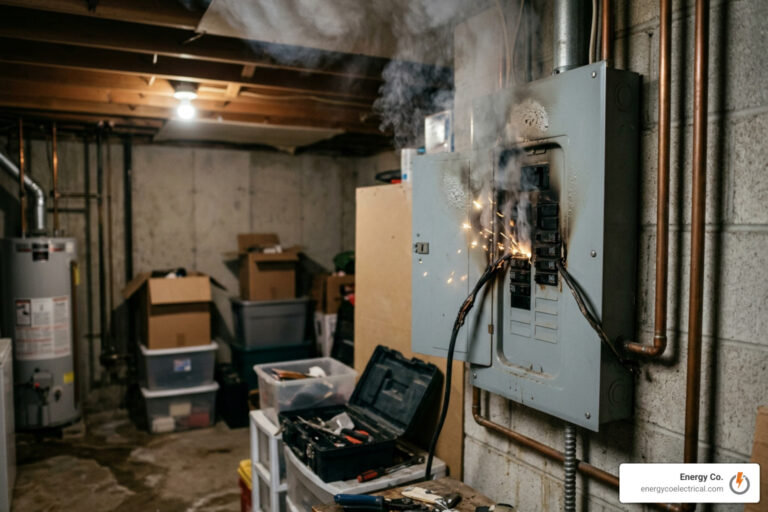
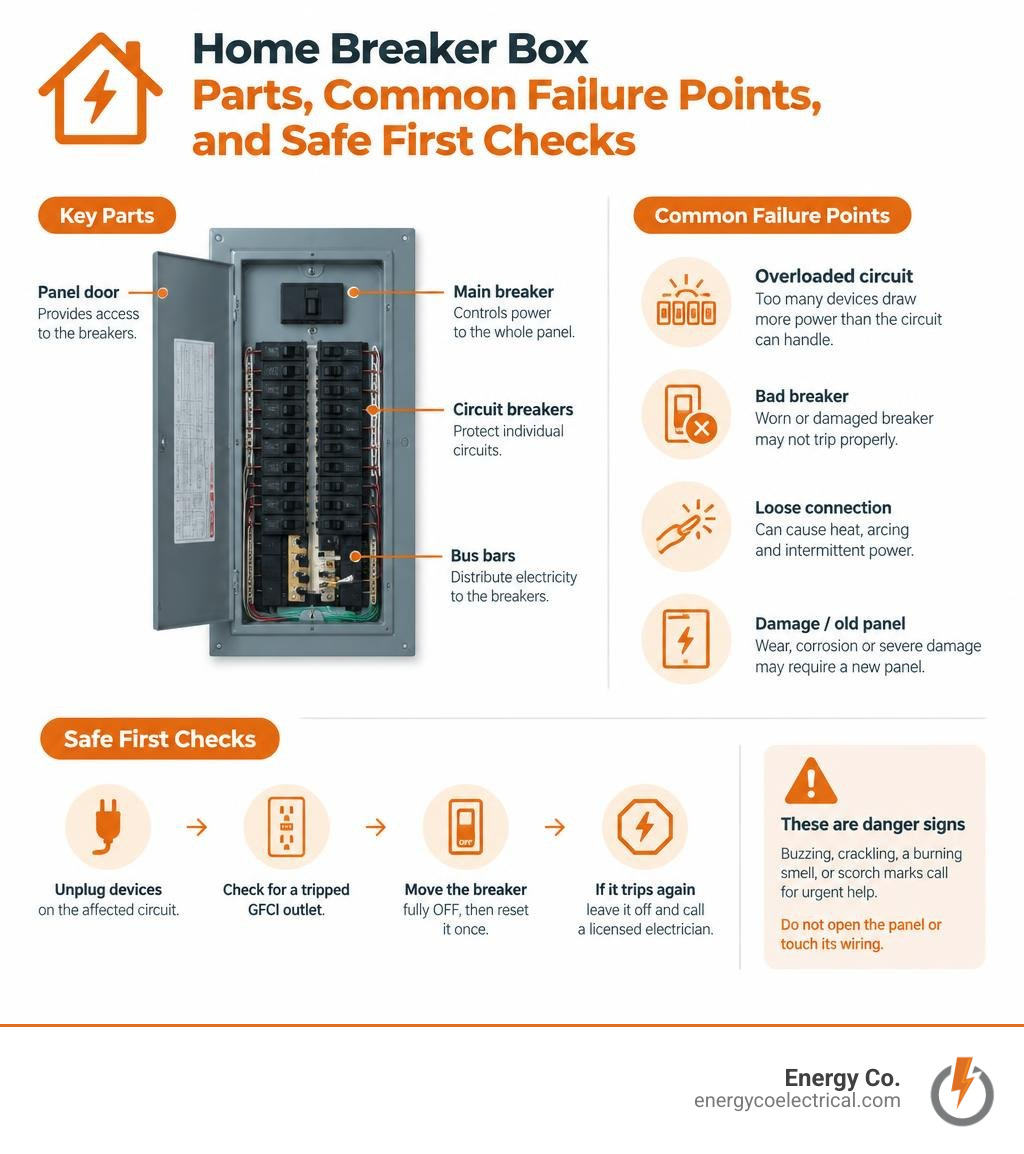
If a breaker keeps tripping or an outlet has no power, start with the safe checks: Unplug devices on the affected circuit, look for a tripped GFCI outlet, and move the breaker fully OFF before resetting it once. If it trips again, leave it off and call a licensed electrician. Buzzing, crackling, a burning smell, or scorch marks call for urgent help. Do not open the panel or touch its wiring.
The cause may be an overloaded circuit, a bad breaker, a loose connection, or damage that calls for a new panel. I’m Michał Napieralski, and I’ll help you spot the difference without taking unsafe risks.
Breaker box problems further reading:
Recognizing Critical Breaker Box Problems and Early Warning Signs
Electrical service panels are designed to sit quietly behind a utility door or in your basement, protecting your home’s wiring without drawing attention. However, when internal components experience thermal stress or mechanical wear, they communicate their distress through specific acoustic, visual, and thermal cues. Recognizing these indicators early prevents minor hardware failures from escalating into structural fires. Incorporating an electrical panel maintenance routine into your regular home upkeep ensures you catch subtle warning signs before they interrupt your power.
Acoustic Warnings: Buzzing, Sizzling, and Crackling
A healthy breaker panel operates with minimal audible interference, producing only a faint 60 Hz hum under heavy power consumption. This low vibration occurs because alternating current creates expanding and contracting magnetic fields around conductors.
When high-amperage current encounters mechanical resistance, this quiet hum shifts into a sharp buzzing or sizzling sound. High-resistance connections inside a panel generate localized temperatures exceeding 800°F (425°C), melting breaker casing plastic, destroying the interior busbar, and presenting severe structural fire risks. Understanding how to diagnose and fix a buzzing circuit breaker panel helps distinguish normal mechanical resonance from active micro-arcing. If the noise sounds like bacon sizzling or produces intermittent clicking, internal contacts are actively sparking behind the metal dead front.
Thermal Abnormalities and Burning Odors
Excess heat indicates abnormal electrical resistance. Professional diagnostic evaluations use infrared thermal imaging to identify hidden hot spots within the panel enclosure. Any individual breaker showing operating temperatures above 140°F (60°C) points to an active overload or loose terminal clamping. Furthermore, an infrared temperature differential (delta-T) of more than 15°F (8°C) between adjacent, similarly loaded breakers confirms dangerous internal resistance.
Thermal deterioration frequently creates a distinct chemical odor before flames develop. Overheated phenolic plastic, wire insulation, and binding adhesives release a sharp, fishy, or sulfurous smell. If this odor is detected near your service box, shut off high-draw appliances immediately and request licensed assistance.
Step-by-Step Troubleshooting for Common Circuit Failures
Circuit breakers trip to prevent electrical overloads from heating your home’s wiring past safe thresholds. Under the National Electrical Code (NEC) 80% continuous load rule, branch circuits must not operate at maximum amperage for three hours or more:
- 15-Amp Branch Circuit: Maximum 1,440 continuous watts (12 amps at 120 volts).
- 20-Amp Branch Circuit: Maximum 1,920 continuous watts (16 amps at 120 volts).
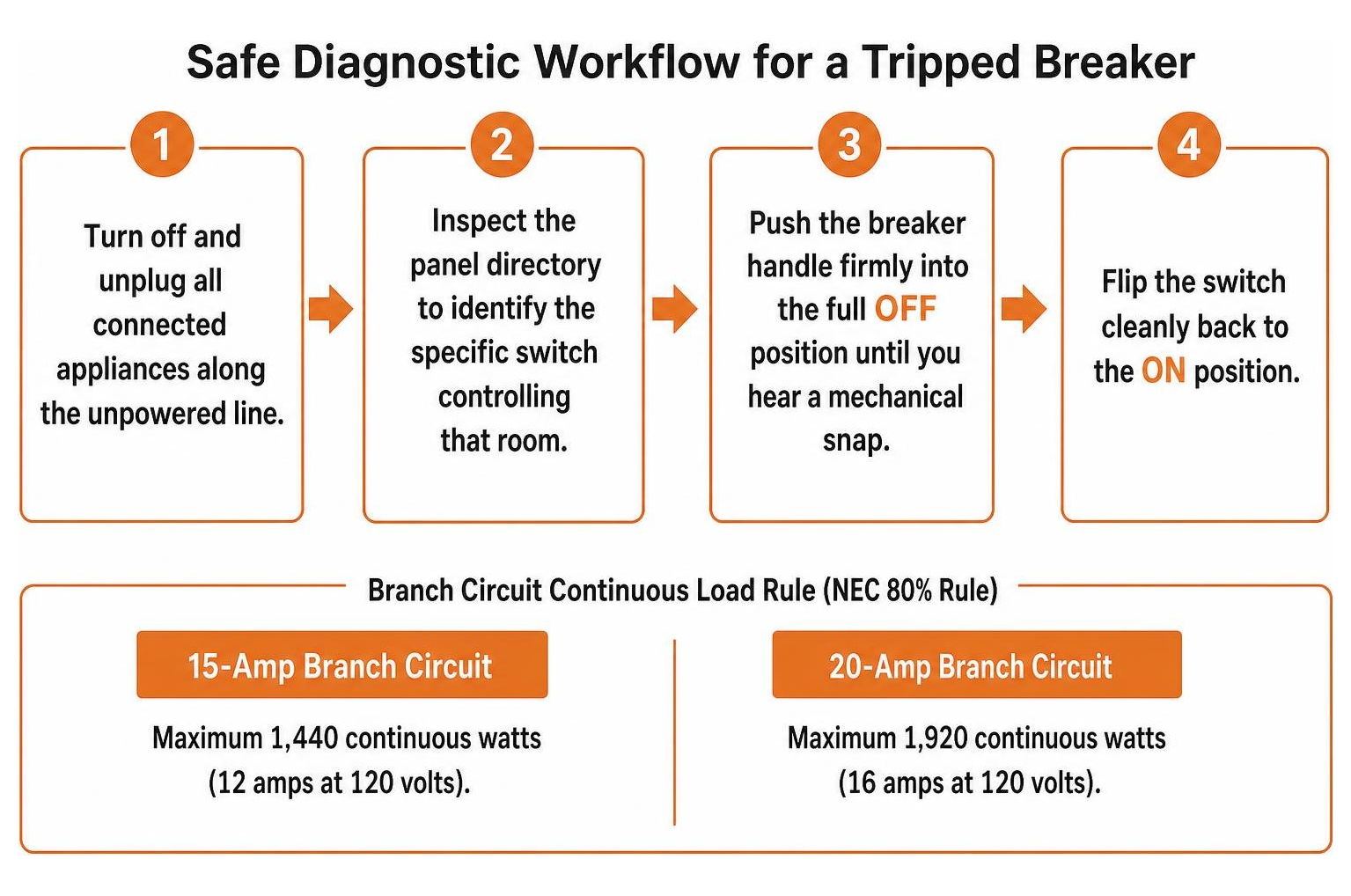
When isolating branch circuit faults, follow this safe diagnostic sequence:
- Turn off and unplug all connected appliances along the unpowered line.
- Inspect the panel directory to identify the specific switch controlling that room.
- Push the breaker handle firmly into the full OFF position until you hear a mechanical snap.
- Flip the switch cleanly back to the ON position.
- Plug appliances in one by one to monitor for immediate trips caused by a specific faulty appliance.
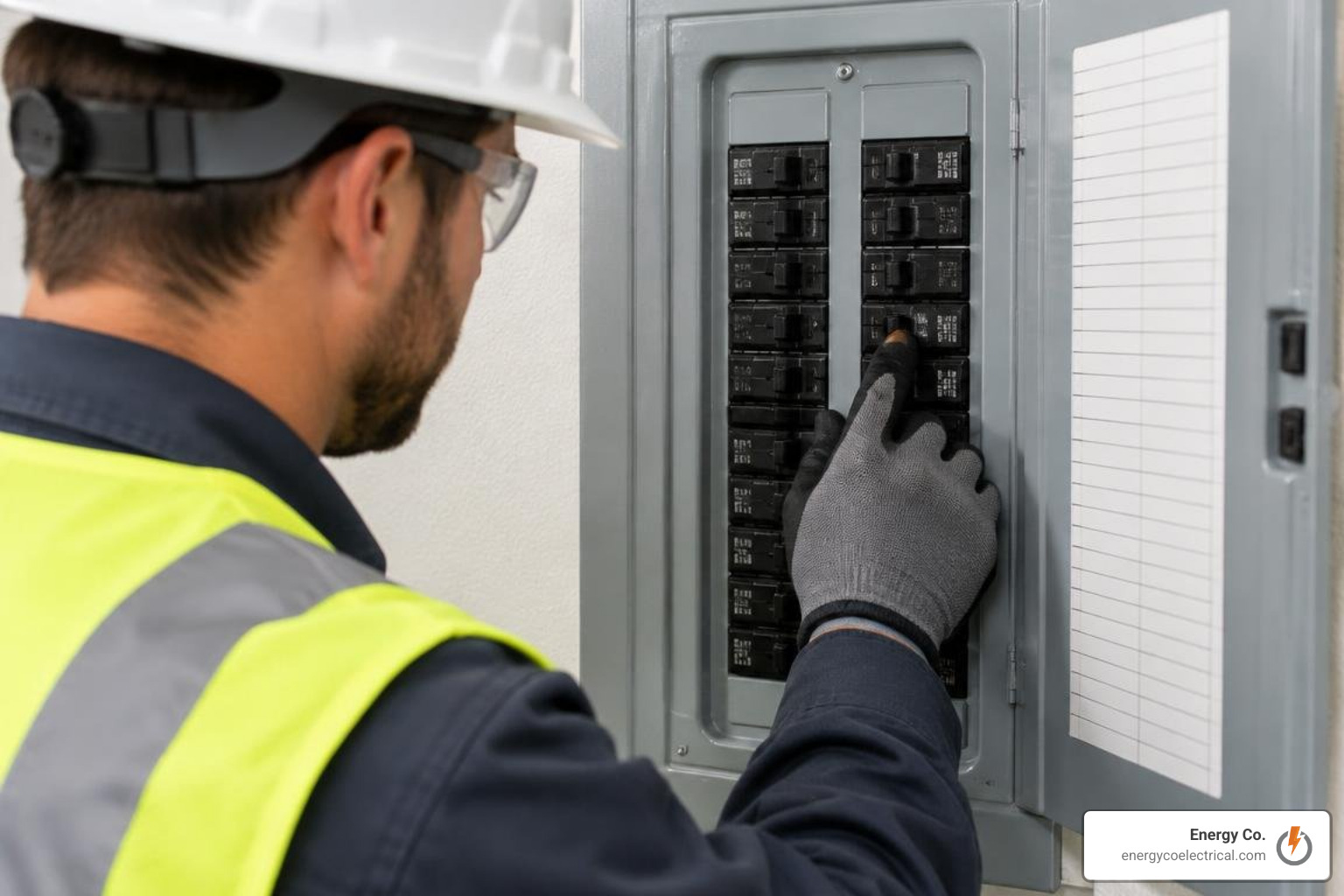
Solving Breaker Box Problems When Outlets Lose Power Unexpectedly
A room losing power despite an apparently operational breaker is a frequent household frustration. When branch circuits lose current without tripping the main box, modern safety designs and wiring methods are usually responsible. Reviewing technical insights on no power at an outlet when the breaker is not tripped shows that the primary culprit is often an upstream GFCI device.
In residential wiring, GFCI outlets are commonly wired in series to safeguard standard downstream receptacles in kitchens, bathrooms, garages, and outdoor locations. If an upstream GFCI trips due to localized moisture or an appliance fault, every downstream outlet loses power while the breaker panel shows no change.
A second cause involves push-in “back-stabbed” connections on the back of older receptacles. Thermal cycling causes these spring-clamp terminals to loosen over decades of use, creating an open circuit that stops current from flowing downstream. Converting these push-in connections to screw-terminal bindings restores line continuity.
Diagnosing Ghost Trips and Faulty Reset Mechanisms
Breakers do not always show their tripped state clearly. A “ghost trip” or “soft trip” happens when the internal bimetallic strip or magnetic armature releases the contacts, but the external plastic handle remains resting near the ON position. The handle may feel loose, springy, or slightly misaligned when touched.
If a soft trip occurs, merely pushing the lever toward “ON” will not reconnect the power. You must perform a hard mechanical reset by pressing the switch firmly to the “OFF” detent to reset the internal trip springs before switching back to “ON.” If an AFCI breaker continues to cycle off without active appliance loads, you may need to troubleshoot your arc fault breakers to isolate hidden neutral-to-ground faults or damaged internal trip mechanisms.
Main Breakers, Obsolete Panels, and Counterfeit Hazards
The main service disconnect controls incoming grid power to your home’s distribution panel. When a main breaker fails, entire phases can drop out, causing whole-house flickering, large appliance failures, or complete power loss. Main lugs operate under constant, unfused line utility current; if they overheat or corrode, contact a technician offering 24-hour emergency electrical repair to avoid severe shock risks.
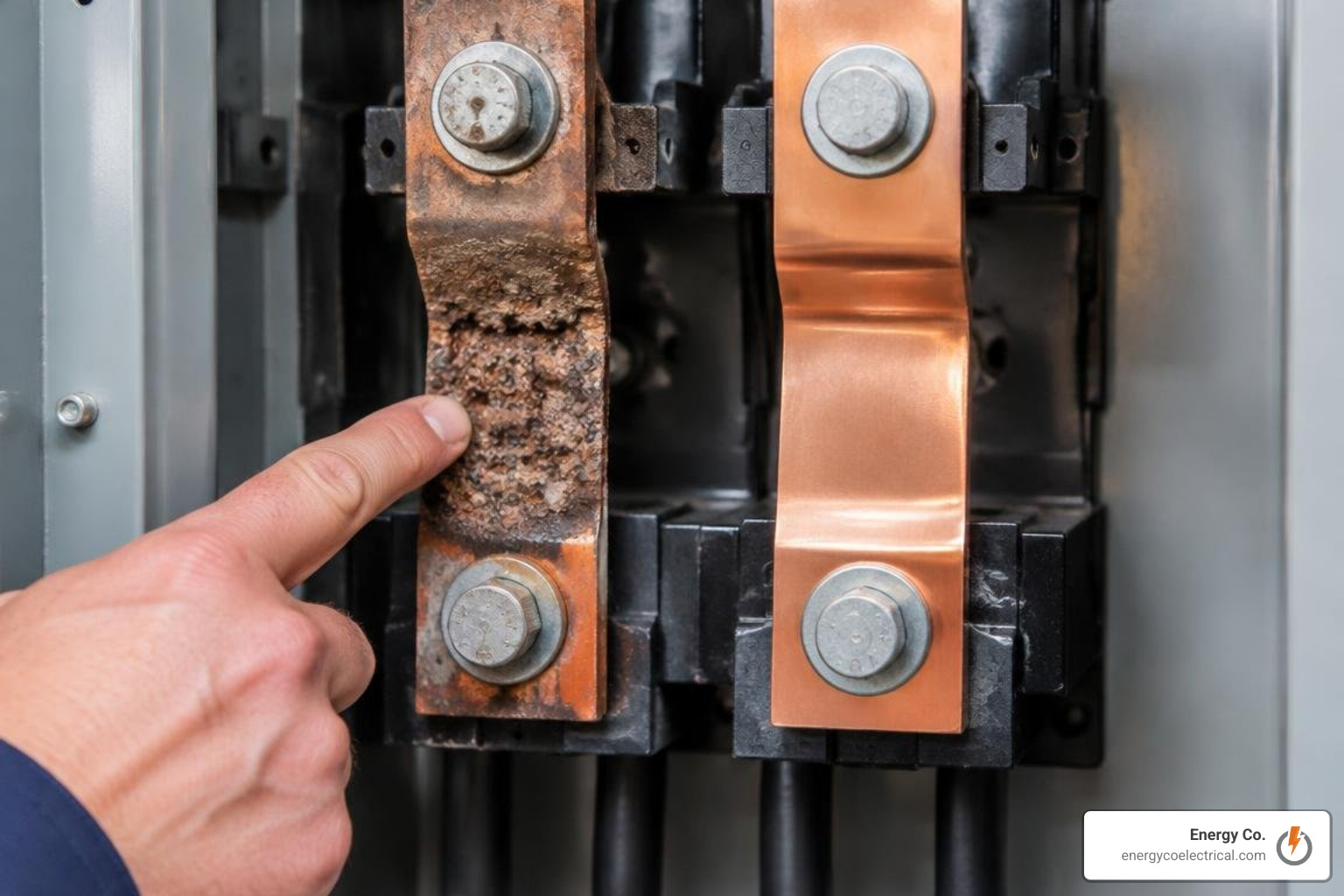
Identifying Counterfeit Units and Main Breaker Box Problems
Counterfeit electrical equipment poses serious safety challenges during supply shortages. Low-quality counterfeit breakers lack reliable arc chutes and contain substandard contact alloys that can weld shut under short-circuit conditions.
Technical diagnostic data from Siemens main breaker diagnostic procedures highlights specific testing and authentication metrics:
- Mass and Weight: Counterfeit main breakers typically weigh 10% to 25% less than authentic models. A genuine 200 A MBK frame weighs approximately 1.4 kg; lighter units indicate missing arc plates or inferior metals.
- Trip Curve Performance: A genuine commercial-grade thermal-magnetic main breaker tested at 300% of rated current ($I_n$) trips between 25 and 90 seconds at 25°C ambient. Counterfeits frequently fail to trip entirely or fail within 5 seconds.
- Thermal Baselines: A terminal temperature rise ($Delta T$) greater than 30°C above ambient points to under-rated connections, while a case temperature rise greater than 25°C indicates contact erosion or non-compliant materials.
- Certification Marks: Always verify manufacturer UL control numbers using the UL Product iQ directory.
Legacy Panel Hazards: Obsolete Panel Types
Older residential panels installed between 1950 and 1990 may carry hidden design flaws. Architectural styles across Chicagoland, from classic Chicago bungalows in Cicero to mid-century properties in Palatine and Mount Prospect, frequently contain obsolete panels that require evaluation:
- Federal Pacific Electric (FPE) Stab-Lok: Forensic testing by the Consumer Product Safety Commission (CPSC) revealed that FPE Stab-Lok breakers fail to trip in over 60% of short-circuit events, operating as live conductors rather than safety switches.
- Zinsco / GTE Sylvania: These panels use aluminum busbars vulnerable to oxidation. Breakers can weld directly to the bus stabs, making them impossible to trip manually or automatically during overcurrent events.
- Challenger Panels: These models often feature defective mechanical clips that overheat and melt the busbar assembly, posing persistent fire risks.
Single Breaker Repair vs. Full Panel Replacement
Deciding whether to repair an isolated component or replace the entire distribution box depends on panel age, busbar condition, and household electrical demand. While a single breaker can be swapped quickly, systemic panel degradation calls for an infrastructure update.
When to Opt for a Targeted Breaker Repair
If your electrical panel is under 20 years old and the internal bus stabs are free of discoloration, a targeted circuit breaker repair is often the most practical solution. Individual breakers can wear out mechanically after frequent trips, internal spring fatigue, or exposure to minor surges.
A licensed electrician will safely isolate the circuit, verify zero voltage with a calibrated meter, unseat the damaged breaker, and install an OEM-specified replacement torqued to manufacturer specifications (typically 35 to 45 in-lbs for branch line terminals).
When to Invest in a Service Panel Upgrade
A complete electrical panel upgrade becomes necessary when the box cannot safely manage your household’s electrical loads. Modern households add significant power demands through electric vehicle chargers, heat pumps, induction ranges, and finished basements. Upgrading from an older 100-amp service to a modern 200-amp service provides the physical space and amperage required for modern lifestyles.
An upgrade is non-negotiable if the interior enclosure shows signs of moisture corrosion, busbar metal pitting, or if you plan a major renovation that requires compliance with modern NEC guidelines.
Long-Term Maintenance and Panel Protection Strategies
Preventing breaker problems requires consistent maintenance and thoughtful load management. Electrical infrastructure benefits from regular care just like heating and cooling systems. Gaining confidence with your home’s setup starts with demystifying your home electric panel so you can safely monitor your equipment.
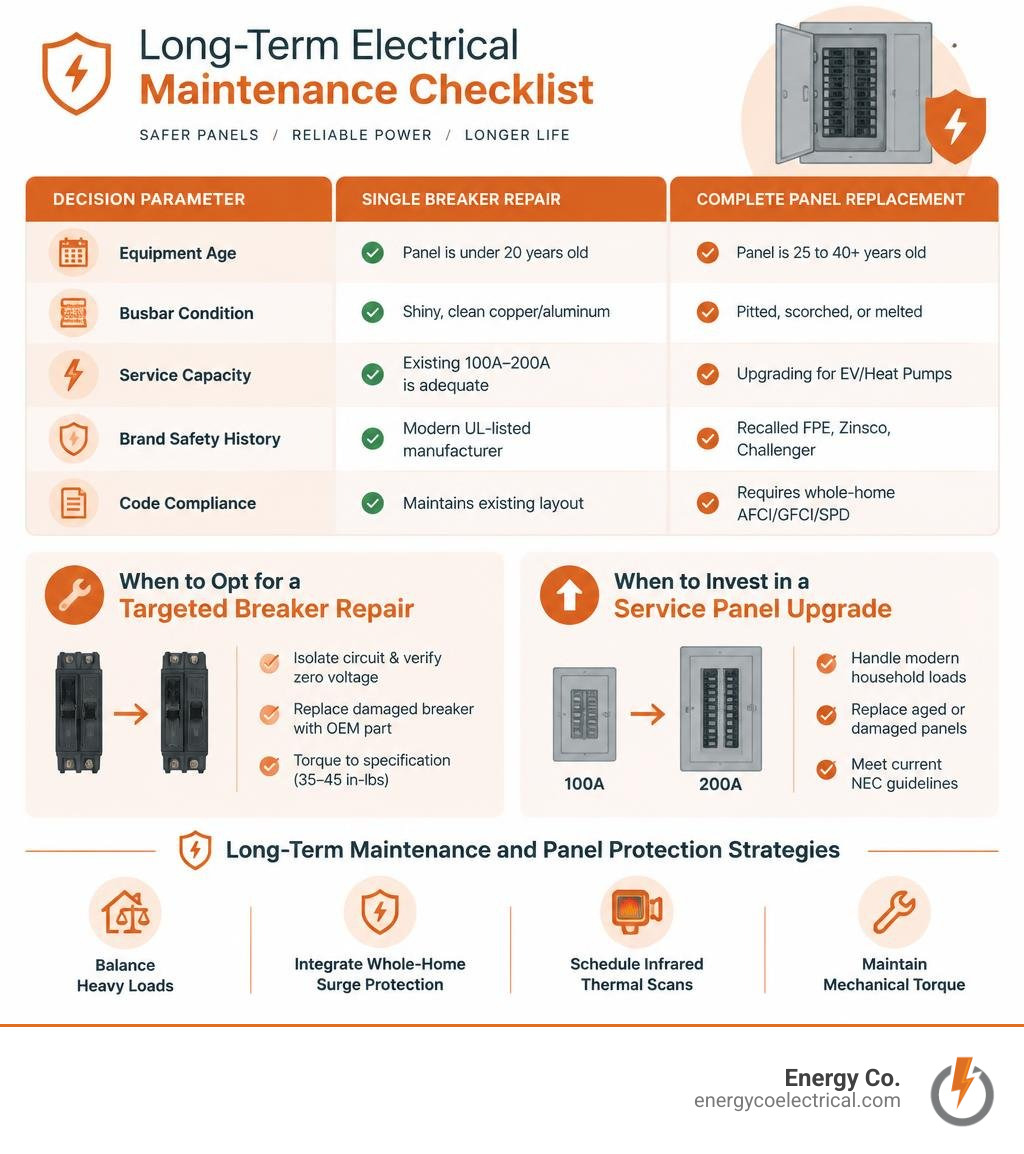
To maintain stable power and prolong panel life:
- Balance Heavy Loads: Avoid operating multiple high-wattage appliances—such as space heaters, air fryers, and microwaves—simultaneously on the same branch circuit.
- Integrate Whole-Home Surge Protection: Install a UL 1449 Listed Type 2 Surge Protective Device (SPD) at the service entrance. This safeguards sensitive circuit boards and AFCI/GFCI breakers from lightning surges and grid spikes.
- Schedule Infrared Thermal Scans: Have an electrician perform a yearly thermal check to detect rising electrical resistance before component failure occurs.
- Maintain Mechanical Torque: Over years of ambient heating and cooling cycles, terminal screws can back out. Professional re-torquing of neutral bars (25–30 in-lbs) and branch lugs ensures safe electrical continuity.
Frequently Asked Questions About Electrical Panels
Why does my breaker buzz even when it is not tripping?
A circuit breaker that buzzes without tripping is usually experiencing high internal current draw that approaches its trip rating without exceeding it. This causes internal components to vibrate at 60 Hz.
Alternatively, the sound may stem from loose busbar clip stabs or internal contact erosion. Because worn contact points generate extreme heat, any constantly buzzing breaker should be inspected by a professional.
Can I replace a 15-amp breaker with a 20-amp breaker to stop nuisance tripping?
No. You must never replace a 15-amp breaker with a 20-amp model unless you verify that all circuit conductors are 12 AWG copper wire. Standard 15-amp circuits rely on 14 AWG wire, which is rated only for 15 amps.
Installing a 20-amp breaker allows current to heat 14 AWG wire beyond safe limits without tripping the breaker, which can melt wire insulation inside your walls and trigger a structural fire.
How can I tell if a breaker is bad or just overloaded?
To test a breaker, turn it off, unplug every device on the line, and reset the switch. If it trips immediately with zero load attached, the breaker is defective, or there is a short circuit in the branch wiring.
If the breaker resets normally and only trips after appliances are turned on, measure the operational amperage with a clamp multimeter. If the meter registers below 80% of the breaker’s rating yet the breaker still trips, the internal latch has weakened and needs replacement.
Conclusion
Your electrical panel protects your home from overcurrent events, shorts, and thermal hazards. Whether you are dealing with a ghost-tripped switch, noisy busbar arcing, or an outdated panel that struggles to keep up with modern energy needs, diagnosing these issues promptly protects your property and appliances.
Energy Co. provides thorough electrical inspections, code updates, panel upgrades, and emergency diagnostic support across Chicago and the Northwest Suburbs. From our base in Schaumburg to homes in Arlington Heights, Rolling Meadows, and the wider Cook County area, our licensed electricians focus on long-term safety and dependable power. For targeted troubleshooting or expert repairs, turn to our team for comprehensive outlet and switch troubleshooting and full-service electrical solutions.