Why an Electrical Installation Course Could Be Your Best Career Move
An electrical installation course is a structured training program that teaches you to safely wire, maintain, and repair electrical systems in homes, commercial buildings, and industrial facilities. Here’s a quick overview of what you need to know:
| Question | Quick Answer |
|---|---|
| Who is it for? | Beginners, career changers, and trade workers seeking formal credentials |
| Qualification levels | Level 1 (intro), Level 2 (foundational), Level 3 (advanced), AAS degree |
| Duration | 8 months (certificate) to 2+ years (associate degree) |
| Cost (US) | ~$1,500 to $7,000 depending on program level |
| Average US salary | $57,267 median; up to $61,590 for licensed electricians |
| Job growth | 11% over the next 10 years — nearly double the national average |
The electrical trade is one of the most in-demand skilled professions in the country. With 80,000 residential electrician jobs expected to open each year through 2031, and employment growth projected at 11% over the next decade, the timing has never been better to get trained.
Whether you’re a complete beginner or a construction worker looking to formalise your skills, there’s a clear pathway into the trade — and it starts with the right course.
I’m Michał Napieralski, a licensed electrician and founder of Energy Co. in Schaumburg, IL, with years of hands-on experience in residential and commercial electrical installation that mirrors everything a quality electrical installation course prepares you for. I’ll walk you through everything you need to know to choose the right program and launch a rewarding career in the trade.
Simple electrical installation course glossary:
- basic electrical installation work
- electrical installation
- electrical installation and maintenance jobs
Understanding Electrical Installation Training Programs
When you decide to take an electrical installation course, you are stepping into a dynamic trade that keeps the modern world running. These structured programs break down complex electrical theory into digestible, practical steps. From understanding how alternating current moves through a structure to safely running wire inside stud walls, training programs bridge the gap between curiosity and career readiness. For a broad look at what this field entails, check out A Practical Guide to Electrical Installation.
Training options generally fall into three main buckets: trade schools, community colleges, and trade union or open-shop apprenticeship programs. Trade schools offer focused, fast-track vocational diplomas that get you job-ready in a matter of months. Community colleges typically provide broader academic support, offering specialized certificates or full two-year Associate in Applied Science (AAS) degrees. Apprenticeships, on the other hand, combine paid on-the-job training under a licensed journeyman with mandatory night or weekend classroom study over four to five years.
Qualification Levels and Program Options
Choosing the right electrical installation course means picking the qualification level that matches your starting skill set and long-term ambition:
- Level 1 (Introductory Certificate): Designed for complete beginners with zero experience, covering workshop safety, hand tools, basic circuitry, and fundamental electrical science.
- Level 2 (Foundational Diploma): Builds practical competence in domestic and commercial wiring, enclosure construction, and National Electrical Code (NEC) standards.
- Level 3 (Advanced Diploma / Technical Specialty): Covers advanced fault diagnosis, inspection, testing, 3-phase power distribution, and environmental tech integration.
- Associate in Applied Science (AAS) Degree: A comprehensive 2-year college pathway (typically 60–66 credit hours) mixing trade theory with industrial motor controls, programmable logic controllers (PLCs), and general education.
If you are exploring structured modular progression, review Level 2 & 3 Diplomas to see how multi-tiered learning helps students transition step-by-step into professional work settings.
Entry Requirements, Duration, and Costs
Entering an electrical installation course is intentionally accessible, though trade programs maintain firm prerequisites to ensure workplace safety and academic success:
- Entry Prerequisites: Most programs require a high school diploma or GED equivalent. Good color vision is crucial due to standard color-coded wire insulation. Crucially, a baseline comfort with high school algebra and geometry is needed to solve load calculations, Ohm’s law, and Kirchhoff’s law problems.
- Completion Timelines: Introductory certificate paths usually take 8 to 10 months. A comprehensive diploma takes roughly 12 months, while an associate degree takes 20 to 21 months of full-time attendance. Fast-track hybrid certificate options can sometimes be finished in 2 to 5 months of intensive study.
- Tuition Costs: In the U.S., community college trade certificates range from $1,500 to $3,800. Full AAS degrees average around $6,900 to $7,000 in tuition. Dedicated career certificates, such as an Electrical Maintenance Certificate, offer structured technical skill building tailored to industrial and facility maintenance settings.
Practical Skills and Hands-On Experience
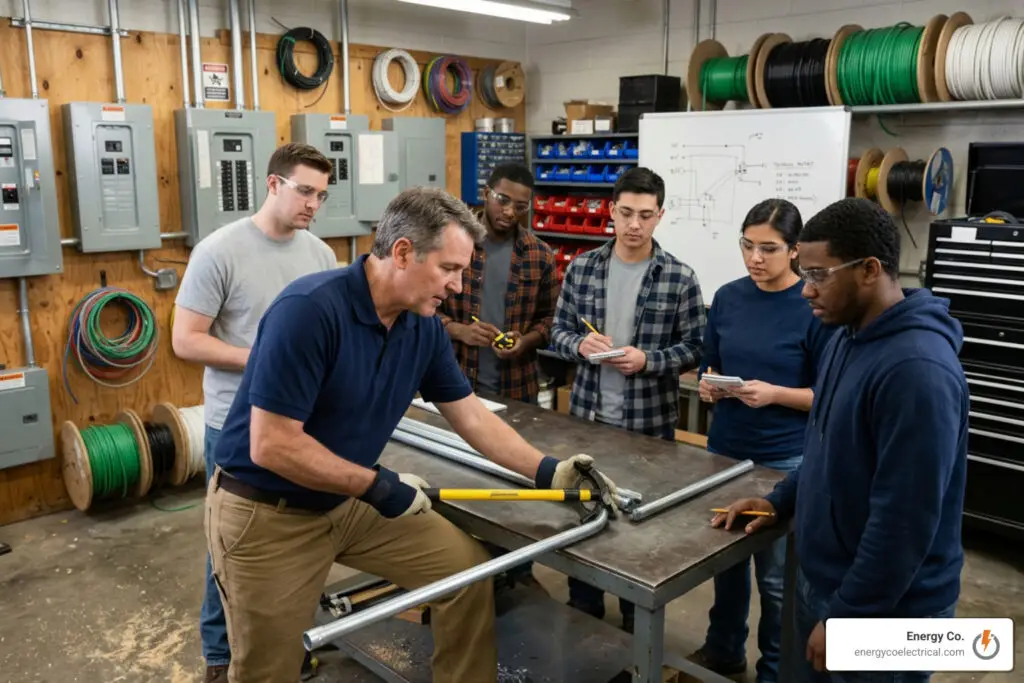
Reading books and memorizing formulas will only take you so far. The heart of any reputable electrical installation course is time spent in the practical workshop lab. It is in the shop where theory transforms into muscle memory — where you learn how much force to apply when pulling wire, how to feel a clean conduit bend, and how to operate test meters safely under expert supervision.
What You Will Learn in an Electrical Installation Course
A well-rounded curriculum equips you with a mix of design principles, safety guidelines, and code compliance skills:
- National Electrical Code (NEC) Compliance: Navigating the codebook to quickly find rules governing box fill capacity, wire ampacity ratings, grounding requirements, and overcurrent protection.
- Electrical Theory & Mathematics: Mastering Ohm’s Law ($V = I times R$), Watt’s Law ($P = V times I$), AC/DC principles, impedance, and 3-phase power calculations.
- Blueprint Reading & Circuit Design: Reading architectural electrical plans, panel schedules, riser diagrams, and industrial control schematics.
- Safety & Personal Protective Equipment (PPE): Implementing OSHA standards, lockout/tagout (LOTO) protocols, NFPA 70E arc flash guidelines, and proper use of Electrical Hazard (EH) safety footwear.
To master these core building blocks from the ground up, review our detailed guide on Mastering the Basics of Electrical Installation Work.
Core Technical Competencies and Tool Mastery
In the hands-on lab, you will get comfortable handling trade-specific tools and materials:
- Conduit Bending: Using mechanical hand benders to execute precise 90-degree stubs, offsets, back-to-back bends, and saddles on Electrical Metallic Tubing (EMT).
- Wiring & Cable Assembly: Stripping non-metallic sheathed cable (Romex), metal-clad (MC) cable, and running single conductors through conduits without damaging insulation.
- Box & Device Mounting: Installing junction boxes, 3-way/4-way switch loops, duplex receptacles, GFCI/AFCI devices, and subpanels.
- Multimeter & Diagnostic Testing: Using digital clamp multimeters, voltage detectors, and GFCI testers to confirm safe de-energization, measure resistance, and check circuit continuity.
For a deep dive into domestic wiring configurations, see A Complete Guide to Residential Wiring Types and Installation.
Choosing the Right Electrical Installation Course
With so many trade schools, vocational colleges, and training platforms available in 2026, selecting the right electrical installation course requires careful research. The quality of your training directly dictates how confident you will feel on your first day as an entry-level helper or apprentice electrician.
When evaluating potential programs, focus heavily on the ratio of hands-on lab hours to classroom lecture time. A great trade course should dedicate at least 50% (and ideally up to 70%) of its contact hours to real-world workshop practice where you physically build mock electrical systems.
Online vs In-Person Electrical Installation Course Formats
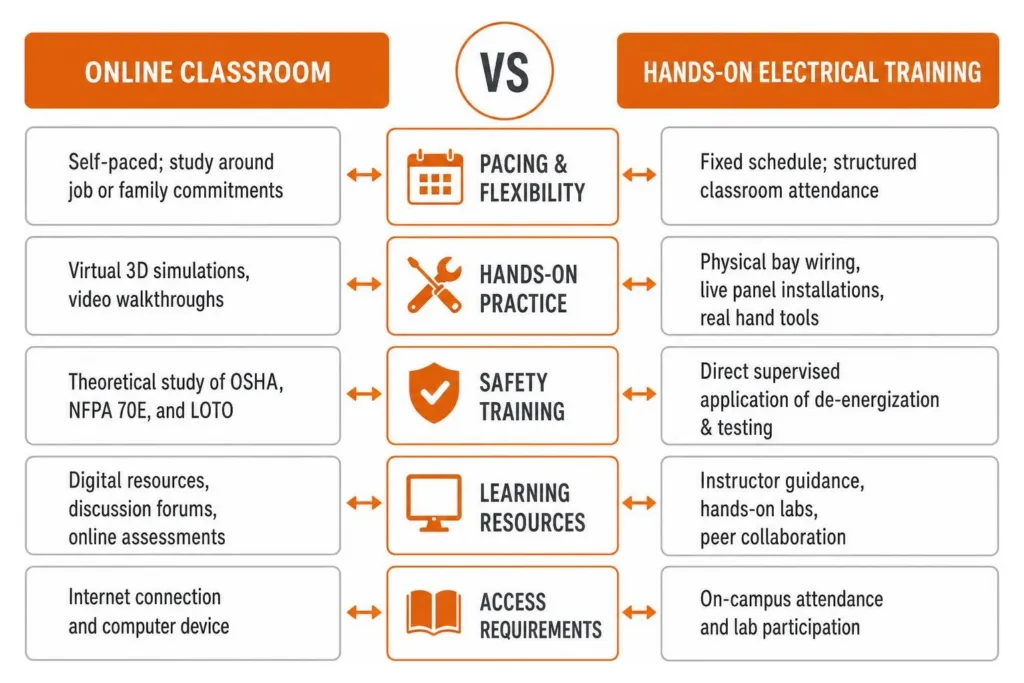
As educational technology advances, many prospective trade students wonder whether an online electrical installation course can replace traditional in-person vocational training. Here is how the two learning formats compare:
| Training Aspect | Online / Hybrid Courses | In-Person Trade Programs |
|---|---|---|
| Pacing & Flexibility | Self-paced; study around job or family commitments | Fixed schedule; structured classroom attendance |
| Hands-On Practice | Virtual 3D simulations, video walkthroughs | Physical bay wiring, live panel installations, real hand tools |
| Safety Training | Theoretical study of OSHA, NFPA 70E, and LOTO | Direct supervised application of de-energization & testing |
| Instructor Interaction | Forum posts, scheduled video calls, chat | Real-time direct feedback in workshop environments |
| Licensing Hour Credit | Varies; usually counts towards classroom hours only | Directly satisfies trade school / apprenticeship classroom quotas |
| Best For | Exam prep, code updates, foundational electrical theory | Complete beginners requiring physical mechanical trade skills |
For career changers looking to grasp basic domestic theory on a flexible schedule before stepping into physical workshops, programs like Online Residential Electrician Training offer accessible self-paced platforms.
Evaluating Accreditation and Certification Pathways
Before signing an enrollment agreement or paying tuition, verify that your chosen course holds proper accreditation and alignment with recognized trade bodies:
- Industry Accreditation: Look for programs accredited by established organizations like NCCER (National Center for Construction Education and Research) or regional college accreditation boards.
- Standard Alignment: In international or specialized settings, standards like the City & Guilds Electrical Qualification Standards demonstrate how structured educational frameworks ensure consistent quality control.
- Licensing Board Recognition: Ensure your local municipal or state licensing board recognizes your coursework toward the mandatory educational hours needed for journeyman exam eligibility.
If your career goals lean toward complex commercial structures, industrial panelboards, or 3-phase systems, explore The Complete Guide to Commercial Wiring to understand the advanced skill set commercial contractors demand.
Career Opportunities, Licensing, and Earning Potential
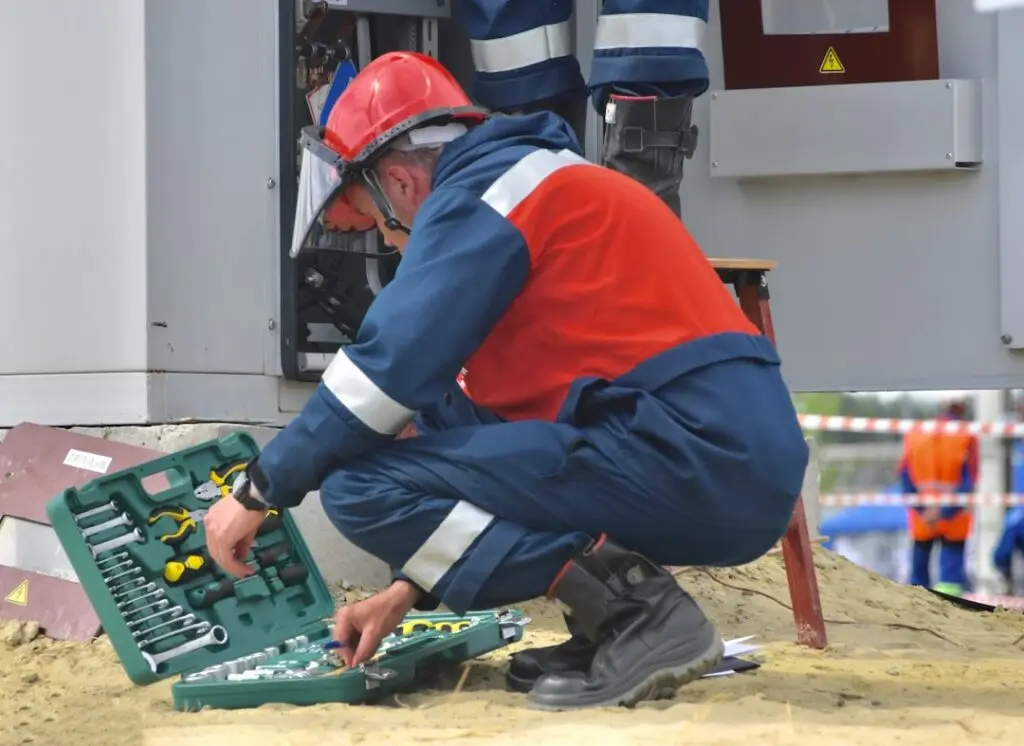
Graduating from an electrical installation course opens the door to a secure, well-compensated career. Modern society depends entirely on continuous, reliable electric power — from powering residential communities in Chicago and surrounding communities like Schaumburg, Elk Grove Village, and Hanover Park to keeping massive industrial facilities running across Cook County and the Northwest Suburbs.
Pathways to Becoming a Licensed Electrician
Unlocking top-tier earnings in the electrical trade requires progressing through a clear series of professional licensing steps:
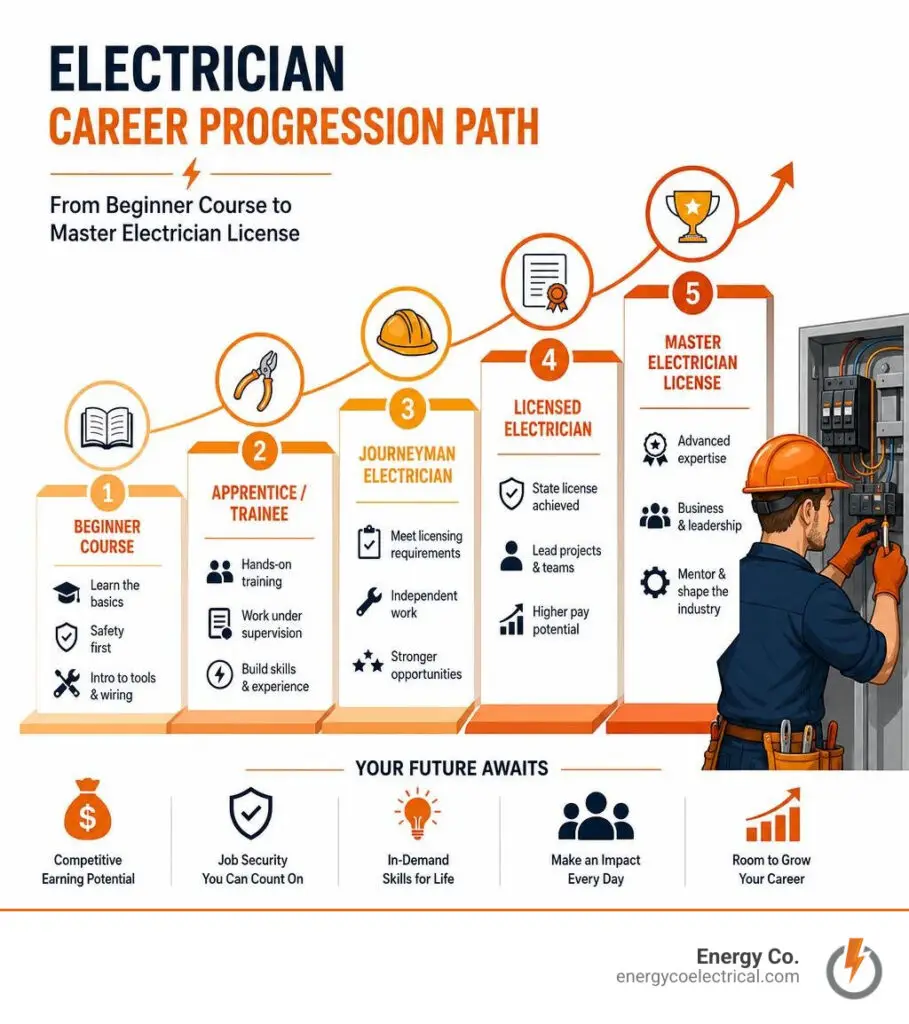
- Electrical Trainee / Helper: Enroll in or complete a foundational certificate course, acquire your basic trade tools and safety gear, and secure entry-level employment on construction sites.
- Registered Apprentice: Log 8,000 hours (roughly 4 years) of supervised on-the-job training alongside 576 to 1,000 hours of related classroom instruction.
- Journeyman Electrician: Pass your local or state journeyman licensing examination covering National Electrical Code rules, load calculations, and practical wiring safety. Licensed journeymen can work independently without direct supervision.
- Master Electrician: After logging roughly 4,000 additional hours as a licensed journeyman (varies by local municipality), pass the master electrician exam to supervise large crews, pull building permits, and design electrical distribution systems.
- Licensed Electrical Contractor: Establish your own business, secure required liability insurance and bonding, and hire electrical crews to execute residential, commercial, or industrial service projects.
Salary Expectations and Industry Demand
The financial outlook for electricians is strong across the board:
- Starting Salaries: Entry-level apprentice or helper roles start around $42,700 to $44,000 annually ($16 to $20 per hour), allowing you to earn while you learn without accumulating massive student debt.
- Median Annual Wages: Nationally, licensed electricians earn a median annual wage of $57,267 to $61,590.
- Experienced & Journeyman Earnings: Experienced journeymen in competitive markets frequently make $66,000 to $85,000+ per year, with specialized industrial or union electricians earning well over six figures with overtime.
- Self-Employed & Contractor Potential: Independent electrical contractors and business owners regularly earn $100,000 to $150,000+ annually depending on business size and market demand.
- Job Growth Projections: Employment of electricians is projected to grow by 11% over the next 10 years — nearly double the average for all occupations — with approximately 80,000 residential electrician job openings occurring each year.
Frequently Asked Questions About Electrical Training
Can I become a licensed electrician through online courses alone?
No, you cannot become a fully licensed electrician through online courses alone. While online courses excel at teaching National Electrical Code regulations, electrical theory, and blueprint reading, state and municipal licensing boards require thousands of hours of documented hands-on experience under the direct supervision of a licensed master or journeyman electrician. Online training is an excellent stepping stone or classroom supplement, but physical trade hours are non-negotiable.
How long does it take to complete an electrical installation course?
Completion time depends entirely on the program path you select:
- Basic Certificate Programs: 8 to 10 months of full-time classroom and lab instruction.
- Accelerated Hybrid Diplomas: 2 to 5 months of self-paced online theory paired with flexible intensive practical workshops.
- Associate Degrees (AAS): 20 to 21 months (roughly two academic years) covering technical trade subjects and college general education.
- Full Apprenticeships: 4 to 5 years total, combining paid daytime field work with evening classroom training.
Do I need prior experience to enroll in an electrical installation course?
No prior experience is necessary. Introductory certificate and Level 1 diploma courses are designed specifically for complete beginners, career changers, and young adults entering the trade. All you need is a high school diploma or GED, basic high school math skills (algebra and arithmetic), good color vision, and a strong work ethic.
Conclusion
An electrical installation course is far more than just a class — it is a launching pad into a resilient, high-paying career that cannot be outsourced or replaced by automation. With 80,000 open residential jobs annually and an 11% growth rate nationwide, taking the initiative to get trained in 2026 places you directly in front of booming industry demand.
By mastering circuit theory, safety standards, and hands-on tool techniques, you build practical skills that stay with you for life. Whether your dream is to work on complex industrial machinery, wire smart modern homes, or build your own successful contracting company, your journey starts with high-quality training.
At Energy Co., we take deep pride in powering our local communities across Chicagoland, Cook County, and the Northwest Suburbs. From panel upgrades and complete building rewiring to 24/7 emergency calls, our licensed team relies on the exact foundational skills taught in top-tier trade programs every day. If you ever need advice from field-proven professionals or are looking for a top-rated electrical installation service in Chicago, reach out to our team today!