Choose the Right LED Retrofit Kit Replacement Without Replacing the Fixture
An LED retrofit kit replacement upgrades the working housing you already have, rather than tearing out the entire light fixture. Choose a kit that matches your fixture’s size, voltage, mounting space, light output, and location rating. For most commercial fluorescent troffers and older HID fixtures, a direct-wire kit that bypasses the old ballast is the better long-term choice because it removes a common failure point.
The payoff can be significant. Replacing a 400W metal halide fixture that actually draws about 460W with ballast losses with a 120W to 150W LED retrofit can cut lighting energy use by roughly 50% to 75%. You also keep ceilings, housings, and mounting hardware intact, which can mean less labor, less waste, and less downtime.
LED retrofit kits work for recessed cans, 2×2 and 2×4 troffers, linear strip lights, high bays, parking-lot shoeboxes, wall packs, and canopy fixtures. Look for DLC, ETL or UL, Energy Star, and wet- or damp-location ratings where applicable. Many quality kits are rated for 50,000 hours or more, while offering better color consistency than aging fluorescent or metal halide lamps.
I am Michał Napieralski of Energy Co., a licensed electrical professional serving homes and businesses in the Chicago suburbs. Our work with led retrofit kit replacement projects, lighting installation, panel upgrades, and code-compliant electrical repairs helps property owners modernize safely without unnecessary disruption.
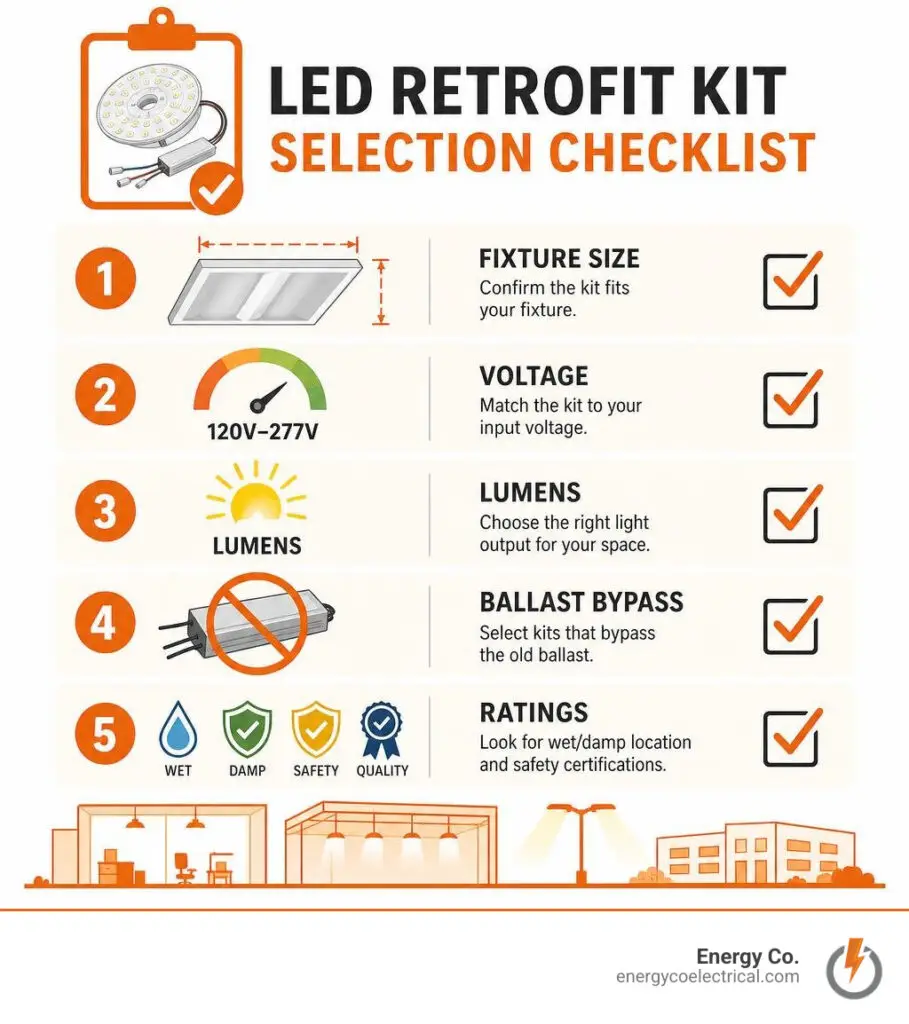
Terms related to led retrofit kit replacement:
Why Choose an LED Retrofit Kit Replacement Over Full Fixture Swaps
Upgrading commercial or residential lighting can feel daunting when you picture torn drywall, cut ceiling grids, and boxes of heavy scrap metal heading to a landfill. An LED retrofit kit replacement offers a smarter path forward by allowing you to modernize your optical engine and driver while leaving the structural housing securely in place.
For facilities with legacy high-intensity discharge (HID) lamps—like metal halide (MH) or high-pressure sodium (HPS)—the case for retrofitting is overwhelming. Metal halide lamps are notorious for lumen depreciation; they typically lose 30% to 50% of their initial light output within the first couple of years of operation. In contrast, modern commercial LED retrofit kits maintain over 90% of their initial output for 50,000 to 100,000 hours. Switching these units out cuts energy consumption by 50% to 75% instantly, translating to roughly $156 to $175 in annual energy savings per 400W fixture (and up to $438 per year when replacing massive 1000W industrial fixtures operating 12 hours daily).
Exploring the bright side of energy savings and LED retrofit financial benefits reveals that preserving existing architectural housings avoids structural ceiling modifications, repainting, and the heavy disposal fees associated with commercial fixtures.
LED Retrofit Kit Replacement vs. Full Fixture Replacement
Property owners often ask whether they should install simple replacement tubes, choose a complete retrofit kit, or replace the entire light fixture.
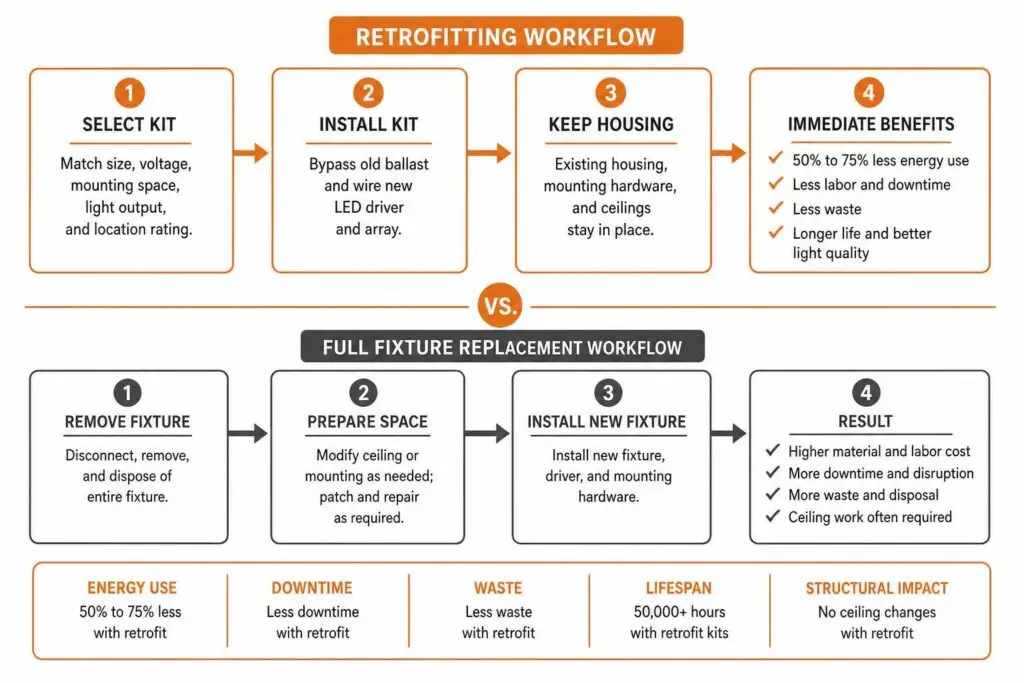
To help evaluate your options, consider how each strategy stacks up:
| Feature / Metric | Plug-and-Play LED Tubes (Type A) | LED Retrofit Kit (Driver + Array) | Complete New LED Fixture |
|---|---|---|---|
| Initial Purchase Cost | Low | Moderate | High |
| Installation Labor | Very Low (Minutes) | Low to Moderate (10–20 Mins) | High (Requires Ceiling Work) |
| Ballast Dependent? | Yes (Keeps failure point) | No (Direct-wire ballast bypass) | No (Built-in new driver) |
| Additional Energy Waste | 10–15% Ballast parasitic draw | 0% (Direct to line voltage) | 0% (Direct to line voltage) |
| Thermal Dissipation | Fair (Enclosed plastic/glass) | Superior (Dedicated aluminum sink) | Superior (Engineered chassis) |
| Expected Service Life | 25,000 – 35,000 Hours | 50,000 – 100,000 Hours | 50,000 – 100,000 Hours |
| Disruption to Ceiling Grid | None | None | Extensive |
Retrofit kits hit the sweet spot for commercial spaces. They replace every aging, prone-to-failure internal part—the ballast, lampholders (tombstones), and wiring harnesses—without forcing you to replace a structurally sound steel or aluminum frame.
Energy Efficiency and Ballast Bypass Savings
One of the largest hidden costs in legacy lighting is the fluorescent or HID ballast itself. Even when running efficient tubes, a magnetic or early-generation electronic ballast constantly consumes between 5W and 60W per fixture in parasitic power draw. By executing a direct-wire line voltage conversion, you eliminate this wasted energy entirely, securing an immediate 10% to 15% efficiency gain over “plug-and-play” replacement bulbs.
Modern kits pair efficient LED circuit boards with external constant-current drivers and dedicated aluminum heat sinks. Because heat is the primary enemy of LED chip longevity and phosphor stability, using a kit engineered with heavy-gauge aluminum ensures heat dissipates quickly into the surrounding air. Learning how to retrofit LED lighting the right way guarantees that your building wiring connects cleanly to internal drivers rated for 120–277V universal commercial circuits, maximizing reliability across Chicagoland’s seasonal temperature swings.
Top Types of LED Retrofit Kits for Common Fixtures
Whether managing an office building in Schaumburg, a manufacturing facility in Elk Grove Village, or updating your family home in Arlington Heights, there is a specialized retrofit kit designed specifically for your fixture profile.
Residential Recessed Can LED Retrofit Kit Replacement
Residential recessed downlights (can lights) are among the simplest and most rewarding fixtures to convert. Traditional incandescent or halogen cans generate immense heat, turn ceiling drywall brittle, and consume 65W to 75W per can.
Modern LED downlight retrofit modules combine an integrated LED light engine, solid aluminum heat sink, and decorative trim ring into a single, cohesive unit. These kits install using an attached medium-base (E26) Edison socket adapter that screws directly into your existing light socket:
- Mounting Mechanism: Uses spring-loaded torsion clips or friction blades to lock tightly inside 4-inch, 5-inch, or 6-inch recessed metal housings.
- Aesthetic Flexibility: Available with baffle trims, smooth reflective trims, and selectable color temperatures (CCT) ranging from warm 2700K to clean 5000K daylight.
- Safety Ratings: Look for wet-location-rated units designed for bathrooms, showers, and exterior soffits to prevent moisture infiltration into your electrical junctions.
Check out our deep dive on the best LED retrofit kits for recessed lighting in 2026, or follow our step-by-step walkthrough to upgrade your ceiling: a step-by-step recessed lighting LED retrofit guide to refresh your residential spaces.
Commercial Fluorescent Troffers and Linear Strip Kits
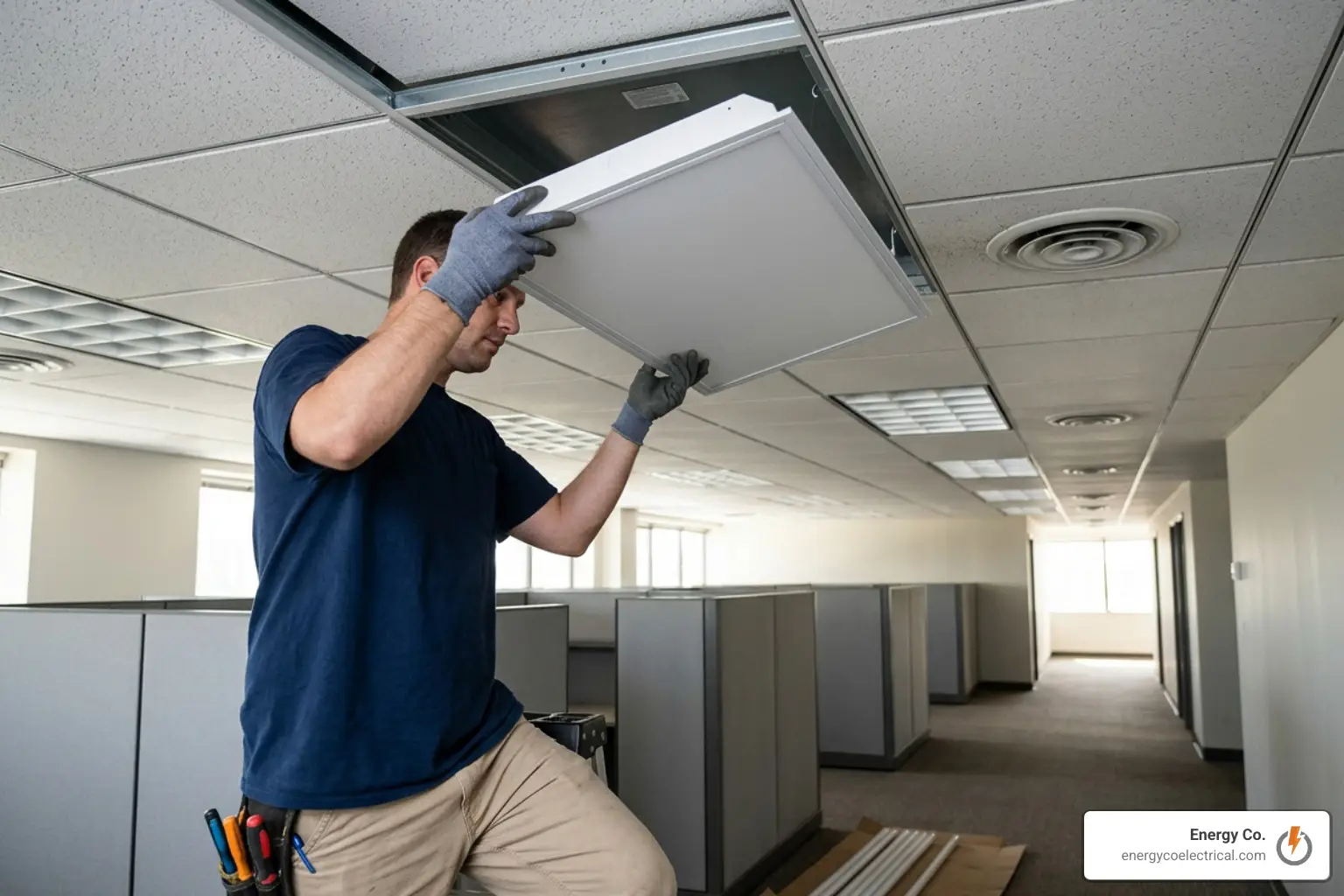
Standard 2×2, 2×4, and 2×8 fluorescent fixtures illuminate thousands of commercial office spaces, schools, and medical facilities across Cook County. Instead of spending hours wrestling with old T8 or T12 tubes and failing tombstones, magnetic strip kits and troffer door retrofit kits streamline the upgrade process.
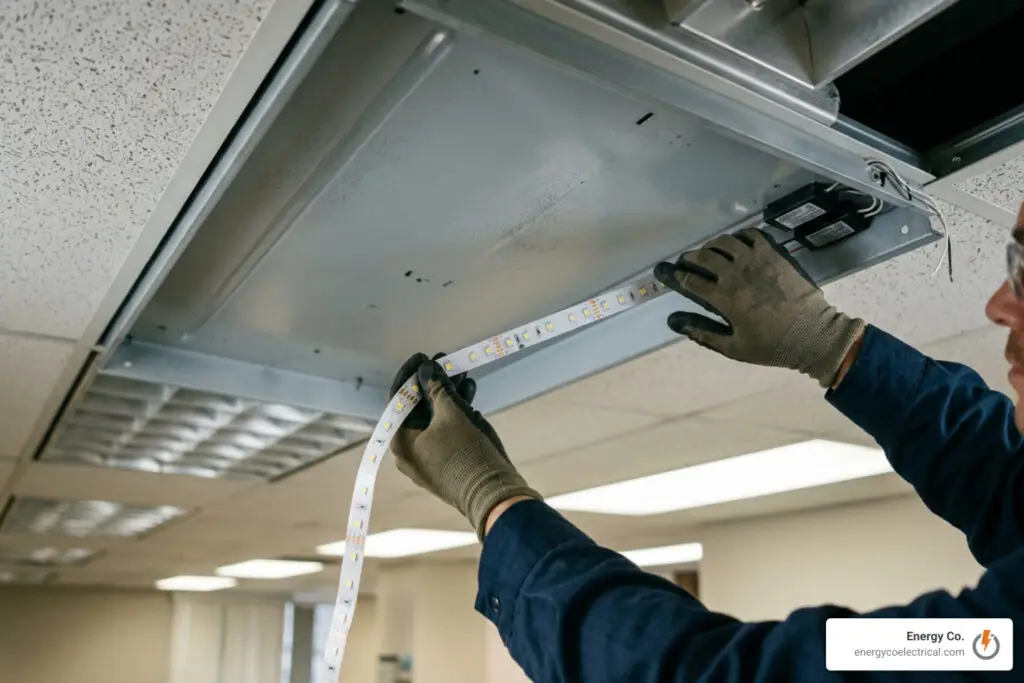
- Magnetic Strip Retrofit Kits: These kits include heavy-duty neodymium magnetic backing on both the LED strips and the driver. Technicians simply snap them directly against the steel fixture housing without drilling or self-tapping screws. The 50W LED Magnetic Strip Retrofit Kit – 2×4 Troffer – Dimmable | Super Bright LEDs provides up to 6,500 lumens of crisp, flicker-free illumination, effortlessly replacing three legacy 32W T8 tubes.
- Troffer Door Frame Kits: If you want a complete architectural refresh, troffer door kits replace the entire front louver or acrylic lens with an integrated, modern center-basket LED panel that hinges right into the existing T-grid frame.
- Linear Strip Conversion Kits: For warehouse aisles, back-of-house storage, and retail spaces, industrial strip conversion kits like the Ace LED Strip Conversion Kit (ASCK2) | Linmore mount over existing 4.25-inch and 5.25-inch channels. They feature field-selectable wattages and CCT switches to tailor lumen levels (from 2,400 up to 12,000 lumens) to your building’s exact task requirements.
For a deeper look into linear conversions, see the smart way to retrofit fluorescent lighting to LED without rewiring.
Industrial High Bays and Outdoor Shoebox Fixtures
Industrial high bays, parking lot shoeboxes, perimeter wall packs, and fuel canopy lights demand heavy-duty thermal and optical engineering. Swapping out a 400W metal halide parking lot shoebox fixture for a 120W to 150W LED retrofit kit cuts operating amperage significantly—lowering electrical load from over 460W (including ballast losses) to under 150W while increasing ground-level foot-candles.
Commercial high-bay and area-light retrofit kits feature:
- Universal Input Drivers: Rated for 120–277V AC (or 347–480V for heavy industrial panels).
- Engineered Optical Distribution: Type III, Type IV, or Type V roadway and area optics that project light precisely where needed rather than scattering it into the night sky.
- Smart Control Integration: Photocell sensors, microwave occupancy sensors, and 0–10V dimming leads to automate energy curtailment during off-peak hours.
How to Install and Wire LED Retrofit Kits Safely
Working with building electrical systems requires caution, proper tools, and adherence to National Electrical Code (NEC) guidelines. While residential recessed retrofits are straightforward, commercial high-voltage bypass projects should always be handled by licensed electrical contractors.
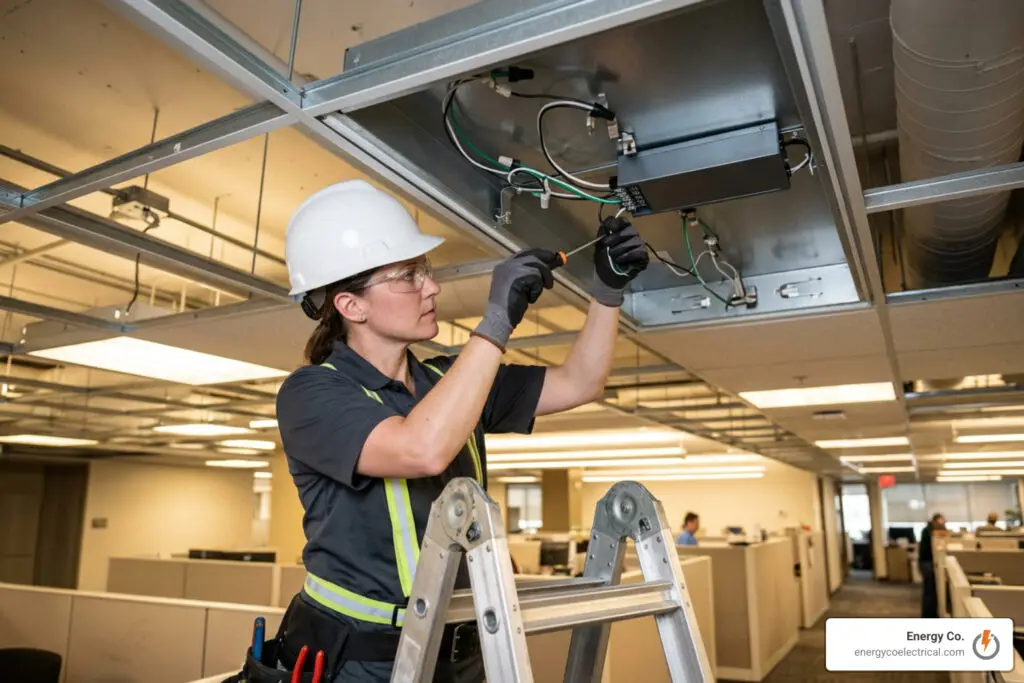
Step-by-Step Ballast Bypass and Wiring
Follow these foundational steps when performing a ballast bypass retrofit on linear commercial fixtures:
- Isolate the Electrical Circuit: Turn off power at the main circuit breaker panel. Use a calibrated, non-contact voltage tester or digital multimeter directly on the hot line at the fixture to ensure zero voltage is present.
- Remove Outdated Components: Carefully remove the legacy fluorescent tubes or HID lamps. Unscrew or unclip the fixture wiring cover (ballast channel cover) and disconnect the line-voltage input wires feeding the old ballast.
- Extract or Disconnect the Ballast: Snip the output wires leading to the existing sockets. Either unbolt and recycle the old ballast or permanently cap all disconnected leads according to local code.
- Mount the LED Driver and Strips: Secure the new constant-current LED driver to the metal chassis using magnetic pads or mechanical fasteners to maintain proper ground bond. Mount the LED light bars along the fixture base, ensuring balanced spacing for uniform diffusion.
- Wire the Direct-Line Connections: Wire the incoming AC branch circuit (Black/Hot and White/Neutral) directly to the LED driver’s input pigtails using listed wire nuts or lever connectors. Connect the fixture grounding wire (Green/Bare Copper) securely to the chassis.
- Connect Low-Voltage Controls: If utilizing 0–10V dimming or occupancy sensors, connect the low-voltage control wires (typically Purple for DIM+ and Pink/Gray for DIM-) to the building’s lighting control circuit.
- Inspect, Close, and Test: Verify that all wire splices are contained inside the fixture junction channel, secure the cover plate, reinstall the diffuser or lens, restore breaker power, and test illumination and dimming curves.
Key Certifications and Dimming Compatibility
When selecting commercial-grade LED retrofit components, prioritize industry certifications that guarantee safety, performance, and rebate eligibility:
- DLC Listed (DesignLights Consortium): Verifies light output, energy efficacy (lumens per watt), and chromaticity. DLC 5.1 and DLC 6.0 Premium listings are mandatory for securing commercial utility rebates from regional utility providers across the Chicagoland footprint.
- ETL / UL Listed (Underwriters Laboratories): Assures that the retrofit kit meets stringent North American electrical safety and fire resistance standards.
- Energy Star & Title 24 JA8: Standard benchmarks for residential downlights ensuring high Color Rendering Index (CRI 90+), flicker-free dimming, and low standby power consumption.
- Dimmer Compatibility: Residential kits typically operate on 120V phase-cut (TRIAC or ELV) wall dimmers, whereas commercial strip, high-bay, and troffer drivers use 0–10V low-voltage analog dimming controls for smooth, flicker-free dimming from 100% down to 10% or 1%.
Frequently Asked Questions About LED Retrofits
Can LED retrofit kits be used in wet or damp locations?
Yes, but you must select a kit specifically labeled with the appropriate Ingress Protection (IP) or UL location rating. Standard troffer and strip kits carry an IP20 or Damp Location rating, which is ideal for indoor commercial environments, basements, and covered shop floors with ambient humidity.
For shower stalls, outdoor soffits, building facades, and unconditioned parking garages, look for kits designated as Wet Location Rated (IP65, IP66, or higher). These kits feature sealed silicone gaskets, water-tight wiring conduits, and conformal-coated circuit boards that resist water spray, driving rain, and condensation.
Do all LED retrofit kits require removing or bypassing the ballast?
While “Type A” plug-and-play tubes exist to run on existing ballasts, true LED retrofit conversion kits almost exclusively require bypassing or removing the ballast. Eliminating the ballast is the most reliable long-term strategy:
- It eliminates the ballast as an ongoing maintenance and failure point.
- It removes parasitic energy draw, saving an additional 10% to 15% on power consumption.
- It prevents ballast hum, buzzing, and high-frequency flickering.
Are LED retrofit kits compatible with smart home and commercial dimmers?
Yes. Residential recessed downlight kits are engineered to pair seamlessly with standard smart wall switches, Wi-Fi dimmers, and leading home automation systems using forward- or reverse-phase (TRIAC/ELV) dimming.
Commercial linear and high-bay retrofit engines utilize dedicated 0–10V dimming channels. These allow facilities to tie their lighting directly into daylight-harvesting photocells, wireless mesh occupancy sensors, and smart commercial energy management platforms.
Conclusion
Upgrading your property’s lighting doesn’t require tearing out perfectly sound structural fixtures. By choosing a high-performance LED retrofit kit replacement, you capture 50% to 75% in immediate electrical savings, eliminate recurring maintenance headaches, and improve visibility across your residential or commercial spaces.
At Energy Co., our team of licensed electricians specializes in delivering safe, compliant, and cost-effective lighting conversions throughout Chicago, Palatine, Schaumburg, Rolling Meadows, Hoffman Estates, and across Cook County. If you are ready to modernize your building’s lighting infrastructure, explore how our team can help by shining a light on commercial lighting services and retrofits—reach out to schedule your professional site evaluation today.