How Fast Is the LED Retrofit Payback Period?
The LED retrofit payback period is the time it takes for lower energy and maintenance costs to recover your upgrade cost. For many projects, it falls between several months and three years; high-use warehouses can pay back in 4 to 8 months, while typical commercial retrofits often land around 1.5 to 3 years.
Quick formula:
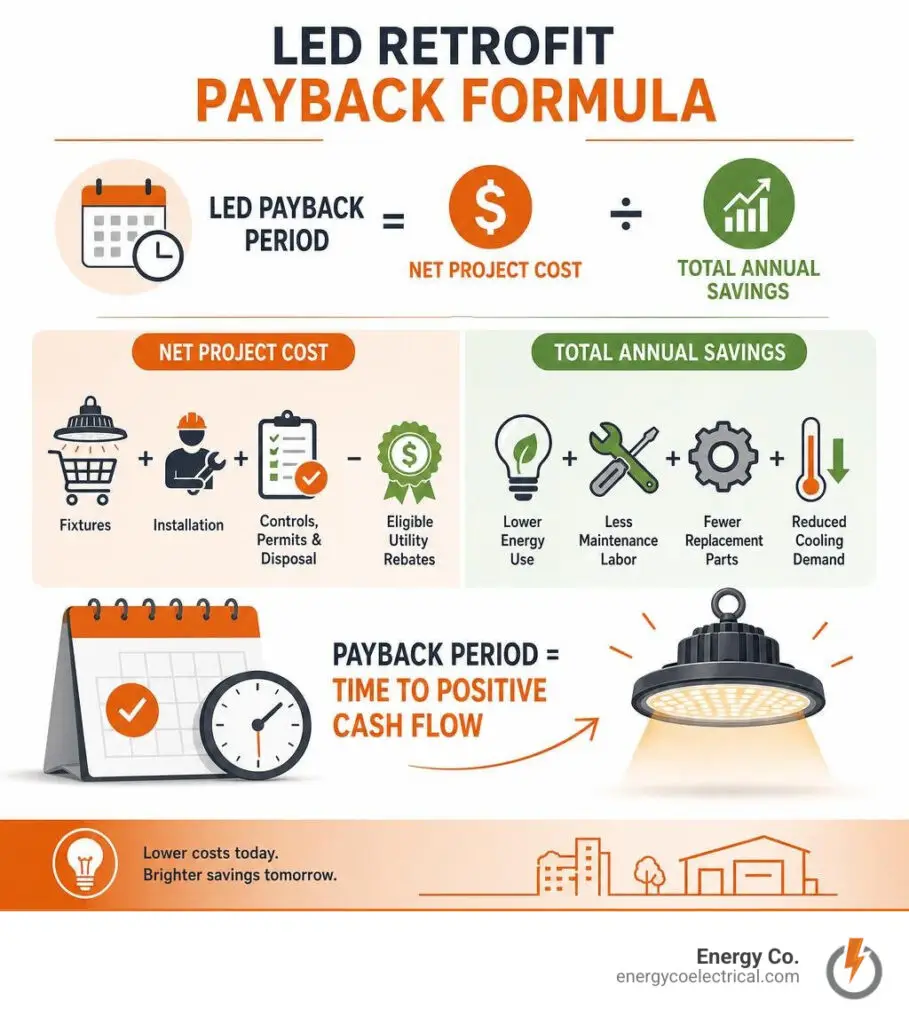
LED payback period = Net project cost / Total annual savings
Your net cost includes fixtures, installation, controls, permits, and disposal, minus eligible utility rebates. Total annual savings can include lower electricity use, less re-lamping labor, fewer replacement parts, and reduced cooling demand in air-conditioned areas.
For Chicago-area homes and businesses, the exact result depends on what you are replacing, how long lights run, your electric rate, and available incentives. A well-planned LED upgrade is not just about using fewer watts – it is about knowing when the investment starts producing positive cash flow.
I am Michał Napieralski of Energy Co., a licensed electrical professional serving Schaumburg and the Chicago suburbs with commercial and residential lighting, wiring, panel, and maintenance work. I help property owners consider the practical installation factors behind an accurate LED retrofit payback period, starting with safe, code-compliant electrical work.
LED retrofit payback period terms to know:
Deconstructing the LED Retrofit Payback Period Mechanics
At its core, calculating the financial return of a lighting upgrade is straightforward, but many property managers accidentally skip crucial expenses or ignore secondary savings. To get a crystal-clear financial picture, we have to look at the total net investment on one side of the scale and the sum of all operational savings on the other.
Your net investment is not just the price tag on a box of light fixtures. A true accounting covers every dollar spent to complete the transition:
- Hardware & Materials: LED luminaires, retrofit kits, lamps, power supplies, and control components.
- Labor & Specialized Equipment: Certified electrical installation labor, lift rentals for high-bay ceilings or parking lot poles, and wiring adjustments.
- Project Overheads: Disposal/recycling fees for hazardous legacy tubes (like mercury-containing fluorescents), recycling documentation, electrical permits, and initial engineering design.
- Capital Offsets: Instant discounts, utility mail-in rebates, and tax incentives subtracted directly from your initial outlay.
On the other side of the equation sits your annual return. LEDs deliver up to 75% to 80% energy reductions compared to legacy incandescent or high-intensity discharge (HID) fixtures. When combined with reduced maintenance demands, the resulting cash flow recovers your net investment surprisingly fast.
Step-by-Step Formula to Determine Your LED Retrofit Payback Period
To see how the numbers work in practice, let us walk through the exact mathematical steps needed to assess a lighting project.
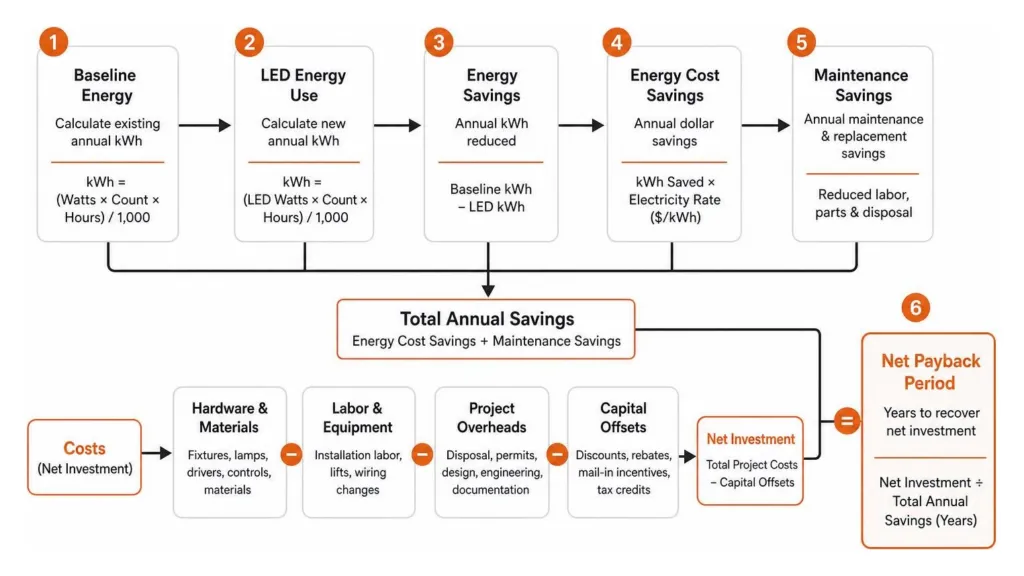
1. Calculate Baseline Kilowatt-Hour (kWh) Consumption
Start by logging your existing lighting inventory. Legacy fixtures draw more than just the lamp’s printed wattage due to ballast losses. For instance, a standard 400W metal halide fixture actually draws roughly 450W to 460W when accounting for its internal magnetic ballast.
$$text{Existing Annual kWh} = frac{text{System Watts} times text{Fixture Count} times text{Annual Operating Hours}}{1,000}$$
2. Calculate Proposed LED Kilowatt-Hour Consumption
Next, calculate the projected power draw using modern LED specifications. Replacing that same 400W metal halide fixture with a 150W LED high-bay cuts system draw down to exactly 150W—a direct 67% reduction in energy demand.
$$text{Proposed Annual kWh} = frac{text{LED Watts} times text{Fixture Count} times text{Annual Operating Hours}}{1,000}$$
3. Determine Direct Energy Cost Savings
Subtract the proposed annual kWh consumption from the baseline consumption, then multiply the difference by your local electricity rate per kWh (including energy delivery fees).
$$text{Annual Energy Savings ($) } = (text{Baseline kWh} – text{Proposed kWh}) times text{Electricity Rate ($/kWh)}$$
4. Add Secondary Savings
Incorporate avoided ballast replacement expenses, reduced re-lamping labor, and lower air conditioning loads (since LEDs convert far less power into ambient heat).
$$text{Total Annual Savings ($) } = text{Energy Savings} + text{Maintenance Savings} + text{HVAC Savings}$$
5. Calculate Simple Payback Period
Finally, divide your net project cost by your total annual savings to establish the exact duration required to recover your capital investment.
$$text{Simple Payback Period (Years)} = frac{text{Total Project Cost} – text{Utility Rebates}}{text{Total Annual Savings}}$$
Comparing Financial Metrics: Simple Payback, ROI, NPV, and IRR
While simple payback gives facility decision-makers an immediate snapshot of when an upgrade breaks even, corporate financial controllers often require more comprehensive metrics before approving capital projects.
- Simple Payback Period (Years): Tells you how many years or months it will take to recover your initial cash outlay. It is simple to calculate, though it ignores cash flows that occur after the break-even mark.
- Return on Investment (ROI %): Expresses annual net financial gain as a percentage of total project cost. For example, a 100-fixture project costing $4,000 that generates $7,056 in total annual savings yields a net annual gain of $3,056 in year one, translating to an ROI of 76.4%. Compared to traditional financial investments, a well-planned lighting project is extraordinarily reliable.
- Net Present Value (NPV): Evaluates the total financial value created by the LED system over its full operating lifespan (typically 10 to 15 years), discounting future cash flows back to today’s dollars using your company’s cost of capital (usually 8% to 12%). A positive NPV demonstrates that the retrofit builds real tangible equity for the facility.
- Internal Rate of Return (IRR %): Calculates the effective annualized yield generated by the project investment. Because commercial LED upgrades routinely generate IRRs between 30% and 50%, they easily surpass corporate hurdle rates for facility improvements.
To model custom discount rates and long-term asset value for your property, check out this interactive Advanced LED Lighting ROI Calculator.
Key Variables Driving LED Upgrade Returns
No two commercial buildings in Cook County have the exact same operational footprint, which means payback timelines vary based on several core facility factors:
- Daily Operating Schedule: Facilities running continuous 24/7 schedules accumulate energy savings three times faster than standard 8-hour office spaces.
- Existing Lighting Technology: Upgrading from legacy T12 fluorescents or power-hungry metal halides yields drastically higher cash savings than replacing relatively newer T5 systems.
- Utility Electricity Rates & Demand Charges: Commercial utility tariffs combine energy consumption rates ($/kWh) with peak demand charges ($/kW). Because LEDs lower your baseline electrical load, they decrease peak monthly demand penalties across every billing period.
- Inflation Hedge: Commercial electricity rates across the United States have historically trended upward by 3% to 5% annually (and over 7% per year in some post-2020 tracking window periods). An LED retrofit effectively locks in low energy consumption, insulating your operations against future utility price hikes.
The Impact of Commercial Utility Rebates and EPAct 179D Tax Deductions
In the Chicagoland area, local utility incentives dramatically accelerate payback timelines. For example, ComEd’s Energy Efficiency Program offers substantial commercial rebates for upgrading outdated fixtures to high-efficiency, DLC-listed LED options.
Prescriptive rebates pay fixed cash amounts per fixture type—ranging anywhere from $4 per T8 LED tube replacement up to $33 per 2×4 office troffer, and up to $100+ for industrial high-bays or exterior pole lights. In favorable high-use scenarios, combining instant rebate programs with bulk purchasing reduces equipment costs to pennies on the dollar.
Property owners can discover more local commercial efficiency opportunities by reading about how to Save Green by Going Green with Chicago Commercial Lighting Upgrades.
Beyond local utility incentives, federal tax incentives offer another major financial boost. Under Section 179D of the Internal Revenue Code (EPAct 179D), commercial building owners who execute qualifying energy efficiency improvements can claim accelerated tax deductions of up to $5.00 per square foot in 2026, depending on total energy reduction percentages and prevailing wage compliance.
Secondary Savings: Maintenance Avoidance and Reduced HVAC Cooling Loads
While direct electricity savings draw the most attention, secondary operational savings routinely account for 30% or more of total financial returns:
- Reduced Maintenance Labor and Materials: Standard metal halide or fluorescent bulbs last between 1,000 and 10,000 hours, requiring constant re-lamping cycles, ballast swaps, lift rentals, and facility labor. Quality commercial LEDs are rated for 50,000 to 100,000 hours (L70 standard). That translates to a decade or more of maintenance-free operation, saving thousands of dollars in parts and labor.
- Decreased Thermal HVAC Loads: Traditional incandescent lamps emit 90% of their energy as waste heat; fluorescents emit roughly 80%. When hundreds of hot legacy fixtures run continuously inside air-conditioned space, your cooling systems must work overtime to compensate. LEDs run significantly cooler, eliminating waste heat and cutting air conditioning operating costs by roughly 0.3 to 0.5 kWh for every 1.0 kWh of lighting load reduced. In large commercial facilities, this heat reduction can account for over 45 tons of avoided cooling load!
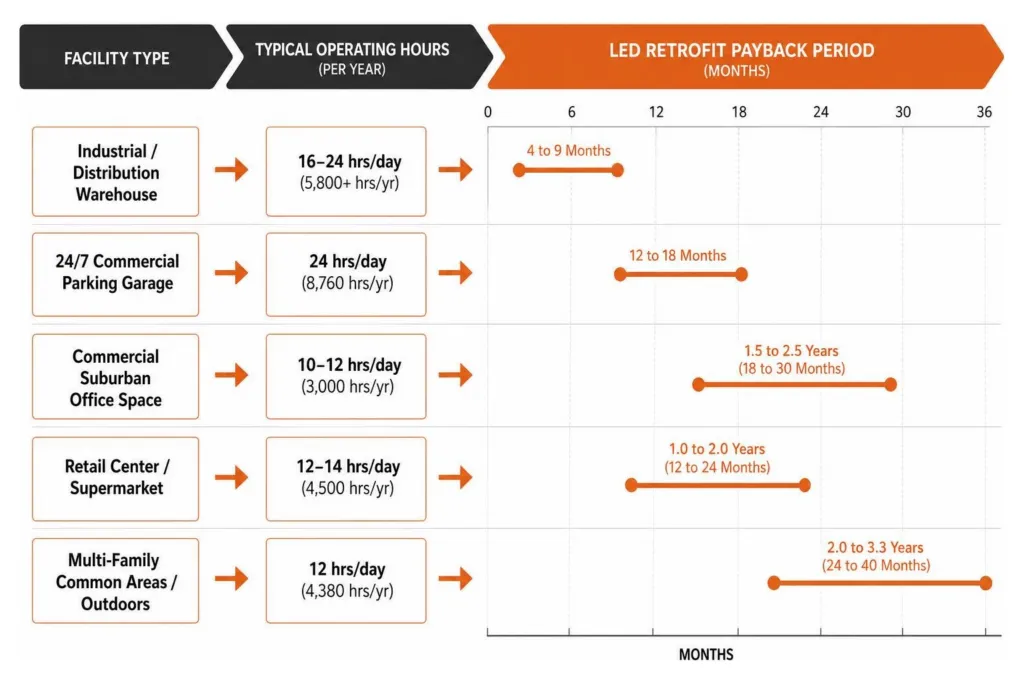
Commercial Payback Timelines Across Facility Types
To understand what you can expect in real-world applications, let us examine typical benchmark figures across common commercial property formats:
| Facility Type | Legacy Fixtures Replaced | Typical Operating Hours | Net Cost Range (Post-Rebate) | Estimated Annual Savings | Typical LED Retrofit Payback Period |
|---|---|---|---|---|---|
| Industrial / Distribution Warehouse | 400W Metal Halide High-Bays | 16–24 hrs/day (5,800+ hrs/yr) | $8,000 – $25,000 | $11,000 – $35,000 | 4 to 9 Months |
| 24/7 Commercial Parking Garage | 250W–400W HID Fixtures | 24 hrs/day (8,760 hrs/yr) | $12,000 – $30,000 | $10,000 – $26,000 | 12 to 18 Months |
| Commercial Suburban Office Space | 4-Lamp T8 Fluorescent Troffers | 10–12 hrs/day (3,000 hrs/yr) | $10,000 – $22,000 | $5,000 – $9,000 | 1.5 to 2.5 Years |
| Retail Center / Supermarket | Halogen / T8 Troffers | 12–14 hrs/day (4,500 hrs/yr) | $6,000 – $18,000 | $4,500 – $11,000 | 1.0 to 2.0 Years |
| Multi-Family Common Areas / Outdoors | 250W Outdoor Wallpacks / Pole Lights | 12 hrs/day (4,380 hrs/yr) | $15,000 – $35,000 | $8,000 – $15,000 | 2.0 to 3.3 Years |
Warehouses, Offices, and Retail: How Operating Schedules Impact the LED Retrofit Payback Period
Operating schedules directly dictate how fast your equipment generates cash savings.
Distribution Warehouses & Industrial Sites
In high-ceiling distribution centers in industrial hubs like Elk Grove Village or Northwest Chicago, lights often burn around the clock. Swapping out power-hungry 400W metal halide high-bays for efficient 150W UFO LED luminaires achieves a massive 62.5% reduction in fixture wattage. Combined with high annual runtimes, warehouse retrofits routinely break even in under 10 months.
Suburban Offices & Corporate Spaces
In standard office spaces in Schaumburg or Arlington Heights operating 10 to 12 hours a day, retrofitting legacy 2×4 fluorescent troffers with 30W–40W flat panel LEDs lowers energy usage while dramatically improving light quality and eliminating distracting ballast buzz. Payback periods here average 1.5 to 2.5 years.
Property owners planning physical ceiling upgrades can follow our guide on How to Retrofit LED Lighting the Right Way.
Retail & Showroom Facilities
Retail locations rely on high-quality illumination to display merchandise effectively. Replacing hot halogen spotlights or legacy fluorescents with high-CRI LEDs reduces ambient showroom temperatures, improves product color rendering, and lowers monthly utility bills, yielding break-even timelines between 12 and 24 months.
Maximizing ROI with Smart Lighting Controls and High-Quality Fixtures
Installing efficient fixtures is only step one. Adding smart controls accelerates your return on investment even further:
- Occupancy & Vacancy Sensors: Passive infrared (PIR) or microwave sensors dim or shut off lights in unoccupied warehouse aisles, office restrooms, or conference rooms, cutting runtime energy use by an additional 15% to 45%.
- Daylight Harvesting Sensors: Photosensors near windows or warehouse skylights automatically dim indoor artificial light when natural daylight is present, trimming power use by another 15% to 30%.
- Quality Fixture Construction & DLC Premium Certification: Selecting DesignLights Consortium (DLC) Premium qualified fixtures guarantees high luminaire efficacy (often 150+ lumens per watt) and ensures your project qualifies for maximum utility incentive tiers. High-grade aluminum heat sinks and premium LED drivers prevent premature failure, protecting your investment for decades.
Learn more about intelligent commercial controls in our guide on how Chicago Smart Lighting: The Future is Energy Efficient.
Common Pitfalls That Distort Lighting ROI Calculations
When building an ROI proposal for property managers or corporate boards, avoiding simple mathematical oversights ensures your payback projections stay accurate:
- Using Nameplate Lamp Wattage Instead of System Wattage: Forgetting to add 10% to 15% ballast losses on legacy fluorescent or HID systems leads you to underestimate baseline power draw—artificially hiding real energy savings!
- Ignoring Peak Coincident Demand Charges: Commercial electricity bills often include monthly kW demand charges. Failing to account for how lower lighting wattage reduces peak demand leads to undercounting your financial return.
- Buying Cheap Non-Certified Equipment: Discount LED fixtures lacking DLC certification miss out on utility rebates and risk early driver failures, turning a short payback period into an ongoing maintenance headache.
- Skipping Disposal, Permit, and Lift Costs: Omitting hazardous mercury recycling fees, lift rentals, or local municipal permits creates unexpected cost overruns that stretch out break-even timelines.
- Overlooking Control Savings: Forgetting to model occupancy dimming or daylight harvesting leaves significant energy savings uncounted on your project balance sheet.
Frequently Asked Questions About LED Payback Periods
How long does a commercial LED retrofit typically take to pay for itself?
For most commercial buildings, the LED retrofit payback period ranges between 1.5 and 3 years. Facilities operating continuous 24/7 schedules (such as warehouses, cold storage plants, or parking garages) routinely break even in 4 to 9 months, while standard 10-hour office environments hit full break-even within 2 to 3 years.
How do utility rebates like ComEd affect initial project costs?
Utility rebates directly reduce your net upfront capital requirement. Prescriptive incentives in the Chicagoland area range from $4 per tube to over $100 per high-bay fixture, often covering 20% to 50% or more of total project installation costs. This dramatically shortens payback timelines and boosts overall Return on Investment.
Does adding occupancy sensors or daylight harvesting improve the payback period?
Yes! Although smart sensors slightly increase upfront material costs, they reduce daily fixture runtimes by an additional 20% to 50%. In intermittently occupied spaces (like warehouse aisles, storage rooms, or perimeter offices), the extra energy savings more than outweigh the initial sensor cost, shortening your overall payback period.
Conclusion
Calculating an accurate LED retrofit payback period gives facility owners a clear roadmap to lower operating costs, reduced maintenance headaches, and long-term utility savings. Whether you manage an industrial facility in Elk Grove Village, an office building in Schaumburg, or a commercial space in Chicago, upgrading to high-efficiency LED lighting is one of the safest, highest-yielding investments you can make for your building.
At Energy Co., our team of licensed electrical professionals brings deep expertise in local electrical codes, ComEd incentive programs, and full-service commercial retrofits. We help you evaluate your current lighting draw, model exact payback timelines, secure every available rebate dollar, and execute a flawless, code-compliant installation from start to finish.
Ready to see how much your building can save? Explore our complete range of commercial solutions by visiting Shining a Light on Commercial Lighting Services and Retrofits, or contact Energy Co. today to schedule your comprehensive facility lighting audit!