Retrofit Fluorescent Lighting to LED Without Rewiring
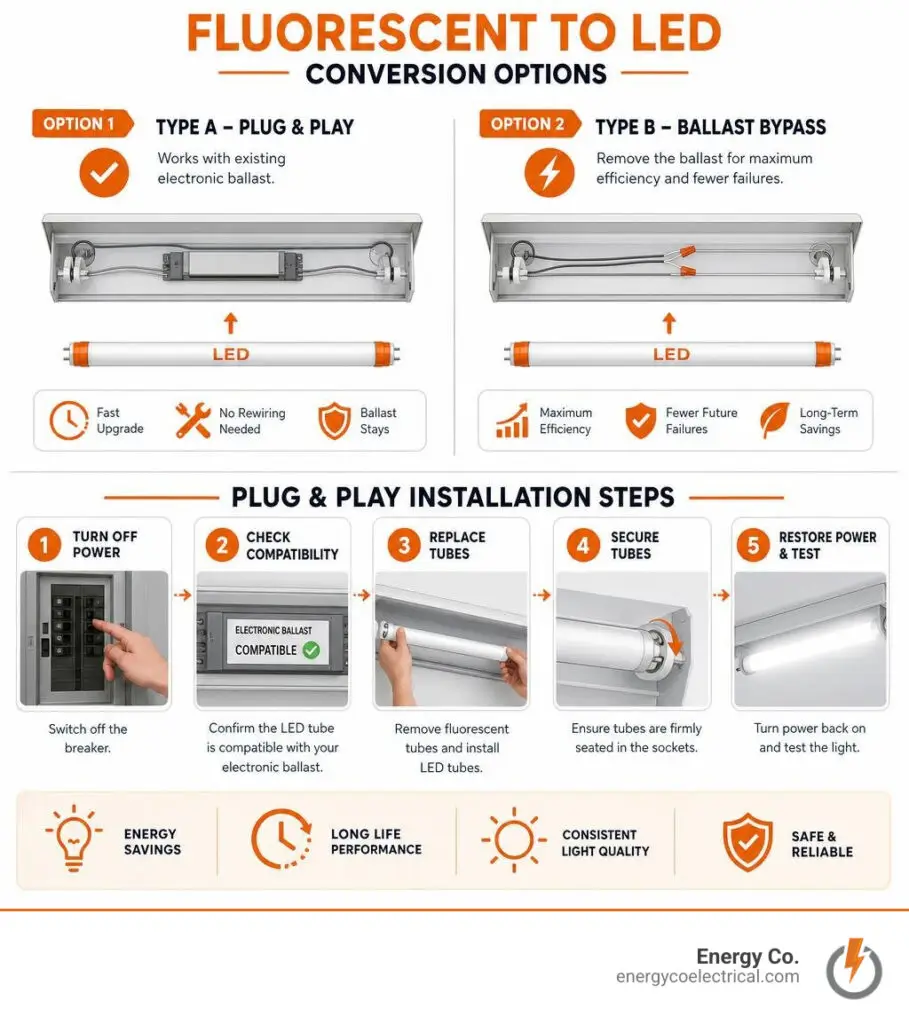
The simplest way to retrofit fluorescent lighting to LED without rewiring is to install Type A plug-and-play LED tubes that are approved for your existing electronic ballast. Turn off the breaker, confirm the tube and ballast are compatible, replace the fluorescent tubes with the LED tubes, then restore power and test. Here is how to retrofit fluorescent lighting LED tubes the smart way.
This approach keeps the fixture housing, sockets, and wiring in place. It is a practical option when the ballast is working well and you need a fast upgrade with minimal downtime. For the best long-term savings, though, many owners later choose a ballast-bypass LED tube or magnetic retrofit kit, which removes the ballast as a future failure point.
LED retrofits can use far less power than fluorescent lighting while providing cleaner, more consistent light. Many commercial kits are rated for 50,000 hours or more, offer selectable brightness and color temperature, and may support 0-10V dimming. Before buying, check fixture size, tube type, supply voltage, ballast compatibility, and safety marks such as UL or ETL. Commercial projects should also look for DLC qualification if utility rebates are available.
I am Michał Napieralski of Energy Co., a licensed electrical professional serving Schaumburg and Chicago-area homes and businesses with lighting upgrades, wiring repairs, inspections, and code-compliant electrical work. In this guide, I will help you choose the safest retrofit fluorescent lighting LED option for your fixture, budget, and long-term maintenance needs.
Retrofit fluorescent lighting led word guide:
Why Retrofit Fluorescent Lighting LED Fixtures in 2026
Fluorescent tubes were once the backbone of commercial and residential workspace illumination, but their operating model has become outdated. Traditional fluorescent systems rely on an internal gas arc that excites a phosphor coating, a design that demands high striking voltages, degrades quickly through frequent switching cycles, and requires toxic mercury.
Upgrading to solid-state LED lighting delivers immediate performance and operational gains:
- Extended Lifespan: Quality LED retrofit kits and linear lamps provide a 50,000-hour operational life (with commercial strip options reaching up to 100,000 hours L70). That is roughly 5 times longer than legacy fluorescent tubes, slashing recurring maintenance cycles.
- Superior Efficacy: Modern retrofits achieve 110 to 145 lumens per watt (lm/W), allowing facilities to cut lighting energy usage by 50% or more while maintaining or exceeding foot-candle targets.
- Enhanced Light Quality: With Color Rendering Index (CRI) options ranging from standard 80+ up to 97 CRI for high-accuracy environments, LEDs eliminate color banding and reduce visual fatigue.
- Advanced Control Integration: Many retrofits feature 0-10V dimming drivers, field-selectable wattage switches, and compatibility with commercial building automation systems.
- Hazardous Material Elimination: Transitioning away from fluorescent lamps eliminates mercury disposal liabilities and tube-breakage safety hazards.
Understanding the financial benefits of lighting upgrades is essential when planning building improvements across Cook County facilities, especially when taking advantage of DesignLights Consortium (DLC 5.1) utility rebate programs.
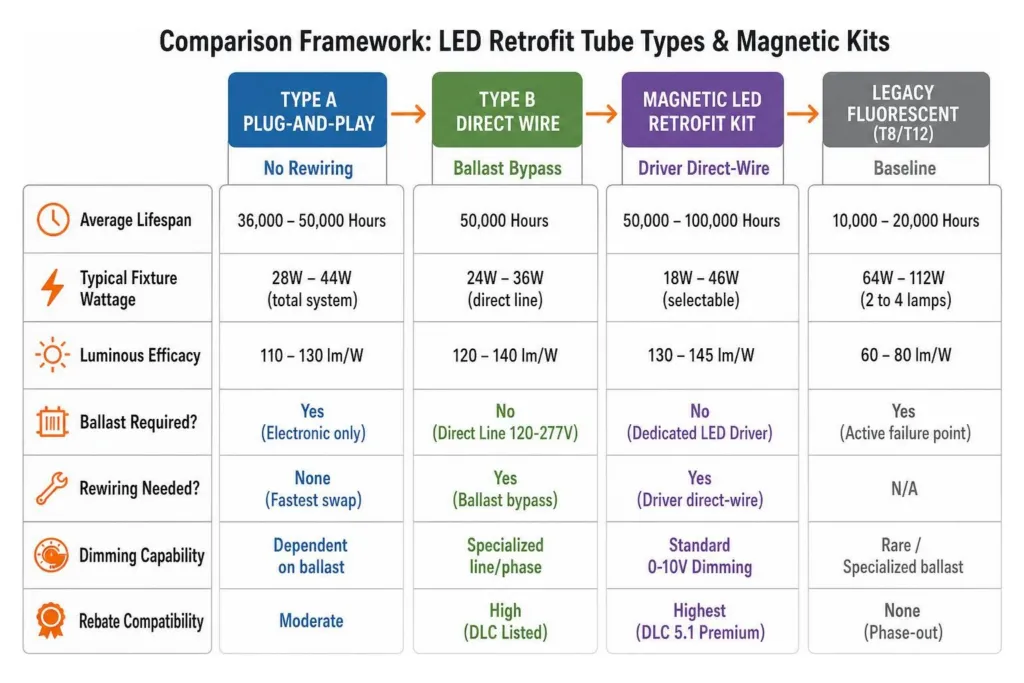
| Feature / Metric | Legacy Fluorescent (T8/T12) | Type A Plug-and-Play LED | Type B Direct Wire LED | Magnetic LED Retrofit Kit |
|---|---|---|---|---|
| Average Lifespan | 10,000 – 20,000 Hours | 36,000 – 50,000 Hours | 50,000 Hours | 50,000 – 100,000 Hours |
| Typical Fixture Wattage | 64W – 112W (2 to 4 lamps) | 28W – 44W (total system) | 24W – 36W (direct line) | 18W – 46W (selectable) |
| Luminous Efficacy | 60 – 80 lm/W | 110 – 130 lm/W | 120 – 140 lm/W | 130 – 145 lm/W |
| Ballast Required? | Yes (Active failure point) | Yes (Electronic only) | No (Direct Line 120-277V) | No (Dedicated LED Driver) |
| Rewiring Needed? | N/A | None (Fastest swap) | Yes (Ballast bypass) | Yes (Driver direct-wire) |
| Dimming Capability | Rare / Specialized ballast | Dependent on ballast | Specialized line/phase | Standard 0-10V Dimming |
| Rebate Compatibility | None (Phase-out) | Moderate | High (DLC Listed) | Highest (DLC 5.1 Premium) |
Comparing Conversion Options: Plug-and-Play, Direct Wire, and Magnetic Kits
When updating fluorescent luminaires, building owners and facility managers can choose among three primary conversion methods based on fixture condition, installation speed, and long-term operating goals.
Type A Plug-and-Play: How to Retrofit Fluorescent Lighting LED Tubes Without Rewiring
Type A linear lamps are engineered for rapid conversion. They utilize the existing instant-start or programmed-start electronic ballast to regulate power, allowing you to swap out fluorescent glass tubes for shatterproof LED tubes in under 3 minutes per fixture.
Because they preserve the existing tombstone sockets and internal wiring layout, Type A tubes avoid structural modifications to the luminaire. Following proven retrofit best practices ensures that your existing ballast is on the manufacturer’s approved compatibility list, preventing unexpected tube failure or driver mismatch.
Type B and Type AB Hybrid Tubes Explained
Type B retrofits require bypassing the legacy fluorescent ballast completely. The incoming AC line voltage (typically 120V to 277V in commercial settings) is wired directly to the tombstone sockets.
Key technical requirements include:
- Socket Type Verification: Single-ended Type B tubes require non-shunted sockets, whereas double-ended Type B lamps can use existing shunted or non-shunted tombstones.
- Safety Warning Compliance: Installers must apply an adhesive warning label inside the fixture housing to notify future technicians that the ballast has been removed and the lampholders carry line voltage.
- Type AB Hybrid Flexibility: Type AB tubes work with functioning electronic ballasts today and can operate directly on line voltage once the ballast reaches the end of its service life.
Implementing structured commercial lighting upgrade strategies helps multi-tenant commercial properties convert large fixture footprints smoothly without excessive downtime.
When to Retrofit Fluorescent Lighting LED Troffers with Magnetic Kits
For sheet-metal troffers, strip channels, and industrial wraparounds, magnetic LED retrofit kits offer a comprehensive fixture overhaul. Rather than sending line voltage through aged plastic tombstones, magnetic kits supply rigid aluminum LED light bars backed with neodymium mounting magnets and a dedicated constant-current driver.
These kits allow commercial facilities to modernize 2×2, 2×4, and 8-foot fixtures in under 10 minutes:
- High-efficiency 40W magnetic troffer retrofit kits output up to 5,200 lumens to replace standard 3-lamp fluorescent troffers.
- Versatile commercial strip retrofit solutions offer controls-ready driver platforms, emergency battery backup modules, and field-selectable CCT (3500K, 4000K, 5000K).
- Integrated quick-connect harnesses streamline connections between drivers and magnetic light bars.
Step-by-Step Guide: Converting Fluorescent Fixtures Without Rewiring
Upgrading to Type A plug-and-play LED lamps requires zero wire cutting when paired with a compatible electronic ballast.
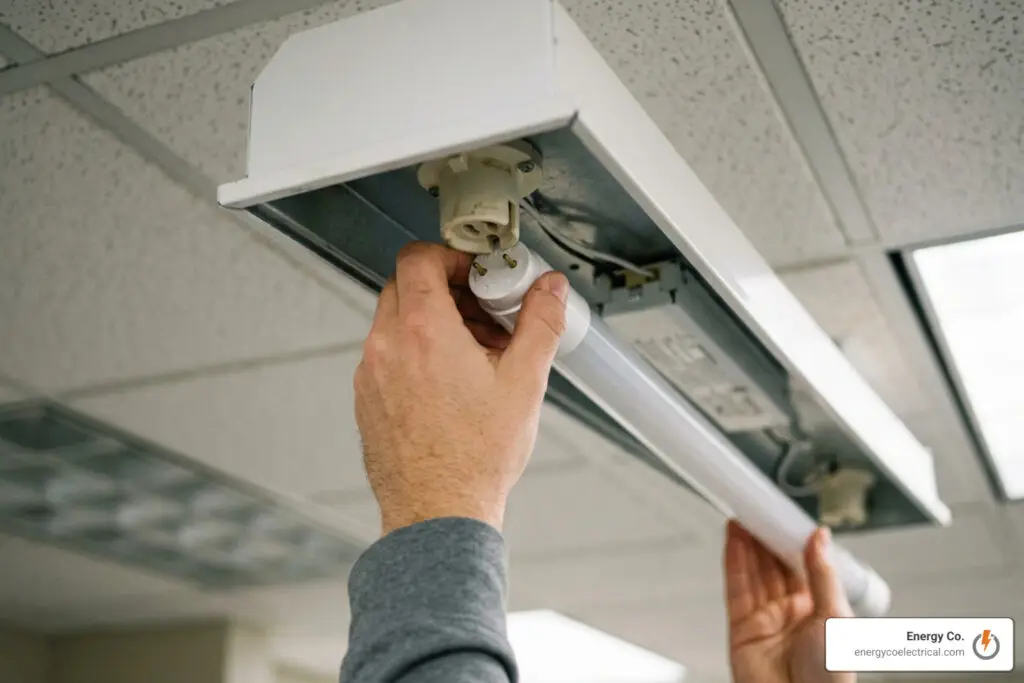
- Isolate Electrical Power: De-energize the lighting circuit at the main breaker panel. Wall switches only open the ungrounded hot leg, leaving the neutral potentially energized. Verify zero voltage at the fixture using a calibrated non-contact voltage tester or multimeter.
- Verify Lamp Diameter and Base Specifications: Check the labeling on the old fluorescent tube. T8 lamps measure 1 inch (25.4 mm) in diameter, T12 lamps measure 1.5 inches (38.1 mm), and slim T5 lamps measure 5/8 inch (15.9 mm). Ensure the bi-pin spacing (typically medium bi-pin G13) matches your replacement LED lamps.
- Remove Existing Fluorescent Lamps: Rotate each lamp 90 degrees until the contact pins align with the tombstone entry slots, then slide the lamp out carefully. Store mercury-containing lamps safely for certified hazardous waste recycling.
- Inspect Lampholders (Tombstones): Examine the plastic sockets for cracks, heat discoloration, or mechanical play. Loose or brittle tombstones must be replaced to prevent arcing and thermal damage.
- Install the Type A LED Tubes: Align the LED tube pins with the socket slots, slide the pins firmly into place, and rotate the tube 90 degrees until it locks securely into position. Ensure any directional optical lenses face downward toward the work plane.
- Re-Energize and Test: Restore circuit power at the breaker panel and test switch operation. Check for smooth, instant illumination without buzzing or visual flicker.
Safety Standards, Rebates, and Building Code Requirements
Commercial lighting alterations in Chicago, Arlington Heights, and across Cook County must comply with local electrical requirements and National Electrical Code (NEC) standards.
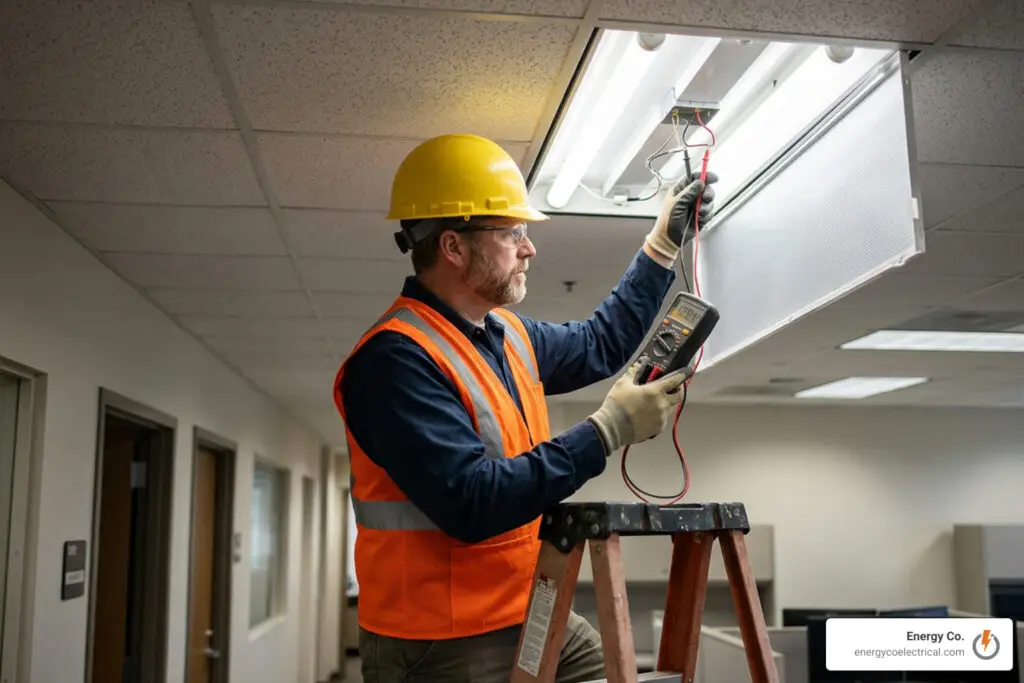
- Safety Certification: Only install equipment carrying Nationally Recognized Testing Laboratory (NRTL) marks, such as UL Listed/Classified or ETL Listed. These marks certify compliance with North American electrical safety standards.
- DLC 5.1 Qualification: Fixtures and kits listed on the DesignLights Consortium Qualified Products List (QPL) satisfy commercial efficiency, lumen maintenance, and harmonic distortion standards necessary to qualify for utility energy efficiency rebates.
- Conduit and Enclosure Integrity: In Cook County and Chicago jurisdictions, all line-voltage splices must remain fully enclosed within metal raceways, approved junction boxes, or certified fixture wireways.
- Egress Lighting: Path-of-egress fixtures must maintain an emergency lighting duration of at least 90 minutes during power outages.
For commercial properties requiring complex ballast bypasses, panel balance assessments, or 0-10V control lines, working with licensed commercial electrical services guarantees full code compliance and smooth rebate submittals.
Troubleshooting Common Retrofit Issues
When retrofitting fluorescent fixtures to LED, you may occasionally run into installation hiccups. Here is how to diagnose and resolve them quickly:
- Fixture Does Not Light Up:
- Cause: Incompatible magnetic ballast (for Type A lamps), misaligned socket pins, or an open breaker.
- Solution: Confirm the ballast is an electronic instant-start model. Reseat the tube to ensure pins make solid contact with internal socket springs.
- Rapid or Intermittent Flickering:
- Cause: Ballast output voltage instability, loose line connections, or using a line-voltage TRIAC dimmer on a non-dimmable driver.
- Solution: Verify socket wire seating; swap out aging electronic ballasts or convert the luminaire to a dedicated Type B ballast-bypass configuration.
- Audible Humming or Buzzing:
- Cause: Older magnetic ballast vibrating under high-frequency solid-state load.
- Solution: Remove the magnetic ballast and transition to a direct-wire Type B LED tube or an integrated magnetic LED strip retrofit kit.
- Ghosting (Faint Glow When Switched Off):
- Cause: Induced ghost voltage running along parallel neutral conductors, or an illuminated wall switch leaking low current through the circuit.
- Solution: Check for neutral-to-ground leakage and ensure the switch breaks the line conductor cleanly.
Frequently Asked Questions About Fluorescent to LED Retrofits
Can I replace fluorescent tubes with LED without removing the ballast?
Yes. Type A plug-and-play LED linear tubes operate directly with compatible electronic ballasts without requiring wiring alterations. However, the existing ballast will still consume a small amount of parasitic power and will eventually need replacement when it reaches the end of its service life.
How do I know if my fluorescent fixture is T8, T12, or T5?
Check the markings stamped near the end of the tube, or measure the lamp diameter across the glass tube:
- T5: 5/8 inch (0.625″) diameter, miniature bi-pin base.
- T8: 1.0 inch (1.000″) diameter, medium bi-pin G13 base.
- T12: 1.5 inches (1.500″) diameter, medium bi-pin G13 base (commonly paired with older magnetic ballasts).
Do LED retrofit kits qualify for commercial energy rebates?
Yes. Most electric utility rebate programs require products to be listed on the DesignLights Consortium (DLC) Qualified Products List (DLC Standard or DLC Premium). Qualifying retrofit kits must meet strict efficacy (lm/W), power factor (≥0.90), and color rendering thresholds.
Conclusion
Retrofitting fluorescent fixtures to modern LED technology provides immediate energy savings, reduced maintenance demands, and superior illumination quality. Whether you choose the tool-free speed of Type A plug-and-play tubes or the lasting reliability of magnetic ballast-bypass kits, solid-state lighting modernizes your property while cutting operating overhead.
At Energy Co., our licensed electricians help facilities across Chicago, Schaumburg, and the surrounding Northwest Suburbs design and execute high-efficiency lighting conversions. Explore our full suite of commercial lighting services and retrofits or reach out to our team today to schedule an on-site lighting assessment.