Start House Electrical Troubleshooting With a Safe, Simple Check
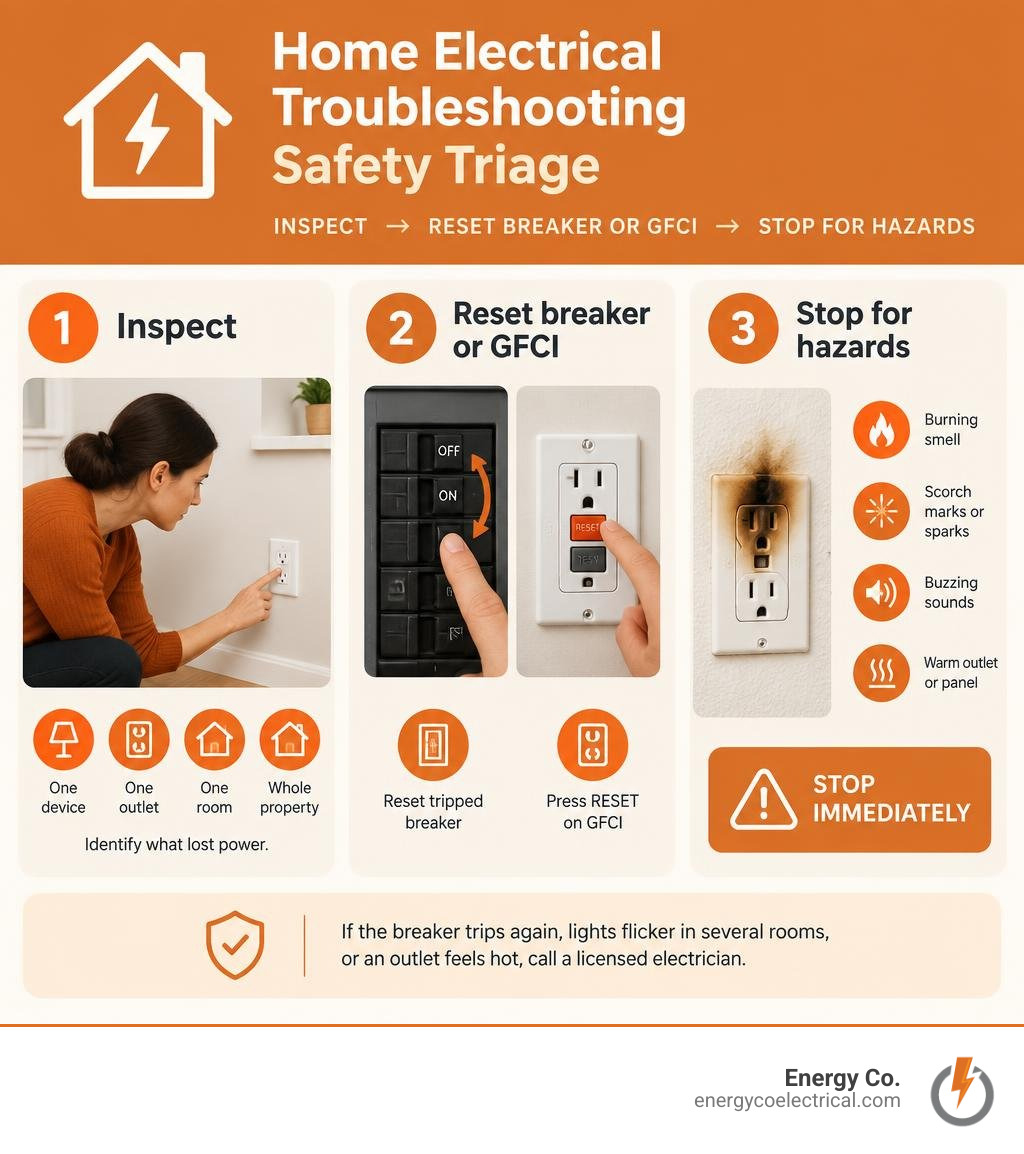
For house electrical troubleshooting, start by identifying what lost power: one device, one outlet, one room, or the whole property. Then check for danger signs, reset the breaker or GFCI if appropriate, and test with a known working device. Stop immediately if you smell burning, see scorch marks or sparks, hear buzzing, or find a warm outlet or panel.
- Unplug the affected appliance and keep hands and floors dry.
- Check whether nearby outlets, lights, or switches are also out.
- At the panel, reset a tripped breaker by moving it fully to OFF, then back to ON.
- Press RESET on nearby GFCI outlets, especially in kitchens, bathrooms, garages, basements, and outdoor areas.
- If the breaker trips again, lights flicker in several rooms, or an outlet feels hot, call a licensed electrician.
Electrical malfunctions contribute to more than 46,700 mostly preventable house fires each year. A calm, step-by-step check can help you spot a simple issue, such as a tripped GFCI or loose bulb, without taking risks around live wiring.
I’m Michał Napieralski, and this guide will help you narrow down common power problems while knowing exactly when to bring in a professional.
Terms related to house electrical troubleshooting:
Essential Safety Rules Before You Begin House Electrical Troubleshooting
Working around your home’s electrical system requires a safety-first mindset. Electricity is always looking for the quickest path to ground, and you must ensure your body never becomes that path. According to the National Fire Protection Association (NFPA), electrical failures or malfunctions remain a leading cause of home structure fires.
Before touching any switch, outlet cover, or breaker handle, follow these baseline rules:
- Ensure Dry Conditions: Never handle electrical components with wet hands or while standing on a damp basement floor. If you are inspecting a sump pump or basement utility area in Cook County after heavy rains, ensure you are standing on a completely dry surface wearing thick, rubber-soled shoes.
- De-Energize the Circuit: Never assume a wire is safe just because a switch is off. Always locate the corresponding breaker in your electrical service panel and switch it completely off.
- Verify Zero Voltage: Use a non-contact voltage tester directly on the wires or outlet slots before handling any device. Treat every wire as live until your tester confirms the absence of voltage.
- Use Insulated Hand Tools: Ensure screwdrivers, pliers, and wire strippers are rated up to 1,000 volts with intact rubber or composite grips.
Must-Have Tools for House Electrical Troubleshooting
You do not need a work van full of specialized gear to perform preliminary diagnostic checks. A small, quality tool kit will help you safely uncover the source of an outage:
- Non-Contact Voltage Tester: A handheld pen that beeps or lights up when placed near live alternating current (AC) voltage.
- Digital Multimeter: Essential for checking exact AC voltage (120V / 240V), measuring resistance (ohms), and performing continuity tests to find broken wires.
- Three-Prong Receptacle Tester: A simple plug-in device that illuminates pattern codes indicating open grounds, reversed hot/neutral wires, or missing connections.
- Insulated Screwdrivers: Standard flathead and Phillips head drivers with dielectric handles.
- Battery-Powered Flashlight or Headlamp: Working in the dark with a live phone battery is a safety hazard; always keep dedicated illumination handy.
If you are just getting familiar with your home’s setup, reading through A Beginner Breakdown of Home Electrical Wiring and Safety will give you a clear baseline of how power flows through your panels and branch circuits.
Recognizing Critical Red Flags That Halt House Electrical Troubleshooting
Certain warning signs indicate severe fire or shock hazards that should stop DIY efforts immediately:
- Acrid, Fishy, or Burning Odors: If an outlet, switch, or panel smells like melting plastic or burnt toast, shut off the main power if possible and back away.
- Visible Charring or Discoloration: Dark scorch marks around outlet slots or faceplates indicate internal arcing and extreme heat.
- Audible Sizzling or Buzzing: Sizzling sounds behind drywall point to loose wire connections arcing inside a junction box.
- Spongy or Hot Wall Plates: Outlets and switches should never feel hot to the touch. Warm dimmer switches can be normal under heavy loads, but regular outlets should stay near ambient room temperature.
- Vintage or Unsafe Wiring: Historic homes across Chicago and the Northwest Suburbs often contain vintage wiring systems, such as ungrounded cloth-covered wiring, knob-and-tube configurations, or 1960s-era solid aluminum branch wiring. Aluminum wiring oxidizes, expands, and loosens under standard screw terminals, creating high fire risks.
Reviewing sparks and smells in house wiring will help you differentiate between harmless dust burn-off and hazardous arcing. If you encounter active sparks or hot electrical panels, consult our 24-hour emergency electrical repair guide to secure your home.
Step-by-Step Diagnostic Strategy for Common Home Power Issues
Tackling electrical issues requires a structured, deductive process. Rather than randomly resetting breakers or swapping out receptacles, we recommend applying a systematic home electrical troubleshooting strategy using the scientific method:
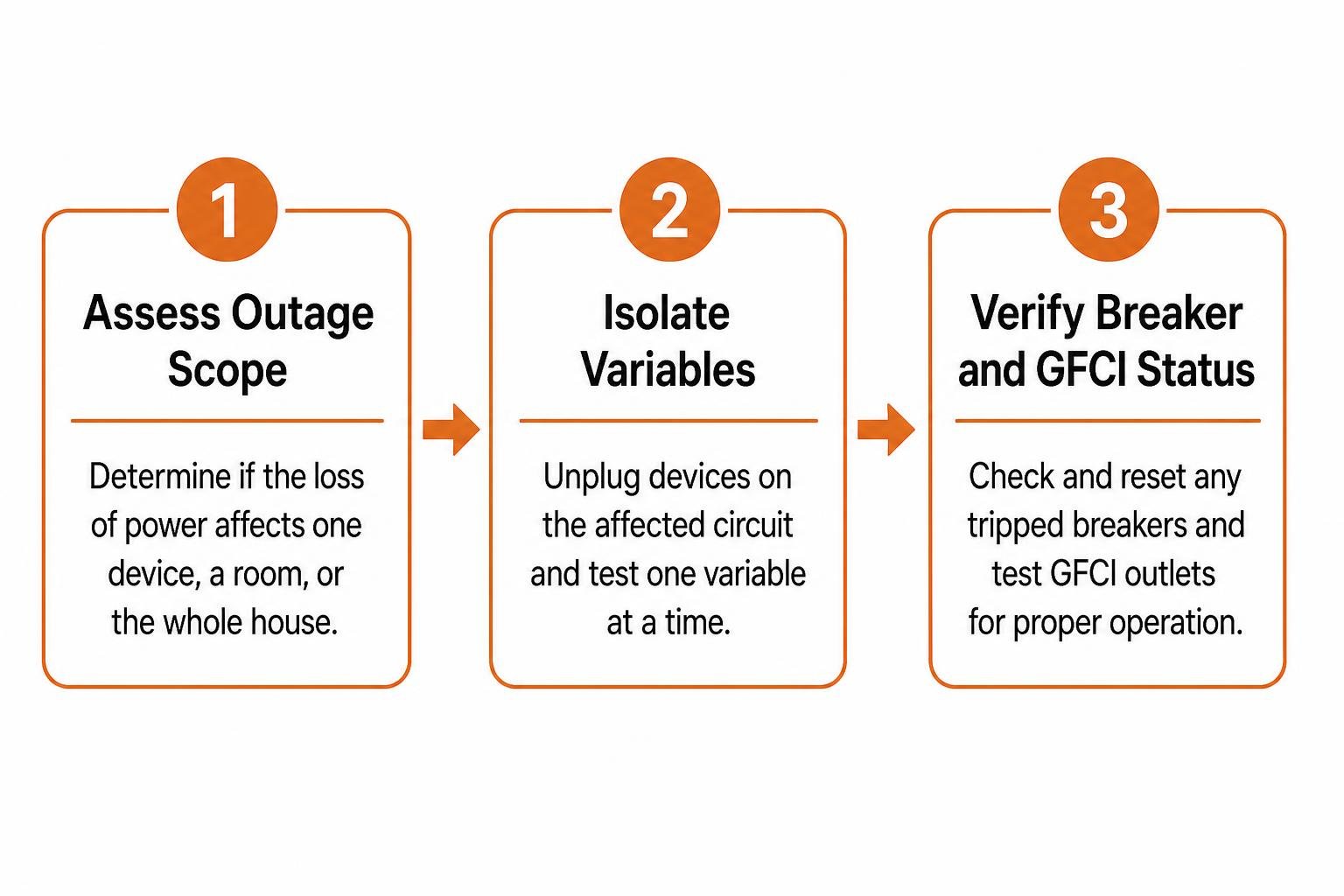
- Define the Scope: Is the failure isolated to one lamp, a single outlet, an entire room, or a split section of the whole house?
- Isolate One Variable at a Time: If a room goes dark, unplug every appliance on that branch circuit before attempting a breaker reset. Changing multiple variables at once makes it impossible to pinpoint the root cause.
- Document Operational Patterns: Take notes. Does the breaker trip immediately upon being flipped, or does it take 15 minutes of running the space heater and microwave simultaneously?
Checking and Safely Resetting Circuit Breakers
When a circuit experiences an overload or fault, the internal mechanism of the circuit breaker trips. Modern breakers do not just snap from “ON” to “OFF”; they typically spring into a spongy center position, showing an orange or red trip indicator window.
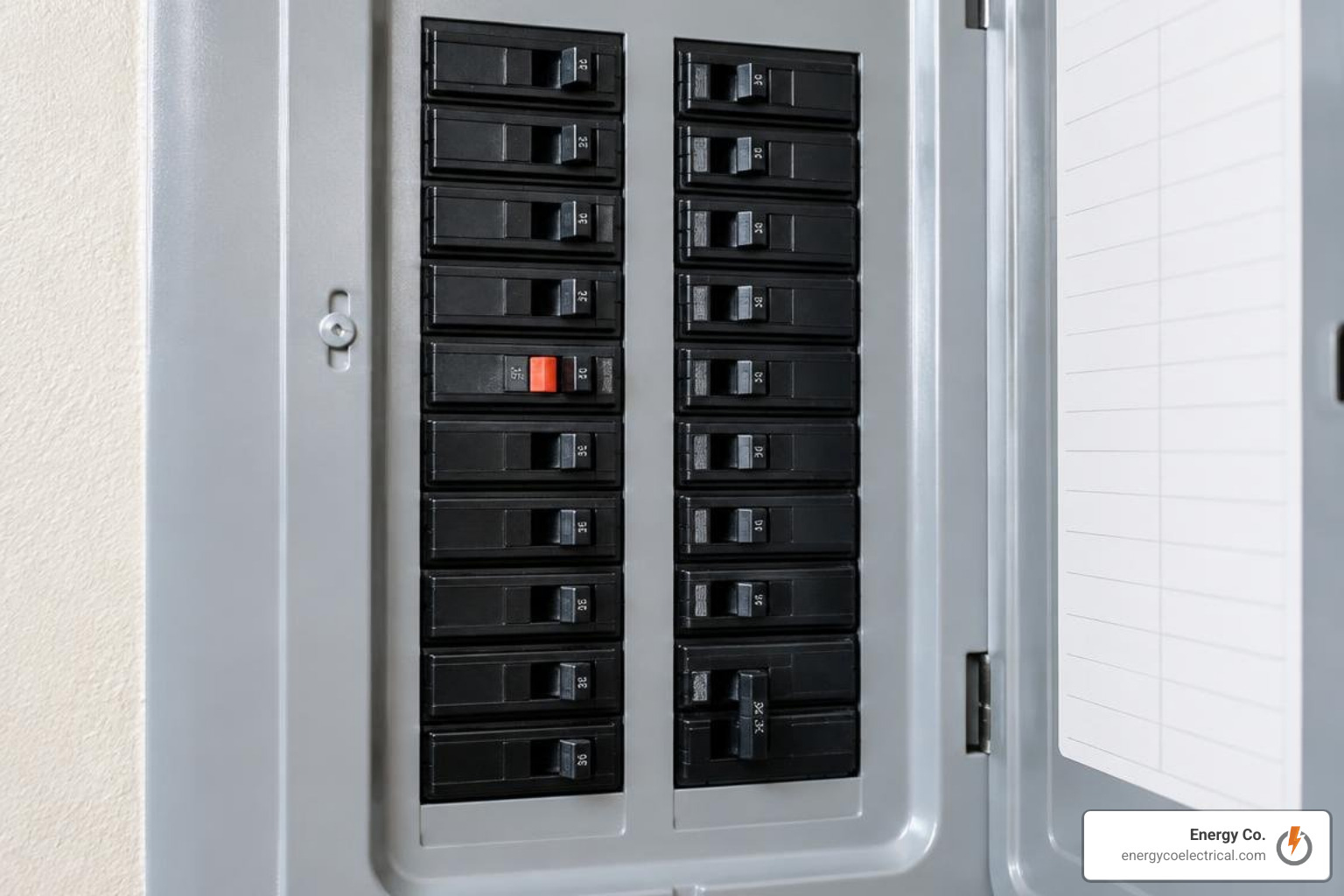
To reset a tripped breaker:
- Turn off or unplug devices connected to that specific circuit to prevent an immediate inrush overload.
- Push the breaker handle firmly toward the OFF position until you hear and feel a solid click.
- Push the handle smoothly back to the ON position.
Standard residential circuits are sized according to wire gauge and breaker capacity:
- 15-Amp Circuits (14 AWG wire): Sized for general lighting and bedroom outlets. Rated for a maximum of 1,800 watts (with a continuous safe load threshold of 1,440 watts).
- 20-Amp Circuits (12 AWG wire): Mandated for kitchens, bathrooms, and laundry spaces. Rated for a maximum of 2,400 watts (with a continuous safe load threshold of 1,920 watts).
If you plug a 1,500-watt portable space heater into a 15-amp circuit that is already powering a 400-watt entertainment system, the breaker is performing its job by tripping to prevent wire insulation from melting inside your walls. For a deeper look at panel maintenance and layouts, explore demystifying your home electric panel.
Testing and Resetting Tripped GFCI Receptacles
Ground-Fault Circuit Interrupters (GFCIs) are sensitive safety devices designed to protect people from fatal electrical shocks. They monitor the balance of electrical current traveling between the hot and neutral conductors. If an imbalance as tiny as 4 to 6 milliamperes is detected—meaning current is leaking through water or a human body—the GFCI cuts power in less than a tenth of a second.
Building codes strictly require GFCI protection in areas where moisture is present:
- Kitchen countertops and food prep areas
- Bathrooms and powder rooms
- Garages, accessory buildings, and workshops
- Basements and crawlspaces
- Outdoor receptacles (and anywhere within 20 feet of a pool or spa)
A single GFCI outlet wired through its “LOAD” terminals can protect several standard outlets downstream. If a bathroom outlet in an older Arlington Heights home stops working, the tripped GFCI reset button might actually be located in an adjacent half-bath, the basement, or the garage. For helpful tips on locating hidden GFCI locations, check out the Easiest Way to Troubleshoot Electrical Problems.
How to Diagnose Dead Outlets, Flickering Lights, and Short Circuits
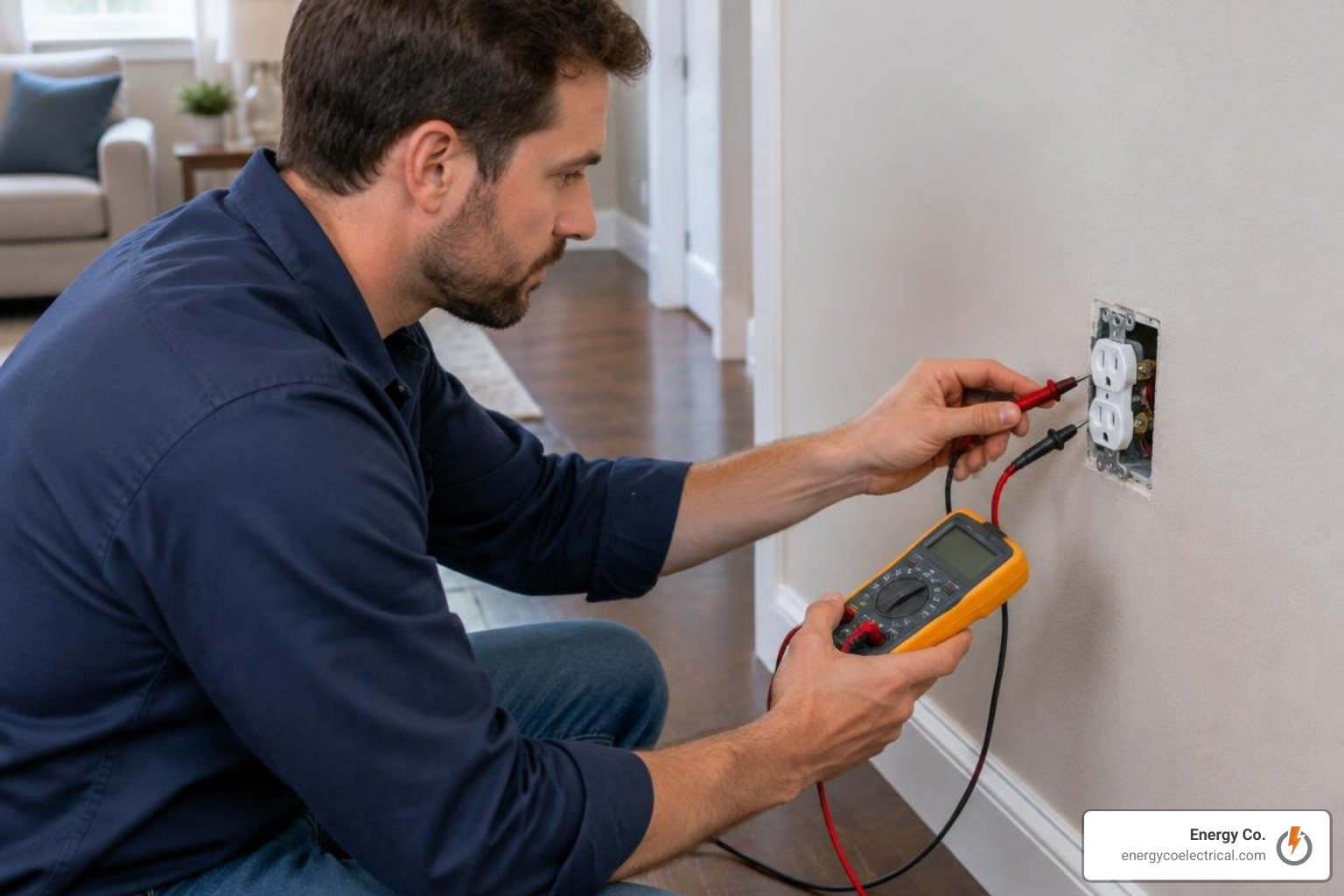
When an outlet or lighting fixture ceases to function, methodical testing reveals whether the issue stems from an appliance, the device itself, or the branch circuit wiring.
Tracing Dead Outlets and Malfunctioning Wall Switches
If a standard receptacle produces zero power, follow these diagnostic steps:
- Check for Switched Outlets: In many living rooms and bedrooms, one half of a duplex receptacle is controlled by a wall switch near the entry door (often installed for floor lamps). Ensure all wall switches are flipped on.
- Plug in a Receptacle Tester:
- Two amber lights: Correct wiring and live power.
- Open Hot (no lights): Broken hot wire, tripped breaker, or tripped GFCI upstream.
- Open Neutral (one amber light): The white neutral wire is detached somewhere along the circuit, breaking the return path.
- Hot/Ground Reverse: The circuit wires are connected to the wrong terminals on the receptacle.
- Inspect for Loose Connections: Older homes often utilize “backstabbed” push-in wire connections on the rear of outlets. Over decades of heating and cooling cycles, backstabbed springs lose tension, causing intermittent contact or dead downstream outlets. Converting these to side-screw terminal loops or secure pigtails using quality wire nuts resolves the issue.
For an in-depth walkthrough on device wiring, reference our outlet and switch troubleshooting guide.
Diagnosing Dimming, Flickering, and Power Dips
Lighting irregularities provide valuable clues regarding the stability of your home’s electrical distribution:
- Single Bulb Flickering: Check if the bulb is loose in the socket. If it is an LED bulb, ensure it is explicitly labeled as “dimmable” when paired with a dimmer switch. Incompatible solid-state LED drivers with older triac dimmers cause high-frequency strobing.
- Isolated Voltage Dips on Appliance Startup: If the lights in your kitchen dip momentarily when the refrigerator compressor kicks on, that branch circuit may be heavily loaded.
- Widespread Whole-House Flickering: If lights across multiple unrelated rooms flicker simultaneously, or if turning on a high-draw 120V appliance (like a microwave) causes lights on another circuit to grow abnormally bright, you may have an open or loose service neutral wire. This requires immediate utility or professional intervention.
Learn more about identifying these warning signs in our guide on why house lights flicker.
Isolating Short Circuits, Ground Faults, and Overloads
When a circuit breaker trips, understanding the type of fault is critical for safety:
| Fault Type | Cause | Typical Breaker Behavior | Diagnostic Method |
|---|---|---|---|
| Circuit Overload | Too many appliances running simultaneously, exceeding breaker amperage (15A/20A). | Breaker trips after operating for several seconds or minutes; breaker body feels warm. | Unplug high-wattage devices (heaters, irons), calculate total wattage, and reset breaker. |
| Short Circuit | Hot wire directly contacts a neutral wire (zero resistance, infinite current spike). | Breaker trips instantly with an audible pop or flash upon resetting. | Inspect appliance power cords; check switch/receptacle terminal screws for direct contact. |
| Ground Fault | Hot wire contacts a bare copper ground wire, metal conduit, or metal junction box. | GFCI or modern AFCI/GFCI dual-function breaker trips instantly. | Inspect moist areas, outdoor connections, and internal metal junction box clearances. |
To isolate an elusive short circuit:
- Switch the breaker to OFF.
- Unplug every single device, power strip, and appliance on that circuit.
- Reset the breaker to ON.
- If the breaker holds, the short circuit is inside one of the unplugged appliances. Plug them back in one by one until the breaker trips to identify the faulty unit.
- If the breaker trips immediately with nothing plugged in, the fault exists within the permanent wall wiring, switches, or receptacles.
DIY vs. Professional: When to Call a Licensed Electrician
Knowing your limits is the most important skill in electrical troubleshooting. While checking a bulb or resetting a GFCI is well within the wheelhouse of most homeowners, invasive repairs can expose you to lethal voltages.
Safe for DIY Troubleshooting
- Resetting tripped circuit breakers and testing GFCI/AFCI receptacles.
- Testing outlets with plug-in three-prong testers or digital multimeters.
- Replacing burned-out light bulbs and swapping standard wall switch cover plates.
- Inspecting external cords and appliance plugs for visible fraying.
Requires a Licensed Electrician
- Replacing Electrical Panels or Subpanels: Working inside the main electrical service panel exposes you to the utility service lugs, which remain energized with 200+ amps of current even when the main breaker is shut off.
- Upgrading to AFCI Breakers: Arc-Fault Circuit Interrupters detect dangerous micro-arcing inside walls and are mandated by modern electrical codes for bedroom and living spaces.
- Mitigating Knob-and-Tube or Aluminum Wiring: These vintage systems require specialized copalum crimps, anti-oxidant pastes, or whole-home rewiring to satisfy municipal safety codes in Chicagoland.
- Running New Dedicated Circuits: Adding high-capacity lines for EV chargers, hot tubs, or heat pumps requires proper load calculations and municipal permits.
For actionable boundaries, consult electrical repairs dos and don’ts for beginners, browse our recommendations on finding trusted home electrical repair, or try interactive diagnostic tools like the advanced electrical troubleshooting diagnostics calculator.
Long-Term Prevention: Protecting Your Home from Electrical Hazards
Preventing electrical emergencies is far more cost-effective than repairing fire damage or replacing fried consumer electronics:
- Install Whole-House Surge Protection: Point-of-use power strips help with minor surges, but a Type 2 Whole-House Surge Protective Device (SPD) installed at your main breaker panel clamps lightning strikes and external utility grid spikes before they reach your home’s sensitive electronics.
- Balance Circuit Loads: Spread high-wattage culinary and heating appliances across different circuits. Avoid running your air fryer, microwave, and coffee maker on the same 20-amp kitchen receptacle line.
- Avoid Counterfeit Electrical Products: Counterfeit circuit breakers, extension cords, and cheap replacement receptacles sold online or at informal markets often lack basic safety standards. Always verify the UL (Underwriters Laboratories), ETL, or CSA certification marks on electrical equipment.
- Inspect for Rodent Intrusion: Mice and squirrels frequently nest in attics, basements, and drop ceilings across Cook County, chewing through soft PVC wire insulation. Check unconditioned spaces for rodent droppings and frayed Romex sheathing.
Frequently Asked Questions About House Electrical Troubleshooting
Why does my circuit breaker trip repeatedly after I reset it?
If a circuit breaker trips instantly the moment you move it to the ON position, there is an active dead short or ground fault on that circuit. If it trips after several minutes of use, the circuit is overloaded by too many connected appliances. A breaker that trips repeatedly under normal load may also have suffered mechanical fatigue and require replacement by a licensed professional.
Can a tripped GFCI outlet cut power to standard outlets in other rooms?
Yes. GFCI receptacles feature “LINE” terminals (power incoming from the panel) and “LOAD” terminals (power outgoing to downstream devices). Standard outlets daisy-chained from the LOAD side inherit ground-fault protection. A tripped GFCI in a garage or powder room will often cut power to outlets in adjacent rooms or outdoor patios.
How do I know if an electrical issue is caused by the utility company or my home wiring?
If you lose power to exactly half of your 120V circuits, or if your 240V heavy appliances (electric clothes dryer, central AC, electric range) stop working while some lights still turn on, you have likely dropped one of the two 120-volt incoming utility service legs. Check with your neighbors; if nearby homes are experiencing similar voltage sags or outages, the problem lies with the municipal power grid or overhead service mast connection.
Conclusion
A methodical approach to electrical troubleshooting allows you to resolve simple device issues quickly while protecting your property from serious electrical fire hazards. Remember: never compromise when safety is on the line.
At Energy Co., we specialize in comprehensive residential, commercial, and industrial electrical solutions throughout Chicagoland, including Schaumburg, Hoffman Estates, Elk Grove Village, Rolling Meadows, Palatine, Roselle, Streamwood, Hanover Park, Arlington Heights, Mount Prospect, Cicero, and Chicago. Whether you are dealing with puzzling voltage drops, aging wiring, or an urgent outage, our licensed professionals provide reliable 24/7 emergency service backed by our satisfaction guarantee.
When troubleshooting hits a wall, turn to the local experts. Explore our specialized outlet and switch troubleshooting services or contact us today to schedule a comprehensive electrical safety inspection for your home.