The Part of Your Home You Probably Never Think About (Until Something Goes Wrong)
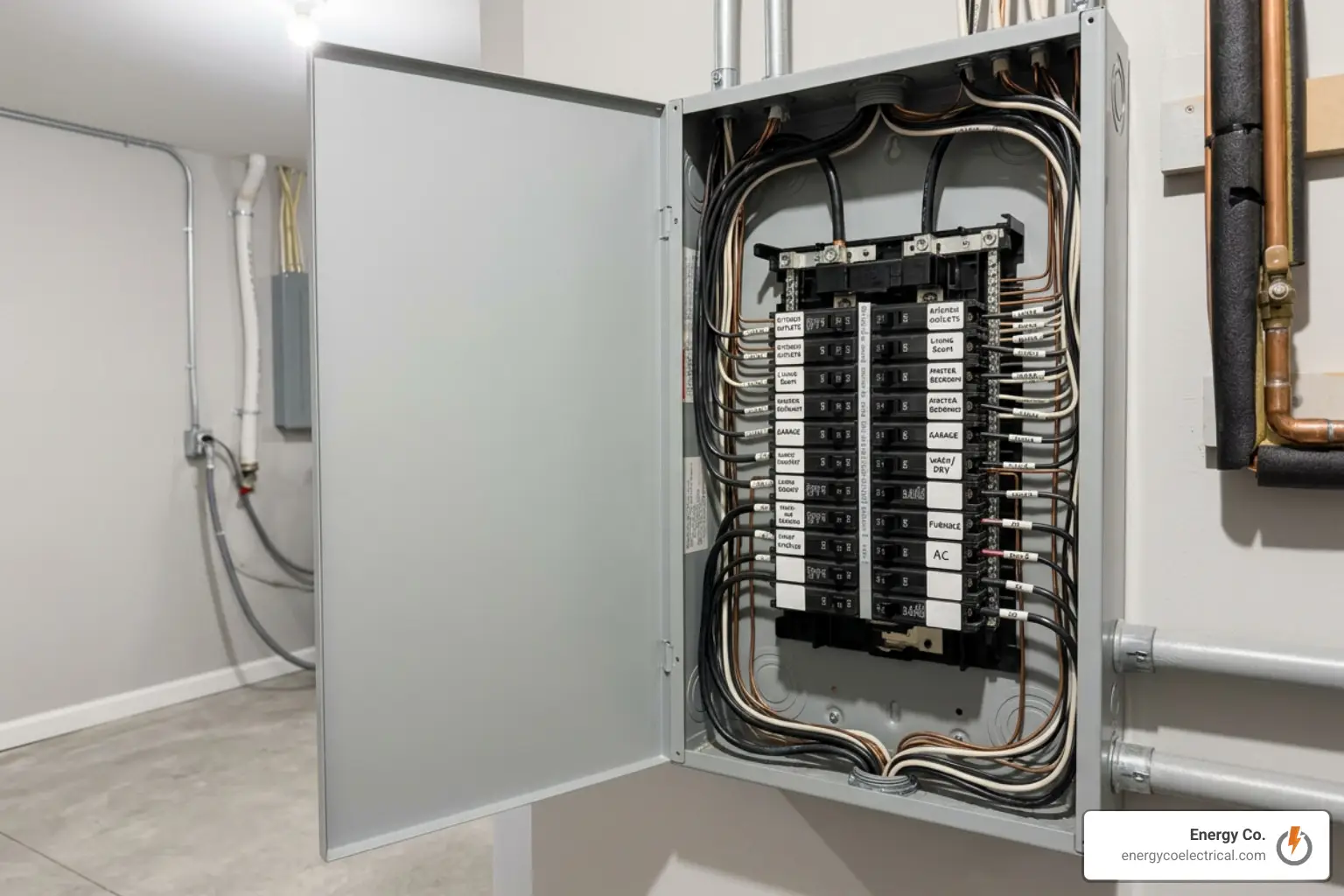
Your home electric panel is the unsung hero of your house. It quietly manages every watt of power flowing to your lights, appliances, outlets, and heating systems — every single day.
Here is a quick overview of what you need to know:
| Question | Quick Answer |
|---|---|
| What is it? | A metal box that distributes electricity from the utility to your home’s circuits |
| Where is it? | Usually in a basement, garage, utility closet, or near the outdoor electric meter |
| Standard size for modern homes | 200 amps |
| Older home sizes | 60–100 amps (may need upgrading) |
| Lifespan | 25 to 40 years |
| Cost to upgrade | $3,000–$5,000 on average |
| Can you replace it yourself? | No — always hire a licensed electrician |
Most homeowners only notice their panel when a breaker trips or the lights start flickering. But your panel does far more than flip off when something goes wrong. It protects your home from overloads, electrical fires, and equipment damage — 24 hours a day.
Between lighting, appliances, and heating and cooling equipment, homes rely on electricity for a significant — sometimes total — share of their energy needs. And with more homeowners adding EV chargers, heat pumps, and smart devices, that demand is growing fast. An outdated or undersized panel can become a real safety risk.
I’m Michał Napieralski, and through my work at Energy Co. serving the Chicagoland area, I’ve inspected and upgraded hundreds of home electric panels — from aging fuse boxes in 1950s bungalows to modern 200-amp service upgrades for EV charging setups. In the sections below, I’ll walk you through everything you need to know, without the technical jargon.
What is a Home Electric Panel and How Does It Work?
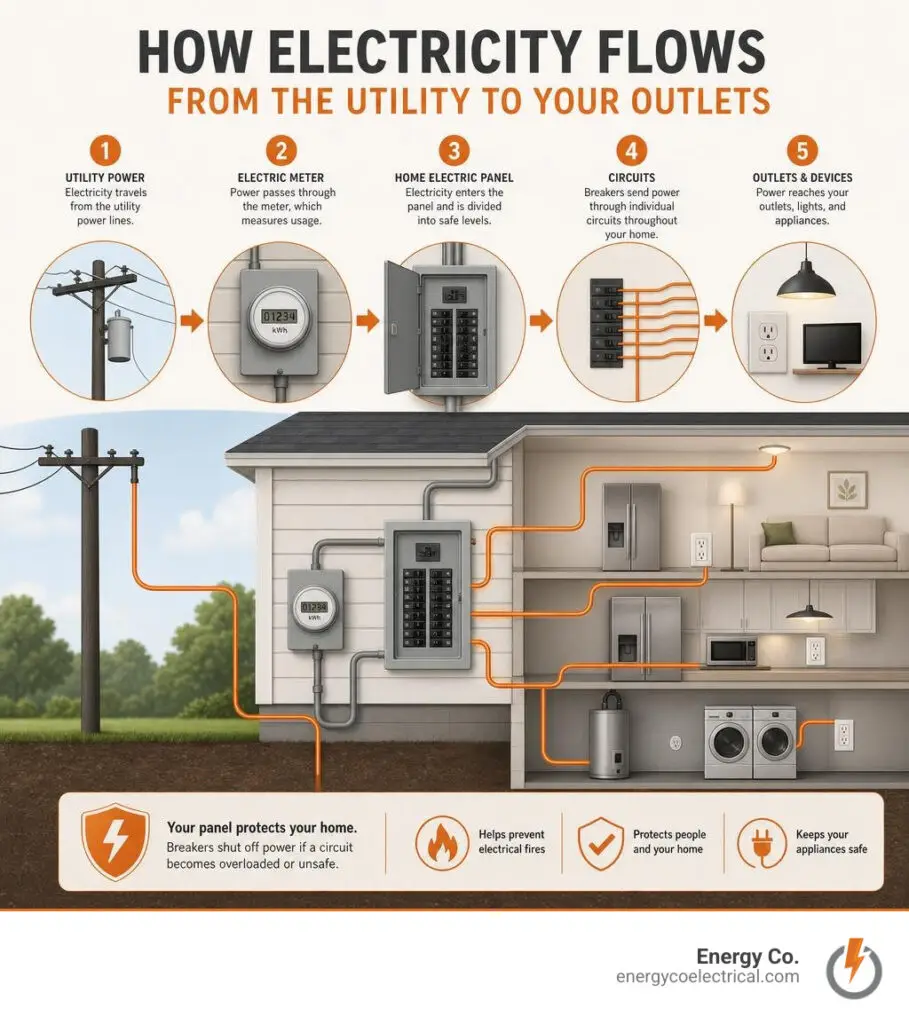
Think of your home electric panel (often called a breaker box, distribution board, or service panel) as the central train station for your home’s electrical system. High-voltage electricity travels from the utility company’s power lines, through your electric meter, and straight into this metal box. From there, the panel divides that massive stream of power into smaller, safer currents that travel along individual branch circuits to your outlets and appliances.
At its core, the main job of the panel is overcurrent protection. Inside the panel, you will find a series of circuit breakers. Each breaker is designed to handle a specific amount of electrical current (measured in amperes, or “amps”). If a circuit draws more current than it is rated for—for example, if you run a space heater, a hair dryer, and a vacuum cleaner on the same outlet at the exact same time—the wires will begin to heat up.
To prevent the wires from melting and starting a fire, the circuit breaker detects this overload and instantly “trips,” cutting off the power. Think of it as a safety valve. For a highly detailed breakdown of how professional inspectors evaluate these components for safety, you can read about Inspecting the Main Electrical Panelboard During a Home Inspection – InterNACHI®.
To understand how electricity behaves inside your panel, it helps to use a simple cardiovascular analogy:
- Voltage (Volts) is like blood pressure—it is the force pushing the electrical current through the system. Standard US household outlets operate at 120 volts, while heavy appliances (like central air conditioners or electric dryers) use 240 volts.
- Current (Amps) is like the volume of blood flowing through your vessels. It represents the actual rate of electrical flow.
- Resistance (Ohms) is like the narrowness of the blood vessels, restricting the flow.
If your home’s “blood pressure” (voltage) pushes too much “blood” (amperage) through a circuit with too much “restriction” (resistance), the breaker trips to prevent a catastrophic blowout.
Main Panels vs. Subpanels
Not every breaker box is built to do the exact same job. In almost every home, there is one main panel and, occasionally, one or more subpanels.
The main panel is the primary distribution point closest to your utility electric meter. It contains the main disconnect (a large double-pole breaker, usually located at the very top, rated for 100 to 200+ amps) that allows you to shut off power to the entire house with a single flip of the hand. Under the National Electrical Code (NEC), the main panel is also the only place where the system’s ground wires and neutral wires are bonded together via a main bonding jumper. This connection is critical because it creates a low-resistance path back to the utility, ensuring a breaker trips instantly during a ground fault.
A subpanel, on the other hand, is a smaller downstream distribution board. Subpanels are commonly installed when you add a home addition, finish a basement, or build a detached garage or workshop. They are fed by a double-pole breaker inside the main panel.
The most critical technical safety rule for subpanels is neutral isolation: the neutral wires and grounding wires must be kept strictly separated. If they are bonded in a subpanel, current can travel back along the ground wires, creating a severe shock hazard on the metal casing of the panel.
If you are expanding your home’s capacity with a subpanel, you might use a compact unit like the PowerMark Plus 125 Amp 8-Space 16-Circuit Indoor Main Lug Circuit Breaker Panel, which is a common choice for distributing power to new branch circuits.
Determining Your Panel Size and Mapping Circuits
Before you plan any major home improvements—like installing a hot tub or switching to clean energy—you need to know the capacity of your current electrical service. Your panel’s size, or amperage rating, determines the maximum amount of power your entire home can pull from the grid at any single moment.
To find your panel size, follow these steps:
- Locate the panel: Look in your basement, garage, utility closet, or on an exterior wall near your outdoor electric meter.
- Find the main breaker: Open the metal door. Look for the largest breaker switch, which is usually isolated at the top or bottom of the panel. This switch will have a number stamped on it (e.g., 100, 125, 150, 200). That number is your home’s total amperage capacity.
- Check the manufacturer’s label: If the main breaker is not clearly marked, look for a paper label stuck to the inside of the panel door. It will list the maximum amperage rating of the panel board.
- Inspect your outdoor meter: If you still can’t find it, look at the glass face of your outdoor electric meter. If you see the code “CL200,” it indicates the meter can handle up to 200 amps, which strongly suggests your home has a 200-amp service.
| Panel Amperage | Common Household Types | Ideal For |
|---|---|---|
| 60 Amps | Older homes (pre-1970s) | Small homes with gas heating/appliances; highly outdated |
| 100 Amps | Mid-century homes | Standard homes without central AC or heavy electric appliances |
| 150 Amps | Transitional homes | Moderate-sized homes with standard electric appliances |
| 200 Amps | Modern standard | All-electric homes, EV chargers, heat pumps, and hot tubs |
| 400 Amps | Large modern homes | Luxury homes over 3,500 sq. ft. with heavy heating/cooling loads |
If you are planning to buy a home or upgrade your current property, understanding these standards is essential. For more detailed guidance, check out The Homeowner Guide to Buying a 200 Amp Electrical Panel.
Safe DIY Mapping of Your Home Electric Panel
Have you ever run to the basement to reset a breaker, only to find a handwritten directory with faded, cryptic labels like “Steve’s Room” or “Plugs”? Properly mapping and labeling your panel is one of the best safety projects you can complete.
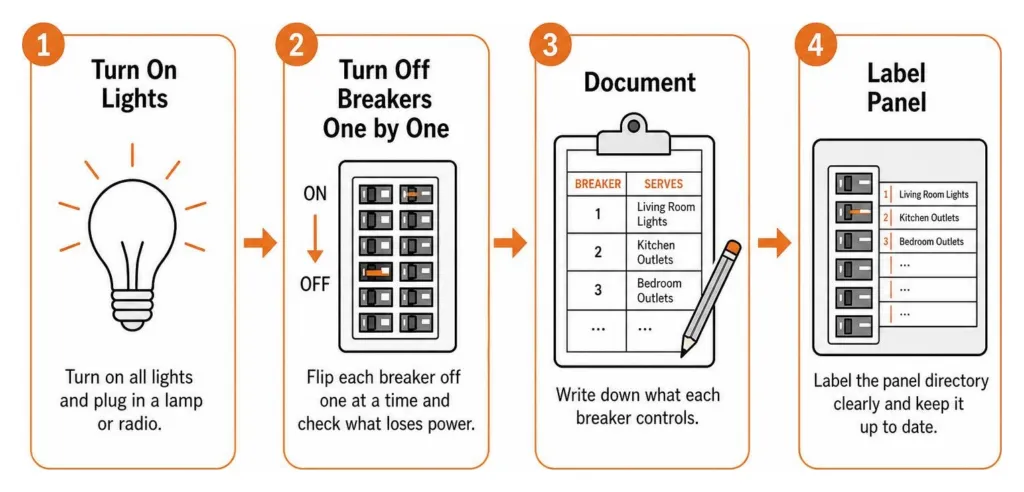
Here is how to safely map your circuits:
- The “Two-Person” Method: Plug a small lamp or radio into an outlet, or turn on all the lights in your house. Have one person stand in the living areas while the other stands at the panel.
- Switch One by One: Flip the branch breakers off one at a time and call out (or text) to identify which lights or outlets lose power.
- Calculate the Load: To understand how much a circuit can handle, use the standard electrical formula: $$text{Amps} times text{Volts} = text{Watts}$$ For example, a standard 15-amp household circuit running at 120 volts can handle a maximum of 1,800 watts ($15 times 120 = 1,800$). Because household loads should not run at 100% capacity continuously, try to keep the total wattage on a single circuit under 80% (1,440 watts).
- Safety First: When mapping, never remove the protective metal cover (the “dead front”) of your panel. Only touch the plastic breaker switches. If you ever experience a sudden blackout at night, refer to our guide on What to Do When Your Power Goes Bump in the Night to handle the situation safely.
Signs You Need an Upgrade vs. Smart Panel Alternatives
Your electrical panel won’t last forever. Most panels have a useful lifespan of 25 to 40 years. If your home was built or last renovated between 1950 and 1990, there is a very high chance your panel is approaching the end of its safe operating life or is simply too small for modern living.
Keep an eye out for these warning signs that your panel is struggling:
- Flickering or Dimming Lights: If your lights dim momentarily when your refrigerator or air conditioner kicks on, your panel is struggling to distribute the sudden demand for power. For a deeper look at this symptom, see Why Is My House Flickering Diagnosing Home Electrical Problems and How to Fix Them.
- Frequent Tripped Breakers: If you find yourself constantly walking to the basement to flip a switch back on, your circuits are overloaded.
- Warm Panel or Burning Smells: This is an immediate electrical emergency. If the metal door of your panel feels warm to the touch, or if you smell a sweet, metallic burning odor, shut off the main power if safe and call us immediately.
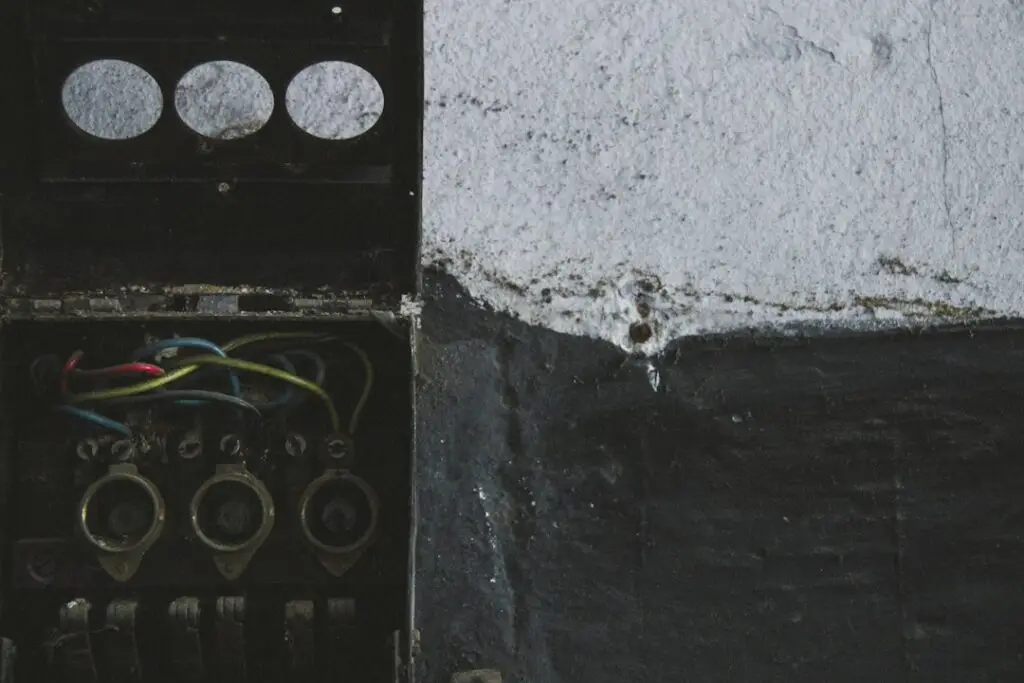
- Outdated Fuse Boxes: If your home still relies on screw-in glass fuses, it is time for an upgrade. Fuses are not inherently unsafe, but they were designed for an era when the average household used a fraction of the electricity we use today.
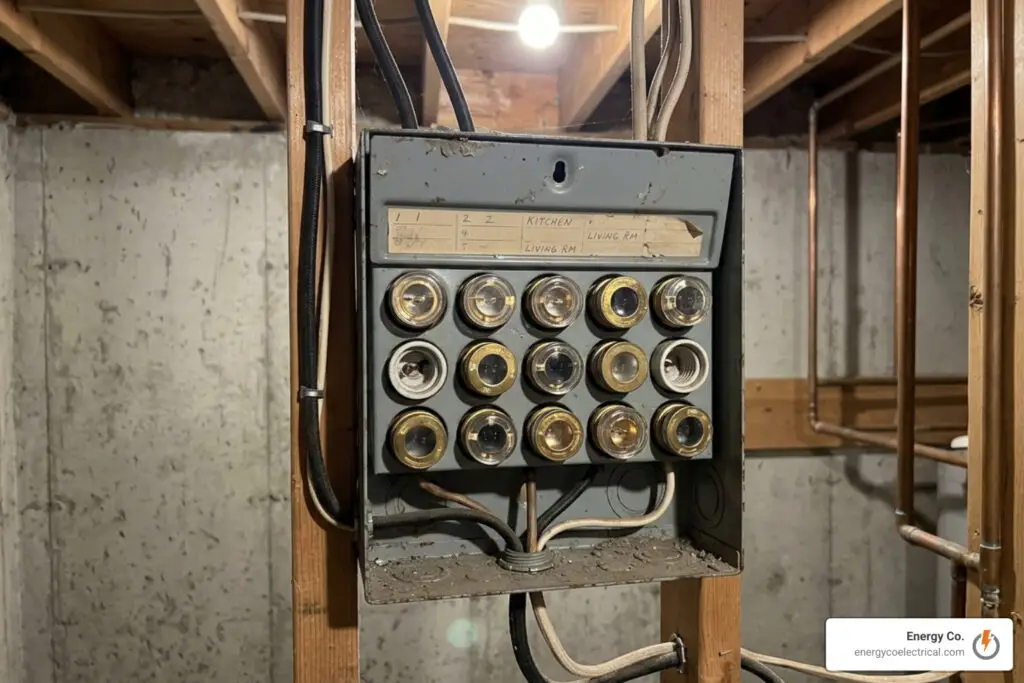
Furthermore, some historical panel brands are major safety hazards. Federal Pacific Electric (FPE) Stab-Lok panels and Zinsco panels have documented design flaws. FPE breakers frequently fail to trip during an overload, causing the wires to overheat and melt instead of shutting off. If you have one of these brands, we strongly recommend a complete replacement.
When to Upgrade Your Home Electric Panel
A full panel replacement or “heavy-up” service upgrade (such as moving from 100-amp to 200-amp service) is necessary when your physical panel is outdated, damaged, or simply out of space.
If you plan to install modern, high-draw systems like:
- An electric vehicle (EV) level 2 fast charger
- A whole-home heat pump system
- An induction cooktop or electric water heater
- A hot tub or central air conditioning system
You will likely need to expand your electrical capacity. To learn more about what this process looks like, explore our services for an Electrical Panel Upgrade.
Smart Panels and Circuit Splitters
If your main panel is in good physical shape but you are running out of capacity for an EV charger or heat pump, you don’t always have to jump straight to a costly utility service upgrade. Modern technology offers some fantastic alternatives.
Smart Electrical Panels: A smart panel, such as the SPAN® Panel | Lower your energy bill, acts as an intelligent brain for your electrified home. Instead of traditional manual breakers, a smart panel uses digital load management. It monitors your home’s total energy draw in real-time and can automatically pause lower-priority circuits (like your water heater or dryer) for a few minutes when your EV charger or heat pump demands peak power.
This dynamic load balancing allows you to run an all-electric home on a 100-amp or 150-amp service, potentially saving you thousands of dollars in utility trenching fees. Additionally, when paired with a home backup battery, a smart panel can extend your battery’s life by up to 40% during a utility outage by letting you turn off non-essential circuits directly from an app. SPAN panels are highly versatile and are available in sizes ranging from 16 to 48 controllable circuits.
Circuit Splitters: If you only need to power one new device—like an EV charger in a garage that already has a 240V dryer outlet—you can use an automatic circuit splitter (like a NeoCharge). These devices cost around $350 and safely share a single outlet, automatically cutting power to the EV charger whenever the dryer is running.
The Cost of Upgrading Your Electrical Panel in 2026
If you decide that a traditional panel upgrade is the best path forward, it helps to understand what factors influence the final price. In the Chicagoland area, a standard residential electrical panel upgrade typically costs between $3,000 and $5,000. Replacing the physical box alone can start around $2,000, while a premium smart panel like SPAN costs about $3,500 for the hardware before installation labor.
Several key factors will determine where your project falls on this price scale:
- Service Capacity (Amps): Upgrading to 200 amps is standard and highly cost-effective. Moving to a 400-amp service requires much heavier wiring and equipment, often pushing the cost above $5,000.
- Utility Connection: If your local utility (such as ComEd) must run new service wires from the overhead pole or dig a trench for underground lines, this will add to the timeline and cost.
- Code Corrections: Older homes in Cook County often require extra work to meet strict local codes. For example, Chicago has exceptionally high standards for running wiring through metal conduit rather than flexible Romex cable.
- Relocation: If your current panel is located in a prohibited area—such as a bathroom, clothes closet, or directly over stairway steps—it must be relocated to a code-compliant space, which requires extending all your existing branch circuits.
To get a better idea of how these costs break down, you can consult How Much to Swap the Box Your Guide to Electrical Panel Upgrade Costs.
Financial Incentives and Rebates
Fortunately, you do not have to shoulder the entire cost of a panel upgrade on your own. There are several excellent state and federal programs designed to help homeowners transition to safer, more efficient electrical systems:
- Federal Tax Credits: Under the Inflation Reduction Act, homeowners can claim a 25C federal tax credit covering 30% of the cost of an electrical panel upgrade, up to $600, provided the upgrade is installed in conjunction with an energy-efficient home improvement (like a heat pump or solar panels).
- Illinois Electrification Rebates: Depending on your household income, state programs offer substantial rebates—sometimes up to $4,000—for electrical service and panel upgrades associated with home electrification.
- ComEd Coordination: While ComEd does not charge to disconnect and reconnect your power lines during a panel swap, they do not cover the cost of the physical panel or the electrician’s labor.
For a step-by-step financial planning guide, read our Step-by-Step Guide to Electric Panel Upgrade Costs.
Questions to Ask Your Electrical Contractor
Because upgrading a panel is a major structural change to your home, you want to make sure you hire the right team. Here are a few essential questions to ask any contractor before signing a contract:
- Are you licensed to work in my specific municipality? (For example, Palatine has its own strict local requirements, as detailed in the Electrical Service Revision (PDF)).
- Will you perform a professional load calculation before sizing my new panel?
- Do your prices include pulling all necessary municipal permits and coordinating the power shutoff with ComEd?
- Will you ensure the new panel is properly grounded to my water pipe and a grounding electrode?
If you are ready to speak with a licensed professional who knows Chicagoland homes inside and out, Contact Us at Energy Co. for a transparent, upfront estimate.
Frequently Asked Questions about Breaker Boxes
Can a homeowner replace their own electrical panel?
No. Under no circumstances should a homeowner attempt to replace their own electrical panel. Working inside a main service panel is incredibly dangerous because the main incoming lugs remain energized with high-voltage electricity even when the main breaker is turned off. One accidental touch can be fatal.
Furthermore, local building codes across Cook County strictly require these permits to be pulled by a licensed, bonded electrical contractor to ensure the work passes a mandatory municipal safety inspection. To understand the safety and financial risks of attempting complex DIY electrical repairs, check out The Shocking Truth About the Cost for Electrician to Replace Circuit Breaker.
What is the difference between a fuse box and a circuit breaker panel?
A fuse box uses small glass fuses with a thin metal strip inside. If a circuit draws too much power, the metal strip melts, physically breaking the circuit. Once a fuse “blows,” it must be thrown away and replaced with a brand-new one.
A circuit breaker panel uses mechanical switches. When an overload occurs, an internal electromagnet or bimetallic strip flips the switch to the “off” position. To restore power, you simply turn off any overloaded appliances, locate the tripped breaker, flip it completely to the “off” position, and then flip it back to “on.” Breakers are much safer, more convenient, and designed for modern electrical loads.
How long does an electrical panel upgrade take?
For a standard single-family home, the physical process of swapping out an electrical panel usually takes between 4 and 8 hours of active labor. During this time, your power will be completely shut off to allow the electricians to work safely.
We coordinate directly with ComEd to schedule the disconnect and reconnect, minimizing the disruption to your day. Once the work is complete, a local municipal inspector will visit your home within one to three business days to verify that everything is fully up to code.
Conclusion
Your home electric panel is the foundation of your home’s safety, comfort, and future value. Whether you are dealing with the minor annoyance of flickering lights, planning to install a fast EV charger, or need to replace an outdated and unsafe mid-century breaker box, keeping this system updated is one of the smartest investments you can make.
At Energy Co., we take the mystery and stress out of electrical upgrades. Our team of licensed, highly trained professionals serves communities across Chicagoland—including Schaumburg, Hoffman Estates, Elk Grove Village, Palatine, Roselle, Streamwood, Hanover Park, and the city of Chicago. We understand the unique architectural history and strict building codes of our local suburbs, and we back all of our work with a comprehensive satisfaction guarantee.
If you are ready to upgrade your home’s electrical system safely and professionally, explore our Electrical Panel Upgrade services or reach out to us today to schedule your safety inspection!