Last updated:
Plan Swim Spa Wiring Before Delivery
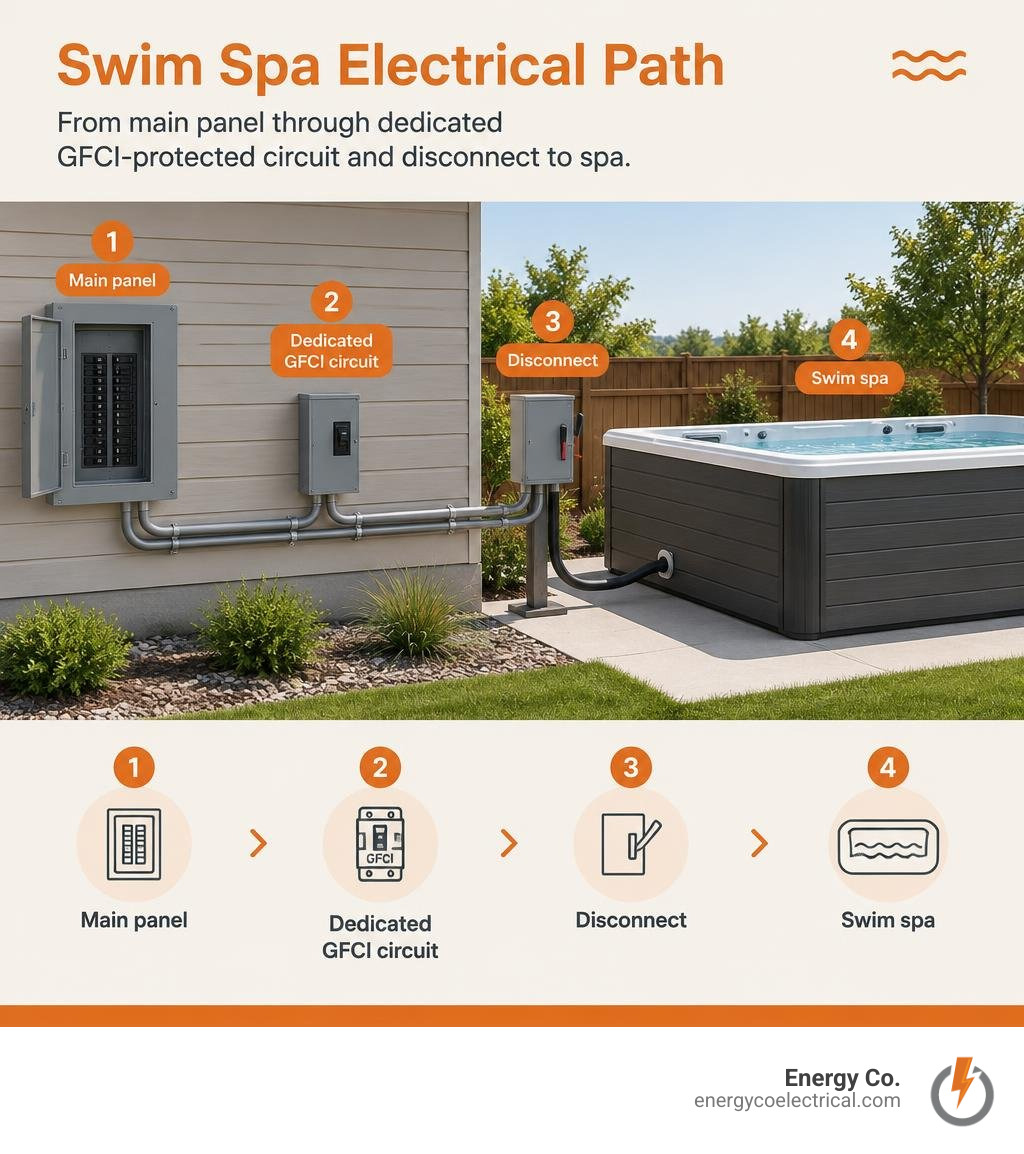
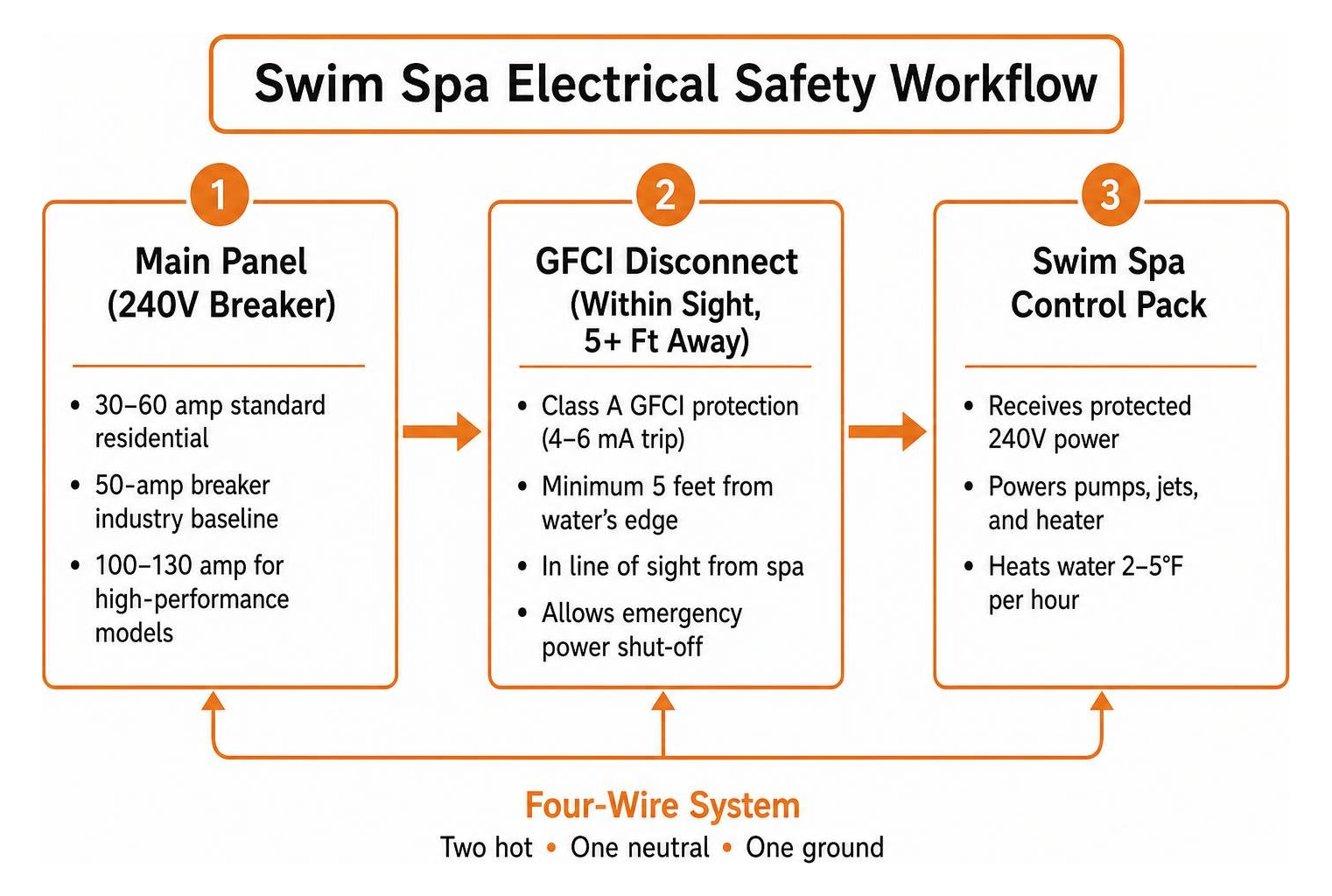
Most full-size swim spas need a dedicated 240-volt circuit with GFCI protection. A 50-amp breaker is common, but dual-zone and high-performance models may need more power or multiple circuits. For swim spa wiring, start with the exact model’s electrical specifications. Then have a licensed electrician check your panel capacity, size the wiring, and plan a disconnect that is within sight of the spa and at least 5 feet away.
That check matters in older Chicagoland homes, where an available breaker space does not always mean the panel can handle the added load. I’m Michał Napieralski, and this guide will help you know what to settle before your swim spa arrives.
Swim spa wiring vocabulary:
Critical Swim Spa Wiring Requirements and Amperage Demands
Unlike standard residential hot tubs that primarily run a couple of therapy pumps and a modest heater, a swim spa is an aquatic treadmill. Generating a continuous, swim-in-place current demands substantial electrical energy. The total load depends heavily on whether your unit is a standard single-zone tub or an advanced dual-zone design featuring independent water reservoirs for swimming and relaxation.
To understand what your backyard retreat needs, review these common configurations:
| Spa Category | Voltage Rating | Dedicated Amperage | Breaker Configuration | Typical Application |
|---|---|---|---|---|
| Plug-and-Play | 120V | 15A – 20A | Single-pole GFCI | Small exercise pools, slow heating |
| Standard Single-Zone | 240V | 50A – 60A | 2-pole GFCI (Hardwired) | Full-size fitness spas, rapid heating |
| High-Performance | 240V | 100A – 130A | Multi-breaker subpanel | High-output propulsion currents |
| Dual-Zone Swim & Spa | 240V | 100A (Dual 50A) | Two independent 2-pole GFCIs | Separate swim and hydrotherapy zones |
Standard residential models draw between 30 and 60 amps, with a 50-amp breaker serving as the industry baseline for mid-range units. However, high-performance propulsion systems and dual-zone designs often require 100-amp service—or up to 130 amps on specialized commercial-grade setups—to power multiple swim pumps, secondary jet arrays, and multi-kilowatt heaters simultaneously.
Operating on a 240V system allows the heater to raise water temperatures by 2 to 5 degrees Fahrenheit per hour, whereas a 120V system struggles in cold Midwest winters. Sizing these systems accurately is critical for long-term reliability; see the essential swim spa electrical requirements outlined by major manufacturers for equipment-specific baselines.
Sizing Conductors and Conduit for Swim Spa Wiring
High-amperage equipment creates intense thermal strain on electrical conductors. For a typical 50-amp to 60-amp, 240-volt circuit, the National Electrical Code (NEC) mandates a four-wire system: two insulated hot conductors, one insulated neutral conductor, and one equipment grounding conductor.
We install individual thermoplastic high heat-resistant nylon-coated (THHN) copper conductors pulled through rigid outdoor conduit. Aluminum wiring is strictly prohibited for spa connections by most manufacturers and local building codes because it expands and contracts under heavy thermal loads, causing loose lugs, arcing, and fire hazards.
When planning conduit runs, consider:
- Standard Runs (Under 50 Feet): Sized with #6 AWG copper conductors for 50-amp circuits.
- Extended Runs (Over 50–100 Feet): Must be evaluated for voltage drop. If line resistance drops voltage by more than 3%, pumps run hot and premature motor failure occurs. Electricians step up the conductor size to #4 AWG or larger.
- Conduit Material: Schedule 40 or Schedule 80 PVC is used for underground runs, while liquid-tight flexible metal conduit (LFMC) or liquid-tight flexible nonmetallic conduit (LFNC) is used for the final sweep into the spa cabinet to isolate pump vibrations.
Detailed guidelines on cable sizing for high-amperage spa installations help prevent nuisance voltage drops over long backyard distances.
Dedicated GFCI Protection and Disconnect Switch Placement
Water and high-voltage electricity demand strict safety engineering. Under NEC Article 680, every outdoor swim spa circuit must be protected by a dedicated Class A Ground Fault Circuit Interrupter (GFCI). A Class A device trips when it detects current leakage to ground between 4 and 6 milliamperes, shutting off power in milliseconds to prevent electrocution.
The NEC enforces strict rules regarding the outdoor maintenance disconnect:
- Minimum Distance: The disconnect switch must be located at least 5 feet away from the inside water’s edge to prevent a bather from touching the switch while still in the water.
- Line of Sight: It must be clearly visible and unobstructed from the spa.
- Emergency Access: First responders or family members must be able to shut off all power instantly if an emergency occurs.
Review our step-by-step walkthrough on proper hot tub disconnect box installation to see how these critical safety clearances are maintained.
Evaluating Main Panel Capacity and Electrical Upgrades
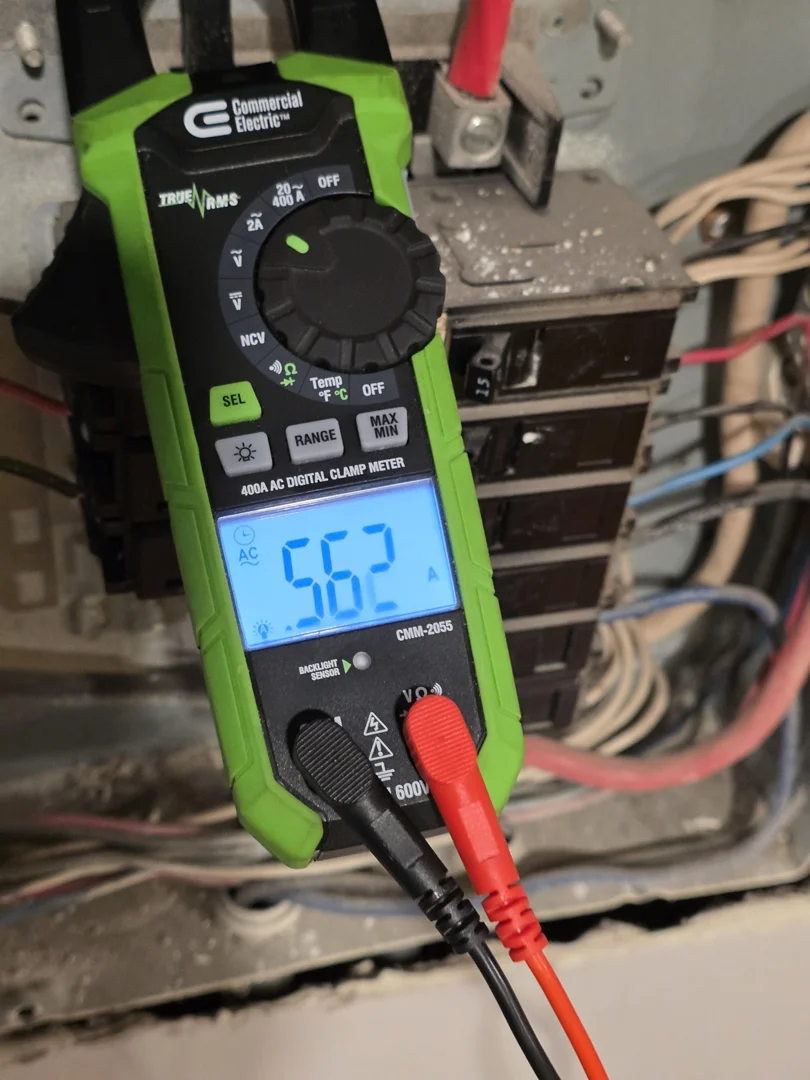
Before ordering a swim spa, you must verify that your home’s main electrical service can handle the demand. In communities across the Northwest Suburbs—such as older neighborhoods in Schaumburg, Rolling Meadows, and Palatine—many homes were originally built with 100-amp or 120-amp main service panels.
Adding a 50-amp or 100-amp continuous load to an older 100-amp panel will cause frequent main breaker trips when your central air conditioning, electric dryer, or kitchen range kick on at the same time.
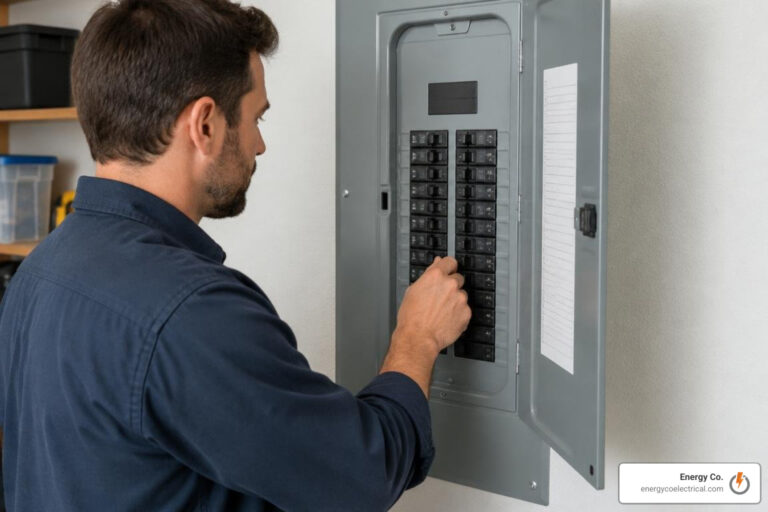
A licensed electrician performs a whole-home load calculation based on your square footage and major appliances:
- Homes with 100-Amp Panels: Almost universally require a heavy-up service upgrade to 200 amps before installing a full-size swim spa.
- Homes with 200-Amp Panels: Typically have enough capacity, provided there is physical space for a double-pole breaker and the calculated peak load stays within safe thresholds.
If your main panel lacks physical breaker spaces but has sufficient amperage capacity, an electrician can install a dedicated outdoor subpanel adjacent to the spa foundation. Homeowners facing panel space limitations can arrange a residential electrical panel upgrade to bring their service up to modern standards.
Single-Pack vs. Multi-Pack Controllers and Propulsion Systems
High-end swim spas use complex control architectures. Units equipped with heavy-duty counter-current propulsion systems—such as industrial-grade propeller drives or high-flow counter-current jets—rely on advanced electronic platforms.
As detailed in the Gecko TechBook specifications, manufacturers frequently use a master-slave configuration with dual control packs. In a single-breaker setup, the control system load-sheds, turning off the electric heater whenever the high-output swim pumps run at full speed. In a dual-breaker, two-supply setup, the swim current and the 4kW–5.5kW heating elements run simultaneously, maintaining your desired water temperature throughout mid-winter workouts.
Preventing Tripped Breakers and Troubleshooting Common Faults
If your newly installed or existing swim spa trips its breaker, avoid resetting it repeatedly without diagnosing the cause. GFCI breakers trip for two distinct reasons: true overcurrent/short circuits or ground faults.
Common triggers include:
- Moisture Intrusion: Rain or condensation entering an improperly sealed disconnect box or conduit fitting.
- Loose Neutral Connections: A floating or loose neutral wire on a 120V/240V shared control board creates an immediate voltage imbalance that trips the GFCI.
- Corroded Heating Elements: Over time, spa water chemistry can degrade the element sheath, causing electrical current to leak into the water path and triggering the ground fault sensor.
- Pump Motor Windings: Failing insulation in secondary jet pumps or primary propulsion drives can leak micro-currents to the motor chassis.
If you are dealing with unexplained power outages, professional circuit breaker repair can help locate the ground fault before it damages sensitive spa electronics.
Site Preparation, Grounding, and Bonding Safety
Grounding protects the electrical equipment, but equipotential bonding protects bathers from electric shock. Stray voltages can emerge from underground power cables, nearby home circuitry, or utility neutral lines. If metal components near the spa reach a different electrical potential than the water or the concrete surrounding it, anyone stepping in or out can complete the circuit and receive a shock.
Under NEC Section 680.42, installers must construct an equipotential bonding grid:
- A continuous, bare #6 AWG solid copper conductor must bond the spa equipment pack, pump motor housings, metal conduit fittings, and any metallic handrails or fencing within 5 feet of the water.
- If the spa sits on an outdoor concrete pad with steel rebar, that rebar grid must be tied into the bonding network using direct-burial approved brass bonding clamps.
Adhering to safe spa wiring practices guarantees that every metal surface, the pad, and the water maintain the exact same electrical potential, eliminating shock hazards.
Trenching, Conduit Burial, and Structural Clearances
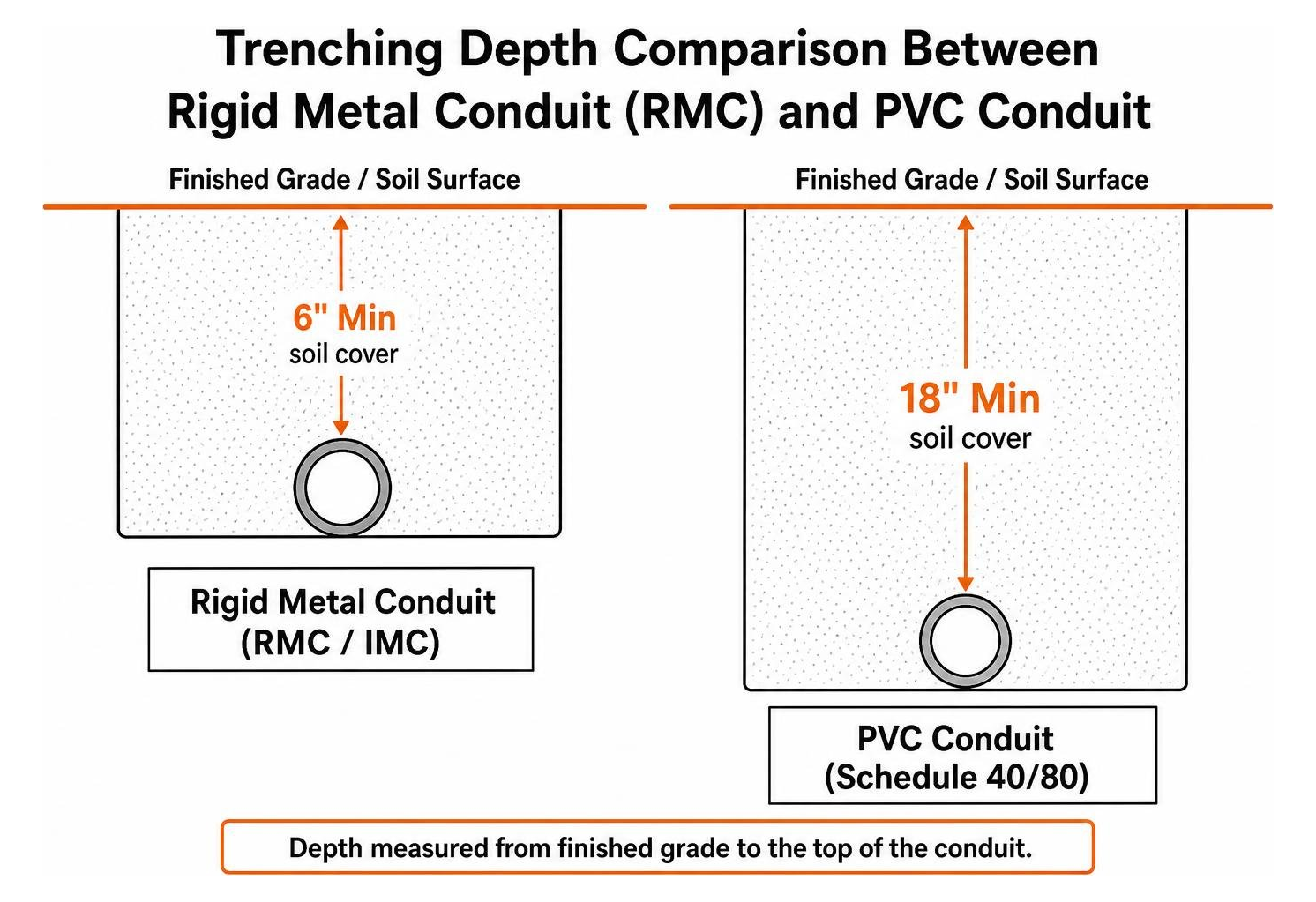
Running high-voltage lines outdoors requires adhering to municipal trenching depths. Building departments in Cook County enforce strict minimum cover requirements measured from finished grade to the top of the conduit:
- Schedule 40/80 PVC Conduit: Minimum 18 inches of soil cover.
- Rigid Metal Conduit (RMC) / Intermediate Metal Conduit (IMC): Minimum 6 inches of soil cover.
- Direct Burial Cables (where permissible): Minimum 24 inches of soil cover.
Additionally, inspect overhead clearances. Never place a swim spa directly beneath overhead utility or electrical service drop lines. Maintain a radial clearance of at least 10 feet from overhead power lines, and leave at least 3 feet of unobstructed clearance around all access panels on the spa cabinet for future equipment servicing.
Permits, Project Costs, and Installation Planning
Wiring an outdoor swim spa requires an electrical permit and subsequent municipal inspection in nearly every incorporated community, including Hoffman Estates, Elk Grove Village, and Hanover Park. Skipping a permit can void your equipment warranty, complicate future home sales, and potentially void your homeowner’s insurance policy in the event of an electrical fire.
For a straightforward installation where the main service panel has available capacity and the spa sits within 30 feet of the house, wiring costs generally range from $750 to $1,500. However, several site-specific factors can increase total project investment:
- Trenching Distance: Long backyard runs through rocky soil or under paved patios add $500 to $1,200 in excavation and materials.
- Service Upgrades: Upgrading an outdated main panel to a 200-amp service adds $1,500 to $3,500.
- Dual-Zone Complexity: Running two dedicated 50-amp circuits with separate outdoor subpanels increases labor and breaker hardware expenses.
Refer to our complete practical guide to electrical installation for an overview of planning home electrical renovations and scheduling inspections.
Step-by-Step Pre-Delivery Checklist for Swim Spa Wiring
- Verify Exact Model Specs: Download the manufacturer’s hookup manual for your specific model (e.g., single-pack 50A vs. dual-pack 100A).
- Schedule an Electrical Site Assessment: Have an electrician calculate existing panel load, identify subpanel placement, and mark the conduit pathway.
- Pour and Cure the Foundation: Ensure your reinforced concrete slab (typically 6 inches thick, rated for 1,000+ psi) is poured, grounded, and fully cured before delivery day.
- Pull Local Permits: Submit site plans and one-line electrical diagrams to your local municipal building department.
- Rough-In Trench and Conduit: Excavate trenches to the code-required depth and install sweep elbows that enter through the bottom or side of the designated spa cabinet corner.
- Mount GFCI Disconnect: Install the weatherproof outdoor disconnect on an exterior wall or mounting post in direct line of sight, between 5 and 10 feet from the spa.
- Pull Copper Conductors: Draw four-wire THHN copper conductors through the conduit run, keeping lines ready for final connection.
- Final Hookup and Inspection: Once the crane or delivery crew sets the spa on the pad, make the final terminations to the control board, verify grounding torque, and pass municipal inspection before filling with water.
Energy Efficiency and Operating Cost Management
Operating a large body of heated water year-round requires proactive efficiency management. Swim spas consume between 2 and 6 kWh per hour depending on ambient weather, usage frequency, and pump speed. In our region, this equates to average monthly electricity costs of $150 to $300.
To keep power consumption manageable:
- Choose Full-Foam Insulation: Factory-sprayed high-density foam locks heat into the plumbing manifold and reduces heater runtime.
- Program Off-Peak Filtration: Set your dual-speed or variable-speed filtration pumps to cycle during off-peak utility billing windows.
- Maintain a Consistent Temperature: Reheating water from a cold baseline requires far more energy than maintaining a steady setpoint with an insulated thermal cover.
Frequently Asked Questions About Swim Spa Wiring
Can I wire a 240V swim spa myself, or do I need a licensed electrician?
We strongly advise against DIY installation. Wiring a 240V, high-amperage outdoor appliance requires working inside the main panel, calculating complex voltage drops, routing rigid conduit, and executing specialized equipotential bonding. An error can cause serious electrical shock, destroy costly control boards, and void your manufacturer’s warranty. Working with licensed residential electrical services ensures the job complies with NEC Article 680 and passes local inspections.
Why does my swim spa breaker trip as soon as the heater or jets turn on?
When a breaker trips immediately upon turning on a high-load component, it points to either a direct short circuit or a ground fault inside that specific part. A cracked heating element sheath or worn motor winding allows microscopic electrical currents to leak into the water, immediately tripping the sensitive GFCI. If your spa trips on startup, contact our team for 24-hour emergency electrical troubleshooting to isolate and repair the issue safely.
How much does it typically cost to wire a swim spa from scratch?
A straightforward installation generally costs between $750 and $1,500. However, if your home needs an electrical service panel upgrade, requires concrete core drilling, or involves long trenching across an expansive yard, total costs can climb to $3,000 or more.
Conclusion
A swim spa brings year-round fitness and relaxation right to your backyard, but it demands serious electrical power. From sizing copper conductors and setting line-of-sight GFCI disconnects to bonding the concrete pad and confirming main panel capacity, safe operation depends on precise execution. Taking shortcuts with high-voltage, outdoor aquatic wiring puts your property and your family at risk.
At Energy Co., our licensed professionals bring deep local experience to every project across Chicago, Arlington Heights, Mount Prospect, Cicero, and the surrounding Northwest Suburbs. We handle every step of the process—including load calculations, permitting, conduit rough-ins, and final terminations—with a 100% satisfaction guarantee.
Contact our team today to evaluate your panel capacity and install reliable, code-compliant dedicated hot tub and spa circuits before delivery day arrives!