What Does an Automatic Standby Generator Installation Cost?
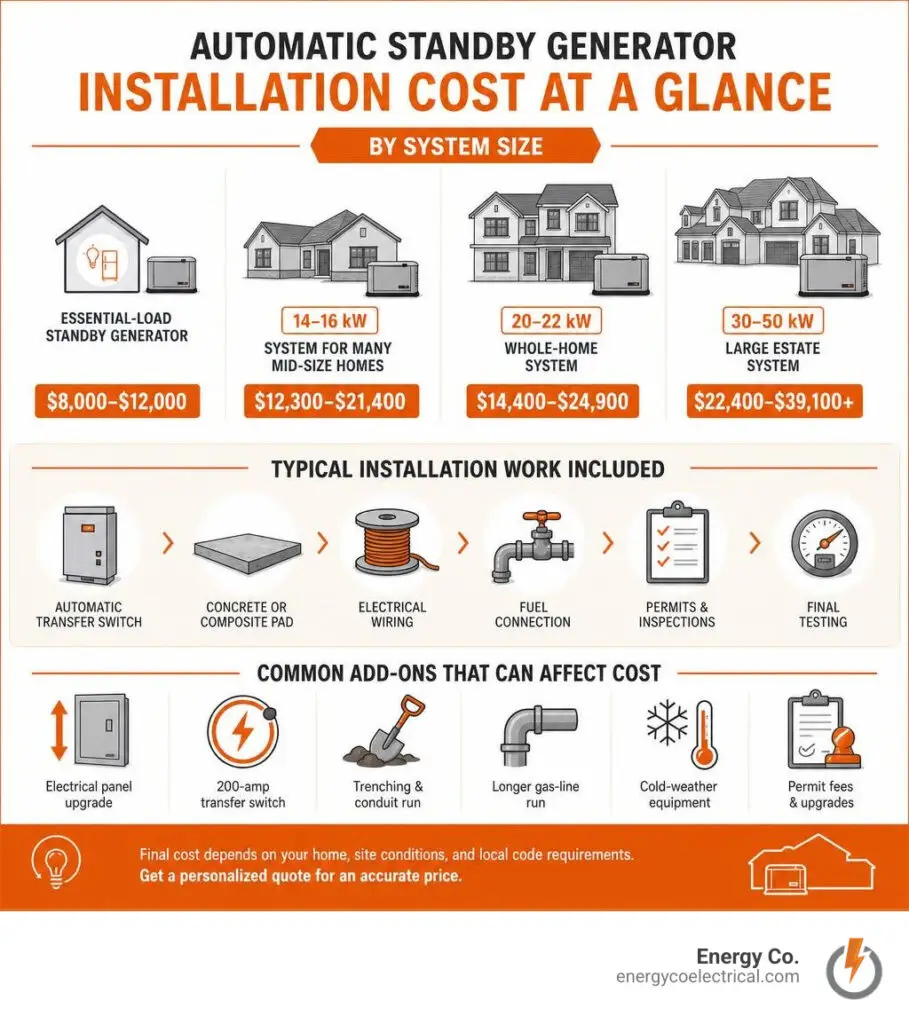
For most homes, the automatic standby generator installation cost is $8,000 to $16,000 installed. A typical whole-home system can cost more when it needs a larger generator, a long gas-line run, trenching, a 200-amp transfer switch, or an electrical-panel upgrade.
A practical starting budget is:
| System type | Typical installed cost |
|---|---|
| Essential-load standby generator | $8,000-$12,000 |
| 14-16 kW system for many mid-size homes | $12,300-$21,400 |
| 20-22 kW whole-home system | $14,400-$24,900 |
| Large 30-50 kW estate system | $22,400-$39,100+ |
The unit itself is only part of the bill. Your quote should also cover the automatic transfer switch, concrete or composite pad, electrical wiring, fuel connection, permits, inspections, and final testing. In the Chicago area, older electrical panels, local permit rules, winter weather equipment, and high-demand storm periods can all move the final price.
I am Michał Napieralski of Energy Co., and our licensed team works with Chicago-suburb homeowners and businesses on electrical panels, wiring, inspections, and code-compliant backup-power planning. That hands-on electrical experience helps us explain automatic standby generator installation cost in terms of the real work your property may need, not just the generator price tag.
Real-World Automatic Standby Generator Installation Cost Breakdown
When reviewing estimates, you quickly discover that the generator unit itself represents roughly 45% to 55% of the total investment. The rest goes toward specialized labor, transfer equipment, electrical components, plumbing, and regulatory compliance.
Here is how typical project pricing breaks down across common residential capacities:
| Generator Capacity (kW) | Equipment & Transfer Switch | Labor, Materials & Gas | Total Installed Range | Best Suited For |
|---|---|---|---|---|
| 7 – 10 kW | $3,000 – $4,500 | $3,500 – $5,000 | $6,500 – $9,500 | Essential circuits (sump pump, fridge, lights, furnace fan) |
| 14 – 16 kW | $4,500 – $6,500 | $4,500 – $7,500 | $9,000 – $14,000 | Mid-sized homes, essential circuits plus one central AC |
| 20 – 24 kW | $5,500 – $8,500 | $5,000 – $8,500 | $10,500 – $17,000 | Full whole-home coverage without strict power rationing |
| 30 – 50 kW (Liquid-Cooled) | $12,000 – $22,000 | $8,000 – $15,000+ | $20,000 – $37,000+ | Large estate properties, multi-zone HVAC, commercial loads |
Professional installation labor typically ranges from $2,000 to $6,000 depending on your home’s setup. To estimate contractor pricing models, contractors often balance material margins against labor risk using tools like a generator installation pricing calculator. If you are wondering how to calculate keyword generator installation cost and process details for your own property, breaking the job down into distinct mechanical and electrical sub-tasks is the best way to avoid surprises.
Sizing Impact on Automatic Standby Generator Installation Cost
Generator sizing is measured in kilowatts (kW) and dictates both equipment price and electrical infrastructure needs. Sizing a system involves evaluating two distinct metrics: running (continuous) wattage and starting (surge) wattage.
Inductive motor loads—such as central air conditioners, well pumps, and refrigerator compressors—require a temporary surge of extra power (starting watts) to start up. If your generator lacks sufficient headroom, the sudden spike will trip the unit.
- 7–10 kW (Essential Load Systems): Powers critical loads via a dedicated subpanel. It covers a refrigerator, freezer, WiFi router, LED lighting circuits, gas furnace blower, and sump pump.
- 14–16 kW (Managed Whole-House Systems): Handles essential loads plus a 3- to 4-ton central air conditioning compressor, often utilizing intelligent load-shedding modules to manage heavy electrical draws.
- 20–24 kW (True Whole-House Systems): The standard for modern 2,000- to 3,500-square-foot homes. This tier allows you to run multiple high-draw appliances simultaneously—such as your AC, electric water heater, and kitchen appliances—without manual intervention.
- 30–50 kW (Liquid-Cooled Estate Systems): Designed for larger properties or residences with extensive electrical loads like dual HVAC units, electric vehicle (EV) charging stations, outbuildings, or medical support equipment.
For a deeper look into selecting the right capacity, check out a practical guide to standby generator costs options for your home.
Site Preparation and Fuel Logistics in Automatic Standby Generator Installation Cost
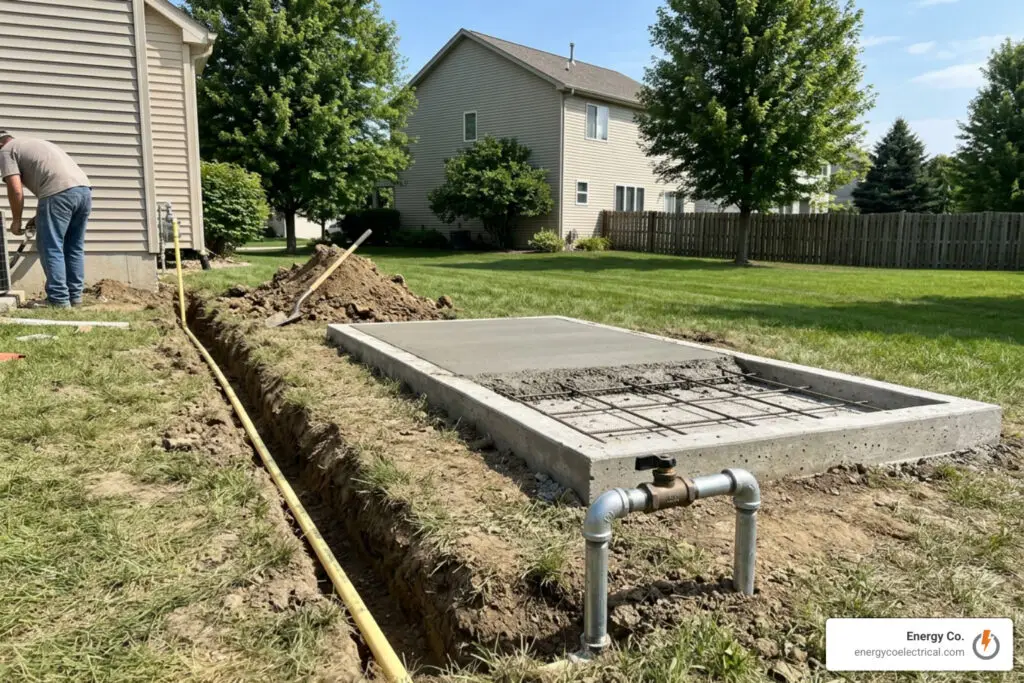
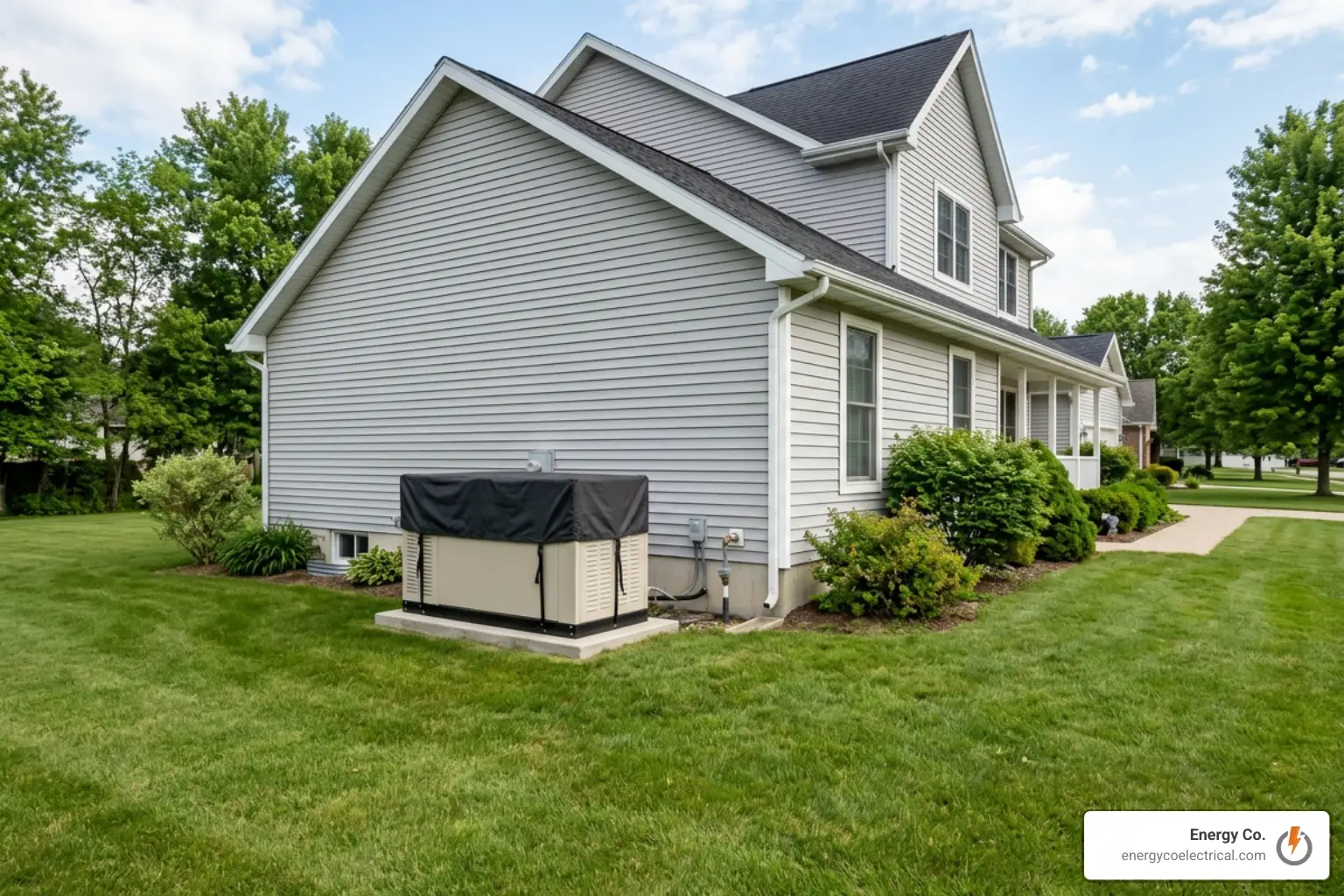
A standby generator cannot sit directly on bare dirt. Site preparation requires a level, stable, and well-drained foundation. Installers typically set the generator on either a poured-in-place concrete slab or a high-density, steel-reinforced composite pad over a tamped pea-gravel bed ($400 to $1,200).
Fuel logistics represent another major cost variable:
- Natural Gas Connections: If your home already has natural gas service, this is usually the most economical approach. However, standby generators require high volume at low pressure (measured in BTUs per hour and inches of water column). Running a gas line from your meter to the unit ranges from $500 to $2,000 depending on distance. If your existing gas meter cannot deliver sufficient volume when your furnace, water heater, and generator run at the same time, the utility may need to upgrade the meter.
- Liquid Propane (LP) Configurations: For properties without natural gas, liquid propane provides high energy density. Installing an above-ground or underground propane tank (typically 250 to 500 gallons) adds $800 to $2,500+ for the tank and dedicated supply line. A 500-gallon tank usually provides 5 to 7 days of continuous runtime during an extended grid outage.
Trenching distance also impacts total costs: longer runs between your electrical panel, utility meter, and the generator location require deeper conduit trenching ($15 to $35 per linear foot). Reviewing don’t blow it a guide to standby generator gas line setup helps illustrate how proper pipe diameter and routing prevent fuel-starvation issues.
Core Infrastructure Costs: Electrical, Codes, and Permitting
Standby generator installations are governed by strict safety standards, primarily NEC Article 702 (Optional Standby Systems), NEC Article 445 (Generators), NEC Article 250 (Grounding and Bonding), and NFPA 37 (Combustion Engines and Fire Clearances).
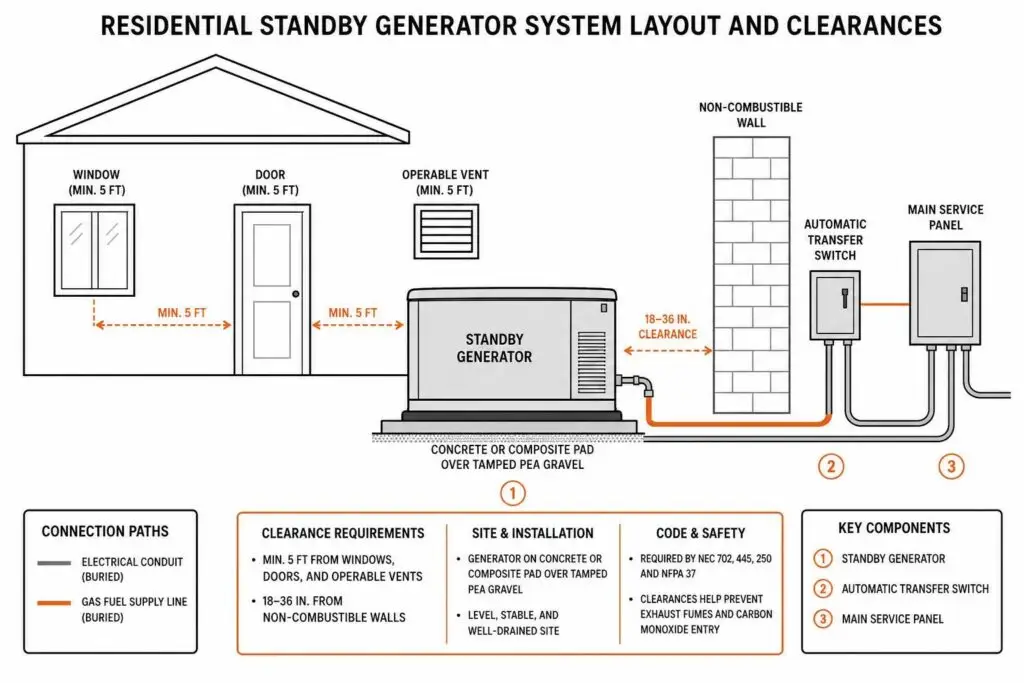
Code requirements impact your budget in several specific areas:
- Clearance Compliance: Generators must maintain minimum clearances (typically 5 feet from window openings, doors, and operable vents, and 18 to 36 inches from non-combustible walls) to prevent exhaust fumes and carbon monoxide from entering the living space.
- Main Service Panel Upgrades: If your home has an older 100-amp service panel that is physically full or lacks sufficient bus capacity, upgrading to a 200-amp service panel adds $1,500 to $3,500 to the project.
- Permitting and Municipal Fees: Local building, mechanical, and electrical permits generally cost between $200 and $1,500 depending on your municipality. Reviewing Cook County generator installation from permits to power up will give you a clear roadmap of local authority requirements.
- National and Regional Benchmarks: For additional baseline comparisons on code-compliant pricing across various markets, check out this standby generator installation cost price guide.
Automatic Transfer Switch (ATS) Requirements
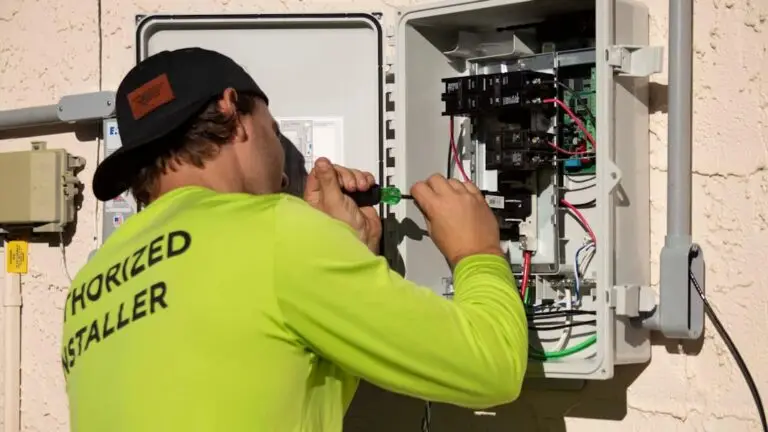
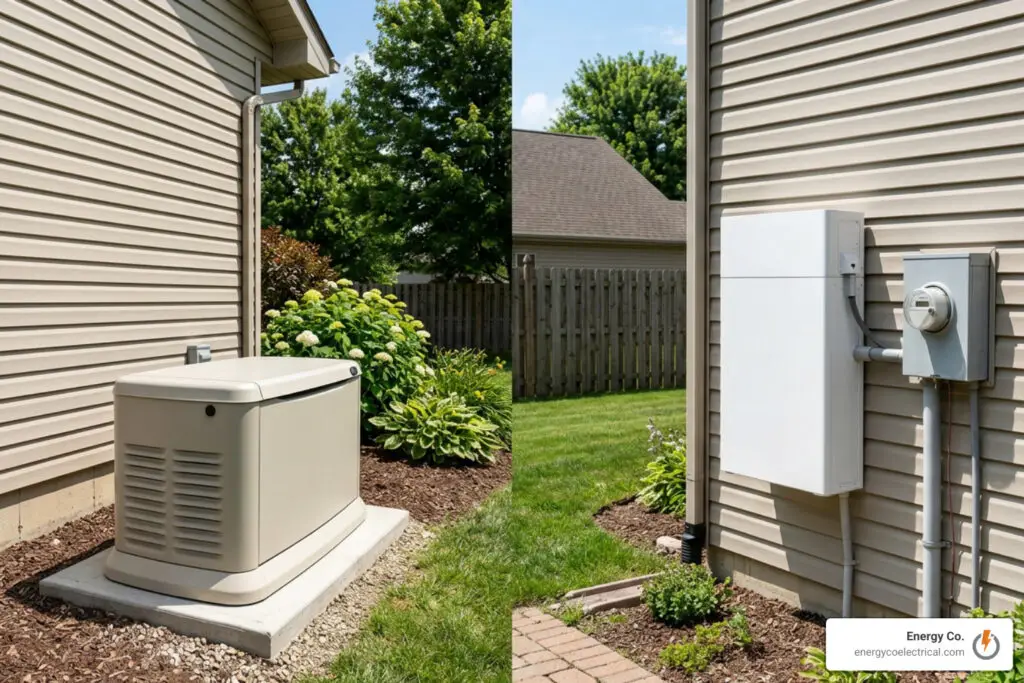
The Automatic Transfer Switch (ATS) acts as the brain of your backup system. When utility voltage drops or fails entirely, the ATS detects the loss, signals the generator engine to start, disconnects your home from the utility grid, and switches your electrical load over to generator power within 10 to 20 seconds.
- 100-Amp Subpanel ATS ($500 – $1,200 installed): Designed for essential-circuit coverage, transferring only selected circuits during an outage.
- 200-Amp Whole-House Service-Rated ATS ($1,500 – $3,500 installed): Installs between your electrical meter and main breaker panel, allowing automatic whole-house coverage.
- Power Management Modules (PMMs): Smart modules that electronically shed large non-critical loads (like an electric oven or secondary AC) if the generator approaches maximum capacity, preventing overloads.
Navigating Regional Labor and Permitting Variables
Labor rates and municipal requirements vary. In northern climates and regions subject to severe freezes, installations require cold-weather kits (oil heaters and battery warmers costing $200 to $500) to ensure reliable starts at sub-zero temperatures.
Furthermore, high storm seasons can lead to contractor backlogs and higher emergency rates. Working with certified professionals ensures compliance with local safety codes; read our guide on how to safely install a backup generator for your home to see why proper grounding, neutral isolation, and utility safety are critical.
Standby Generators vs. Portables and Battery Storage Systems
When evaluating backup power options, it helps to compare stationary standby generators against portable units and whole-home battery backup systems:
| System Type | Typical Installed Cost | Automatic Transfer? | Fuel / Power Source | Continuous Runtime | Maintenance Needs |
|---|---|---|---|---|---|
| Whole-Home Standby Generator | $8,000 – $16,000+ | Yes (10–20 seconds) | Natural Gas / Propane | Indefinite (NG) or 5–7 days (Propane tank) | Annual oil/filter service ($200–$500/yr) |
| Portable Generator + Interlock | $4,400 – $7,700 | No (Manual setup) | Gasoline / Dual-Fuel | 6–12 hours per tank refill | Engine maintenance & fresh fuel rotation |
| Whole-Home Battery Backup | $12,000 – $25,000+ | Yes (Instantaneous) | Grid / Solar Recharge | 8–24 hours (Expands with solar) | Minimal regular maintenance |
- Portable Generators: While a portable generator paired with a manual interlock switch offers a lower upfront cost ($4,400 to $7,700 installed), it requires manual rollout, cable hookups in severe weather, and continuous gasoline management during an outage.
- Home Battery Systems: Battery banks provide silent, instant transfer without on-site fossil fuels. However, multi-day winter storms with low solar generation can deplete storage quickly. To evaluate this approach, see the ultimate guide to installing a standalone battery backup.
Long-Term Maintenance, Warranties, and Financing Solutions
To keep an automatic standby generator reliable, plan for modest ongoing maintenance costs:
- Annual Preventative Maintenance ($200 – $500 per year): Covers engine oil changes, spark plug inspection, air/oil filter replacements, valve lash checks, battery load tests, and ATS transfer simulations.
- Self-Exercise Cycles: Most modern units run an automatic 5- to 12-minute weekly self-test cycle at low RPM to lubricate internal seals and verify system readiness.
- Warranties: Standard manufacturer warranties typically range from 5 to 10 years, covering parts and labor against manufacturing defects when serviced by certified technicians.
- Financing Solutions: Many homeowners take advantage of flexible financing programs with monthly installments starting around $109/month, spreading the upfront cost across multi-year terms.
- Insurance Savings: Because an automatic standby generator protects against frozen pipes, mold from failed sump pumps, and food spoilage, many homeowners insurance carriers offer policy discounts of 4% to 10%.
Frequently Asked Questions About Standby Generator Costs
How long does a whole-house generator installation take from start to finish?
The physical installation on your property typically takes 1 to 2 business days (one day for site prep, pad placement, and mechanical mounting, and another for electrical and gas hookups). However, the total project timeline from contract signing to final commissioning usually spans 2 to 6 weeks. This timeline accommodates local municipal plan reviews, permit approvals, utility meter evaluations, and scheduling final municipal building and electrical inspections.
Is a whole-house standby generator worth the investment for resale value?
Yes. In regions with severe weather and aging power grids, an automatic standby generator is a sought-after home feature. Real estate data shows that a professionally installed standby generator can increase a home’s market value by roughly 3% to 5%, while substantially boosting buyer interest and reducing days on market during sale.
Can I save money by doing a DIY standby generator installation?
We strongly discourage DIY standby generator installations. Installing a stationary generator requires cutting into main service entrance cables, configuring high-voltage transfer switches, tying into high-pressure municipal gas lines, and securing complex municipal permits.
Improper DIY installations violate NEC Article 702, risk carbon monoxide poisoning or backfeeding the utility grid (which endangers line workers), void the manufacturer’s warranty, and will fail municipal inspections. Always rely on licensed, insured electrical and mechanical contractors.
Conclusion
A whole-home automatic standby generator provides continuous peace of mind, keeping your home warm, dry, and powered through unpredictable weather events. While the total investment ranges from $8,000 to $16,000 for most residential applications, understanding your property’s electrical and fuel requirements helps you budget accurately.
At Energy Co., we specialize in delivering safe, code-compliant, and transparent electrical solutions throughout Chicagoland, including Schaumburg, Hoffman Estates, Elk Grove Village, Rolling Meadows, Palatine, Roselle, Streamwood, Hanover Park, Arlington Heights, Mount Prospect, and Cicero.
For additional planning resources, explore the definitive guide to standby generator installation costs or contact our team today to schedule an expert load evaluation and receive an itemized, shock-free installation quote.