Last updated:
How to Spot Electrical Wiring Problems at Home
Electrical wiring problems often show up as flickering lights, breakers that trip repeatedly, loose plugs, buzzing, hot outlets, sparks, or a burning smell. If you notice heat, sparks, or an odor, stop using the outlet or circuit. Turn off its breaker only if you can do so safely, and call a licensed electrician. If you see smoke or fire, leave the building and call 911.
For a flickering light, try a different bulb. For a dead outlet, check whether a nearby GFCI has tripped. If the problem returns, don’t keep resetting it. A professional needs to find the cause, especially in an older Chicago home where the wiring may not meet today’s needs.
I’m Michał Napieralski, and this guide will help you sort simple checks from signs that need an electrician.
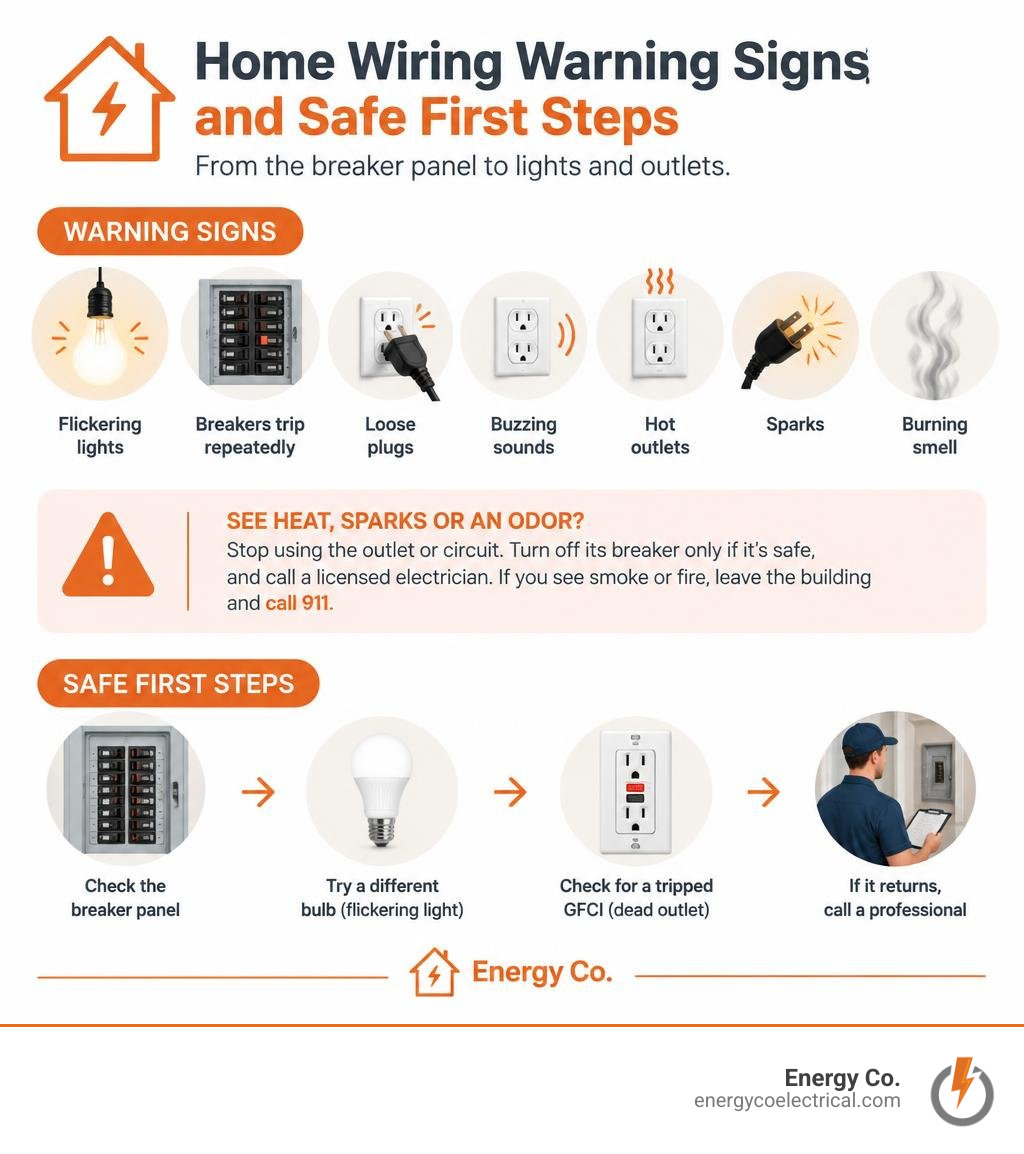
Simple guide to electrical wiring problems:
According to the Electrical Safety Foundation International, electrical malfunctions cause more than 50,000 house fires each year. Understanding how electrical flow travels through your home’s infrastructure can help you spot hazards long before they become active threats.
Recognizing the Warning Signs of Electrical Wiring Problems
Your electrical system constantly communicates with you through sight, sound, touch, and smell. Recognizing these cues helps prevent minor circuit faults from escalating into dangerous arc faults, charred insulation, or structure fires.
Visual, Auditory, and Olfactory Red Flags
When an electrical circuit degrades, it produces distinct physical symptoms:
- Unusual Odors: A fishy, acrid, or burning plastic smell near an outlet, switch, or main service panel indicates that wire insulation is melting due to localized overheating or sustained arcing.
- Auditory Warnings: Outlets, light switches, and breaker panels should operate silently. If you detect a distinct buzzing, sizzling, or humming sound, it points to loose terminal connections, vibrating components under load, or dangerous electrical arcing.
- Thermal Anomalies: Outlet faceplates and wall switches should never feel hot to the touch. A warm or vibrating cover plate suggests an overloaded circuit, loose wiring splices, or internal contact failure.
- Visible Discoloration: Blackened, scorched, or warped receptacle plastic signals active arc tracking and severe internal heat build-up.
Learn more about why these red flags occur in our breakdown of sparks and burning smells explained.
Nuisance Tripping, Flickering Lights, and Loose Outlets
Frequent disruptions in your daily power supply usually indicate deeper circuit instability:
- Breakers That Trip Constantly: Circuit breakers are designed to cut power when current exceeds safe operating limits (typically 15 amps for general lighting circuits and 20 amps for small appliance circuits). If a breaker trips the moment you turn on a microwave or hair dryer, the circuit is either overloaded or suffering from a direct short.
- Flickering and Dimming Lights: If your lights flicker when high-draw appliances kick on (like an air conditioner or refrigerator), your home may be experiencing significant voltage drops across shared branch circuits. If lights flicker during windy weather, frayed utility service lines at the outdoor weatherhead may be brushing together. Read our detailed guide on diagnosing home flickering issues to isolate the root cause.
- Overlamping Hazards: Installing a 100-watt incandescent bulb into a fixture rated for 60 watts generates excessive thermal energy, scorching the socket wiring and creating a latent fire hazard behind ceiling drywall.
- Loose Receptacle Contacts: If heavy appliance cords slip out of an outlet or plugs sit loosely within the socket slots, the internal metal contact tensioners are worn out. Worn contacts create high electrical resistance and small localized arcs. You can master straightforward safety checks using a systematic electrical troubleshooting guide.
The Hidden Dangers of Overloaded Extension Cords
Extension cords are intended strictly for temporary utility, not as permanent substitutes for dedicated structural wiring. Misusing them creates critical points of failure:
- Extension cords cause approximately 3,300 residential fires each year in the United States.
- Daisy-chaining power strips or running light-gauge extension cords under rugs traps heat and rapidly degrades wire jackets.
- Undersized wire gauges (such as using a 16-gauge lamp cord for a 1,500-watt space heater) lead to severe resistive heating, melting the vinyl casing long before the upstream circuit breaker trips.
Outdated Residential Systems: Hazards and Modern Upgrades
Older housing stock across Cook County and the surrounding Northwest Suburbs often features legacy electrical systems designed for a fraction of today’s power demands.
Resolving Hidden Electrical Wiring Problems in Older Homes
Two vintage wiring methods present severe modern safety and operational concerns:
- Knob-and-Tube Wiring (Late 1800s to 1940s):
- Consists of single insulated conductors routed through porcelain knobs and protective ceramic tubes.
- Lacks an equipment grounding conductor entirely.
- Utilizes rubber-and-cloth insulation that becomes brittle, cracks, and crumbles over decades of thermal exposure.
- Poses an extreme fire hazard when modern thermal insulation is blown into attics or walls, trapping heat that knob-and-tube requires open air to dissipate.
- Solid Aluminum Branch Wiring (Mid-1960s to Mid-1970s):
- Introduced as a low-cost substitute for copper.
- Possesses a higher thermal expansion coefficient than copper, causing it to expand and contract dramatically during electrical load cycles.
- This “creep” loosens mechanical screw terminals on standard receptacles, causing oxidation, high contact resistance, dangerous overheating, and potential structural fires.
- Remediation requires full copper replacement or retrofitting all terminal junctions using specialized, code-approved mechanical connectors like AlumiConn or COPALUM crimp sleeves.
Explore the engineering details in our complete guide to residential wiring types and review structural rewiring fundamentals to understand modern replacement techniques.
Ungrounded Outlets, Backstabbed Connections, and Wet-Area GFCI Protection
Modern residential electronics require stable grounding paths and robust mechanical connections:
- Two-Prong Ungrounded Receptacles: Older homes often feature legacy two-prong outlets lacking a dedicated ground wire. While adapters allow three-prong appliances to plug in, they offer zero surge dissipation or ground-fault diversion, leaving sensitive electronics and occupants vulnerable to shock.
- Backstabbed Push-In Connections: Many tract homes built over recent decades used push-in “backstab” terminals on the rear of switches and receptacles rather than wrapping the conductor around side screw terminals. These internal spring clamps lose tension over time, leading to intermittent power losses and hidden arc hazards inside the wall box.
- Wet-Location Safety: Modern building codes require Ground Fault Circuit Interrupter (GFCI) devices in kitchens, bathrooms, laundry rooms, garages, basements, and exterior locations. A GFCI continuously monitors the balance between incoming hot current and outgoing neutral current, cutting power within 4 milliseconds if an imbalance as small as 4 to 6 milliamperes occurs.
For a step-by-step breakdown of how power routes through your home, consult our guide on the residential meter to receptacle path. You can also review common household wiring issues and solutions to identify outdated code practices.
How Modern Smart Tech Exposes Latent Electrical Wiring Problems
Integrating smart home tech, high-efficiency heat pumps, and electric vehicles (EVs) places unprecedented demands on older residential systems:
- Missing Neutral Conductors: Smart dimmers, automated switches, and video doorbells require continuous baseline current to maintain wireless network connectivity, requiring dedicated neutral conductors inside switch boxes that older two-wire switch loops lack.
- Voltage Drop and Inrush Spikes: Smart appliances and sensitive microprocessors tolerate very narrow voltage windows. Weak, undersized branch circuits suffer voltage sags when central HVAC blowers start up, causing smart hubs to reboot or disconnect.
- High-Amperage Continuous Loads: Level 2 EV charging stations pull continuous 32-amp to 48-amp loads for hours at a time, instantly revealing thermal weaknesses in aging 100-amp service panels and deteriorating meter enclosures.
DIY vs. Licensed Electrician: Troubleshooting, Safety, and Costs in 2026
When evaluating electrical repairs, understanding the boundary between safe homeowner maintenance and work requiring a licensed electrical professional is essential for personal safety and code compliance.
| Electrical Task | Skill Level Required | Permit Required? | Safety Tools Required | Recommended Action |
|---|---|---|---|---|
| Replacing Wall Plate Covers | Beginner / DIY | No | Screwdriver | Safe for DIY |
| Resetting Tripped Breaker / GFCI | Beginner / DIY | No | Flashlight | Safe for DIY (Once) |
| Replacing Bulb within Fixture Rating | Beginner / DIY | No | Ladder, Work Gloves | Safe for DIY |
| Swapping 15A Receptacle (Like-for-Like) | Intermediate DIY | No (Jurisdiction Dependent) | Non-Contact Voltage Tester, Multimeter | DIY with Caution / Power Off |
| Diagnosing Burning Odor / Sizzling Panel | Professional | Yes (for Repairs) | Full Diagnostic Meter Kit, PPE | Call Licensed Electrician Immediately |
| Main Service Panel Upgrade (200A) | Professional | Yes | Commercial Utility Gear | Mandatory Licensed Electrician |
| Remediating Aluminum / Knob-and-Tube | Professional | Yes | Specialized Torque Tools, Crimp Gear | Mandatory Licensed Electrician |
| Installing Dedicated EV / 240V Circuit | Professional | Yes | Conduit Benders, Load Calculators | Mandatory Licensed Electrician |
Safe Homeowner Fixes vs. Mandatory Professional Interventions
Before touching any electrical device, you must always follow core safety protocols: turn off the branch breaker at the main distribution panel, lock out the panel door if possible, and verify the total absence of power using a reliable non-contact voltage tester directly against the circuit conductors.
Homeowners can safely tackle tasks like swapping decorative wall plates, changing dead light bulbs for matched LED units, and resetting a single tripped GFCI receptacle. However, work involving panel interiors, adding new branch runs, fishing wire through structural wall cavities, or repairing legacy aluminum wiring involves high-voltage arc-flash and electrocution hazards.
Review our fundamental home electrical repair dos and don’ts and explore our practical homeowner electrical troubleshooting tips. For a comprehensive decision framework on project safety, read this electrical safety guide on DIY vs. professional work.
Estimated Repair and Upgrading Costs in 2026
In 2026, standard hourly rates for licensed residential electricians generally range from $80 to $150 per hour depending on complexity, location, and emergency response needs:
- Standard Receptacle or Switch Replacement: $150 – $250 per device (including diagnostic verification and labor).
- Dedicated 20-Amp Appliance Circuit Addition: $300 – $800 per run.
- Main Service Panel Upgrade (100A to 200A Service): $1,800 – $4,500 (including local municipal permits, utility coordination, and new grounding electrode systems).
- Level 2 EV Charger Dedicated 240V Circuit: $500 – $1,400.
- Comprehensive Whole-Home Rewire: $8,000 – $20,000+ depending on home square footage, wall accessibility, and finish restoration needs.
If your home suffers from systemic wiring failure or crumbling insulation, explore our complete whole house rewiring solutions.
Recommended Electrical Inspection Frequencies and Code Compliance
The Consumer Product Safety Commission (CPSC) and the National Electrical Contractors Association recommend comprehensive professional electrical safety inspections at the following intervals:
- Every 10 Years: For modern single-family residences with copper wiring and modern breaker panels.
- Every 3 to 5 Years: For residences over 30 years old.
- Every 1 to 2 Years: For historic residences retaining any operational knob-and-tube or aluminum wiring segments.
- Upon Property Transfer: Prior to purchasing any existing home.
- Following Major Renovations: Roughly 11% of home renovation projects require structural permits and formal inspections; roughly 24% of bathroom remodels uncover hidden plumbing leaks and water damage behind walls, which can compromise nearby electrical cabling and necessitate mold remediation (seen in roughly 18% of projects).
Frequently Asked Questions About Residential Wiring
What should I do immediately if an outlet sparks or smells like burning plastic?
If an outlet produces visible sparks, emits sizzling sounds, or produces a distinct burning odor, take the following sequence immediately:
- Safely unplug any cord connected to that receptacle if you can do so without touching damaged or hot surfaces.
- Go directly to your main electrical panel and switch off the specific circuit breaker controlling that room.
- If the panel or breaker itself is hot, buzzing, or smoking, shut down the main service disconnect breaker only if safe to approach; otherwise, evacuate immediately and dial 911.
- Contact a qualified, licensed electrician to perform an in-wall diagnostic inspection before restoring power to the affected branch.
Why are GFCI outlets mandatory in kitchens and bathrooms?
Water is an exceptional conductor of electricity. In wet environments like kitchens, bathrooms, laundry rooms, and basements, a person who touches a faulty appliance while in contact with water or a grounded pipe can easily become the path of least resistance to ground.
GFCI (Ground Fault Circuit Interrupter) devices continuously measure the current flowing out on the hot wire and returning on the neutral wire. If the device detects a current difference as tiny as 4 to 6 milliamperes—indicating that current is leaking outside the circuit path, potentially through human tissue—it mechanically breaks the connection within 4 milliseconds. This ultra-fast reaction shuts off the power before a dangerous or fatal shock can occur.

How do I know if my house requires whole-home rewiring or just a panel upgrade?
A service panel upgrade (such as replacing a 100-amp fuse box or obsolete split-bus panel with a modern 200-amp breaker panel) resolves capacity constraints at the service entrance, enabling high-demand installations like central air conditioning or EV chargers.
However, a panel upgrade does not fix degraded wiring inside your walls. You likely need a whole-home rewire if:
- Your existing branch conductors feature ungrounded two-wire configurations throughout.
- The branch wiring consists of active knob-and-tube or un-remediated solid aluminum cabling.
- Wire insulation in attic spaces or basement joists is physically flaking, brittle, or discolored from chronic thermal overload.
- You experience persistent, widespread circuit breaker trips across multiple distinct living zones simultaneously.
Conclusion
Electrical wiring is the central nervous system of your home. Ignoring early warning signs like flickering fixtures, nuisance breaker trips, and warm outlet covers allows minor issues to develop into costly property damage or severe fire hazards.
At Energy Co., we specialize in comprehensive residential, commercial, and industrial electrical solutions throughout Chicago and the surrounding communities, including Schaumburg, Arlington Heights, Hoffman Estates, Elk Grove Village, Palatine, Rolling Meadows, Mount Prospect, Cicero, Roselle, Streamwood, and Hanover Park. Whether you are living in a historic Cook County home with legacy wiring or outfitting a modern home for high-draw smart systems, our licensed pros deliver reliable, code-compliant craftsmanship backed by our 100% satisfaction guarantee.
If you are dealing with unexplained circuit issues, contact Energy Co. for professional outlet and switch troubleshooting or call our team for 24/7 emergency response. Schedule your comprehensive home safety assessment today to keep your home’s power running safely and reliably.